SIMPLE INTELLIGENT PARKING ASSIST SYSTEM
-
OUTLINE
-
The simple intelligent parking assist system mainly consists of the clearance warning ECU assembly, ultrasonic sensors and IPA switch.
-
The simple intelligent parking assist system is controlled by the clearance warning ECU assembly. The system assists perpendicular parking operations, parallel parking operations or parallel parking departure operations by detecting an allowable parking space using the ultrasonic sensors and automatically operating the steering wheel.
-
The simple advance parking guidance system can be disabled or enabled using the customize function on multi-information display of the combination meter assembly.
-
-
MAIN FEATURES
-
When the simple intelligent parking assist system operating conditions are met and the IPA switch is pressed to turn the system on, perpendicular parking assist mode, parallel parking assist mode or parallel parking departure assist mode can be selected.
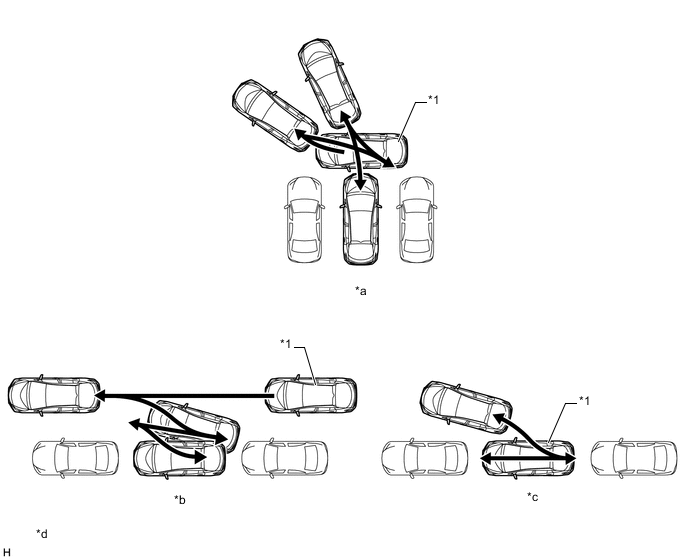
*1 This Vehicle - - *a Perpendicular Parking Assist Mode (with Forward Guidance Function) *b Parallel Parking Assist Mode *c Parallel Parking Departure Assist Mode *d The illustrations shown are examples only. -
By using the ultrasonic sensors to detect empty space, allowable parking spaces can be detected.
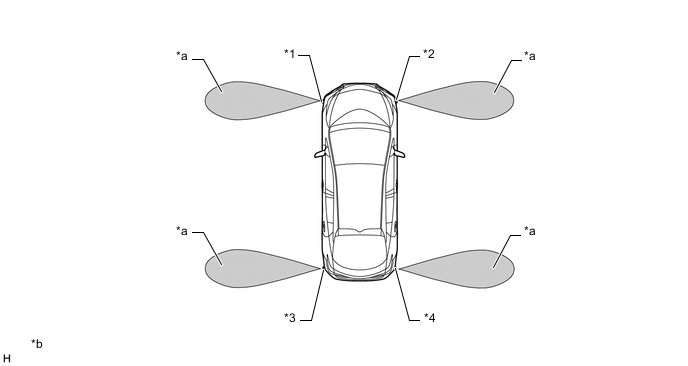
*1 Front Side Ultrasonic Sensor (FLS) *2 Front Side Ultrasonic Sensor (FRS) *3 Rear Side Ultrasonic Sensor (RLS) *4 Rear Side Ultrasonic Sensor (RRS) *a Detection Area of Ultrasonic Wave *b The illustration shown is an example only. -
During automatic operation of the steering, if the intelligent clearance sonar system detects an obstruction in the path of the vehicle and a collision is possible, driving torque restriction control and brake control are performed.
-
During automatic operation of the steering wheel, the TOYOTA parking assist-sensor system operates and informs the driver of the presence of an obstruction and the distance from the vehicle to the obstruction.
-
-
PRECAUTION
-
General Precautions
-
Do not rely solely upon the simple intelligent parking assist system. As with unequipped vehicles, move forward and back up carefully while directly confirming the safety of your surroundings and the area to the rear of the vehicle.
-
Do not back up while viewing the multi-information display. Backing up while only viewing the monitor screen may cause a collision or lead to an accident, as the image displayed on the monitor screen may differ from actual conditions. Make sure to visually check the surrounding areas and the area to the rear of the vehicle with and without the mirror while backing up.
-
Drive slowly while adjusting your speed by depressing the brake pedal when backing up or moving forward.
-
If it seems the vehicle may make contact with a pedestrian, another vehicle or any other obstacles, stop the vehicle by depressing the brake pedal, and then press the IPA switch to turn OFF the system.
-
Use the system on a flat surface.
-
Observe the following precautions, as the steering wheel automatically turns during use.
-
There is risk of a necktie, scarf, your arm, etc. being caught on the steering wheel. Please do not allow your upper body to be close to the steering wheel. Also, do not allow children close to the steering wheel.
-
There is a possibility of injury when the steering wheel turns if you have long fingernails. In case of emergency, stop the vehicle by depressing the brake pedal, and then press the IPA switch to turn OFF the system.
-
-
Always confirm that there is appropriate space before attempting to park the vehicle and operate the system.
-
Do not use the system in the following situations, as the system may be unable to correctly assist you in reaching the target parking spot and may lead to an unexpected accident.
-
In an area that is not a parking lot
-
A parking lot that is not paved and has no parking space lines, such as a sand or gravel parking lot
-
A parking lot that has a slope or undulations in the road
-
The asphalt is melting due to hot weather
-
A frozen, snow-covered or slippery road
-
There is an obstacle between the vehicle and the target parking spot
-
Using tire chains or emergency tire
-
-
The system may not be able position the vehicle in the set location in the following situations.
-
The tires are extremely worn or the tire pressure is low
-
The vehicle is carrying very heavy load
-
The vehicle is tilted due to having luggage, etc. located on one side of the vehicle
-
There are road heaters installed in the parking lot to prevent the road surface from freezing.
-
When the vehicle has improper wheel alignment due to the tires having received a strong impact such as bumping against a curb.
-
-
-
Parallel Parking Departure Assist Mode Precautions
-
Parallel parking departure assist mode is a function used when departing from a parallel parking spot. However, this function may not be usable if obstacles or people are detected in front of the vehicle. Only use this function when departing from a parallel parking spot. In the event that the steering control operates, either turn the system off using the IPA switch or operate the steering wheel to stop the control.
-
If parallel parking departure assist mode is mistakenly used in the following situations, the vehicle may make contact with an obstacle.
-
The departure function is operated in a direction where an obstacle is present, but the obstacle is not detected by the side sensors (situations such as when the vehicle is directly beside a pole)
-
-
-
Parking Space Detection Precautions
-
Depending on the distance to a parked vehicle or the shape of a vehicle, detection of an appropriate parking space may not be possible.
-
Depending on walls or posts in the surrounding area, correct detection of an empty parking space may not be possible.
-
Depending on obstructions in parking spaces other than parked vehicles, detection of an appropriate parking space may not be possible.
-
-
Ultrasonic Sensor Precautions
-
Do not subject the sensor to strong shocks by hitting it, etc. The sensors may not function properly.
-
When using a high-pressure washer to wash the vehicle, do not spray water directly on the sensors. Equipment may not function properly if subjected to an impact from strong water pressure.
-
If the vehicle bumper strikes something, equipment may not operate properly due to a sensor malfunction. Have the vehicle inspected at your Toyota dealer.
-
Obstacles cannot be detected in the side areas until a scan of the side areas is completed
-
Even after the scan of the side areas is completed, obstacles such as other vehicles, people or animals that approach from the sides cannot be detected.
-
In the following situations, the sensors may not operate normally and may lead to an accident.
-
The sensor is frozen (if it thaws, the system returns to normal). A warning message may display at particularly low temperatures due to the sensor freezing and it may not detect parked vehicles.
-
The sensor is blocked by someone's hand.
-
The vehicle is tilted a large amount.
-
The temperature is extremely hot or cold.
-
The vehicle is driven on undulating roads, slopes, gravel roads, in areas with tall grass, etc.
-
An ultrasonic wave source is nearby, such as the horn or sensors of another vehicle, a motorcycle engine or the air brake of a large vehicle.
-
Heavy rain or a water strikes the vehicle.
-
Do not install any accessories within the sensor detection range.
-
-
The angle of the sensor may be deviated when assist control starts even if there is a parked vehicle next to the target parking spot. Have the vehicle inspected at your Toyota dealer.
-
Other than parked vehicles, detection of other obstacles such as walls or posts may not be possible.
-
Depending on the distance to a parked vehicle or the shape of a vehicle, detection may not be possible.
-
-
Other Precautions
-
Do not use tire other than that provided by the manufacturer. The system may not operate properly. When replacing tires, contact your Toyota dealer.
-
-