FEATURES
-
OUTLINE
-
Hybrid System
-
A THS-II Plug-in (TOYOTA Hybrid System-II Plug-in) is used. By incorporating a plug-in charge control system into the THS-II (TOYOTA Hybrid System-II) Hybrid synergy drive concept, an external power source can be used to charge the lithium ion HV battery (plug-in charging).
-
By optimally controlling the ratio of drive torque provided by the engine and motors (MG1 and MG2) and the electrical generation of MG1 and MG2, the hybrid vehicle control ECU can maintain a high state of charge of the HV battery, providing for excellent vehicle performance and fuel economy.
-
A dual motor drive system has been adopted. By incorporating an additional one-way clutch in the HV transaxle, the operating torque of MG1 (Motor Generator No. 1) can be transmitted to the wheels. This allows the vehicle to be driven in EV drive mode at even during rapid acceleration.
-
The hybrid system uses a high-output HV battery with a nominal voltage of DC 351.5 V, and available voltage system in which a boost converter increases the operating voltage of the system to a maximum voltage of DC 600 V.
-
A solar charging system has been adopted. By using solar panels installed in the roof of the vehicle, electricity is generated and used to charge the HV battery and auxiliary battery. By allowing the HV battery to be charged while the vehicle is parked and suppressing the consumption of the HV battery while the vehicle is being driven, the distance the vehicle can be driven in EV drive mode is increased and fuel economy is improved.*
*: Models with solar charging system
-
By using a high capacity lithium ion HV battery with improved output, dual-motor drive system, battery heating system and heat pump air-conditioning system, increased EV drive mode range and performance have been realized.
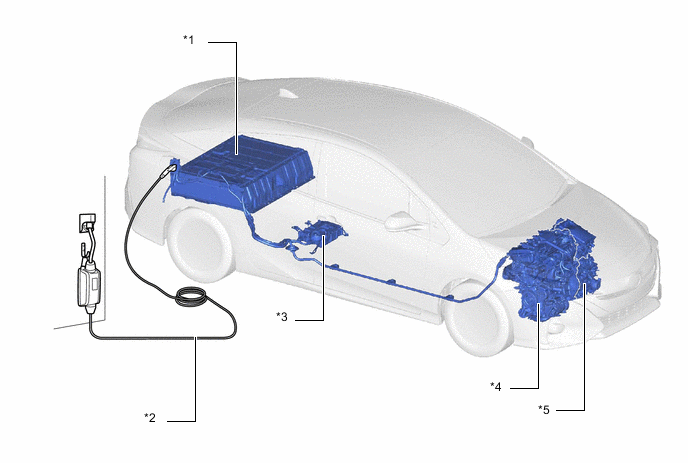
*1 HV Battery *2 Charge Cable (Electric Vehicle Charger Cable Assembly) *3 Electric Vehicle Charger Assembly *4 Engine *5 Hybrid Vehicle Transaxle Assembly - -
-
-
2ZR-FXE Engine
-
The 2ZR-FXE engine is an in-line, 4-cylinder, 1.8-liter, 16-valve DOHC engine. This engine uses a high-expansion ratio Atkinson cycle, Variable Valve Timing-intelligent (VVT-i) system, Direct Ignition System (DIS), Electronic Throttle Control System-intelligent (ETCS-i) and Exhaust Gas Recirculation (EGR) system employing a highly efficient EGR cooler. In addition, use of an electric water pump has enhanced warm-up performance and reduced cooling losses. Thus, improved engine performance, quietness, fuel economy, and cleaner emissions have been achieved.
Engine Type 2ZR-FXE No. of Cyls. and Arrangement 4-cylinder, In-line Valve Mechanism 16 valve DOHC, Chain Drive (with VVT-i) Fuel System Sequential Multiport Fuel Injection (SFI) Displacement cm3(cu. in.)
1798 (109.7) Max. Output (EEC) kW@rpm 72@5200 Max. Torque (EEC) N*m@rpm 142@3600
-
-
Transaxle
-
A P610 hybrid vehicle transaxle is used.
-
-
Suspension
-
A MacPherson strut type independent suspension, which has L-type lower arms, is used for front.
-
A double-wishbone type independent suspension, which consists of an upper control arm, 2 lower suspension arms and a trailing arm, is used for rear.
-
-
Brake
-
A ventilated disc brake is provided for the front brake.
-
A solid disc brake is provided for the rear brake.
-
The following brake control systems are provided: Anti-lock Brake System (ABS), Electronic Brake force Distribution (EBD), Brake Assist, Traction Control (TRAC), Vehicle Stability Control (VSC), Enhanced-VSC and Hill-start Assist Control.
-
-
Steering
-
A rack and pinion type steering gear assembly is used.
-
An Electric Power Steering (EPS) system is used.
-
A manual tilt and manual telescopic system is used.
-
-