HYBRID CONTROL SYSTEM
-
OPERATION
-
In the fuel cell vehicle, the electric power from the FC stack assembly and EV battery assembly are distributed in an optimal way according to a variety of driving conditions, realizing excellent vehicle performance including smooth starting and acceleration. Also, during deceleration the traction motor operates as a regenerative brake to convert braking force into electrical energy that is used for charging the EV battery assembly or powering FC related auxiliary components such as the FC air compressor with motor assembly.
-
The following items are examples of vehicle performance in response to a variety of driving conditions.
-
System start
-
When the brake pedal is depressed and the power switch is then pressed, the EV control ECU will start the system after first checking the results of the FC system check performed by the FC control ECU, the power source check, the shift position check, etc.
-
-
Charging while stopped
-
When the vehicle is stopped and the SOC is low, the FC stack assembly will generate electricity and charge the EV battery assembly.
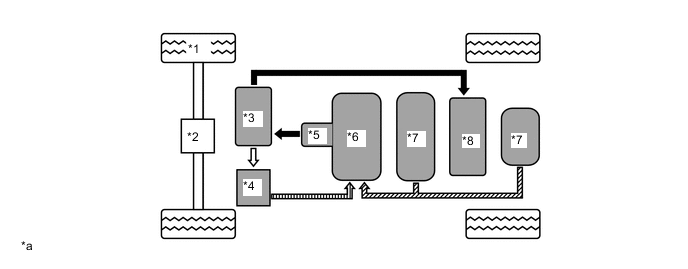
*1 Tire *2 Traction Motor *3 Inverter with Converter Assembly *4 FC Air Compressor with Motor Assembly *5 FC Converter Assembly *6 FC Stack Assembly *7 Hydrogen Tank Assembly *8 EV Battery Assembly *a Illustrations expressed in the image - - 
Electrical Power Path (DC) 
Electrical Power Path (AC) 
Hydrogen 
Compressed air (Oxygen)
-
-
Starting to move / Driving with low load
-
Under normal conditions, when the vehicle starts to move, the traction motors are powered by electrical energy from the EV battery assembly.
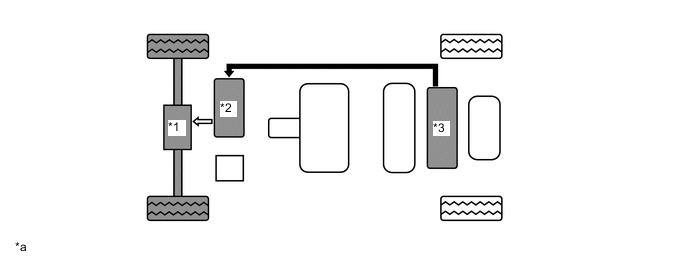
*1 Traction Motor *2 Inverter with Converter Assembly *3 EV Battery Assembly - - *a Illustrations expressed in the image - - Electrical Power Path (DC) Electrical Power Path (AC)
-
-
Steady driving
-
During steady driving, electrical energy from the FC stack assembly is used to drive the traction motor.
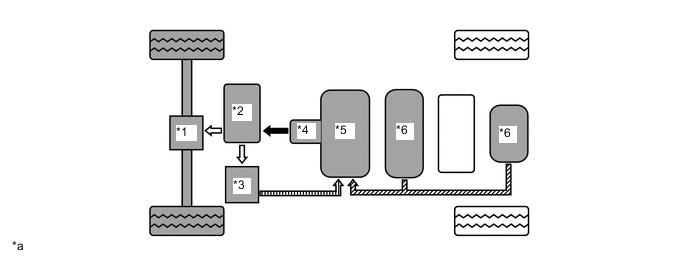
*1 Traction Motor *2 Inverter with Converter Assembly *3 FC Air Compressor with Motor Assembly *4 FC Converter Assembly *5 FC Stack Assembly *6 Hydrogen Tank Assembly *a Illustrations expressed in the image - - Electrical Power Path (DC) Electrical Power Path (AC) Hydrogen Compressed air (Oxygen)
-
-
Acceleration
-
During acceleration, the electrical power from the FC stack assembly is increased, the boost ratio of the FC converter assembly is made larger, and additional electrical energy is supplied from the EV battery to accelerate the vehicle.
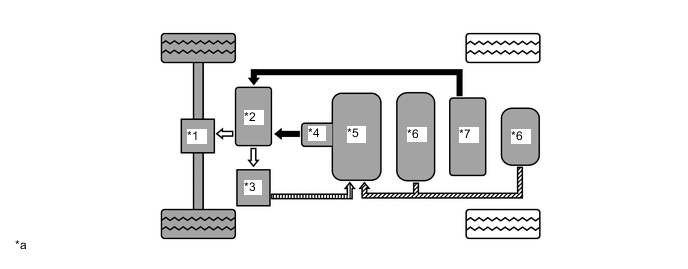
*1 Traction Motor *2 Inverter with Converter Assembly *3 FC Air Compressor with Motor Assembly *4 FC Converter Assembly *5 FC Stack Assembly *6 Hydrogen Tank Assembly *7 EV Battery Assembly - - *a Illustrations expressed in the image - - Electrical Power Path (DC) Electrical Power Path (AC) Hydrogen Compressed air (Oxygen)
-
-
Deceleration / braking
-
By using the driving force transmitted through the wheel to spin the traction motor, kinetic energy is converted to electrical energy and used to charge the EV battery assembly, or used by FC auxiliary equipment such as the FC air compressor with motor assembly.
Tech Tips
During regenerative braking, even when the FC stack assembly is not performing electrical generation, FC auxiliary devices may operate.
-
During braking, to ensure that braking force proportional to the brake pedal operation amount is achieved, cooperative control is performed together with the electronically controlled hydraulic brake system while the amount of energy to recover is decided.
-
When the amount of generated electricity is more than can be absorbed by the EV battery capacity and FC auxiliary equipment, the proportion of braking force supplied by the hydraulic brakes increases.
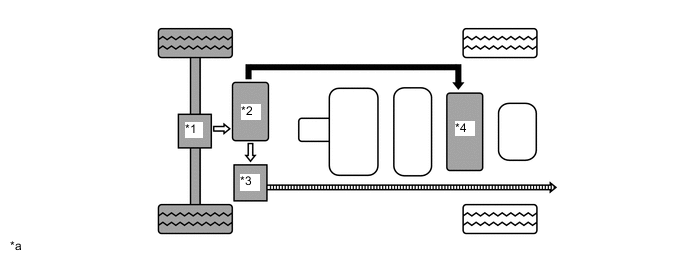
*1 Traction Motor *2 Inverter with Converter Assembly *3 FC Air Compressor with Motor Assembly *4 EV Battery Assembly *a Illustrations expressed in the image - - Electrical Power Path (DC) Electrical Power Path (AC) Compressed air (Oxygen) - -
-
-
Driving in reverse
-
When driving in reverse, electrical power from the EV battery assembly is used to spin the traction motor in the opposite direction of that used in forward motion, which drives the vehicle in reverse.
-
-
-