EMISSION CONTROL SYSTEM
-
SYSTEM CONTROL
-
If the DPF temperature is high under normal driving conditions, PM captured by the DPF is oxidized by the temperature of the DPF and is emitted as CO2 and H2O.
-
If the DPF temperature becomes low, catalyst performance decreases, resulting in an increase of the amount of PM stuck in the filter substrate. The ECM detects that the filter substrate is clogged by calculating the accumulated volume of the PM discharged by the engine. To reduce PM, the ECM controls the injection timing and the injection frequency of the injectors, and activates the exhaust fuel addition injector. At the same time, ECM controls the engine speed and glow plug assembly temperature via the glow plug controller. As a result, filter substrate temperature becomes high and PM reacts with active oxygen and changes into CO2 for purification. This is known as catalyst support control.
-
When PM has accumulated in the DPF while driving normally, the ECM automatically performs catalyst support control.
-
However, sufficient purification of the PM by the catalyst support control may not be possible when driving repeatedly over short distances. As a result, the PM accumulation limit may be surpassed. If a predetermined level of PM accumulation has been surpassed, the DPF indicator light in the combination meter is illuminated. This prompts the driver to drive at a constant speed (60 km/h or more) for automatic catalyst support control to be carried out.
-
In addition, if the driver keeps driving without driving at a constant speed (60 km/h or more), the DPF indicator light illuminates or blinks when a predetermined level of PM accumulation is surpassed. This prompts the driver to bring the vehicle to a dealer for manual catalyst support control to be carried out.
-
Moreover, if the driver keeps driving without bringing the vehicle to a dealer, PM accumulates further. In this situation, if the catalyst support control is conducted, the DPF could be destroyed. To prevent this, the MIL will be illuminated when a predetermined driving distance is reached. At the same time, the ECM changes the engine control to the fail-safe mode, thus controlling the amount of fuel injection to a minimum.
CAUTION:
During regeneration, observe the following precautions.
Failure to do so may result in serious injury such as burns caused by the hot exhaust pipe and exhaust gases, or may cause a fire.
-
Do not place flammable materials near the exhaust pipe.
-
Make sure that there are no people near the exhaust pipe.
Tech Tips
-
When replacing the exhaust manifold converter sub-assembly with a new one, it is necessary to perform initialization of the DPF deteriorate data history in the ECM by using a Grobal TechStream (GTS).
-
When replacing the ECM with a new one, it is necessary to read DPF deteriorate data history from the installed ECM and then transfer that data history to the new ECM by using a Grobal TechStream (GTS). When the DPF deteriorate data history is not transferred, Diagnostic Trouble Code (DTC) is stored in the ECM, and the MIL comes on.
-
When replacing both the exhaust manifold converter sub-assembly and the ECM, it is necessary to perform initialization of the DPF deteriorate data history in the ECM using a Grobal TechStream (GTS). When DPF deteriorate history initialization is not performed, DTC is stored in the ECM and the MIL comes on.
-
A DPF switch for the manual catalyst support control is provided as optional equipment. The manual catalyst support control methods differ with provision of the DPF switch. For details refer to the Repair Manual.
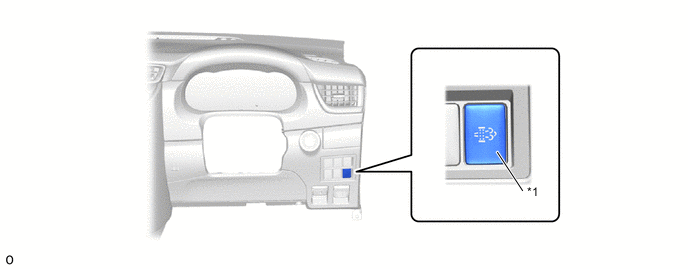
*1 DPF Switch - -
-
-