AIRBAG SYSTEM
-
OUTLINE
-
The driver dual-stage Supplemental Restraint System (SRS) airbag and front passenger dual-stage SRS twin-chamber airbag supplement the seat belts to help reduce shock to the head and chest of the driver and front passenger in the event of a frontal collision.*1,*2
-
The driver Supplemental Restraint System (SRS) airbag and front passenger SRS airbag supplement the seat belts to help reduce shock to the head and chest of the driver and front passenger in the event of frontal collision.*3
-
The SRS driver knee airbag is used as a supplement to the seat belt to help restrain the lower body (mainly knees) of the driver, enhancing the effectiveness of occupant protection.
-
The SRS front side airbags are used in the event of a frontal or side collision to help reduce shock to the chest of the driver or front passenger.
-
The SRS front seat cushion airbag is used as a supplement to the seat belt to prevent the front passenger from sliding forward in the event of a frontal collision.*2
-
The SRS curtain shield airbags are used in the event of a frontal, side or rear side collision to help reduce shock to the head of the driver, front passenger and rear passengers.
-
The Roll Sensing Curtain Shield Airbags (RSCA) help reduce the impact applied to the occupants by operating the driver and front passenger seat belt pretensioners and the curtain shield airbags.*2
Tech Tips
*1: Models for Europe
*2: Destination Package for South Korea
*3: Models for Australia and G.C.C. Countries
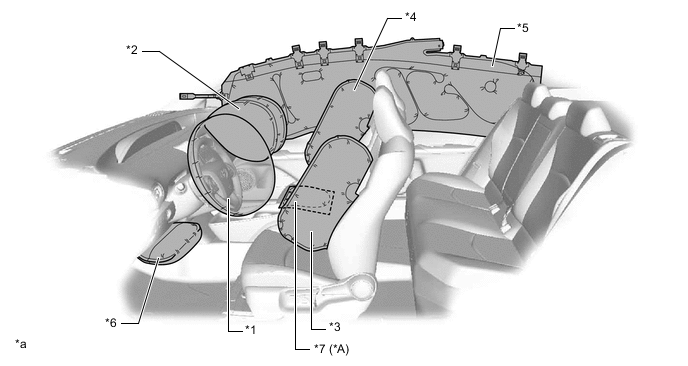
*A Destination Package for South Korea - - *1 SRS Driver Airbag *2 SRS Front Passenger Airbag *3 SRS Side Airbag for Driver *4 SRS Side Airbag for Front Passenger *5 SRS Curtain Shield Airbag *6 SRS Driver Knee Airbag *7 SRS Seat Cushion Airbag - - *a The illustrations shown are examples only - -
-
-
PRECAUTION
-
Event Data Recorder
-
This vehicle is equipped with an event data recorder (EDR). The main purpose of an EDR is to record, in certain crash or near crash-like situations, such as an airbag deployment or hitting a road obstacle, data that will assist in understanding how a vehicle's systems performed. The EDR is designed to record data related to vehicle dynamics and safety systems for a short period of time, typically 30 seconds or less.
-
The EDR in this vehicle is designed to record such data as:
-
How various systems in your vehicle were operating;
-
Whether or not the driver and passenger safety belts were buckled/fastened;
-
How far (if at all) the driver was depressing the accelerator and/or brake pedal; and,
-
How fast the vehicle was traveling.
-
-
These data can help provide a better understanding of the circumstances in which crashes and injuries occur.
-
NOTE: EDR data are recorded by your vehicle only if a nontrivial crash situation occurs; no data are recorded by the EDR under normal driving conditions and no personal data (e.g., name, gender, age, and crash location) are recorded. However, other parties, such as law enforcement, could combine the EDR data with the type of personally identifying data routinely acquired during a crash investigation.
To read data recorded by an EDR, special equipment is required, and access to the vehicle or the EDR is needed. In addition to the vehicle manufacturer, other parties, such as law enforcement, that have the special equipment, can read the information if they have access to the vehicle or the EDR.
-
Disclosure of the EDR data
-
An agreement from the vehicle's owner (or the lessee for a leased vehicle) is obtained
-
In response to an official request by the police, a court of law or a government agency
-
For use by Toyota in a lawsuit
Toyota will not disclose the data recorded in an EDR to a third party except when:
-
Use the data for research on vehicle safety performance
-
Disclose the data to a third party for research purposes without disclosing information about the specific vehicle or vehicle owner
However, if necessary, Toyota may:
-
-
-