METER / GAUGE SYSTEM
-
CONSTRUCTION
-
Windshield glass without a combiner treatment is used for the headup display.
-
This glass has a wedge-shaped inner PVC film. This film, with its varying thickness, is located between the outer and inner layers of glass.
-
The light that strikes the glass is reflected by the inner surface of the inner glass, and also by the inner side of the outer surface of outer layer of glass. With a conventional windshield, the light reflected from these 2 surfaces diverges due to the thickness of the glass, resulting in a double image.
-
The PVC film uses its wedge shape to eliminate the reflection angle difference between the outer glass and inner glass. This recombines the reflected light and eliminates the double image.
-
Thus, the reflected light from the head up display unit is recognized by the driver as a single display image.
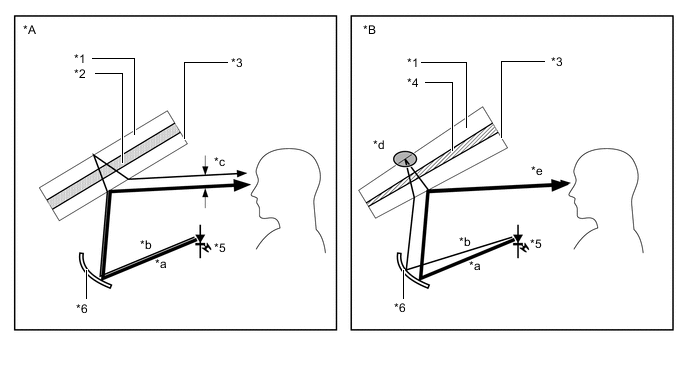
*A Windshield Glass with Normal PVC Film *B Windshield Glass with Wedge-shaped PVC Film *1 Outer Glass *2 PVC Film *3 Inner Glass *4 Wedge-shaped PVC Film *5 LED Light Source *6 Concave Mirror *a Visible light reflected by the inner glass *b Visible light reflected by the outer glass *c Double image is caused by divergence of reflected light *d Reflection angle changed *e Reflected light is recombined and a double image is prevented - -
-