SFI SYSTEM
-
OPERATION
-
Based on engine speed, intake air volume, throttle position and engine coolant temperature, the ECM calculates optimal valve timing for all driving conditions. The ECM also controls the camshaft timing oil control valve assembly. In addition, the ECM uses signals from the cam position sensor and the crank position sensor to detect the actual valve timing, thus providing feedback control to achieve the target valve timing.
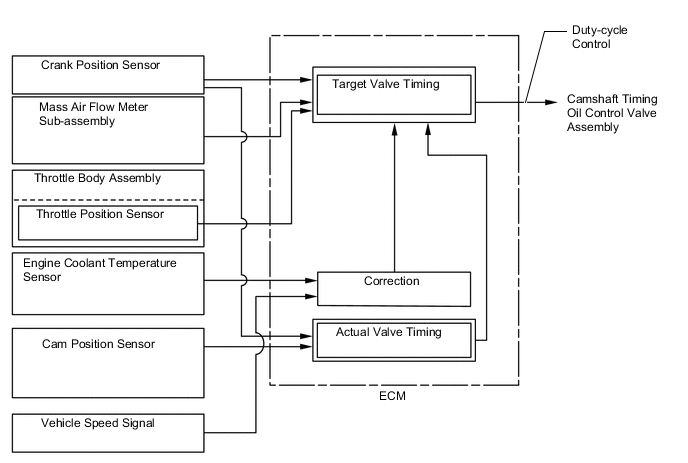
-
When the camshaft timing oil control valve assembly is operated as illustrated below by the advance signal from the ECM, the resultant oil pressure is applied to the timing advance side vane chamber to rotate the camshaft in the timing advance direction.
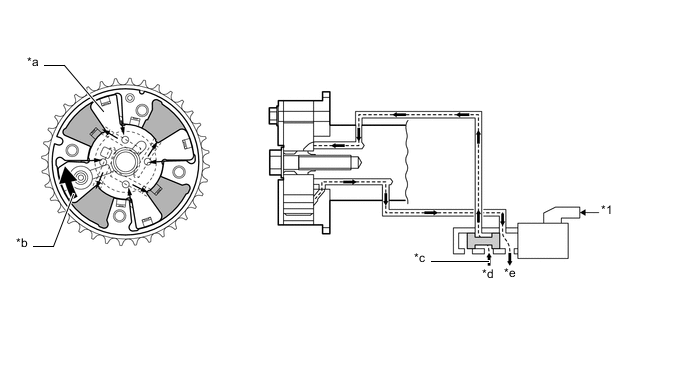
*1 ECM - - *a Vane *b Rotation Direction *c Oil Pressure *d In *e Drain - - -
When the camshaft timing oil control valve is operated as illustrated below by the retard signal from the ECM, the resultant oil pressure is applied to the timing retard side vane chamber to rotate the camshaft in the timing retard direction.
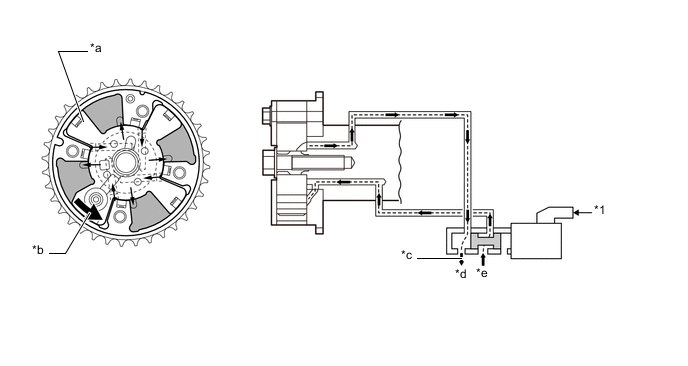
*1 ECM - - *a Vane *b Rotation Direction *c Oil Pressure *d Drain *e In - - -
After reaching the target timing, the valve timing is held by keeping the camshaft timing oil control valve assembly in the neutral position unless the driving conditions change. This maintains the valve timing at the desired target position and prevents the engine oil from running out when unnecessary.
-