BODY STRUCTURE
-
CONSTRUCTION
-
Floor Silencer and Dash Panel Insulator Sheet
-
The floor silencer (applied damping materials) optimal thickness varies by the area, is lightweight and provides excellent quietness. These characteristics allow the floor silencer to reduce road and engine noise which enters the cabin.
-
Steel sandwich panel filler damping materials (dash panel insulator sheets (*2, *3 and *4 in illustration)) are provided in the dash panel sub-assembly. As a result, steel sandwich panel filler damping materials reduce road and engine noise which enters the cabin.
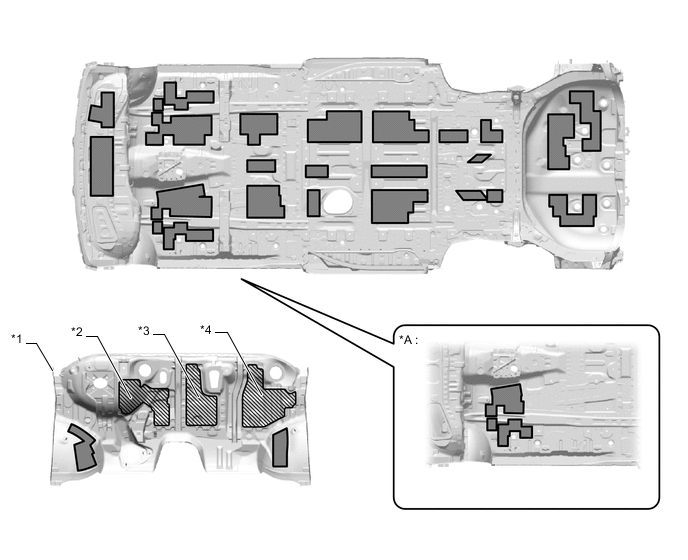
*A Models with Front Passenger Super Long Slide Seat - - *1 Dash Panel Sub-assembly *2 Dash Panel Insulator Sheet No.1 *3 Dash Panel Insulator Sheet No.3 *4 Dash Panel Insulator Sheet No.4 
Steel Sandwich Panel Filler Damping Materials 
Floor Silencer
-
-
Sealing Material
-
Foamed materials, damping materials and sponge sealant are optimally placed in the side member opening and front header to suppress wind noise and road noise which enter the cabin.
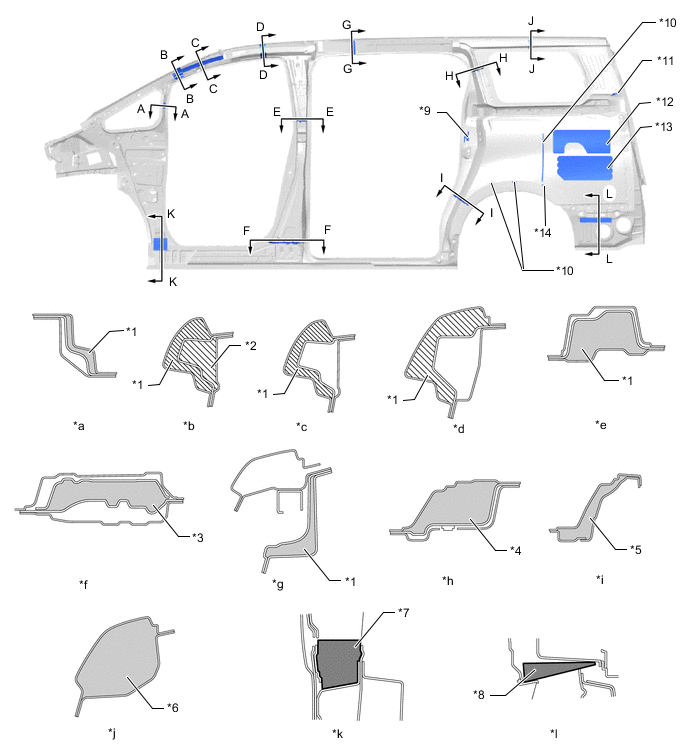
*1 Pillar Pad No. 2 *2 Pillar Pad No. 3 *3 Pillar Pad No. 4 *4 Roof Side Rail Seal FR *5 Quarter Wheel House Seal *6 Roof Side Rail Seal RR *7 Quarter Vent Silencer *8 Quarter Wheel House Pad Inner Rear LH (Left Side Only) *9 Roof Side Inner Cover Seal No. 1 (No. 2) *10 Quarter Panel Seal No. 2 *11 Pillar Pad No. 5 (Right Side Only) *12 Quarter Panel Silencer Sheet *13 Quarter Panel Silencer Pad No. 2 *14 Quarter Panel Seal No. 2 (Left Side Only) *a A - A Cross Section *b B - B Cross Section *c C - C Cross Section *d D - D Cross Section *e E - E Cross Section *f F - F Cross Section *g G - G Cross Section *h H - H Cross Section *i I - I Cross Section *j J - J Cross Section *k K - K Cross Section *l L-L Cross Section 
Foamed Material (Damping Material) Foamed Material (Sound Insulation Material) Polyurethane Foam Material - - -
The front door weatherstrip No. 2 (*1 in illustration) and front door weatherstrip No. 3 (*2 in illustration) are added to suppress wind noise and road noise which enter the cabin. Also, these items reduce the amount of dirt and mud that can stick to the side sill.
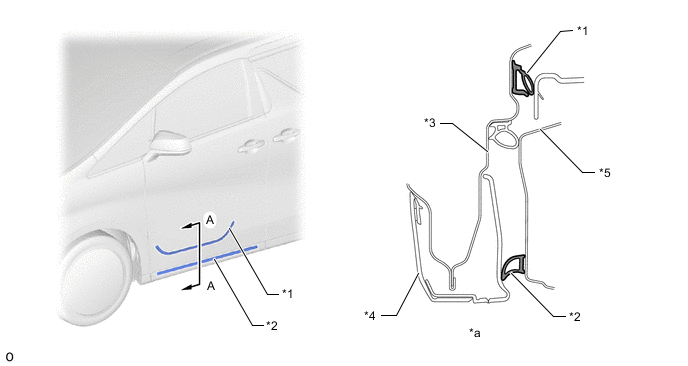
*1 Front Door Weatherstrip No. 2 *2 Front Door Weatherstrip No. 3 *3 Front Door Panel Sub-assembly *4 Slide Door Mudguard *5 Side Panel Outer - - *a A - A Cross Section - -
-
-
Sound Absorption and Insulation Structure around Engine Compartment
-
A hood insulator (*1 in illustration) is provided below the hood sub-assembly (*2 in illustration) to suppress engine drive noise which penetrates the cabin and provide excellent quietness.
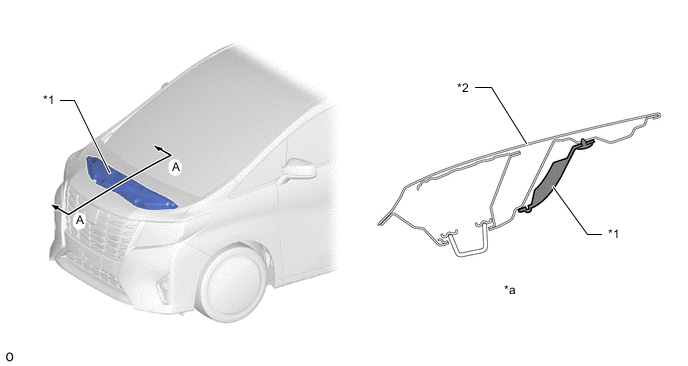
*1 Hood Insulator *2 Hood Sub-assembly *a A - A Cross Section - - -
The dash outer silencer (dash panel insulator outer: *2 in top illustration) is provided in the engine room side of the dash panel sub-assembly (*3 in illustration) and a dash panel insulator assembly (*1 in bottom illustration) is provided in the cabin side. The dash panel insulator assembly (*1 in bottom illustration) wraps around the top of the cowl panel sub-assembly (*2 in bottom illustration) and has a shape which fills in holes and gaps as much as possible. This structure absorbs and insulates mechanical noise such as engine noise and ensures excellent quietness.
-
The dash panel insulator outer No. 2 (*1 in top illustration) is provided under the cowl panel sub-assembly (*4 in top illustration) to suppress engine drive noise, etc., from penetrating the cabin, providing superior quietness.
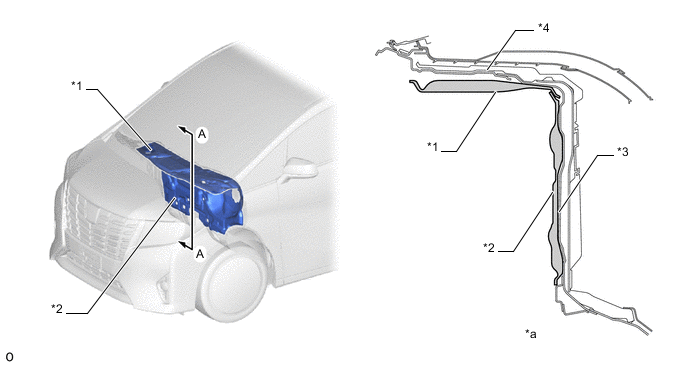
*1 Dash Panel Insulator Outer No. 2 *2 Dash Panel Insulator Outer *3 Dash Panel Sub-assembly *4 Cowl Panel Sub-assembly *a A - A Cross Section - - 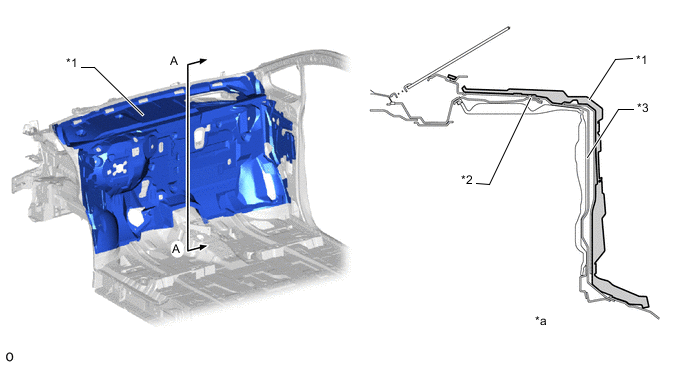
*1 Dash Panel Insulator Assembly *2 Cowl Panel Sub-assembly *3 Dash Panel Sub-assembly - - *a A - A Cross Section - -
-
-
Sound Absorption and Insulation Structure around Wheel
-
On models with 2GR-FE engine, front fender splash shield seal front (*2 and *3 in illustration) and front side air guide (*1 in illustration)/front side air guide No. 2 (*4 in illustration) are used in the front fender to reduce the noise which travels through the fender toward the cabin.
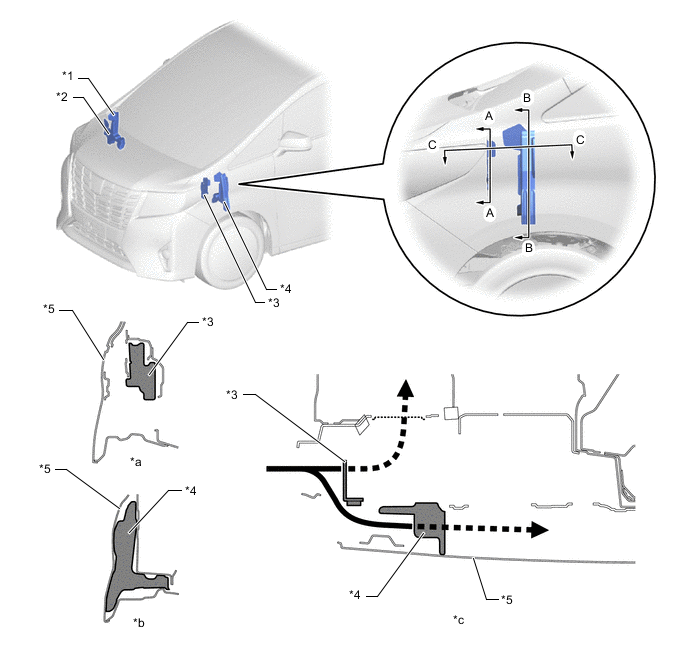
*1 Front Side Air Guide *2 Front Fender Splash Shield Seal Front RH *3 Front Fender Splash Shield Seal Front LH *4 Front Side Air Guide No. 2 *5 Front Fender Panel - - *a A - A Cross Section *b B - B Cross Section *c C - C Cross Section - - 
Noise Route - - -
The front fender side panel protector and front fender main seal are provided to reduce the engine noise which enters the cabin.
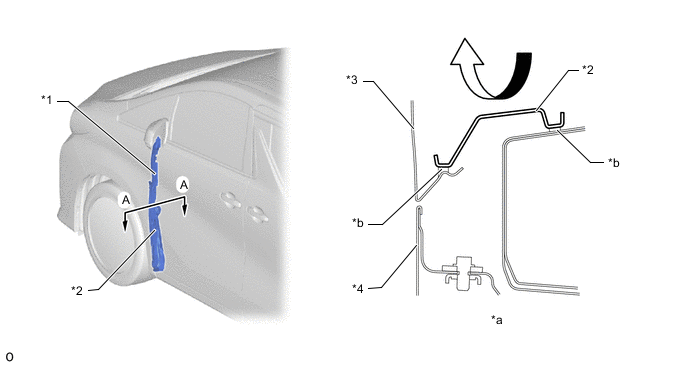
*1 Front Fender Side Panel Protector *2 Front Fender Main Seal *3 Front Fender Panel *4 Front Door Panel Outer *a A - A Cross Section *b Caulking Sponge
-
-
Reducing Wind Noise Structure
-
An acoustic layer laminated windshield glass (*4 in illustration) is provided to reduce the engine noise and road noise intruding into the cabin.
-
1-sided adhesive molding (windshield molding outside upper (*3 in illustration)) is used to reduce the difference in height between the windshield glass and roof panel, and dampen wind noise.
-
The difference in height between the roof drip side finish molding and windshield glass (D in illustration), the width of the front body pillar (side panel outer: E in illustration) and the corner shape of the front body pillar (side panel outer: R in illustration) have been optimized to dampen wind noise.
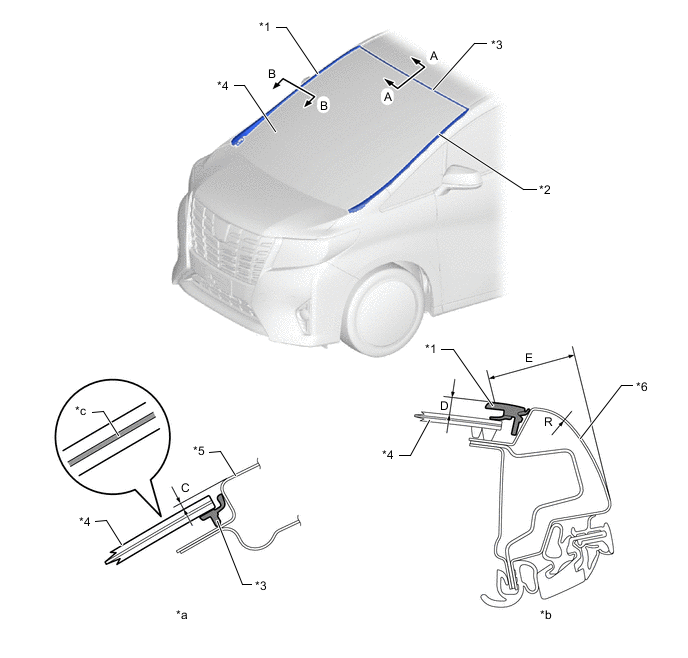
*1 Roof Drip Side Finish Molding RH *2 Roof Drip Side Finish Molding LH *3 Windshield Molding Outside Upper *4 Windshield Glass *5 Roof Panel *6 Side Panel Outer *a A - A Cross Section *b B - B Cross Section *c Acoustic Layer - -
-
-