POWER STEERING SYSTEM
-
OPERATION
-
When the steering wheel is not turned
-
If the vehicle is driven straight and the driver does not turn the steering wheel, the yoke is centered between the N and S poles of the multipole magnet. Thus, no magnetic flux passes between the Hall ICs. In this case, the Hall ICs output a specified voltage to the power steering ECU assembly, to indicate that no turning torque is being applied to the steering wheel. Therefore, current is not applied to the motor.
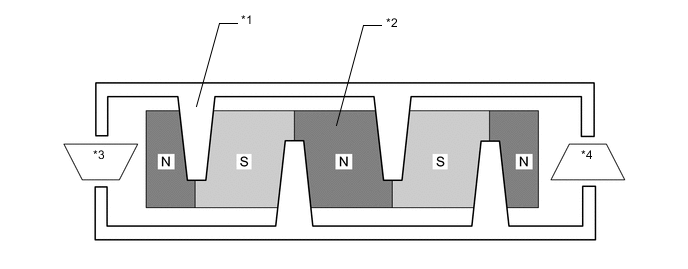
*1 Yoke Tab *2 Multipole Magnet *3 Hall IC 2 *4 Hall IC 1
-
-
When the steering wheel is turned right or left
-
When the driver turns the steering wheel to the right or left, the twist created in the torsion bar creates a relative displacement between the multipole magnet and yoke.
-
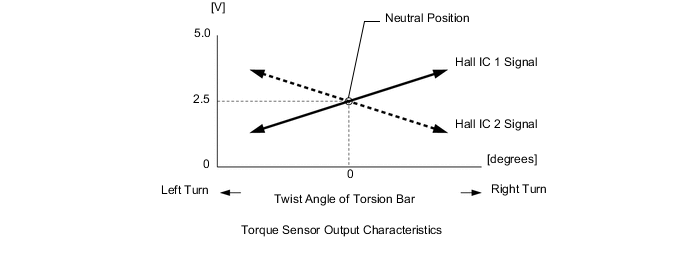
At this time, the magnetic flux from the N to S poles of the multipole magnet passes between the Hall ICs. The system detects the direction the steering wheel is being turned in accordance with the direction of the magnetic flux that passes between the Hall ICs. Hall IC1 and Hall IC2 are installed facing opposite to each other. As a result, the output characteristics of the 2 Hall ICs are constantly opposite each other. The system monitors the different outputs of these Hall ICs in order to detect malfunctions.
-
The magnetic flux density becomes higher as the Hall ICs get closer to the center of each respective pole. Each Hall IC converts these magnetic flux fluctuations into voltage fluctuations in order to transmit the rotational torque of the steering wheel to the power steering ECU assembly.
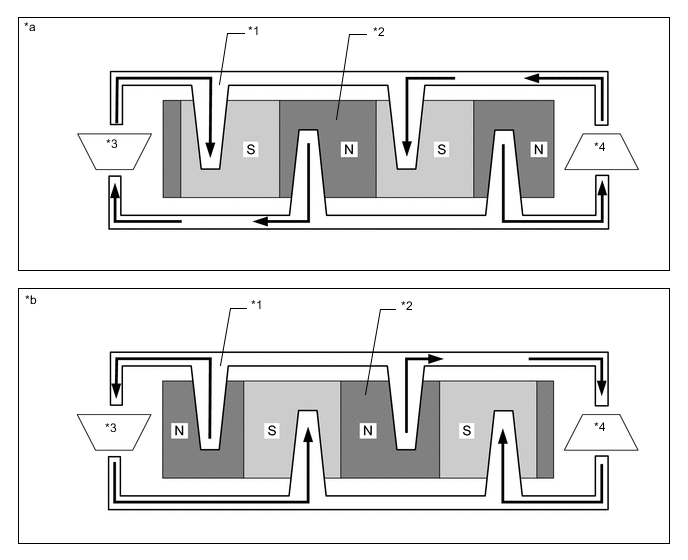
*1 Yoke Tab *2 Multipole Magnet *3 Hall IC 2 *4 Hall IC 1 *a When the steering wheel is turned right *b When the steering wheel is turned left 
Direction of the Magnetic Flux - -
-
-
Torque Sensor Output Characteristics
-
When the driver does not turn the steering wheel, the power steering torque sensor outputs a specified voltage (2.5 V) to the power steering ECU assembly. As long as the specified voltage is output, the power steering ECU assembly determines that no turning torque is being applied to the steering wheel.
-
When the driver turns the steering wheel to the right or left, the voltage output from the power steering torque sensor to the power steering ECU assembly changes. Based on the changes, the power steering ECU assembly determines the steering torque and steering direction input by the driver.
-
-