SFI SYSTEM
-
CONSTRUCTION
-
Magnetic Resistance Element (MRE) sensors are used for the crankshaft position, camshaft position, and VVT sensors.
-
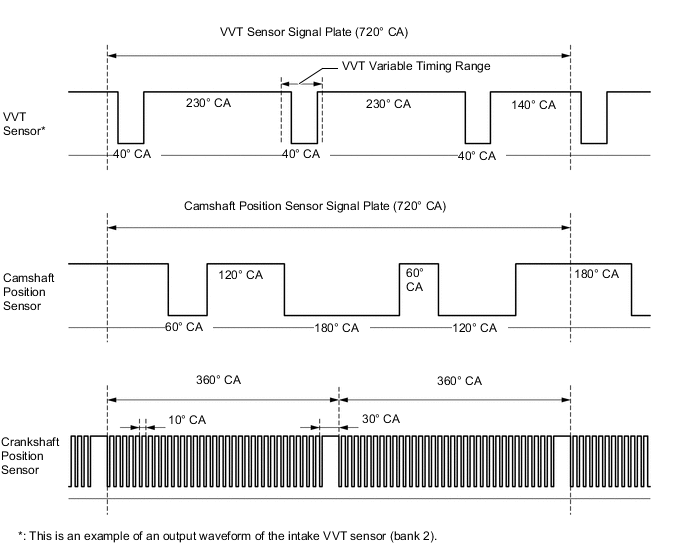
The timing rotor for the crankshaft position sensor is installed on the back end of the crankshaft. The timing rotor has 34 teeth, with 2 teeth missing, at 10° intervals. Based on these teeth, the crankshaft position sensor transmits crankshaft position signals (NE signal) consisting of 33 high/low output pulses every 10° per revolution of the crankshaft, and 1 high/low output pulse every 30°. The ECM uses the NE signal for detecting the crankshaft position as well as for detecting the engine speed. It uses the missing teeth signal for determining the top-dead-center.
-
The camshaft position sensor uses a timing rotor that is installed on the front end of the intake camshaft sprocket of the right bank. Based on the timing rotor, the sensor outputs camshaft position signals (G2 signal) consisting of 3 pulses for every 2 revolutions of the crankshaft. The ECM compares the G2 and NE signals to detect the camshaft position and identify the cylinder.
-
The intake and exhaust VVT sensors use timing rotors that are installed on the intake and exhaust camshafts of each bank. Based on the timing rotors, the sensors output VVT position signals consisting of 3 pulses for every 2 revolutions of the crankshaft. The ECM compares these VVT position signals to the NE signal to detect the actual valve timing.
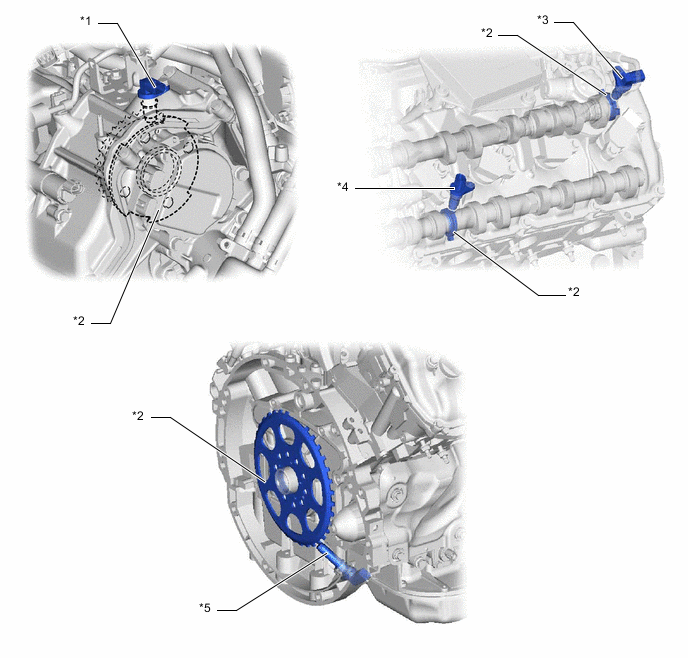
*1 Camshaft Position Sensor *2 Timing Rotor *3 VVT Sensor (Bank 1 Intake) *4 VVT Sensor (Bank 1 Exhaust) *5 Crankshaft Position Sensor - - Figure 1. Sensor Output Waveforms
-
An MRE type sensor consists of an MRE, a magnet and a sensor. The direction of the magnetic field changes due to the profile (protruding and non-protruding portions) of the timing rotor, which passes by the sensor. As a result, the resistance of the MRE changes, and the output voltage to the ECM changes to either high or low. The ECM detects the crank position and intake and exhaust cam positions based on this output voltage.
-
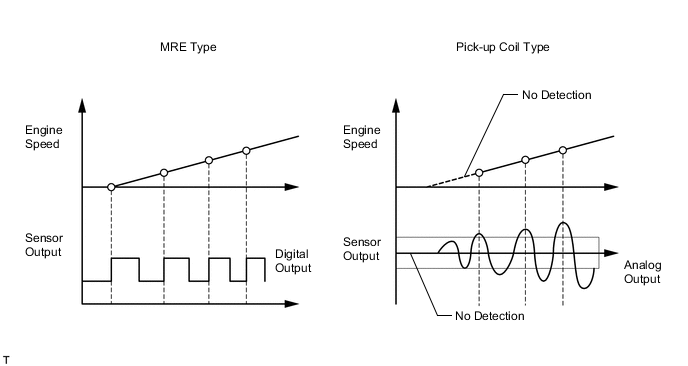
The differences between an MRE type sensor and the pick-up coil type sensor used on a conventional model are as follows.
-
An MRE type sensor outputs a constant level of high/low digital signals regardless of the engine speed. Therefore, an MRE type sensor can detect the positions of the crankshaft and camshaft at an early stage of cranking.
-
A pickup coil type sensor outputs analog signals with levels that change with engine speed.
-
-