METER / GAUGE SYSTEM
-
FUNCTION
-
The headup display shows information on the windshield glass through the combination meter mirror ECU. The headup display gives the appearance of being displayed ahead of the vehicle.
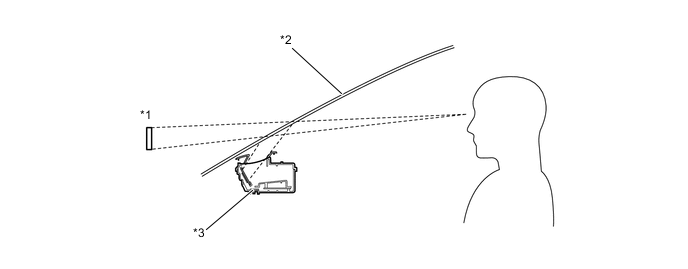
*1 Display Area *2 Windshield Glass *3 Combination Meter Mirror ECU - - -
By changing the angle of the concave mirror, the position of the image displayed can be adjusted.
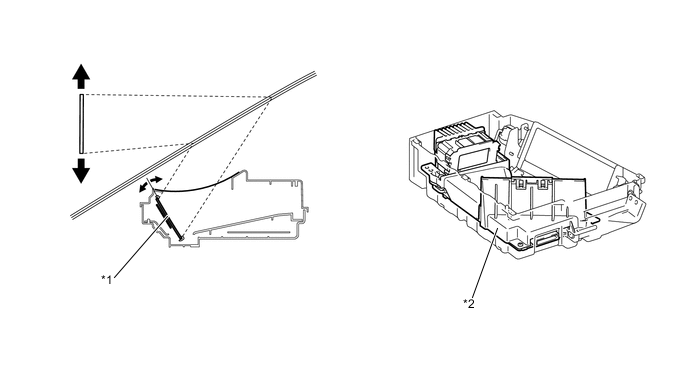
*1 Concave Mirror *2 ECU -
The headup display indicates as follows:
Display Outline Vehicle Speed
-
The vehicle speed is displayed.
-
The vehicle speed display can be switched between MPH and km/h by operating the HUD switch (headup display main switch).
Hybrid System Indicator Hybrid system indicator is shown on the display. Sport Mode The tachometer is shown on the display. Turn-by-turn Navigation*1 Turn-by-turn navigation information is displayed based on the signal from the radio receiver assembly. Audio*2
-
Audio information is displayed based on the signal from the radio receiver assembly or radio and display receiver assembly.
-
The audio mode can be turned on or off by using a customization function.
Dynamic Radar Cruise Control Warning*3 Dynamic radar cruise control warning display indicates when the vehicle is nearing the vehicle ahead during the vehicle-to-vehicle control. Pre-collision System Warning*4 The pre-collition warning display will interrupt the current information immediately when a warning occurs. Lane Departure Alert Warning*5 The lane departure alert system is displayed when the vehicle is out of its lane. Intelligent Clearance Sonar Warning*6 The intelligent clearance sonar system warning is displayed when a braking operation request signal is received. G Monitor*7 Acceleration (G) in the longitudinal direction is indicated by using the movement of a ball. Road Sign Assist Display*8 Recognized signs based on information of road signs are displayed recognized by the forward recognition camera.
-
*1: Models with navigation system
-
*2: Models with audio system
-
*3: Models with dynamic radar cruise control system
-
*4: Models with pre-collision system
-
*5: Models with lane departure alert system
-
*6: Models with intelligent clearance sonar system
-
*7: F-SPORT
-
*8: Models with road sign assist system
Figure 1. Normal Condition
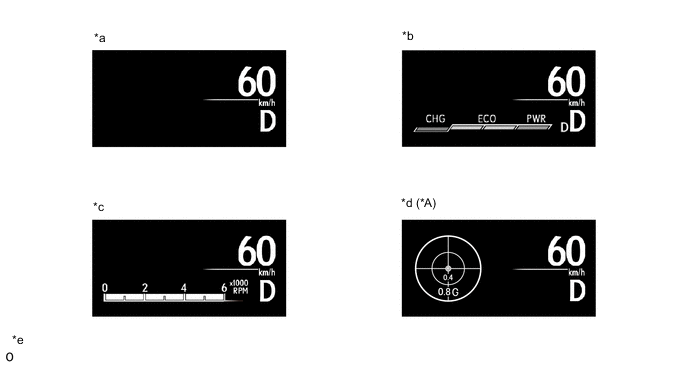
*A F-SPORT - - *a Vehicle Speed Display *b Hybrid System Indicator and Vehicle Speed Display *c Tachometer and Vehicle Speed Display *d G Monitor and Vehicle Speed Display *e The illustrations shown are examples only. The illustrations may differ from the actual vehicle screen. - - Figure 2. Interrupt Condition or Warning Condition
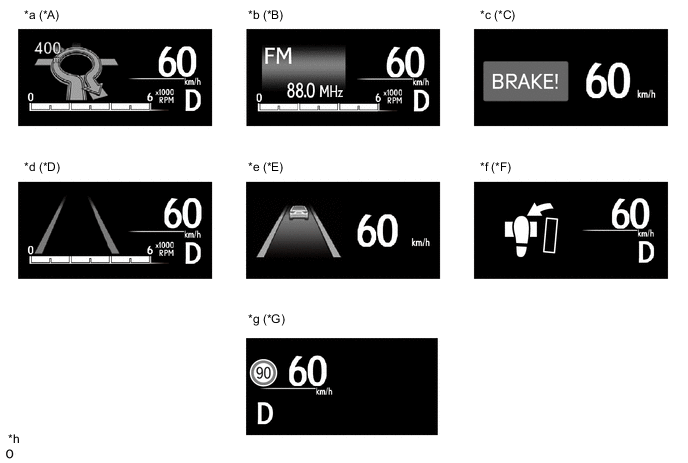
*A Models with Navigation System *B Models with Audio System *C Models with Pre-collision System *D Models with Lane Departure Alert System *E Models with Dynamic Radar Cruise Control System *F Models with Intelligent Clearance Sonar System *G Models with Road Sign Assist System - - *a Turn-by-turn Navigation Display (Models with Navigation System) *b Audio Display (When the Audio Display is On) *c Pre-collision System Warning Display *d Lane Departure Alert Warning Display *e Dynamic Radar Cruise Control Warning Display *f Intelligent Clearance Sonar Warning *g Road Sign Assist System Display *h The illustrations shown are examples only. The illustrations may differ from the actual vehicle screen. -
-
Customize Display
-
By pressing and holding the DISP switch (headup display main switch assembly) for 1.5 minutes or more, the headup display will be changed from normal mode to customization function mode. The following transitions will occur after entering customization function mode:
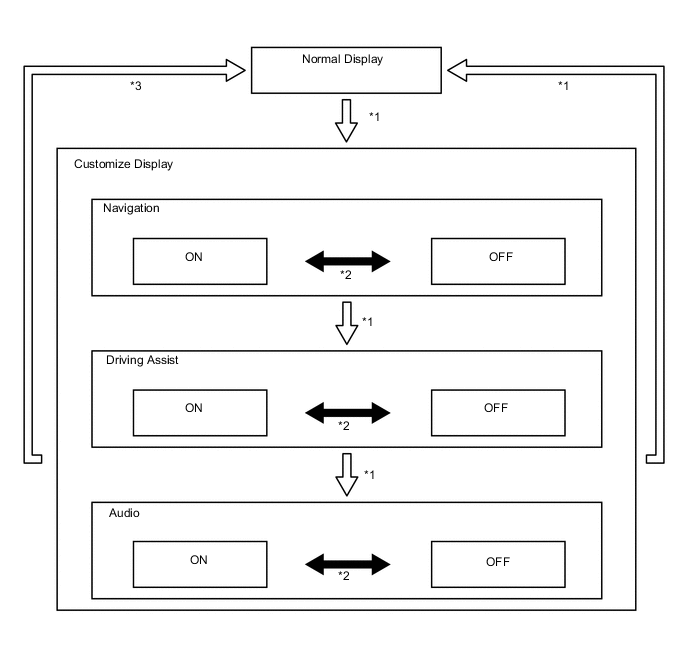
No. Condition *1 The DISP switch (headup display main switch assembly) is pressed for 1.5 seconds or more when the vehicle speed is 8 km/h (5 MPH) or less. *2 The DISP switch (headup display main switch assembly) is pressed for less than 1.5 seconds when the vehicle speed is 8 km/h (5 MPH) or less. *3 The vehicle speed is 8 km/h (5 MPH) or more, or the headup display has not been operated for 3 seconds.
-
-
Windshield Glass for Headup Display
-
Windshield glass without a combiner treatment is used for the headup display.
-
This glass has a wedge-shaped inner PVC film. This film, with its varying thickness, is located between the outer and inner layers of glass.
-
The light that strikes the glass is reflected by the inner surface of the inner glass, and also by the inner side of the outer surface of outer layer of glass. With a conventional windshield, the light reflected from these 2 surfaces diverges due to the thickness of the glass, resulting in a double image.
-
The PVC film uses its wedge shape to eliminate the reflection angle difference between the outer glass and inner glass. As a result, the reflected light is displaced to reduce double images.
-
Thus, the reflected light from the headup display unit is recognized by the driver as a single display image.
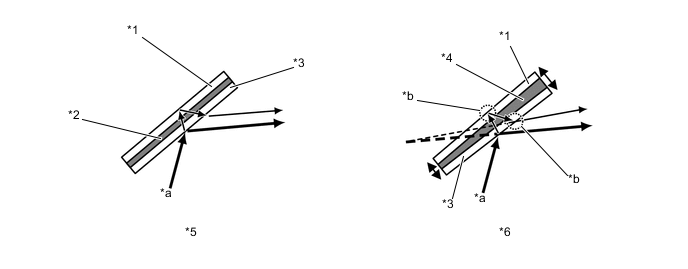
*1 Outer Glass *2 PVC Film *3 Inner Glass *4 Wedge-shaped PVC Film *5 Windshield Glass with Normal PVC Film *6 Windshield Glass with Wedge-shaped PVC Film *a Visible Light Reflected by Inner Glass *b Reflection Angle Changed
-
-