ASC SYSTEM
-
FUNCTION OF MAIN COMPONENTS
Component Function Stereo Component Equalizer Assembly
-
Generates electrical driving sounds based on the vehicle speed, accelerator pedal depression amount, shift lever position, shift range and drive mode signals.
-
Generated electrical driving sound signals are output from the No. 1 speaker with box assembly.
Vehicle Sound Switch Turns off or adjusts the volume of the sound output from the No. 1 speaker with box assembly. No. 1 Speaker with Box Assembly Emits sounds based on the signal from the stereo component equalizer assembly. The No. 1 speaker output sound is reverberated in the box. Hybrid Vehicle Control ECU Sends the accelerator pedal depression angle, calculated engine speed, generated torque, shift lever position, shift range and driving mode signals to the stereo component equalizer assembly. Radio Receiver Assembly Sends drive mode customization setting information to the stereo component equalizer assembly. Acceleration Pedal Sensor Assembly Sends the accelerator pedal depression angle signal to the hybrid vehicle control ECU. Paddle Shift Switch (Transmission Shift Switch Assembly) Detects the paddle shift switch operation and transmits a signal to the hybrid vehicle control ECU. Shift Lever Position Sensor Sends a shift lever position signal to the hybrid vehicle control ECU. Integration Control and Panel Assembly Sends a drive mode selected signal to the hybrid vehicle control ECU. Brake Booster with Master Cylinder Assembly
-
Skid Control ECU
Detects the signals from each speed sensor and outputs the vehicle speed signal to the hybrid vehicle control ECU. Speed Sensor Detects the wheel speed of each of the 4 wheels. Central Gateway ECU (Network Gateway ECU) Relays the signal between the CAN communication lines. -
-
OPERATING CONDITION
-
Idle sound generation conditions are as follows:
Item Condition*1 Remark Drive Mode ECO NORMAL SPORT*2/SPORT S*3 CUSTOMIZE*3, *4 SPORT S+*3 - Shift Lever Position - P, R, N, D, S - Vehicle Speed - Less than 10 km/h (6 mph) (acceleration) or 9 km/h (6 mph) or lower (deceleration) When all of the conditions on the left are met, idling sound output is performed. Accelerator Pedal Opening Angle - Shift position is in P or N: 1080 +/- 30 r/min
Shift position is in D, S or R: 1000 +/- 30 r/min
Sound Volume No sound Small Large Small*5
Large*6
Large - Tech Tips
*1: When the drive mode select is NORMAL or CUSTOMIZE-NORMAL, it is necessary to drive the vehicle at 10 km/h or more before the driving sounds are output. In addition, when the drive mode select is SPORT S/S+ or CUSTOMIZE-POWER, it is necessary to drive the vehicle at 0.1 km/h or more or start the engine before the driving sounds are output.
*2: Models without AVS
*3: Models with AVS
*4: Idling sounds are only output when the POWER TRAIN item is set to NORMAL or POWER using drive mode customization. Furthermore, idling sounds are not output when the POWER TRAIN item is set to ECO.
*5: The NORMAL mode is selected for the POWER TRAIN item through the drive mode customization.
*6: The POWER mode is selected for the POWER TRAIN item through the drive mode customization.
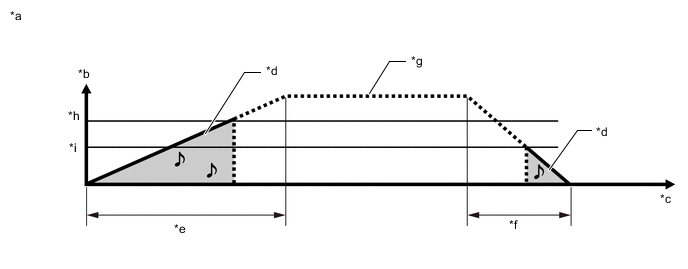
*a Example of Idle Sound *b Vehicle Speed *c Time *d Sounds Output *e Accelerating *f Decelerating *g When Vehicle being Driven *h 10 km/h (6 mph) *i 9 km/h (6 mph) - - -
Driving sound generation conditions are as follows:
Item Condition Remark Drive Mode ECO NORMAL SPORT*1/SPORT S*2 CUSTOMIZE*2, *3 SPORT S+*2 - Shift Lever Position - R, D, S - Vehicle Speed - 10 km/h (6 mph) or higher (acceleration) or more than 9 km/h (6 mph) (deceleration) - Sound Volume No sound Small Large Small*4
Large*5
Large - Tech Tips
*1: Models without AVS
*2: Models with AVS
*3: The idling sound output is performed through the drive mode customization only when NORMAL or POWER mode is selected for the POWER TRAIN item. However, idling sound output is not performed when ECO mode is selected for the POWER TRAIN item.
*4: The NORMAL mode is selected for the POWER TRAIN item through the drive mode customization.
*5: The POWER mode is selected for the POWER TRAIN item through the drive mode customization.
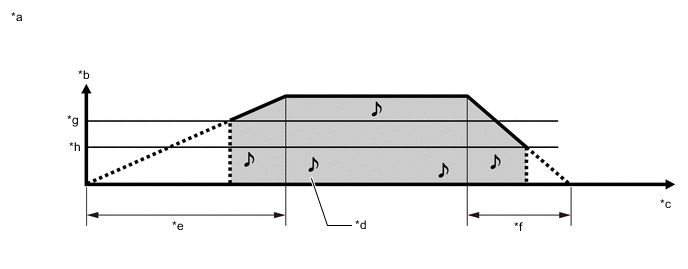
*a Example of Driving Sound *b Vehicle Speed *c Time *d Sounds Output *e Accelerating *f Decelerating *g 10 km/h (6 mph) *h 9 km/h (6 mph) -
Exhaust pulsation sound generation conditions are as follows:
Item Condition Remark Drive Mode ECO NORMAL SPORT*1/SPORT S*2 CUSTOMIZE*2 SPORT S+*2 - Shift Lever Position - - - - D, S - Vehicle Speed - - - - 75 km/h (47 mph) or more - Accelerator Pedal Opening Angle - - - - From 80% or more to 0% within 300 msec - Sound Volume No sound No sound No sound No sound Large - *1: Models without AVS
*2: Models with AVS
-
-
SYSTEM CONTROL
-
The following sounds are generated.
Idle Sound
-
Sounds when the accelerator pedal is not depressed and the engine speed is stable.
-
Sound output is performed when a vehicle speed is less than 10 km/h (6 mph) (during acceleration) or 9 km/h (6mph) or less (during deceleration).
Driving Sound
-
When the vehicle is being driven, the ASC system outputs a driving sound.
-
While driving in sequential shift or sequential paddle shift operation, the stereo component equalizer assembly outputs the sound resembling a shift change and the accelerator operation.
-
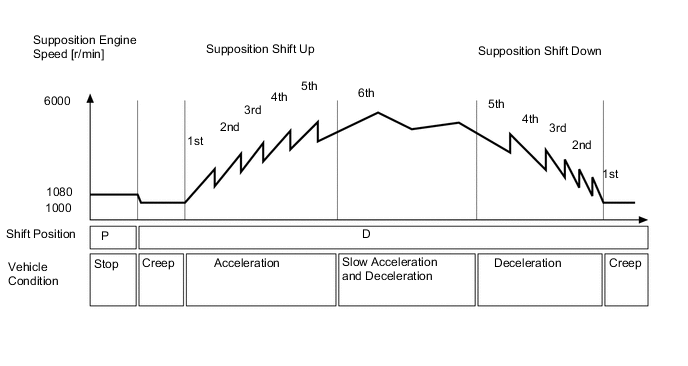
While driving with the shift lever in D, the stereo component equalizer assembly outputs the sound with more presence by calculating the shift position.*1
-
The sound output is performed while driving with a vehicle speed of 10 km/h or more (during acceleration) or higher than 9 km/h (during deceleration).
Exhaust Pulsation Sound*2
-
Specially designed exhaust pulsation sounds simulate the sound of unburned exhaust gases combusting in and around the exhaust pipe.
-
Generated when the vehicle is being driven with the accelerator pedal depressed, and the accelerator pedal is suddenly released.
Tech Tips
*1: For the virtual shift change, see the illustration below.
*2: Models with AVS
-
-
-
DIAGNOSIS
-
If the stereo component equalizer assembly detects a malfunction in the ASC system, Diagnostic Trouble Codes (DTCs) are stored in the stereo component equalizer assembly.
-
The 5-digit DTCs can be read by connecting the Global TechStream (GTS) to the DLC3. For details, refer to the Repair Manual.
-
-