REAR SUSPENSION SYSTEM
-
CONSTRUCTION
-
A highly rigid, solid type rear stabilizer bar is used. The rigidity of the rear stabilizer bar has been optimized. Also, the roll angle is suppressed by improving the spring constant and understeering is reduced by optimizing the distribution of rolling rigidity in the longitudinal direction, improving the vehicle's stable posture during cornering and its ability to accurately respond to steering operations.
-
A ball joint is used between the rear stabilizer link assembly and the rear stabilizer bar. As a result, the ball joint performs effectively even for slight rolling and maintains a stable roll feeling.
-
The stabilizer bar bush reduces friction by using a fluorine coating in the bore diameter. As a result, resistance due to friction with the stabilizer bar is reduced, improving reaction response performance. Furthermore, the rubber hardness is optimized to enhance the initial effect of the stabilizer, ensuring superior yaw response.
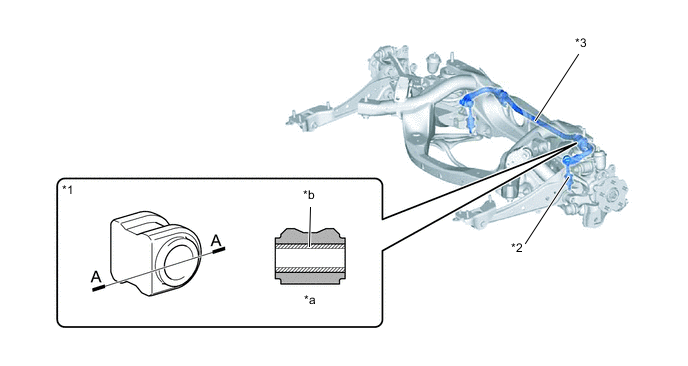
*1 Rear Stabilizer Bar Bush *2 Rear Stabilizer Link Assembly *3 Rear Stabilizer Bar - - *a A-A Cross Section *b Fluorine Coating
-