SFI SYSTEM
-
CONSTRUCTION
-
Crank Position Sensor
-
A pick-up type crankshaft position sensor is used to detect the engine speed and crankshaft angle.
-
The timing rotor of the crankshaft consists of 34 teeth with 2 teeth missing. The crank position sensor outputs the crankshaft rotation signals every 10°, and the change of the signal due to the missing teeth is used to determine top-dead-center.
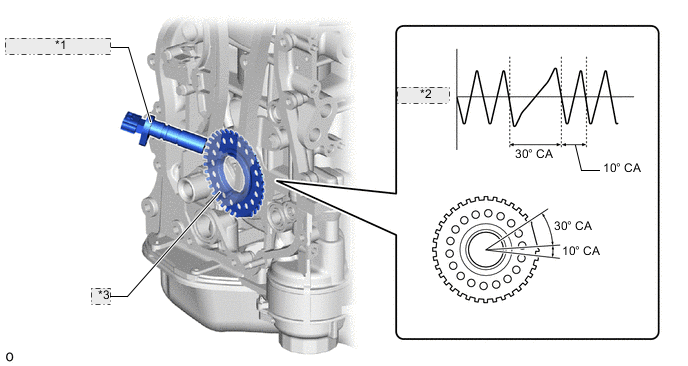
*1 Crank Position Sensor Assembly *2 NE Signal *3 Timing Rotor
-
-
Camshaft Position Sensor
-
A Magnetic Resistance Element (MRE) type camshaft position sensor is used. To detect the camshaft position, a timing rotor that is part of the camshaft is used to generate 6 (3 high output, 3 low output) pulses for every 2 revolutions of the crankshaft.
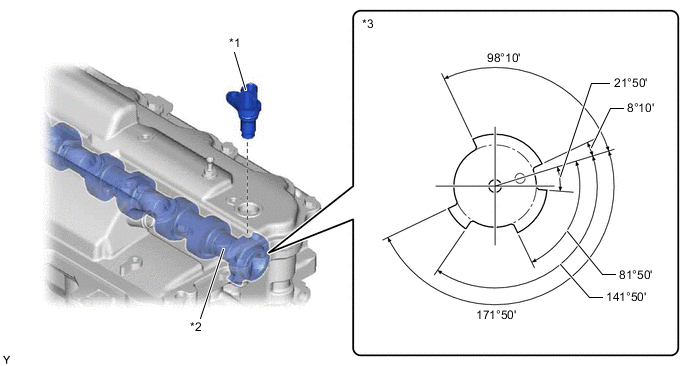
*1 Camshaft Position Sensor *2 Camshaft *3 Timing Rotor - - -
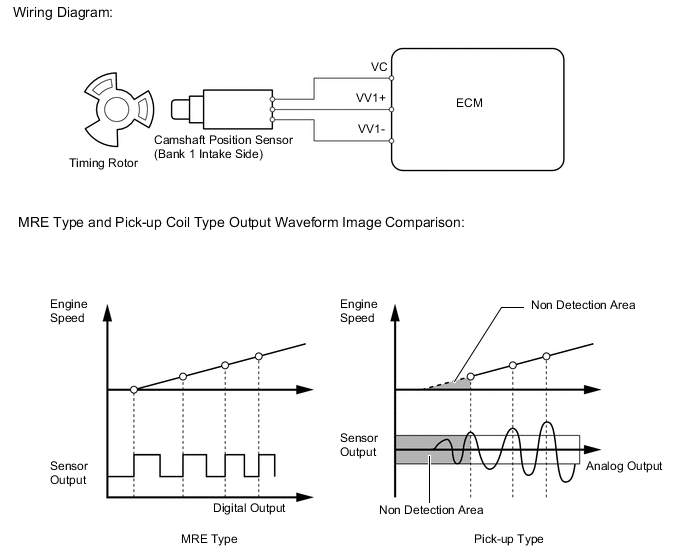
The MRE type camshaft position sensor consists of an MRE, a magnet and a sensor. The direction of the magnetic field changes due to the profile (protruding and non-protruding portions) of the timing rotor, which passes by the sensor. As a result, the resistance of the MRE changes, and the output voltage to the ECM changes to high or low. The ECM detects the camshaft position based on this output voltage.
-
-