FEATURES
-
OUTLINE
-
Hybrid System
-
LEXUS Hybrid Drive optimally performs cooperative control of the 2AR-FXE engine, Motor Generator No. 1 (MG1) and Motor Generator No. 2 (MG2) in the P314 hybrid transaxle that provides excellent transmission performance for the front wheel drive system.
-
On AWD models, the E-Four system optimally controls the Motor Generator Rear (MGR) through a Q211 rear drive unit that provides excellent traction performance for the rear wheel drive system.
-
The hybrid system uses a high-output HV battery with a nominal voltage of DC 244.8 V, and a variable voltage system in which a boost converter increases the operating voltage of the system to a maximum voltage of DC 650 V.
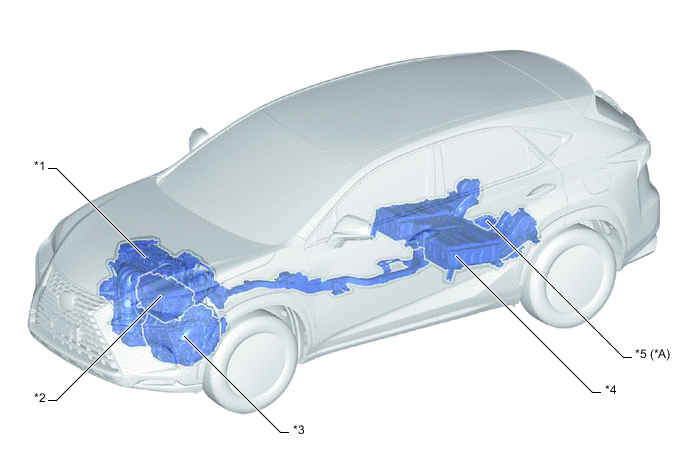
*A AWD Models - - *1 2AR-FXE Engine *2 Inverter with Converter Assembly *3 P314 Hybrid Transaxle (Hybrid Vehicle Transaxle Assembly) *4 HV Battery Assembly *5 Q211 Rear Drive Unit (Rear Traction Motor with Transaxle Assembly) - - System Performance Maximum System Output*1
147 kW, 145 KW*2
Tech Tips
*1 : Maximum system output is the combined power of the engine and the electric motor.
*2 : Models for Korea
-
-
2AR-FXE Engine
-
This engine uses a high-expansion ratio Atkinson cycle, Variable Valve Timing-intelligent (VVT-i) system, Direct Ignition System (DIS), Electronic Throttle Control System-intelligent (ETCS-i) and Exhaust Gas Recirculation (EGR)*1system employing a highly efficient EGR cooler. Thus, improved engine performance, quietness, fuel economy, and cleaner emissions have been achieved.
Engine Type 2AR-FXE Item No. of Cyls. and Arrangement 4-cylinder, In-line Valve Mechanism 16-valve DOHC, Chain Drive (with VVT-i) Fuel System SFI Displacement 2493 cm3(152.1 cu. in.)
Max. Output [SAE-NET] 114 kW @ 5700 rpm
112 kW @ 5700 rpm*2
Max. Torque [SAE-NET] 210 N*m @ 4200 - 4400 rpm
206 N*m @ 4400 - 4800 rpm*2
Tech Tips
*1: Models with EGR
*2: Models for Korea
-
-
Transaxle
-
The P314 hybrid transaxle is used for the front wheel drive system.
-
On AWD models, the Q211 rear drive unit is used for the rear wheel drive system.
-
-
Suspension
-
A MacPherson strut type independent suspension is used for the front.
-
A double-wishbone type independent suspension is used for the rear.
-
An Adaptive Variable Suspension system (AVS) is provided in accordance with the specification.
-
-
Brake
-
A ventilated disc brake is provided for the front brake.
-
A solid disc brake equipped with brake caliper-with-parking brake actuator is provided for the rear brake.
-
An electronically controlled brake system is used to control the hydraulic pressure at the 4 wheels.
-
The following brake control functions are provided: Anti-lock Brake System (ABS), Electronic Brake force Distribution (EBD), brake assist, Traction Control (TRC), Vehicle Stability Control (VSC), steering cooperative control, trailer sway control, hill-start assist control and brake hold.
-
An electric parking brake system, which allows the parking brake to be locked and released using a switch, is provided.
-
-
Steering
-
A rack and pinion type steering gear assembly is used.
-
An Electric Power Steering (EPS) system is used.
-
A manual tilt and telescopic mechanism and a power tilt and power telescopic system are provided in accordance with the specification.
-
-
Drive Mode Select
-
The drive mode select is a function where control characteristics switches of the powertrain (hybrid control system), chassis [Adaptive Variable Suspension system (AVS)*, Electric Power Steering (EPS) system] and air conditioning (air conditioning system) are integrated. This function optimally controls each system according to the driving mode selected by the driver.
-
*: Models with AVS
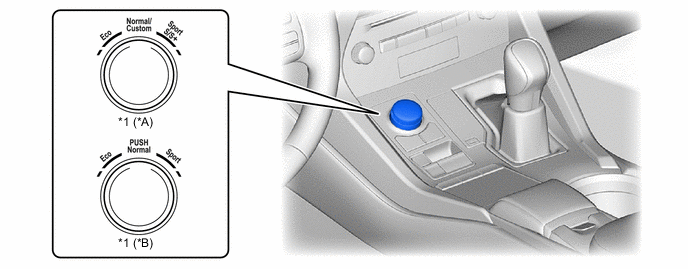
*A Models with AVS *B Models without AVS *1 Drive Mode Select - - -
-
Each drive mode of the drive mode select is provided with the following control characteristics:
Models with AVS Drive Mode Powertrain Chassis Air Conditioning Hybrid Control System AVS EPS System Air Conditioning System Normal Normal Normal Normal Normal Eco Eco Normal Normal Eco Sport S Power Normal Normal Normal Sport S+ Power Sport Sport Normal Models without AVS Drive Mode Powertrain Chassis Air Conditioning Hybrid Control System EPS System Air Conditioning System Normal Normal Normal Normal Eco Eco Normal Eco Sport Power Sport Normal -
The control characteristics in each drive mode are as follows:
Models with AVS Drive Mode Control Characteristics Normal Performs control for normal driving. Eco Performs control for driving with improved fuel efficiency by generating torque more gently than Normal mode according to accelerator pedal depression while suppressing air conditioning cooling and heating operations. Sport S Improves accelerator response by controlling the hybrid control system to perform control for driving that requires powerful acceleration. Sport S+ Comprehensively controls the AVS and EPS system in addition to the hybrid control system of Sport S mode to ensure maneuverability and stability to perform control for sporty driving. Models without AVS Drive Mode Control Characteristics Normal Performs control for normal driving. Eco Performs control for driving with improved fuel efficiency by generating torque more gently than Normal mode according to accelerator pedal depression while suppressing air conditioning cooling and heating operations. Sport Performs control suitable for sporty driving by improving the acceleration response by controlling the transmission and hybrid control system and also improving the steering feeling. -
Custom mode is provided. Custom mode is a function where the control characteristics of each system can be freely selected and combined by the driver. Powertrain (Normal/Eco/Power), chassis (Normal/Sport) and air conditioning (Normal/Eco) combinations can be freely selected to support the specific needs of the driver. Refer to the Repair Manual for the details of the custom mode setting method.
-
-