СИСТЕМА ВПУСКА
-
CONSTRUCTION
-
The variable nozzle vane type turbocharger sub-assembly consists primarily of a turbine, nozzle vane, unison ring, nozzle ring and turbocharger variable nozzle motor (DC motor and nozzle vane position sensor).
-
This turbocharger has achieved improvements in low-speed torque, fuel consumption and emission reduction. Both torque improvement at low speed and low fuel consumption are achieved by using a small size turbocharger because it enables high boost pressure at low speed. Response in boost pressure change is improved by changing control from the actuator to DC motor.
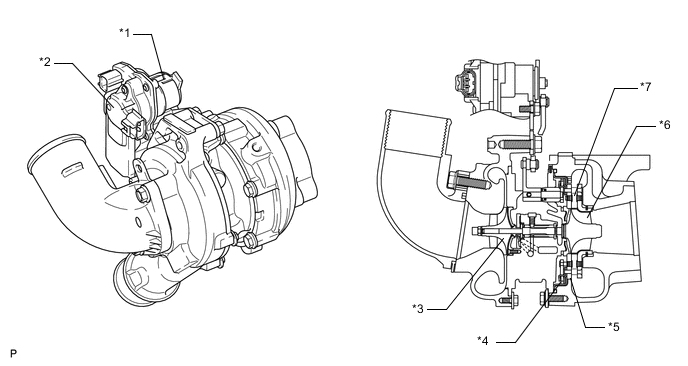
*1 DC Motor *2 Nozzle Vane Position Sensor *3 Impeller Wheel *4 VGS Link Plate *5 Nozzle Ring *6 Turbine Wheel *7 Nozzle Vane - - -
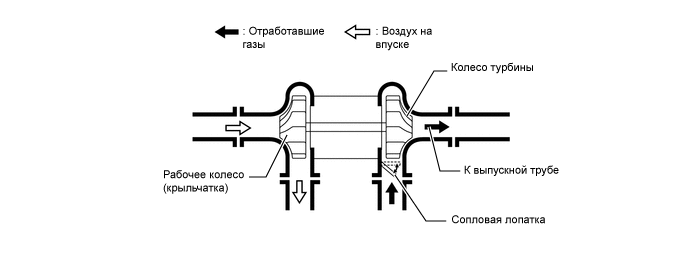
The exhaust gas from the exhaust manifold goes through the nozzle vane inside the turbocharger housing, and flows to the exhaust pipe through the turbine. The speed of the turbine (supercharging pressure) differs depending on the flow velocity of the exhaust gas going through the turbine. The flow velocity of the exhaust gas is controlled by the nozzle vane opening.
-
-
OPERATION
-
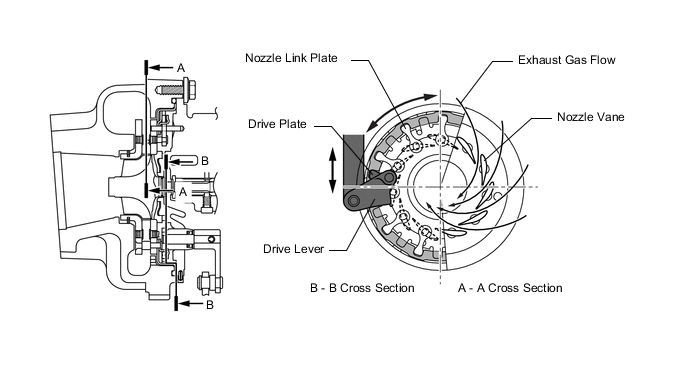
At Low Load Range or Low Speed Range
-
The DC motor moves the drive lever in the closing direction of the nozzle vanes in accordance with signals from the ECM.
-
This results in increasing the velocity of the exhaust gas flowing to the turbine, as well as the speed of the turbine. As a result, torque is improved when the engine is running at low speeds.
-
-
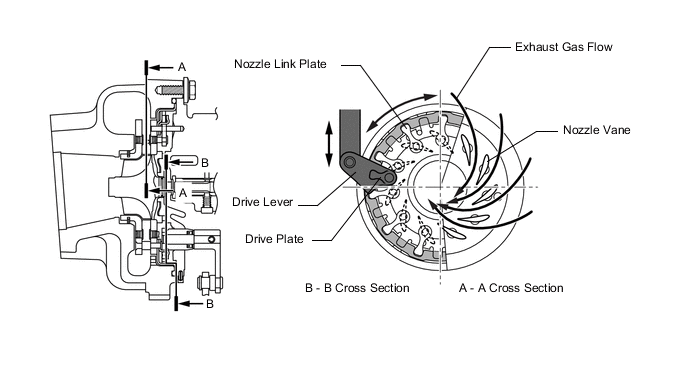
At High Load Range or High Speed Range
-
When the engine is running in high load range or high speed range, the nozzle vanes are opened and the discharging pressure is maintained at a certain level.
-
-