СИСТЕМА СНИЖЕНИЯ ТОКСИЧНОСТИ ОТРАБОТАВШИХ ГАЗОВ
-
OPERATION
-
If the DPF catalyst temperature becomes low, catalyst performance decreases, resulting in an increase of the amount of PM stuck in the filter substrate. The ECM detects that the filter substrate is clogged by calculating the accumulated volume of the PM discharged by the engine. To reduce PM, the ECM controls the injection timing and the injection frequency of the injectors, and activates the exhaust fuel addition injector.
-
At the same time, the filter substrate temperature becomes high and PM reacts with active oxygen and changes into CO2for purification.
-
Fuel efficiency drops while this control is operative.
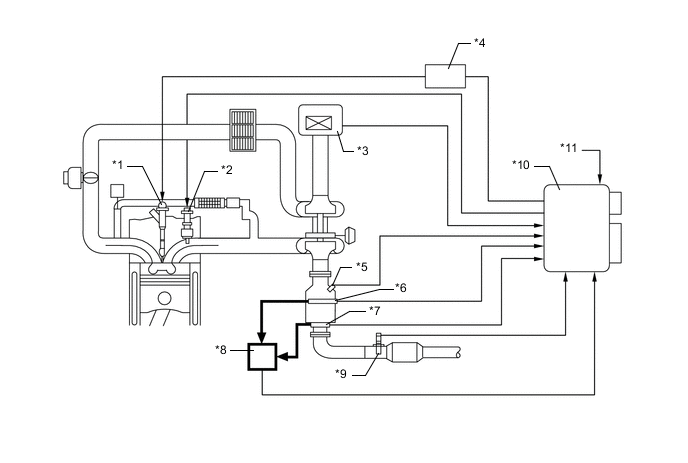
*1 Injector Assembly *2 Exhaust Fuel Addition Injector Assembly *3 Intake Mass Air Flow Meter Sub-assembly *4 Injector Driver *5 Exhaust Gas Temperature Sensor *6 No. 2 Exhaust Gas Temperature Sensor (Upper Side) *7 No. 3 Exhaust Gas Temperature Sensor (Lower Side) *8 Differential Pressure Sensor Assembly *9 Air Fuel Ratio Sensor *10 ECM *11 Engine Coolant Temperature Sensor - - Tech Tips
-
When replacing the exhaust manifold converter with a new one, it is necessary to perform initialization of the DPF catalyst deterioration data history in the ECM by using a Global TechStream (GTS).
-
When replacing the ECM with a new one, it is necessary to read DPF catalyst deterioration data history from the installed ECM and then transfer that data history to the new ECM by using the GTS. When the DPF catalyst deterioration data history is not transferred, Diagnostic Trouble Code (DTC) P062F is stored in the ECM and the MIL comes on.
-
When replacing both the exhaust manifold converter and the ECM, it is necessary to perform initialization of the DPF catalyst deterioration data history in the ECM using the GTS. When DPF catalyst deterioration history initialization is not performed, DTC P062F is stored in the ECM and the MIL comes on.
-
-