БЛОК ДВИГАТЕЛЯ
-
CONSTRUCTION
-
A crankshaft made of forged steel is used.
-
The crankshaft has 4 balance weights and 5 bearing journals.
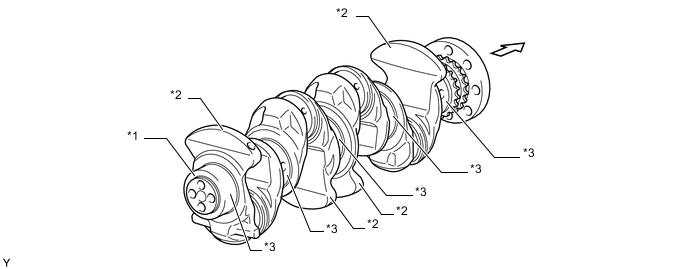
*1 Crankshaft *2 Balance Weight *3 Bearing Journal - - 
Transaxle Side - - -
The crankshaft bearings subjected to high loads are designed as tri-metal bearings. The steel backing, the lead-free bronze and the bearing metal layer made from a tin-copper alloy provide the basis for wear-resistant bearings with high load capacities.
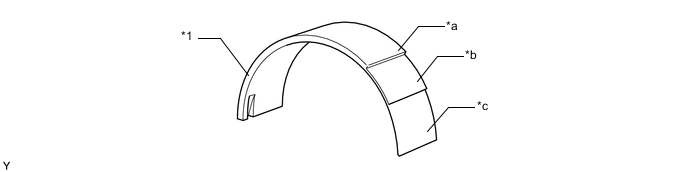
*1 Crankshaft Bearing - - *a Steel Backing *b Aluminum Bronze *c Bearing Metal Layer - - -
There are 2 oil holes in the upper crankshaft bearing. This is because the oil hole in the bearing seat is located alternately on the left or right side, whereas the bearing shell should be a common part.
-
An all-round groove in the upper crankshaft bearing improves the distribution of the oil. This groove however reduces the size of the sliding surface and thereby increases the effective pressure. Strictly speaking, the bearing is split into 2 halves, each with a smaller bearing capacity. The oil grooves are therefore only situated in the zone not subjected to load. The bearing is also cooled by the engine oil.
-
The crankshaft has only one thrust bearing. This bearing holds the crankshaft in the axial direction and absorbs forces in the longitudinal direction. A built-up thrust bearing is used in this engine.
-
Built-up bearings are made up of several separate components. Thrust washers are fitted on both sides to provide for a stable, loose connection with the crankshaft bearing and facilitate easy installation. The thrust washers are movable, thereby making contact more uniform and reducing wear. Also, 2 built-up bearing halves are installed to guide the crankshaft. These provide the crankshaft with a 360° thrust bearing and very good stability against axial displacement.
-
The thrust bearing is located in the middle of the crankshaft at the position of the No. 3 crankshaft bearing. This allows thermal expansion to occur more uniformly. The steel of the crankshaft and the aluminum of the cylinder block sub-assembly have different coefficients of thermal expansion, i.e. in the case of temperature differences the level of thermal expansion also differs. If the thrust bearing were located at one of the ends of the crankshaft, the expansion difference in relation to the cylinder block sub-assembly over the length of the entire crankshaft would be very great. However, because the thrust bearing is located in the middle, thermal expansion is distributed symmetrically in both directions. This means that the expansion difference at the 2 ends of the crankshaft is only half as great.
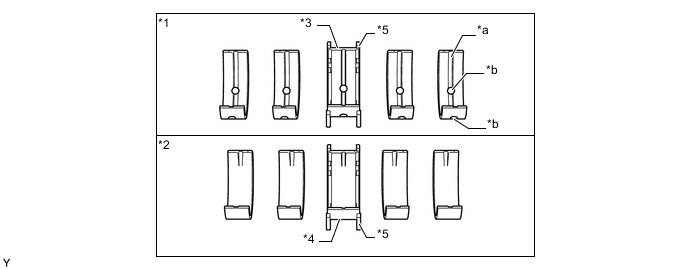
*1 Upper Crankshaft Bearings (in Bearing Seat) *2 Lower Crankshaft Bearings (in Bearing Cap) *3 No. 3 Upper Crankshaft Bearing *4 No. 3 Lower Crankshaft Bearing *5 Thrust Bearing - - *a Oil Groove *b Oil Hole Tech Tips
-
It is extremely important to handle the crankshaft bearings with care, as the very thin bearing metal layer can be easily damaged.
-
It is important to ensure that the bearing is lubricated with engine oil. Overheating is usually the cause, even when a thrust bearing fails.
-
The bearing classification for the upper crankshaft bearings in the crankshaft bearing cap is marked on the crankshaft. The first digit indicates bearing cap No. 1, the second digit for bearing cap No. 2, and so on. In the example shown bearing No. 1 starting at the output end has the classification 1, bearing No. 2 the classification 2, and so on. The code letter K indicates the clutch end.
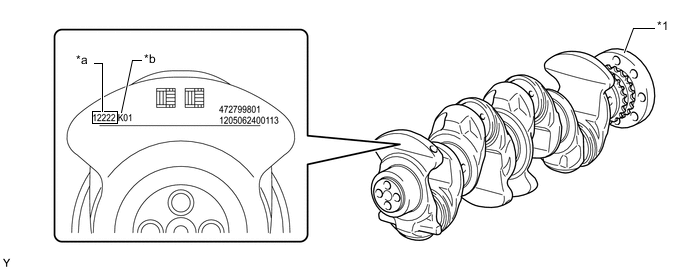
*1 Crankshaft - - *a Bearing Classification *b Code letter "K" indicates clutch end. -
The bearing classification for the lower crankshaft bearings in the bearing seat is marked on the cylinder block. If there is a "K" before the digits, the classification is started at the clutch end. In this case, the first digit indicates bearing No. 5. The fifth digit then indicates bearing No. 1. If there is no "K" before the digits on the cylinder block, the first digit indicates bearing No. 1, and so on. The zeros at the beginning and the end are omitted.
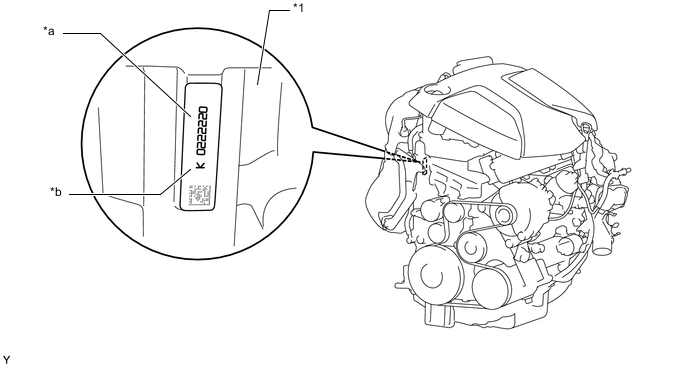
*1 Cylinder Block - - *a Bearing Classification *b Code letter "K" indicates clutch end. -
For details of the installation of the crankshaft bearings, refer to the Repair Manual.
-
-