СИСТЕМА SFI
-
CONSTRUCTION
-
A Magnetic Resistance Element (MRE) type crank position sensor is used. The timing rotor of the crankshaft consists of 34 teeth with 2 teeth missing. The crank position sensor outputs the crankshaft rotation signals every 10°, and the missing teeth are used to determine the top dead center.
-
The Magnetic Resistance Element (MRE) type intake and exhaust camshaft position sensors are used. To detect the camshaft position, each timing rotor on the intake and exhaust camshafts is used to generate 3 (3 high output, 3 low output) pulses for every 2 revolutions of the crankshaft.
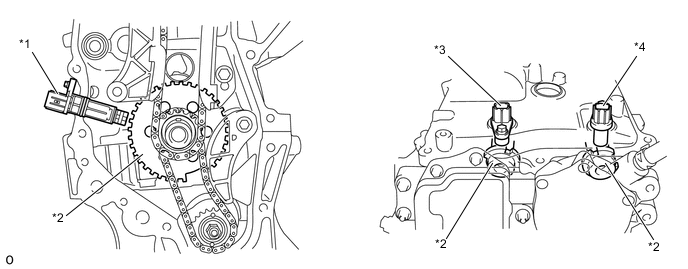
*1 Crank Position Sensor *2 Timing Rotor *3 Camshaft Position Sensor (Intake) *4 Camshaft Position Sensor (Exhaust) Figure 1. Sensor Output Waveforms
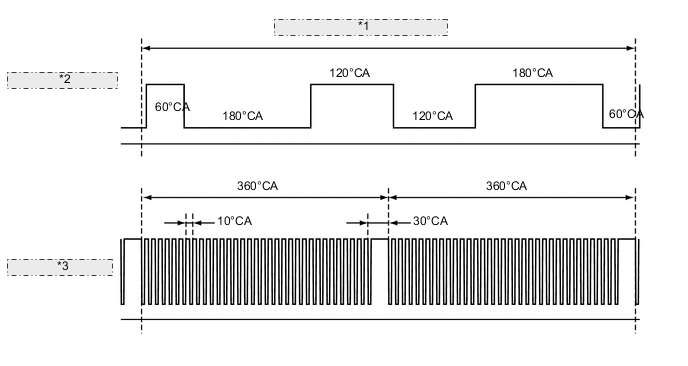
*1 Camshaft Timing Rotor (720°CA) *2 Camshaft Position Sensor *3 Crank Position Sensor Assembly -
The MRE type sensor consists of an MRE, a magnet and a sensor. The direction of the magnetic field changes due to the profile (protruding and non-protruding portions) of the timing rotor, which passes by the sensor. As a result, the resistance of the MRE changes, and the output voltage to the ECM changes to high or low. The ECM detects the crankshaft and camshaft positions based on this output voltage.
-
The differences between the MRE type sensor and the pick-up coil type sensor used on the conventional models are as follows:
-
The MRE type sensor outputs a constant level of high and low digital signals regardless of the engine speed. Therefore, the MRE type sensor can detect the positions of the crankshaft and camshaft at an early stage of cranking.
-
The pick-up coil type sensor outputs analog signals with levels that change with the engine speed.
-
-