BODY STRUCTURE
-
FUNCTION
-
Safety Features
-
Impact Absorbing Structure for Front Collisions
-
Through the adoption of a body structure that disperses collision energy to multiple frame components, collision energy is efficiently absorbed to suppress cabin deformation.
-
The front side members absorb and disperse collision energy received from the front bumper reinforcement.
-
Collision energy applied to the upper side members is transmitted to the front door beltline reinforcement and front pillar reinforcement via the MICS bulk.
-
The side member torque box adopted on the side member disperses collision energy to the dash panel, rocker inner reinforcement and floor members.
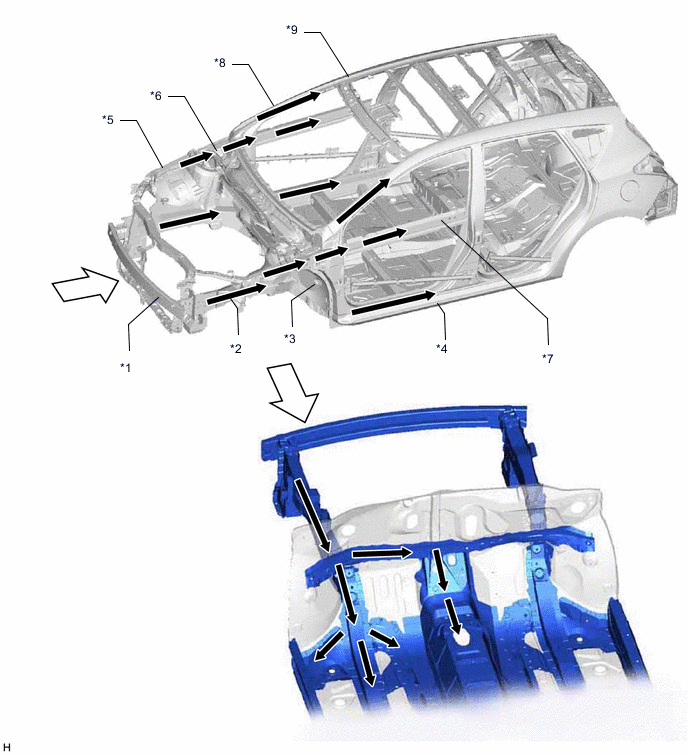
*1 Front Bumper Reinforcement *2 Front Side Member *3 Side Member Torque Box *4 Rocker Inner Reinforcement *5 Upper Side Member *6 MICS Bulk *7 Front Door Beltline Reinforcement *8 Front Pillar Reinforcement *9 Rail Reinforcement - - 
Impact 
Path of Collision Energy -
Dash panel insulator pads are provided in the lower section of the dash panel to lessen the impact to the legs of the Driver and front passenger.
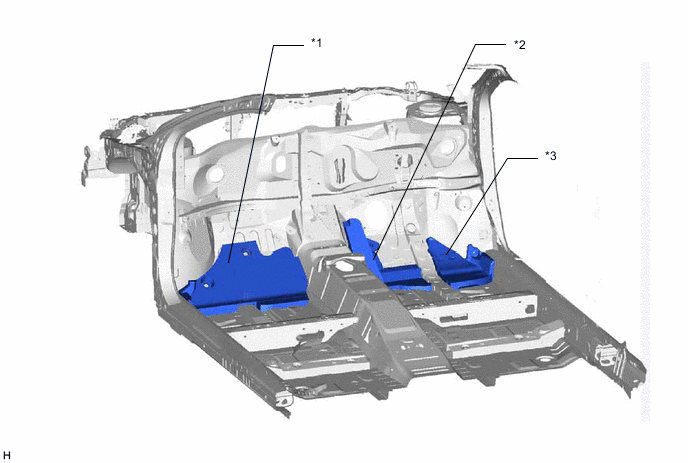
*1 Dash Panel Insulator Pad No. 3 *2 Dash Panel Insulator Pad No. 2 *3 Dash Panel Insulator Pad No. 1 - -
-
-
Impact Absorbing Structure for Side Collision
-
High strength sheet steel is used for the center pillar outer reinforcement, rocker outer reinforcement, front door impact protect beams and rear door impact protect beams to ensure high strength.
-
Optimal placement of the door impact beams enables a construction that efficiently transmits load.
-
Bulkheads are placed on the rocker panel reinforcement sides of the floor cross members to efficiently transmit impact load from the impact beams to the floor cross members.
-
The use of a roof reinforcement enables a construction that transmits load to the opposite side of the vehicle in a collision.
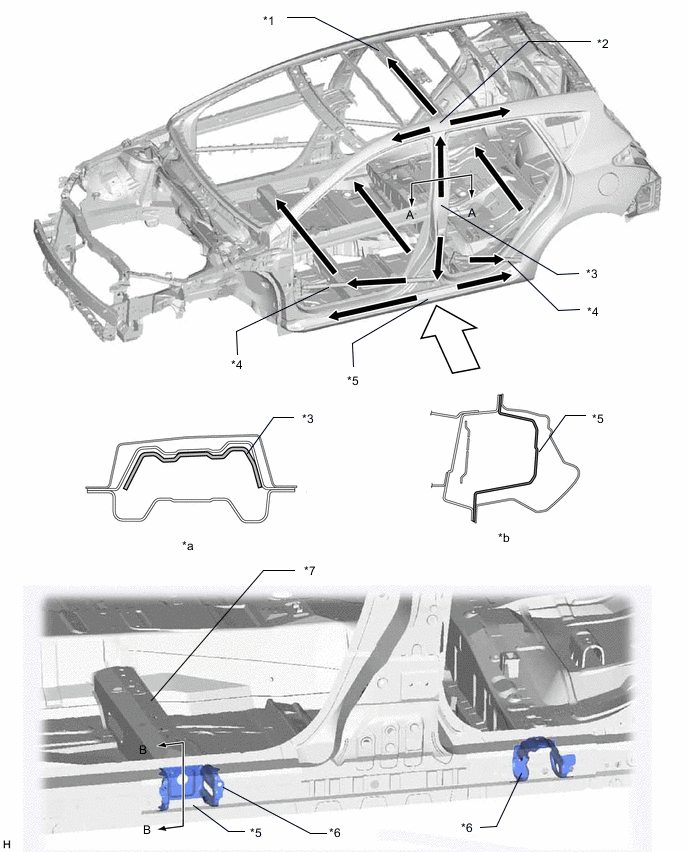
*1 Roof Reinforcement *2 Roof Rail Reinforcement *3 Center Pillar Outer Reinforcement *4 Door Impact Protect Beam *5 Rocker Outer Reinforcement *6 Bulkhead *7 Center Floor Cross Member - - *a A-A Cross Section *b B-B Cross Section Impact Path of Collision Energy
-
-
-
Lessening Pedestrian Injury
-
A front bumper energy absorber and front lower bumper absorber are provided to dampen the impact to the legs of a pedestrian in the event of a collision.
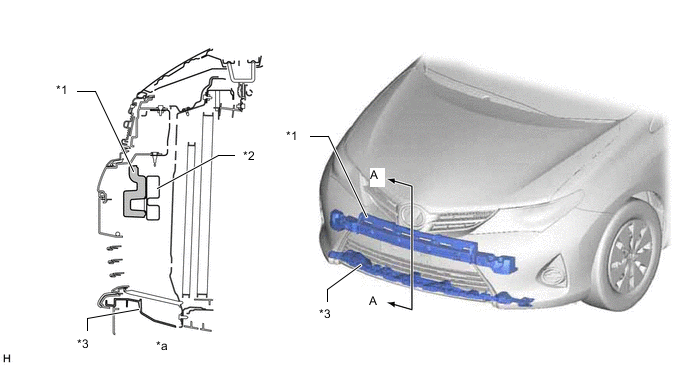
*1 Front Bumper Energy Absorber *2 Front Bumper Reinforcement *3 Front Lower Bumper Absorber - - *a A-A Cross Section - - -
A longitudinal ribbed structure is adopted for the inner hood to cushion impact.
-
The space between the hood panel and the engine has been formed into a crushable structure so that the hood sub-assembly and dent reinforcement can collapse easily during a collision.
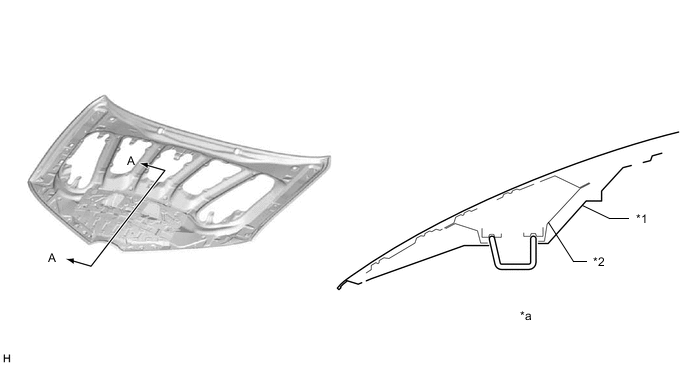
*1 Hood Inner Panel *2 Hood Reinforcement *a A-A Cross Section - - -
An impact absorbing bracket is used for the mounting portion of the front fender panel to absorb impact energy to the head of a pedestrian in a collision, thus dampening the impact to the head.
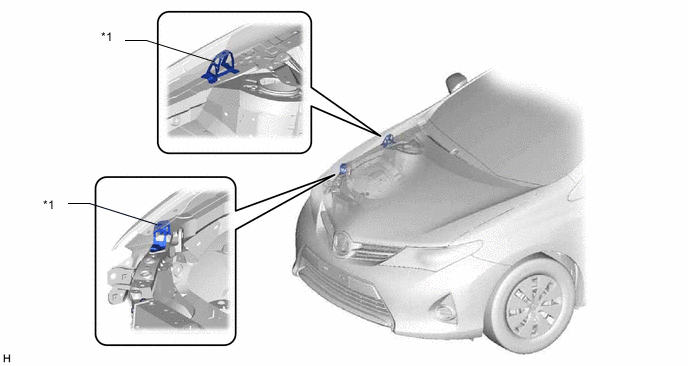
*1 Impact-absorbing Bracket - -
-
-
Aerodynamics
-
A step roof, a roof that has a curved surface, is used to reduce the frontal projected area, reducing wind drag while driving and improving fuel efficiency.
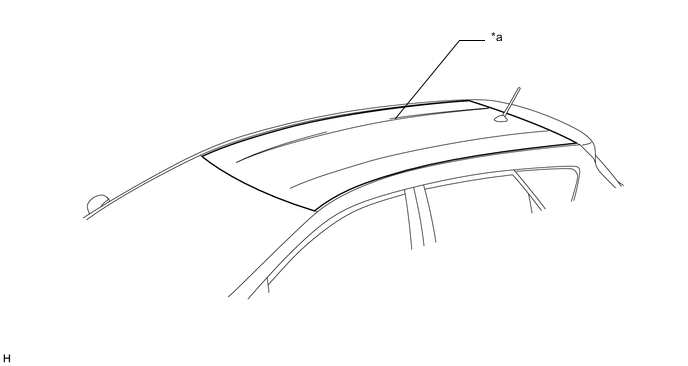
*a Step Roof - - -
A rear roof spoiler has been provided at the back of the roof to prevent the air flowing over the roof from entering the area behind the vehicle, reducing wind drag and improving fuel efficiency.
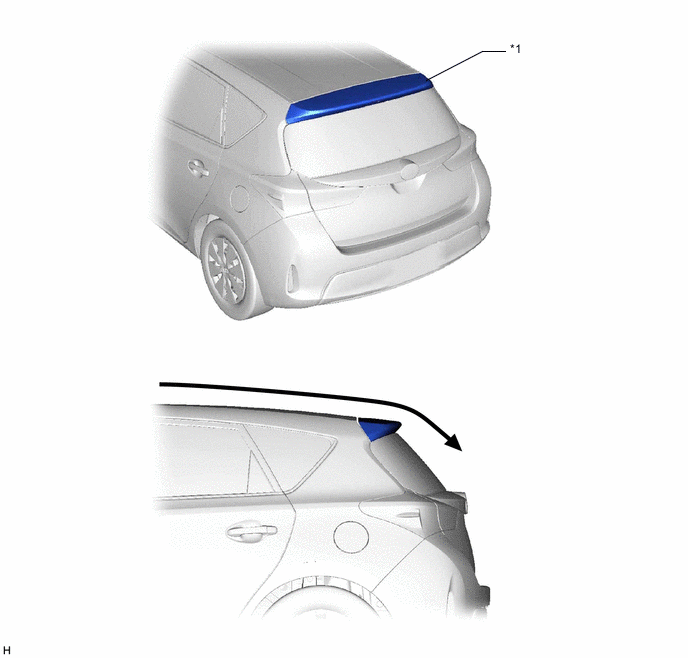
*1 Rear Roof Spoiler - - Airflow - - -
Various types of airflow routing parts are provided under the floor to control airflow. In addition, an under cover is provided to make the under floor area flat in order to ensure excellent aerodynamic performance.
-
A fin-shaped floor under cover have been adopted to achieve higher diffuser efficiency, thereby ensuring stability.
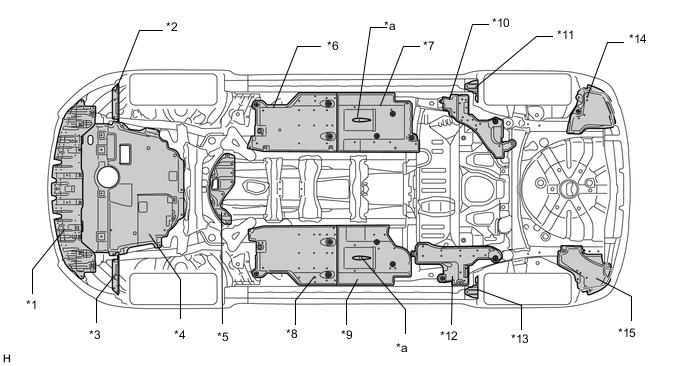
*1 Front Lower Absorber *2 Front Air Spats (Front Wheel Opening Extension pad LH) *3 Front Air Spats (Front Wheel Opening Extension pad RH) *4 Engine Under Cover No. 1 *5 Engine Under Cover Front No. 3 *6 Front Floor Cover LH *7 Front Floor Cover Center LH *8 Front Floor Cover RH *9 Front Floor Cover Center RH *10 Rear Floor Side Member Cover LH *11 Rear Air Spats (Rear Wheel House Plate LH) *12 Rear Floor Side Member Cover RH *13 Rear Air Spats (Rear Wheel House Plate RH) *14 Floor Under Cover No. 2 *15 Floor Under Cover No. 1 - - *a Fin-shaped - -
-
-
-
CONSTRUCTION
-
Lightweight and Highly Rigid Body
-
A highly rigid yet lightweight vehicle body has been created by considerable use of mainly high strength sheet steel and ultra high strength sheet steel for body frame members, ensuring a high level of impact safety, driving stability and quietness.
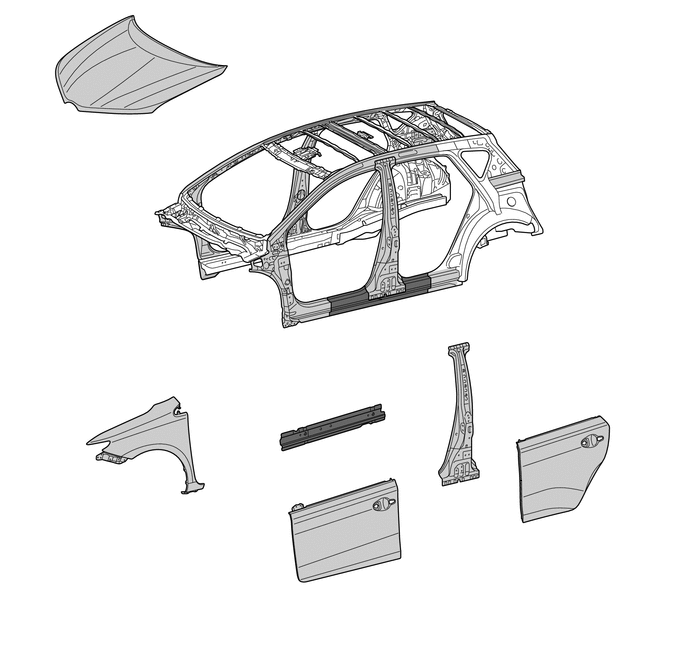

High Strength Steel 
Ultra High Strength Steel 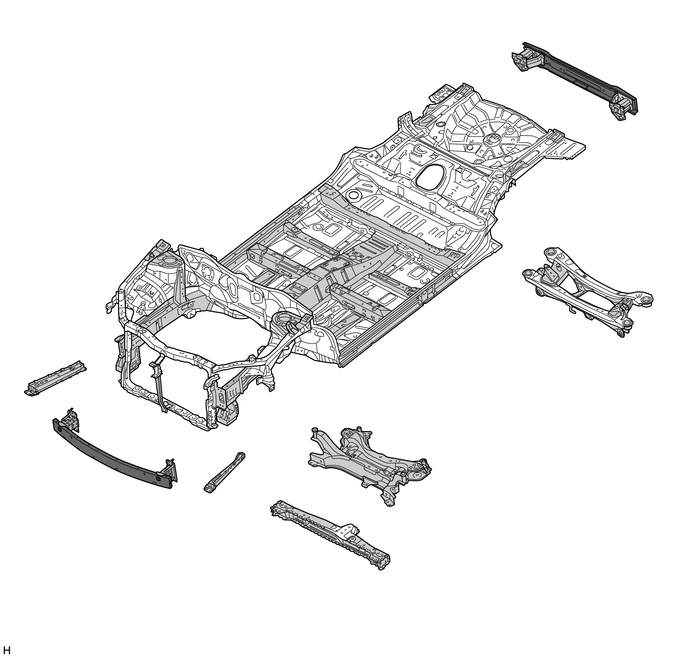
High Strength Steel Ultra High Strength Steel
-
-
Body Shell Construction
-
An outer cowl top panel sub-assembly, which has a smooth ridge line, is used to connect the left and right front spring supports improving lateral rigidity and ensuring front suspension input point rigidity and body rigidity.
-
Gussets have been added to the cowl top panel, ensuring front suspension input point rigidity.
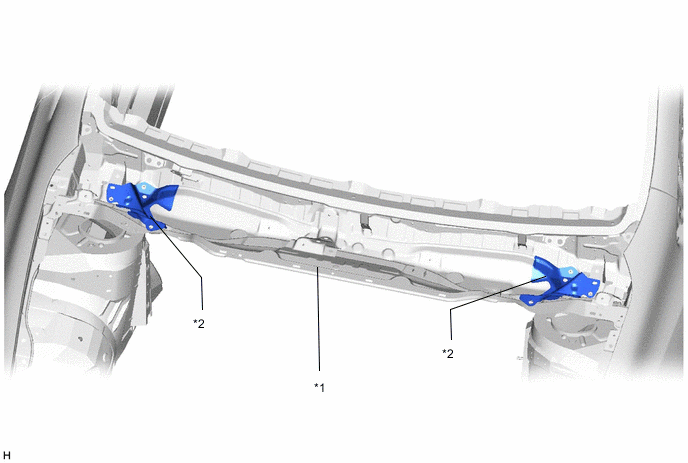
*1 Outer Cowl Top Panel Sub-assembly *2 Gusset
-
-
Anti-corrosion Sheet Steel
-
Anti-corrosion sheet steel is used as shown in the following illustration.
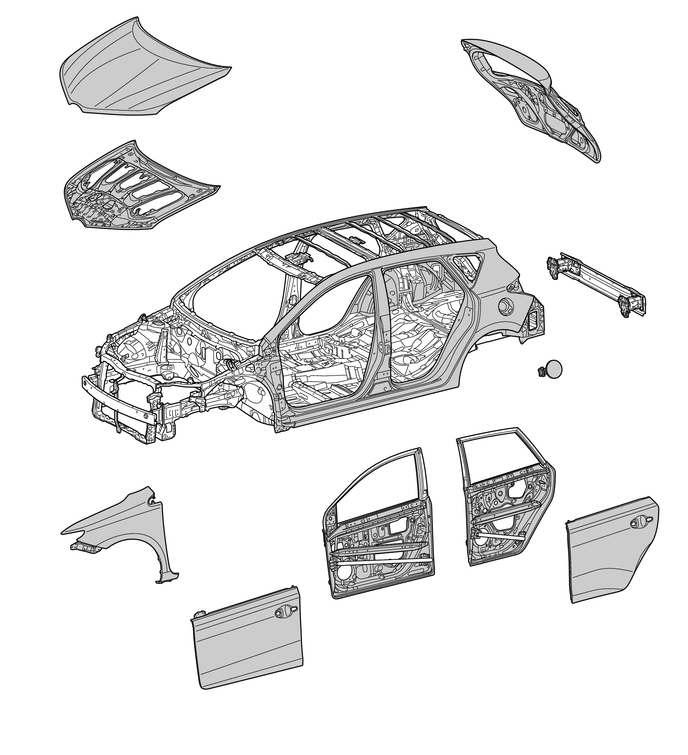
Anti-corrosion Steel - - 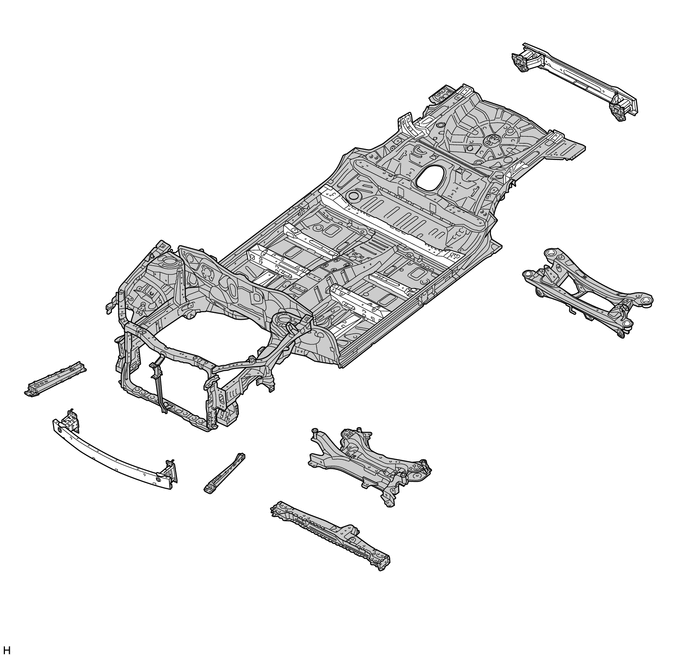
Anti-corrosion Steel - -
-
-
Wax and Sealer
-
Wax is applied to the frontal edge of the hood, the edge of the lower part of the door, and the fuel filler lid hinge to improve rust-resistance performance. Sealer is applied to hemmed portions of the front edge of the hood, front and back door panels and fuel filler lid.
-
-
Under Coat
-
Acrylic acid resin is applied to the under side of the body, inside the wheel housing and other parts that are susceptible to stone chipping damage, thus improving the rust-resistance performance of these areas.
-
-
Anti-chipping Application
-
To help prevent the paint from chipping, anti-chipping paint is applied to the hood panel.
-
Anti-chipping tape is applied to the rear quarter panel just behind the back of the rear door to protect the paint surface from icy snow or gravel and to achieve a high level of rust resistance.
-
-
Low Vibration and Low Noise Body
-
Silencer pads are provided on the engine compartment side and cabin side of the dash panel, minimizing penetration of engine noise and road noise into the cabin.
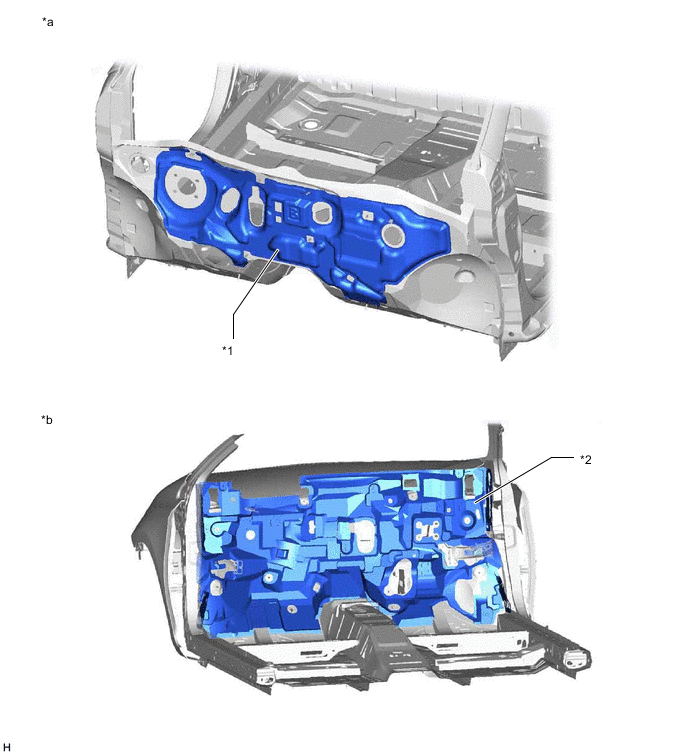
*A Engine Room *B Cabin *1 Dash Panel Insulator Outer *2 Dash Panel Insulator Inner -
Sealing material is applied to the roof panel and pillars to reduce wind and road noise.
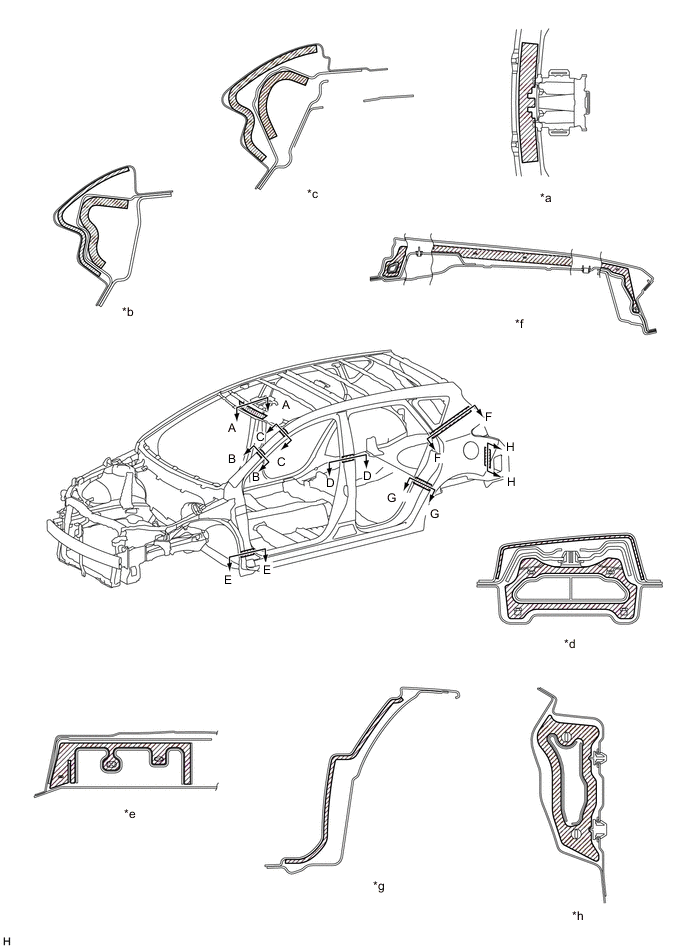
*a A-A Cross Section *b B-B Cross Section *c C-C Cross Section *d D-D Cross Section *e E-E Cross Section *f F-F Cross Section *g G-G Cross Section *h H-H Cross Section 
Sealing Material - - -
Damping coatings are applied to the floor in order to reduce vibration and noise in the cabin.
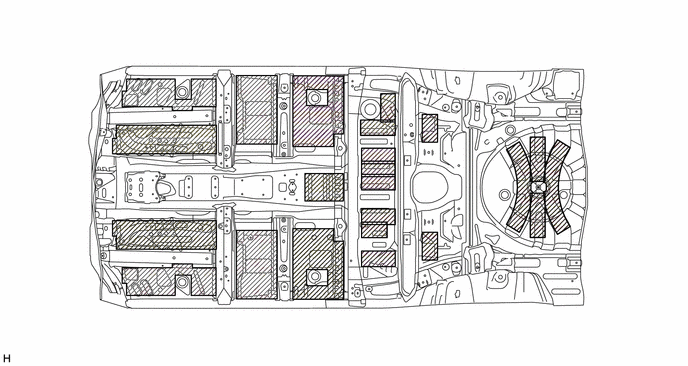
Damping Coating - -
-
-
Parts with Low Repair Cost
-
The rear bumper reinforcement is connected to the rear side member using bolts to improve the ease of repair and replacement.
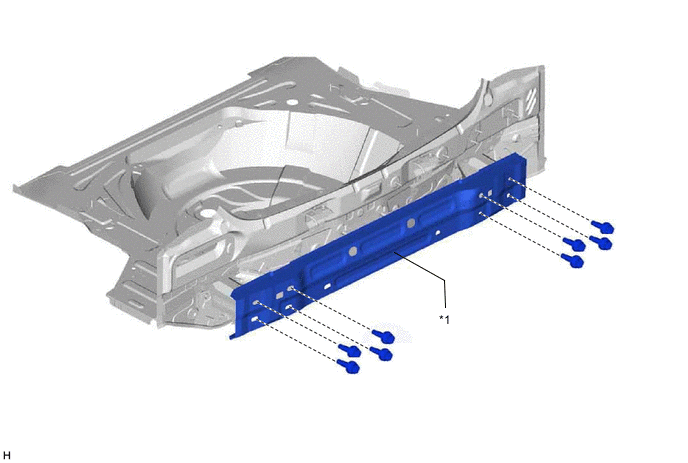
*1 Rear Bumper Reinforcement - -
-
-