PRE-CRASH SAFETY SYSTEM
-
FUNCTION OF MAIN COMPONENTS
Item Function Pre-crash Safety City Sensor
-
Laser Sensor
-
Monocular Camera Sensor
-
Pre-crash Safety City Sensor ECU
-
Receives information from the monocular camera sensor and laser sensor regarding vehicles ahead, and performs pre-crash safety system control.
-
When performing pre-crash safety system control, it also sends request signals to the combination meter assembly to display applicable messages and sound the buzzer.
-
When pre-crash brake or pre-crash brake assist are operating, it sends signals to the skid control ECU requesting vehicle speed reduction.
-
Sounds the meter buzzer during warning operation.
Pre-crash System Cancel Switch Assembly
-
Turn the pre-crash safety system on/off.
-
Switches between the 3 warning timings (Far, Middle and Near) when pressed.
Combination Meter Assembly PCS Warning Light
-
Flashes when the system is malfunctioning or temporarily disabled.
-
Illuminates when the pre-crash safety system is not activated due to cancel switch or when pre-crash brake and pre-crash brake assist operation are disabled since the VSC system has been disabled.
Multi-information Display Displays a warning message to inform or warn the driver of the system condition in accordance with signals from the pre-crash safety city sensor. Buzzer Sounds during warning operation to warn the driver. Hybrid Vehicle Control ECU Assembly
-
Detects the shift position signal and accelerator pedal opening angle and sends that information to the pre-crash safety city sensor.
-
Performs hybrid system output control based on information from the pre-crash safety city sensor.
Brake Booster With Master Cylinder Assembly Skid Control ECU
-
Receives a brake assist standby request signal from the pre-crash safety city sensor and switches the brake assist to standby mode. When a stop light switch signal is input, it activates the brake assist.
-
Receives a pre-crash brake request signal from the pre-crash safety city sensor, and then applies the brakes.
-
Transmits vehicle speed signals to the pre-crash safety city sensor.
Speed Sensors Detect the wheel speed of each of the 4 wheels and transmits the signals to the skid control ECU. Airbag Sensor Assembly Yaw Rate Sensor Detects the yaw rate and lateral/longitudinal deceleration of the vehicle and transmits the signal to the pre-crash safety city sensor. Spiral Cable with Sensor Sub-assembly Steering Sensor Detects the angle and direction of steering and transmits a signal to the pre-crash safety city sensor. Stop Light Switch Assembly Detects if the brake pedal is depressed and transmits a signal to the pre-crash safety city sensor. VSC OFF Switch Disables the pre-crash brake and pre-crash brake assist operation when the switch is turned on. Main Body ECU (Multiplex Network Body ECU) Sends country specification information signals to the pre-crash safety city sensor. -
-
FUNCTION
-
The pre-crash safety system uses the monocular camera sensor and laser sensor inside the pre-crash safety city sensor to determine if there is a risk of this vehicle colliding with the preceding vehicle.
-
When the probability of a collision is high, the pre-crash safety system sends a warning via the meter display and buzzer, and performs brake assist control. Additionally, when the probability of a collision is extremely high, the system performs brake control in order to reduce the impact force if a collision occurs.
-
During brake control by the pre-crash safety system, the skid control ECU illuminates the stop light in order to inform any following vehicles that this vehicle is braking.
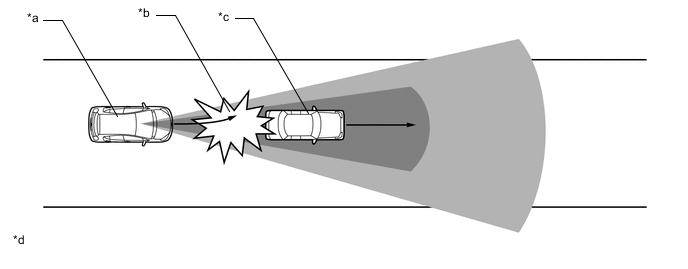
Text in Illustration *a This Vehicle *b Probability of collision extremely high *c Preceding Vehicle *d The illustrations shown are examples only. 
Laser Sensor Detection Area 
Monocular Camera Sensor Image Recognition Area
-
-
OPERATIONAL CONDITIONS
-
The pre-crash safety system is enabled and determines that the possibility of a frontal collision with a vehicle is high.
Each function is operational at the following speeds:
-
Vehicle speed is approximately 15 to 140 km/h (10 to 86 mph).
-
The relative speed between your vehicle and the vehicle ahead is greater than approximately 15 km/h (10 mph).
Pre-crash warning:
-
Vehicle speed is approximately 30 to 80 km/h (19 to 49 mph).
-
The relative speed between your vehicle and the vehicle ahead is greater than approximately 30 km/h (19 mph).
-
The brake pedal is being depressed.
Pre-crash brake assist:
-
Vehicle speed is approximately 10 to 80 km/h (7 to 49 mph).
-
The relative speed between your vehicle and the vehicle ahead is greater than approximately 10 km/h (7 mph).
Pre-crash brake:
The system may not operate in the following situations:
-
If a battery terminal has been disconnected and reconnected and then the vehicle has not been driven for a certain amount of time (until the zero point calibration of steering sensor is completed)
-
If the shift position is in R
-
If VSC is disabled (only the pre-crash warning function will be operational)
-
If the PCS warning light is flashing or illuminated
-
-
Cancelation of the pre-crash
-
If either of the following situations occur while the pre-crash function is operating, it will be canceled:
-
The accelerator pedal is depressed strongly
-
The steering wheel is turned sharply or abruptly
-
-
If the vehicle is stopped by the operation of the pre-crash function, the operation of the pre-crash function will be canceled after the vehicle has been stopped for approximately 2 seconds.
-
When the driver is depressing the brake pedal, the system judges that the driver is preparing to avoid a collision, so the system may delay the pre-crash brake activation timing.
-
During the following, the driver operations takes precedence and the system may not operate:
-
The acceleration pedal is depressed strongly
-
The steering wheel is turned sharply or abruptly
-
-
-
Conditions under which the system may operate even if there is no possibility of a collision
-
In some situations such as the following, the system may determine that there is a possibility of a frontal collision and operate.
-
When passing a vehicle in an oncoming lane that is stopped to make a left/right turn

-
When passing an oncoming vehicle while making a left or right turn

-
When driving on a road where relative location to vehicle ahead in an adjacent lane may change, such as on a winding road

-
When rapidly closing on a preceding vehicle

-
If the front of the vehicle is raised or lowered, such as when the road surface is uneven or undulating
-
When passing extremely close to a vehicle or structural object

-
When there is a vehicle or object by the roadside at the entrance of a curve

-
When driving on a narrow path surrounded by a structure, such as in a tunnel or on an iron bridge
-
When there is a reflective object (manhole cover, steel plate, etc.), steps, dip, or a protrusion on the road surface or roadside

-
When passing through a place with a low structure above the road (low ceiling, traffic sign, etc.)

-
When there is a structural object (overpass, traffic sign, billboard, street light, etc.) at the top of an uphill road

-
When rapidly closing on an electric toll gate barrier, parking area barrier, or other barrier that opens and closes

-
When using an automatic car wash
-
When approaching a low hanging object that may contact the vehicle, such as a banner, tree branches or thick grass

-
When the vehicle is hit by water, snow, dust, etc. from a vehicle ahead

-
When driving through steam or smoke

-
When there are patterns or paint on the road or a wall that may be mistaken for a vehicle
-
When the front part of the vehicle is raised or lowered

-
When the pre-crash safety city sensor is misaligned due to a strong impact being applied to the pre-crash safety city sensor, etc.

-
When the vehicle is being parked in a place where there is a low hanging object at the height of the pre-crash safety city sensor

-
When the windshield is covered with raindrops, etc.

-
-
-
Conditions under which the system may operate even if there is no possibilityof a collision
-
In some situations such as the following, a vehicle may not be detected by the pre-crash safety city sensor, preventing the system from operating properly:
-
If an oncoming vehicle is approaching your vehicle
-
When approaching the side or front of a vehicle
-
If a preceding vehicle has a small rear end, such as an unloaded truck
-
If a preceding vehicle has a low rear end, such as a low bed trailer

-
If a vehicle ahead is carrying a load which protrudes past its rear bumper
-
If a vehicle ahead has extremely high ground clearance

-
If a vehicle ahead is irregularly shaped, such as a tractor or side car
-
If the sun or other light is shining directly on a vehicle ahead
-
If a vehicle cuts in front of your vehicle or emerges from beside a vehicle

-
If a vehicle ahead makes an abrupt maneuver (such as sudden swerving, acceleration or deceleration)
-
When suddenly cutting behind a preceding vehicle
-
When a vehicle ahead is not directly in front of your vehicle

-
When driving in inclement weather such as heavy rain, fog, snow or a sand storm

-
When the vehicle is hit by water, snow, dust, etc. from a vehicle ahead
-
When driving through steam or smoke that may obscure vehicles ahead
-
When driving in a place where the surrounding brightness changes suddenly, such as at the entrance or exit of a tunnel
-
When a very bright light, such as the sun or the headlights of oncoming traffic, shines directly into the pre-crash safety city sensor

-
When the surrounding area is dim, such as at dawn or dusk, or while at night or in a tunnel

-
While driving on a curve and for a certain amount of time after driving on a curve
-
If your vehicle is skidding

-
When the front part of the vehicle is raised or lowered
-
If the wheels are misaligned
-
If a wiper blade is blocking the pre-crash safety city sensor
-
The vehicle is wobbling
-
The vehicle is being driven at extremely high speeds
-
When driving on roads with sharp bends or uneven surfaces
-
When a preceding vehicle is a poor reflector of laser
-
When the pre-crash safety city sensor is misaligned due to a strong impact being applied to the pre-crash safety city sensor, etc.
-
-
In some situations such as the following, sufficient braking force may not be obtained, preventing the system from performing properly:
-
If the braking functions cannot operate to their full extent, such as when the brake parts are extremely cold, extremely hot, or wet
-
If the vehicle is not properly maintained (brakes or tires are excessively worn, improper tire inflation pressure, etc.)
-
When the vehicle is being driven on a gravel road or other slippery surface
-
-
-
If the PCS warning light flashes and a warning message is displayed on the multi-information display
The pre-crash safety system may be temporarily unavailable or there may be a malfunction in the system.
-
In the following situations, the warning light will turn off, the message will disappear and the system will become operational when normal operating conditions return:
-
When the area around the pre-crash safety city sensor is hot, such as in the sun
-
When the windshield is fogged up, or covered with condensation or ice
-
When the pre-crash safety city sensor or the area around the sensor is cold, such as in an extremely cold environment
-
If the area in front of the pre-crash safety city sensor is obstructed, such as when the hood is open
-
-
If the PCS warning light continues to flash or the warning message is not cleared, the system may be malfunctioning.
-
-
If VSC is disabled
-
If VSC is disabled, the pre-crash brake assist and pre-crash functions are also disabled. However, the pre-crash warning function will still operate.
-
The PCS warning light illuminates and "Pre-Crash Brake is disabled due to VSC OFF." is displayed on the multi-information display.
-
-
-
SYSTEM CONTROL
-
The pre-crash safety city sensor sends and receives signals to and from various ECUs, sensors and switches to perform pre-crash safety system control.
Pre-crash Safety System Control List Control Function Pre-crash Brake
-
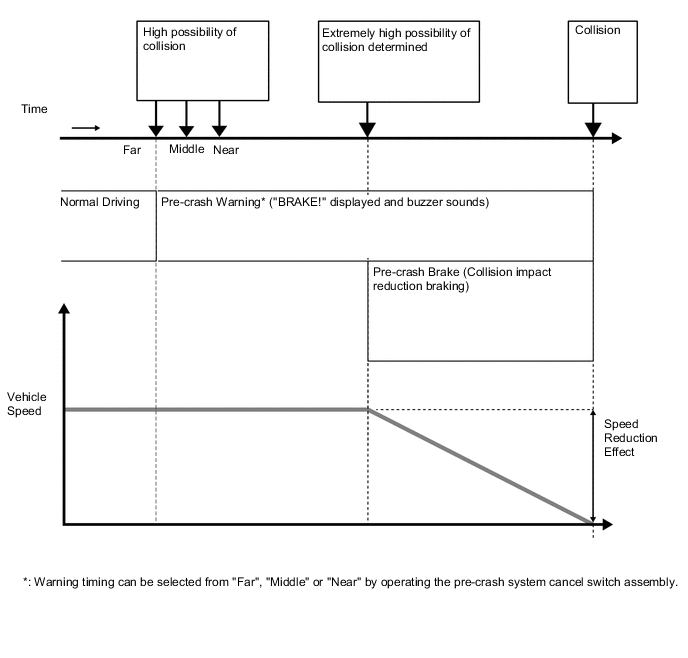
When the system determines that there is a high probability of a collision, "BRAKE!" is displayed on the multi-information display, and the warning buzzer sounds to warn the driver.
-
When the system determines that there is an extremely high probability of a collision, the brake is applied to reduce vehicle speed even if the driver has not depressed the brake pedal.
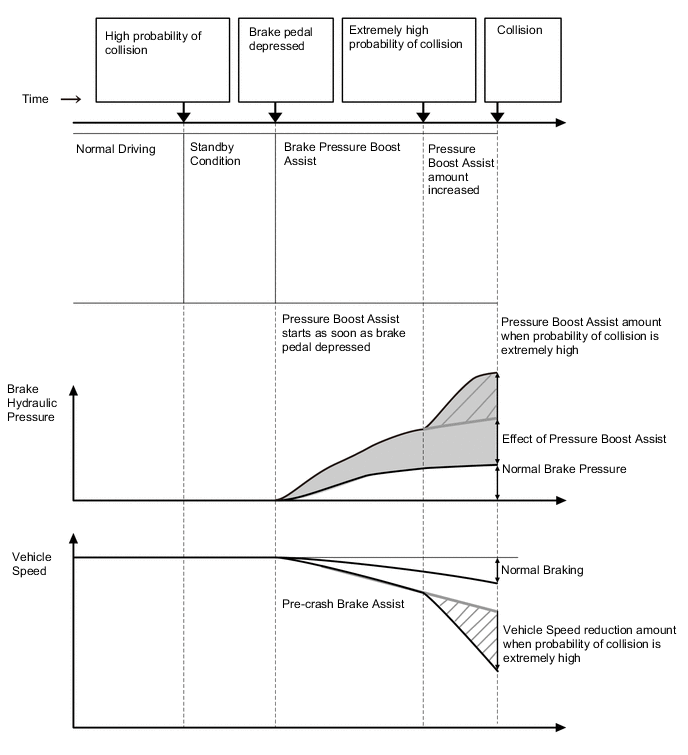
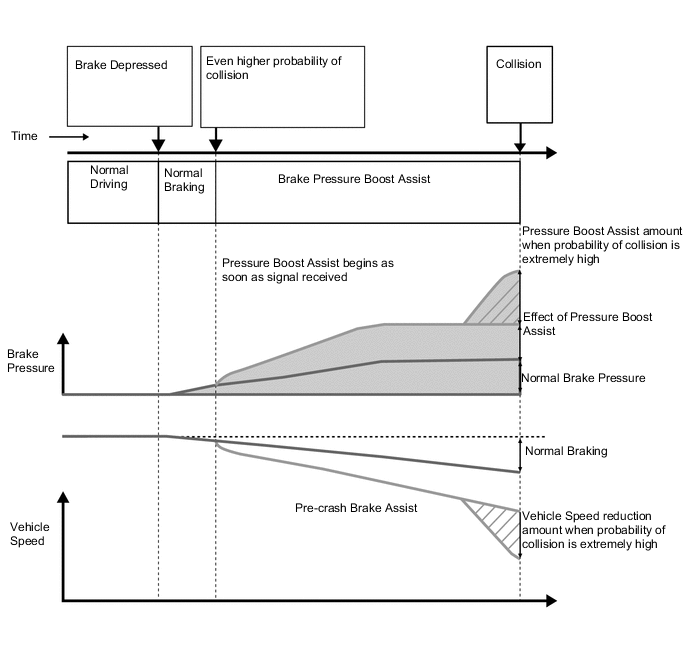
Pre-crash Brake Assist When the system determines that there is a high probability of a collision, brake hydraulic pressure assistance is performed, improving brake effectiveness when the brake pedal is depressed. Also, if the brake pedal is depressed before the system determines there is a high possibility of a collision, once the determination is made, brake hydraulic pressure assistance is immediately performed. -
-
Pre-crash Brake
-
When the pre-crash safety city sensor detects an object such as a vehicle or road structure in front of the vehicle and determines that the probability of a collision is high, in the combination meter, "BRAKE!" is displayed on the multi-information display, and the warning buzzer sounds to warn the driver.
-
When the system determines that there is an extremely high probability of a collision, pre-crash brake control activates.
-
-
Pre-crash Brake Assist
-
While the pre-crash safety city sensor has determined that there is a high probability of a collision, brake hydraulic pressure assistance is performed when the driver depresses the brake pedal. Also, the amount of brake hydraulic pressure assistance increases further when the system determines that there is an extremely high probability of a collision.
-
When the driver begins to depress the brake pedal before the system determines that there is a high probability of a collision, once the determination is then made, brake hydraulic pressure assistance is immediately performed. This hydraulic pressure assistance is also applied in response to the amount the brake pedal was depressed before the start of assistance.
-
-
-
DIAGNOSIS
-
Initial Check
-
The pre-crash safety city sensor performs an initial check on the system for approximately 3 seconds after the power switch has been turned on (IG).
-
-
Monitor Function
-
After completing the initial check, the pre-crash safety system becomes ready to operate. During this time, the pre-crash safety city sensor periodically monitors the system for any malfunctions.
-
-
Diagnostic Trouble Code (DTC)
-
If the pre-crash safety city sensor detects a malfunction in the pre-crash safety system, it stores a 5 digit Diagnostic Trouble Code (DTC) in memory.
-
-