SIMPLE INTELLIGENT PARKING ASSIST SYSTEM
-
OUTLINE
-
The simple intelligent parking assist system mainly consists of the clearance warning ECU assembly, No. 1 ultrasonic sensors and IPA main switch assembly.
-
The simple intelligent parking assist system is controlled by the clearance warning ECU assembly. The system assists parallel parking operations by detecting an allowable parking space using the No. 1 ultrasonic sensors and automatically operating the steering wheel.
-
During automatic operation of the steering wheel, the TOYOTA parking assist-sensor system also operates and informs the driver of the presence of an obstruction and the distance from the vehicle to the obstruction.
-
-
MAIN FEATURES
-
In the simple intelligent parking assist system, the No. 2 ultrasonic sensors mounted on the sides of the front bumper judge whether it is possible or not to park the vehicle in the area between 2 parked vehicles or the area behind 1 parked vehicle.
-
Once an allowable parking space has been detected, moving the shift lever to R starts automatic operation of the steering wheel to assist driver's parking operation.
-
While the simple intelligent parking assist system is operating, the driver is informed of the state of the parking operation via the multi-information display in the combination meter assembly and a buzzer.
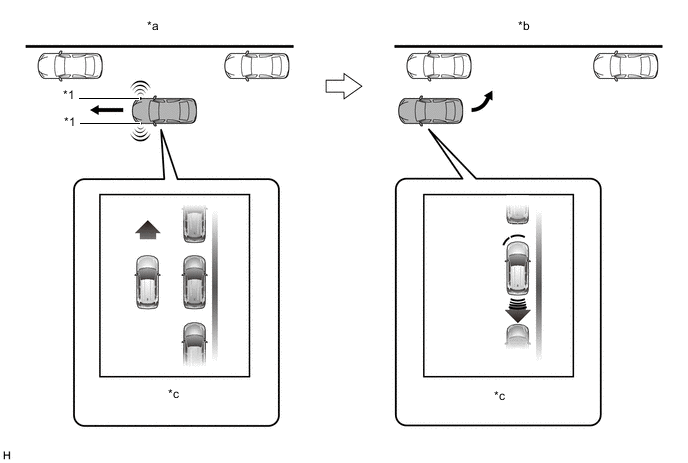
*1 No. 2 Ultrasonic Sensor - *a Parking Space Detection Mode *b Automatic Steering Mode *c Multi-information Display Screen -
-
-
PRECAUTION
-
General Precautions
-
Do not rely entirely on the simple intelligent parking assist system. When backing up, drive the vehicle as carefully as you would drive one that is not equipped with the simple intelligent parking assist system.
-
Back up slowly by depressing a brake pedal to adjust the speed.
-
If the vehicle is about to come in contact with a surrounding vehicle or pedestrian, depress the brake pedal to stop the vehicle and to disable the operation of the simple intelligent parking assist system.
-
During simple intelligent parking assist system operation, the steering wheel operates automatically. Maintain a proper driving posture without allowing a necktie, pendant, or your arms to get caught, or long finger nails to come in contact with the steering wheel. Do not allow children to come close to the steering wheel.
-
Check that the parking space is suitable. (Width of the space, if there are any obstacles, road surface condition, etc.)
-
The simple intelligent parking assist system will not operate properly if the vehicle at the front or back of the parking space moves, or if an obstacle enters the parking space after the sensors have detected the parking space. Always check the surrounding area during parking assist operation.
-
The sensors may not be able to detect curbs. The vehicle may drive onto the curb depending on the situation, such as if a vehicle at the front or back of the parking space has driven on the curb. Check the surrounding area to prevent the tires and wheels from being damaged.
-
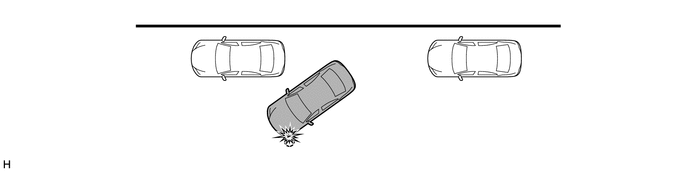
When backing up, reverse the vehicle slowly to prevent the front end of the vehicle from hitting an obstacle in the front of the vehicle.
-
When backing up, reverse the vehicle slowly to prevent the front end of the vehicle from hitting the vehicle parked in front of the parking space.

-
The vehicle may not be able to be parked at a target parking space if the vehicle moves forward when the shift lever is in R or backs up when the shift lever is in a position other than R, such as when parking on a slope.
-
-
Ultrasonic Sensor Precautions
-
Under the following conditions, an ultrasonic sensor may not function properly:
-
A sensor is covered with foreign matter, such as mud or snow (the detection function returns to normal when the sensor is cleaned).
-
A sensor is frozen (the detection function returns to normal when the temperature of the sensor rises).
-
A hand or similar object is blocking the sensor.
-
-
A detection range may be affected by the following conditions:
-
An ultrasonic sensor is covered with foreign matter, such as mud or snow.
-
The vehicle is in an excessively hot or excessively cold area.
-
-
Under the following conditions, a detection error may occur:
-
Driving on a bumpy road, an unpaved road, or in tall grass.
-
Ultrasonic waves are received from the horn or parking sonar system of another vehicle, a motorcycle engine, or the air brakes of a large vehicle.
-
It is raining heavily or a sensor is splashed with water.
-
The vehicle is tilted at a steep angle.
-
The vehicle is equipped with a fender pole or a wireless antenna mechanism.
-
A sensor is covered with foreign matter, such as mud or snow.
-
The vehicle is moving forward or backward towards high curbs or objects that are perpendicular to the ground.
-
A sensor is sprayed with high-pressure water or steam.
-
A towing hitch is mounted on the vehicle.
-
-
The sensors cannot detect the following objects:
-
Thin objects, such as wires and ropes.
-
Materials that absorb ultrasonic waves, such as cotton, snow, etc.
-
Objects with sharp edges.
-
Short objects.
-
Objects that are tall and protrude toward the vehicle above the detection range of the sensors.
-
-
Other notices:
-
The sensors cannot detect objects directly under the bumper. (A sensor may detect low objects and thin poles, and then lose track of them.)
-
Beware that the detection range of this system is limited. In certain conditions, some objects may not be detected. As a result, always make sure to visually confirm the safety of your surroundings when driving or parking.
-
The sensors may not be able to detect obstacles that are too close to the sensor.
-
The sensors may not be able to detect obstacles if the sensors have been dropped or subjected to a strong impact.
-
-
-
Other Precautions
-
Do not use the simple Intelligent parking assist system under the following conditions. Doing so may cause improper operation and lead to an unexpected accident.
-
On sharp bends or slopes.
-
On slippery or icy roads, or in snow.
-
On uneven road surfaces such as gravel.
-
During bad weather such as heavy rain, fog, snow, or a sandstorm.
-
When the tires are extremely worn or tire pressure is low.
-
When the vehicle has improper wheel alignment due to the tires having received a strong impact such as bumping against a curb.
-
When the compact spare tire (if equipped) or snow chains are installed.
-
When the tires slid while attempting to park.
-
When fallen leaves or snow is in a parking space.
-
When items such as a towing bracket, trailer, bicycle carrier, etc. are installed on the rear of the vehicle.
-
When a vehicle of which the front/rear end is above the detection area, such as a truck, bus or vehicle with a towing bracket, trailer, bicycle carrier, etc., is parked at the front or rear of the parking space.
-
If the front bumper has been damaged.
-
If the sensor is covered by the front bumper cover, etc.
-
If a vehicle or obstacle is not in a suitable position at the front or rear of the parking space.
-
-
-
When the simple intelligent parking assist system is used continuously, the power steering system may overheat temporarily. It may deactivate or cancel simple intelligent parking assist system operation. In this case, wait a few minutes before using simple intelligent parking assist system again.
-
The system may not work properly when the cabin temperature is high due to parking the vehicle in the sun. Use the simple intelligent parking assist system after the cabin cools down.
-