AUDIO AND VISUAL SYSTEM
-
OUTLINE
-
Audio System
-
The audio systems shown below are available. Enhanced navigation system functions are available by installing a navigation ECU.
Audio System Audio Head Unit Speaker Navigation ECU Multimedia System Radio and Display Receiver Assembly 6 Speakers ○* 9 Speakers ○* *: The navigation ECU is available as a standard model or an upper model, each with different functions.
-
-
Audio Head Unit
-
A Thin Film Transistor Liquid Crystal Display (TFT LCD) is used for the multi-display of the radio and display receiver assembly. The multi-display shows the audio screen, Bluetooth hands-free screen, vehicle information screen, etc. and can be operated using touch operation, flick operation* or drag operation*.
*: Flick operation or drag operation may not be performed on all screens.
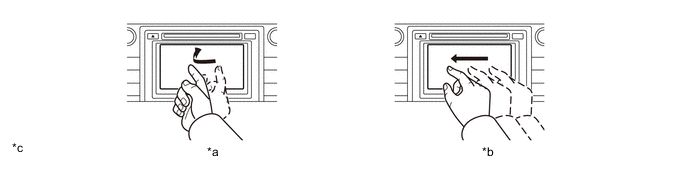
*a Flick Operation *b Drag Operation *c The illustrations shown are examples only. The illustrations may differ from the actual audio head unit. - - -
The radio text broadcast by FM radio stations is displayed in the radio text area, such as program information and currently broadcasted song information.
-
Discs containing MPEG audio layer-3 (MP3) files, Windows Media Audio (WMA) files and Advanced Audio Coding (AAC) files can be played.
-
Discs with the marks shown below can be played.

-
-
Digital Audio Broadcast (DAB) (Models with Digital Audio Broadcast Tuner)
-
Digital Audio Broadcast (DAB) reception is available. This mostly prevents broadcast interference, achieving clear reception with high quality sound.
-
The time shift operation function can be used to play back DAB programs at a later time.
Tech Tips
The amount of playback possible depends on the bit rate of the DAB station to be recorded, the amount of DAB unit memory, and the time at which reception of the broadcast began.
-
-
Application
-
By operating the applications, which are preinstalled to the radio and display receiver assembly, with on-screen commands on the multi-display, functions such as the e-mail function and MirrorLink function can be used.
-
-
USB Audio System
-
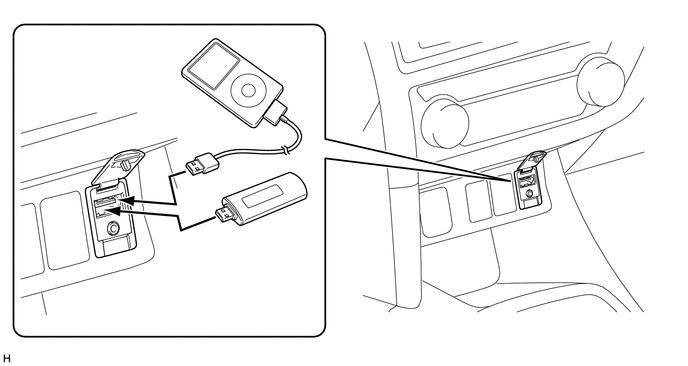
By plugging a USB hub into the USB port, up to 2 of the following items can be used at once: USB memory device, portable audio player (USB type) or Apple product.
Tech Tips
-
Even if 3 or more USB devices are connected using a USB hub, only the first 2 connected USB devices will be recognized.
-
iPhone, iPod, iPod classic, iPod nano and iPod touch are trademarks of Apple Inc., registered in the U.S. and other countries.
-
The following iPod, iPod nano, iPod classic, iPod touch and iPhone devices can be used with this system.
- Made for
-
iPod touch (5th generation)
-
iPod touch (4th generation)
-
iPod touch (3rd generation)
-
iPod touch (2nd generation)
-
iPod touch (1st generation)
-
iPod classic (except 5th generation)
-
iPod nano (7th generation)
-
iPod nano (6th generation)
-
iPod nano (5th generation)
-
iPod nano (4th generation)
-
iPod nano (3rd generation)
-
iPod nano (2nd generation)
-
iPod nano (1st generation)
-
iPhone 5
-
iPhone 4S
-
iPhone 4
-
iPhone 3GS
-
iPhone 3G
-
iPhone
-
-
Depending on differences between models, software versions etc., some models may be incompatible with this system.
-
USB memory devices that meet the following specifications are supported:
USB Communication Speed
-
USB 2.0, Full Speed (12 Mbps)
-
USB 2.0, High Speed (480 Mbps)
File System FAT 16/32 (Windows) Device Class Mass Storage Class File Format MP3, WMA, AAC -
-
-
Bluetooth Audio System
-
The Bluetooth audio system enables users to enjoy music stored on a portable player from the vehicle speakers via Bluetooth communication.
-
The Bluetooth specifications and profiles required for operation are as follows:
Specification/Profile Version Requirements Recommendations Bluetooth Specification Version 1.1 Version 3.0 + EDR Profile Advanced Audio Distribution Profile (A2DP) Version 1.0 Version 1.2 Audio/Video Remote Control Profile (AVRCP) Version 1.0 Version 1.4
-
-
Bluetooth Hands-free System
-
The Bluetooth hands-free system allows the user to make or receive a call without taking their hands off the steering wheel when the system is linked with a Bluetooth-compatible cellular phone.
-
The Bluetooth specifications and profiles required for operation are as follows:
Specification/Profile Version Requirements Recommendations Bluetooth Specification Version 1.1 Version 3.0 + EDR Profile Hands-free Profile (HFP) Version 1.0 Version 1.6 Phone Book Access Profile (PBAP) Version 1.0 Version 1.1 Message Access Profile (MAP) Version 1.0 - Dial-up Networking Profile (DUN) Version 1.1 - Personal Area Networking (PAN) Version 1.0 - Tech Tips
-
The operation of the interrupt call function of the Bluetooth hands-free system may vary with the Bluetooth phone or the telephone company that is used.

"Bluetooth" is a trademark owned by Bluetooth SIG, Inc. -
Some profiles described above may not be supported by the system depending on the audio head unit equipped.
-
If the specification of the connected Bluetooth phone is lower than the recommended or does not support the functions required, the available functions may be limited.
-
-
When a Bluetooth phone is connected to the radio and display receiver assembly, e-mails and Short Message Service (SMS) messages received on the phone can be displayed or read out (Messages may not be displayed depending on the message service or profile that the connected Bluetooth phone supports.)
-
-
Wi-Fi Communication (Models with Navigation ECU Upper Model)
-
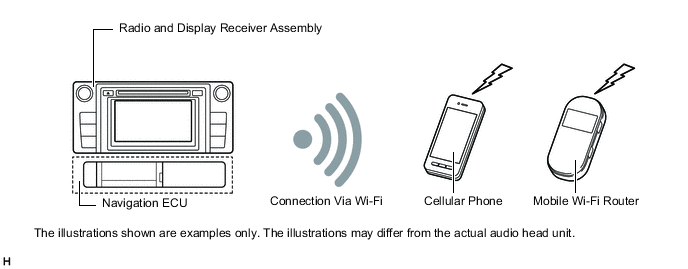
A wireless LAN antenna is integrated into the radio and display receiver assembly, enabling Wi-Fi communication to a user's tethering-compatible cellular phone or mobile Wi-Fi router.
Tech Tips
Wi-Fi communication may be unavailable depending on the vehicle conditions, condition of the surroundings such as radio wave conditions around the radio and display receiver assembly, the distance to the device or device conditions. Additionally, during Wi-Fi communication, communication may be cut or become unstable due to the conditions described above.
-
-
Voice Recognition Search System (Models with Navigation ECU Upper Model)
-
Due to the Grapheme to Phoneme (G2P) function of converting sounds into text, a song in the USB audio system can be searched for by saying an artist name, album name, title or playlist name.
-
-
"GreenEdge" Speakers
-
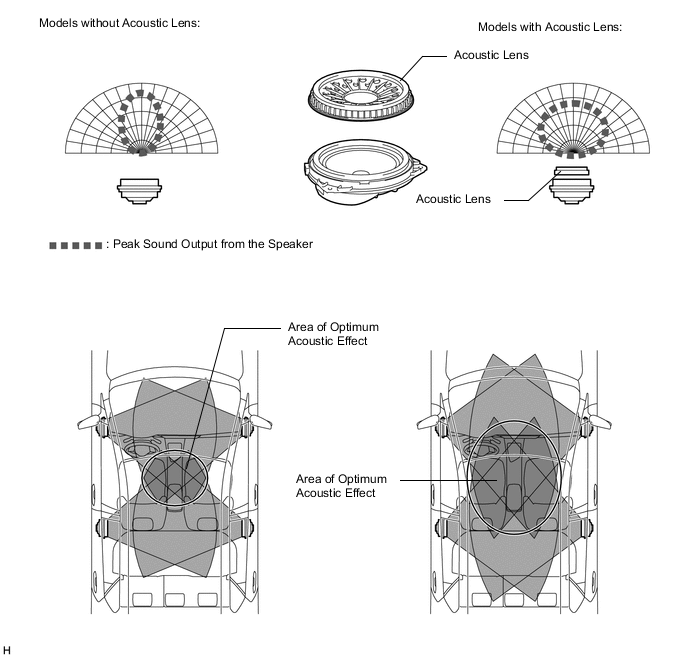
"GreenEdge" speakers that efficiently convert electricity to sound with less sound corruption have been adopted. These speakers realize high sound pressure levels with low power consumption while still maintaining superb sound quality.
-
Due to the adoption of acoustic lenses, the directionality of the speaker output is improved, enhancing the area where the acoustics are effective.
-
-
Class H Amplifier
-
A Class H amplifier is provided for the 9-speaker system. The amplifier controls the power supplied to the amplifier circuit in the most efficient way according to the received audio signals.
-
The power consumption and heat generation of the Class H amplifier is small, minimizing the size of the heatsink and related parts. This realizes a compact and lightweight amplifier.
-
-
Automatic Sound Levelizer (ASL)
-
The Automatic Sound Levelizer (ASL) function automatically adjusts the sound volume in order to enable clear audio quality even when vehicle noise increases (as vehicle noise increases, the volume is turned up, etc.).
-
Vehicle speed signals are received from the combination meter assembly and used for ASL control.
-
-
Steering Pad Switch Assembly
-
Switches that the driver often uses are provided on the steering wheel for convenience.
-
Due to the adoption of a 4 way switch, back and enter switches, the driver can operate the audio and Bluetooth hands-free functions without taking their hands off the steering wheel.
-
-
-
SPECIFICATION
-
Audio Head Unit
Audio Head Unit Design Specification Radio and Display Receiver Assembly 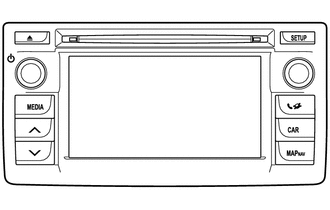
Multimedia System:
-
6.1-inch Wide Liquid Crystal Display (VGA Type)
-
Display Language Supported: English, German, French, Spanish, Italian, Portuguese, Dutch, Swedish, Norwegian, Danish, Russian, Finnish, Greek, Polish, Ukrainian, Turkish, Hungarian, Czech, Slovak and Romanian
-
AM/FM Tuner
-
Application Function
-
Digital Audio Broadcast (DAB) Tuner (Models with Digital Audio Broadcast Tuner)
-
Radio Data System Traffic Message Channel (RDS-TMC) Tuner
-
Automatic Sound Levelizer (ASL)
-
CD Player: Compatible with MP3, Windows Media Audio (WMA) and Advanced Audio Coding (AAC) files
-
CD-TEXT Display Function
-
Bluetooth Audio
-
Bluetooth Hands-free System
-
Wi-Fi Communication (Models with Navigation ECU Upper Model)
-
Portable Audio Player (USB type) Interface
-
iPod/iPhone Interface
-
Media Transfer Protocol (MTP) Device (Models with Navigation ECU)
-
USB Memory Device Interface
-
Voice Recognition Search (USB Audio System) (Models with Navigation ECU Upper Model)
-
Stereo Jack Adapter
-
Customizable vehicle settings can be changed
-
6-speaker System
-
Unit: Panasonic
Radio and Display Receiver Assembly 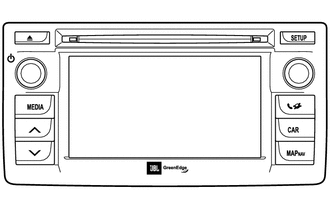
Multimedia System:
-
6.1-inch Wide Liquid Crystal Display (VGA Type)
-
Display Language Supported: English, German, French, Spanish, Italian, Portuguese, Dutch, Swedish, Norwegian, Danish, Russian, Finnish, Greek, Polish, Ukrainian, Turkish, Hungarian, Czech, Slovak and Romanian
-
AM/FM Tuner
-
Application Function
-
Digital Audio Broadcast (DAB) Tuner (Models with Digital Audio Broadcast Tuner)
-
Radio Data System Traffic Message Channel (RDS-TMC) Tuner
-
Automatic Sound Levelizer (ASL)
-
CD Player: Compatible with MP3, Windows Media Audio (WMA) and Advanced Audio Coding (AAC) files
-
CD-TEXT Display Function
-
Bluetooth Audio
-
Bluetooth Hands-free System
-
Wi-Fi Communication (Models with Navigation ECU Upper Model)
-
Portable Audio Player (USB type) Interface
-
iPod/iPhone Interface
-
Media Transfer Protocol (MTP) Device (Models with Navigation ECU)
-
USB Memory Device Interface
-
Voice Recognition Search (USB Audio System) (Models with Navigation ECU Upper Model)
-
Stereo Jack Adapter
-
Customizable vehicle settings can be changed
-
9-speaker System
-
Unit: Panasonic
-
Stereo Amplifier: JBL
-
-
6-speaker System
Figure 1. Hatchback Models
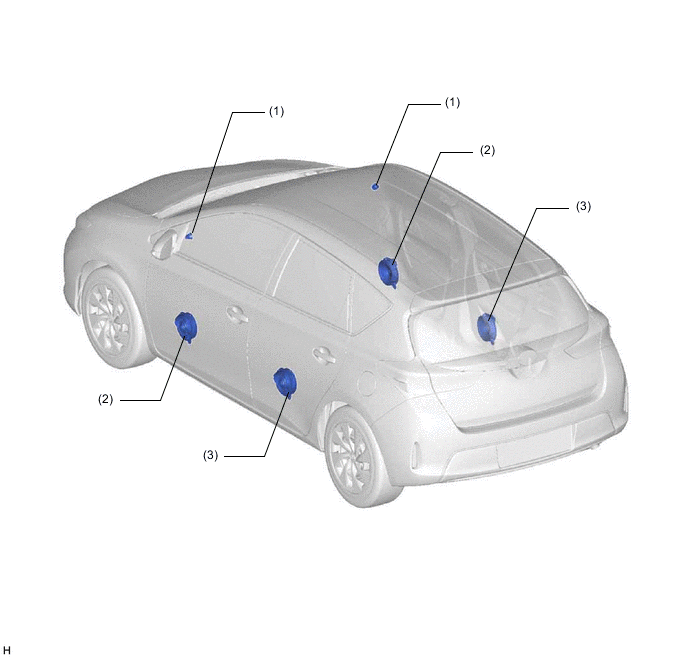
Figure 2. Wagon Models
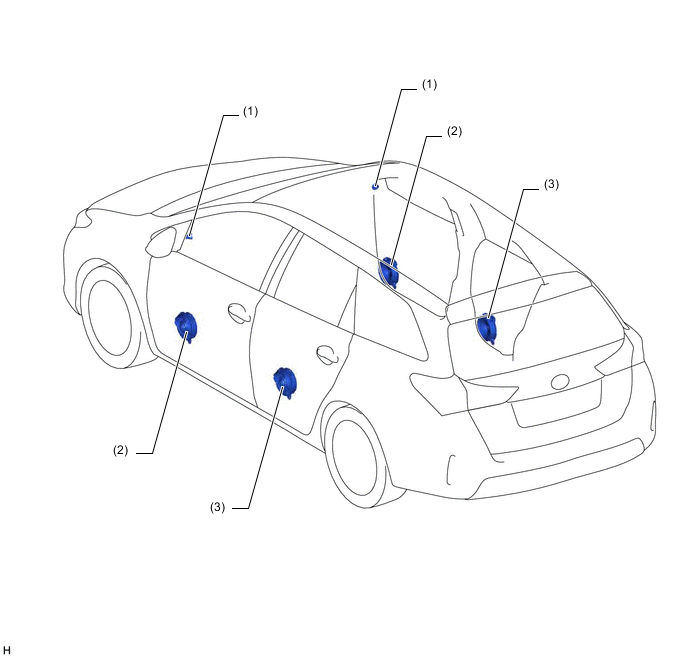
Location Speaker Name Quantity Size Impedance Rated Input Power (1) Front No. 2 Speaker Assembly 2 2.5 cm (1 in.) 4 Ω 17.5 W (2) Front No. 1 Speaker Assembly 2 16 cm (6.3 in.) 4 Ω 20 W (3) Rear Speaker Assembly 2 16 cm (6.3 in.) 4 Ω 20 W -
9-speaker System
Figure 3. Hatchback Models
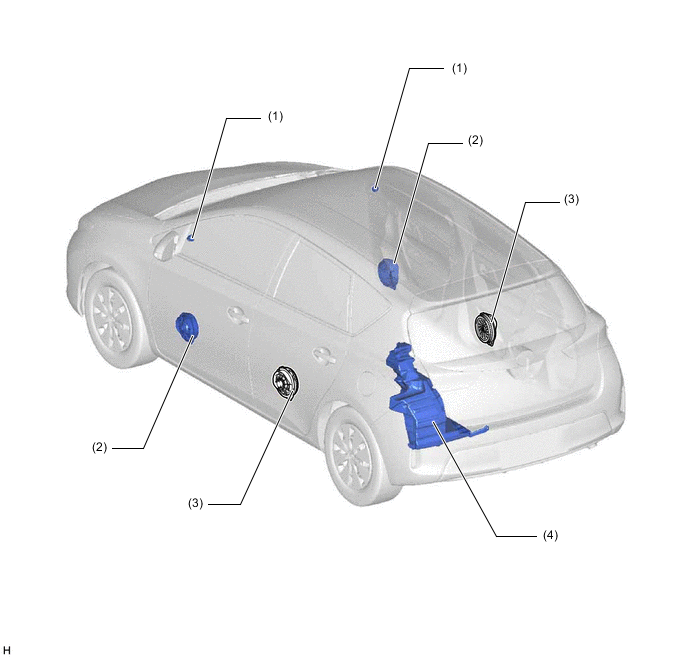
Figure 4. Wagon Models
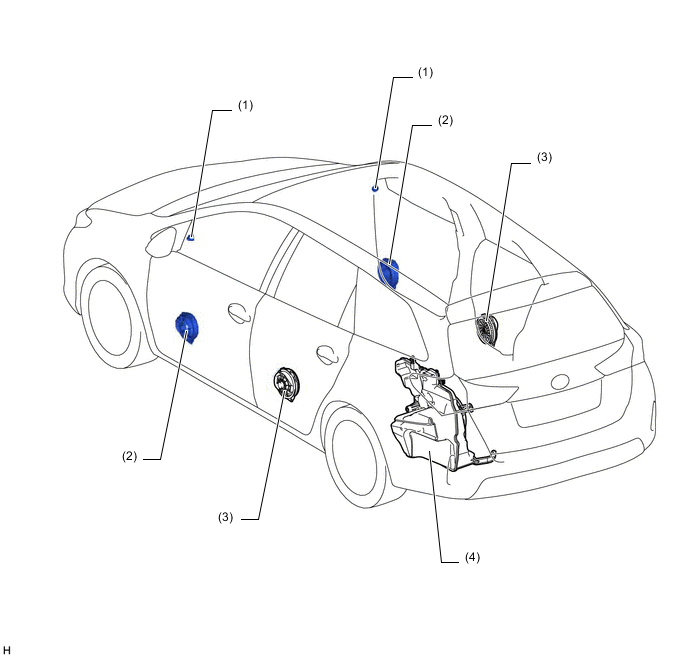
Location Speaker Name Quantity Size Impedance Rated Input Power (1) Front No. 2 Speaker Assembly 2 2.5 cm (1 in.) 4 Ω 0.5 W (2) Front No. 1 Speaker Assembly 2 17 cm (7 in.) 4.2 Ω 5 W (3) Rear Speaker Assembly (1 + 1) X 2 17 cm (7 in.) 4 Ω 6 W (4) No. 1 Speaker with Box Assembly 1 20 cm (7.8 in.) 5.2 Ω 3 W -
Steering Pad Switch Assembly
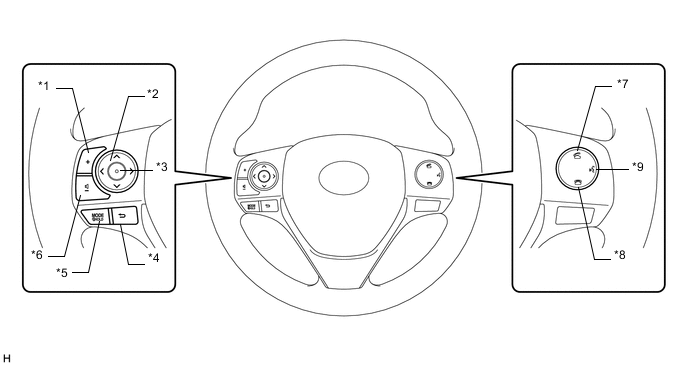
*1 Volume + Switch *2 4 Way Switch *3 Enter Switch *4 Back Switch *5 MODE Switch *6 Volume - Switch *7 Off Hook Switch *8 On Hook Switch *9 Voice Switch - -
-
-
MAIN FEATURES
-
Application
-
Available applications are listed in the following table:
Application Outline Preinstalled Application E-mail When a Bluetooth phone is connected to the radio and display receiver assembly, e-mails and Short Message Service (SMS) messages received on the phone can be displayed or read out. In addition, it is possible to reply to the received e-mails and send Short Message Service (SMS) messages.*4 Calendar*1 When a Bluetooth phone is connected to the radio and display receiver assembly, calendar entries, tasks and notes stored in the phone can be downloaded and displayed on the multi-display.*5 Picture*2 When a USB memory is connected to the radio and display receiver assembly, pictures stored in the USB memory can be displayed on the multi-display as well as played as a slide show.*6 MirrorLink*3
-
To utilize the MirrorLink function, it is necessary to connect a compatible smartphone*7 to the radio and display receiver assembly using a USB cable.
-
After a connection is established, the screen of the smartphone is displayed on the multi-display. Using this screen, the user can operate applications installed on the smartphone and listen to the audio of the smartphone via the vehicles speakers.
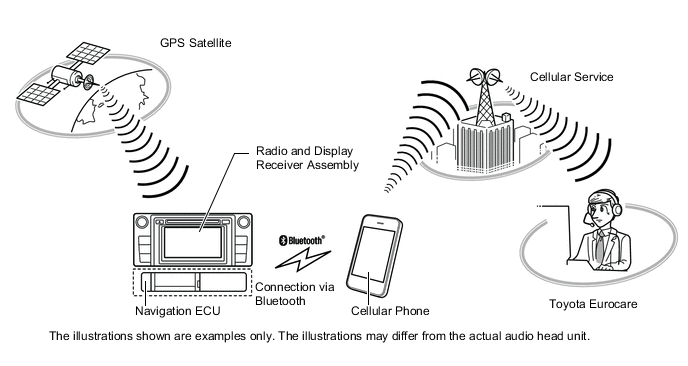
Toyota Eurocare*2
-
With a Bluetooth phone connected to the radio and display receiver assembly, a call*8 to Toyota Eurocare can be made.
-
Upon receiving the information from the GPS satellite, the vehicle's current location is displayed on the Toyota Eurocare call screen so that the user will be able to promptly tell the operator the current location of the vehicle.
*1: Models with navigation ECU upper model
*2: Models with navigation ECU
*3: MirrorLink is a registered trademark of Car Connectivity Consortium, Inc.
*4: Messages may not be displayed depending on the message service or profile that the connected Bluetooth phone supports.
*5: This function may not be available depending on the model of the cellular phone connected via Bluetooth.
*6: Available image data formats: JPEG, PNG and BMP
*7: This function is not available if the smartphone does not support Car Connectivity Consortium.
*8: Calls are only available when the user is in a Toyota Eurocare supported country and the country in which the vehicle is currently located has been selected using the multi-display.
Figure 5. MirrorLink Image
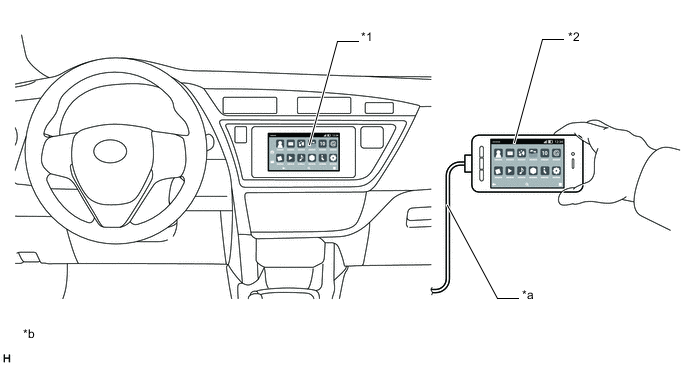
*1 MirrorLink Screen *2 Smartphone *a Connection via USB cable *b The illustrations shown are examples only. The illustrations may differ from the actual screens. Figure 6. Toyota Eurocare Image
-
-
-