ROAD SIGN ASSIST SYSTEM
-
OUTLINE
-
The pre-crash safety city sensor is used to recognize road signs, and Road Sign Assist system (RSA) is used to display recognized information on the multi-information display.
-
RSA recognizes different road signs* for each country. Therefore, signs such as the speed limit of the currently driven road can be recognized regardless of which country the vehicle is being driven in. As a result, the burden on the driver to understand speed limit changes is reduced,contributing to safer driving.
Tech Tips
*: Road signs designed under the Vienna Convention on Road Signs and Signals (including electronic and flashing signs)
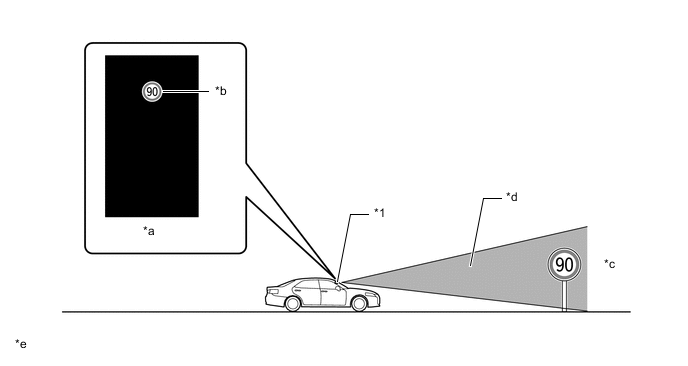
*1 Pre-crash Safety City Sensor - - *a Multi-information Display *b Sign Display *c Road Sign *d Camera Field of View *e The illustrations shown are examples only. - -
-
-
PRECAUTION
-
General Handling Precautions
-
The RSA system recognizes traffic signs and provides information to the driver. The system is not meant to replace the driver's own vision and recognition, and therefore drivers must personally acknowledge and determine traffic conditions.
-
The driver must also personally check speed limit signs while driving, as a sign may be incorrectly recognized or not detected if it is dirty, bent, hidden from view, etc.
-
When moving to a region that uses a different speed unit or driving direction, some time may be required for the system to learn the new traffic conditions. Until learning is complete, speed units and driving directions may be incorrect, and incorrect displays and notifications may be issued. Therefore, the driver must not trust solely in the RSA system, and must personally acknowledge and determine traffic conditions. (The user can change meter units for the given region, therefore displays and notifications can be correctly issued directly after moving to a region with different speed units.)
-
Under the following conditions, sign recognition may not be possible.
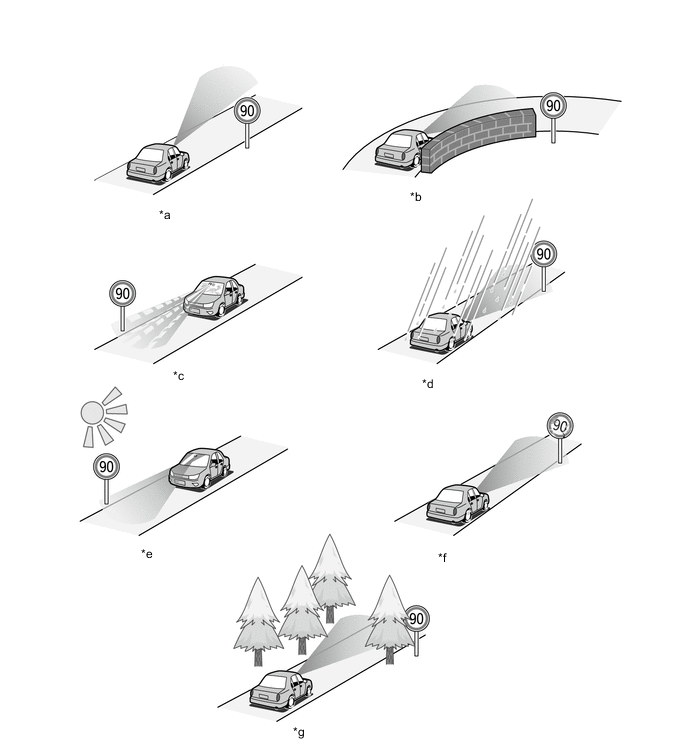
Number Condition *a The orientation of the pre-crash safety city sensor is deviate *b After a sign appears, the vehicle passes by too quickly *c Mud, snow, ice, a sticker, etc. is stuck to the windshield glass in front of the pre-crash safety city sensor *d During bad weather (such as heavy rain, heavy snow or dense fog) *e A light source, such as the headlights of an oncoming vehicle or sunlight, is shining into the pre-crash safety city sensor *f The sign is extremely dirty, faded or tilted, or an electronic message sign with poor contrast *g All or part of the sign is covered by another object (a truck or other vehicle crosses in front of the sign, or a pillar or the leaves of a tree cover part of the sign) -
Under the following conditions, the system may not operate normally or may recognize inappropriate signs.
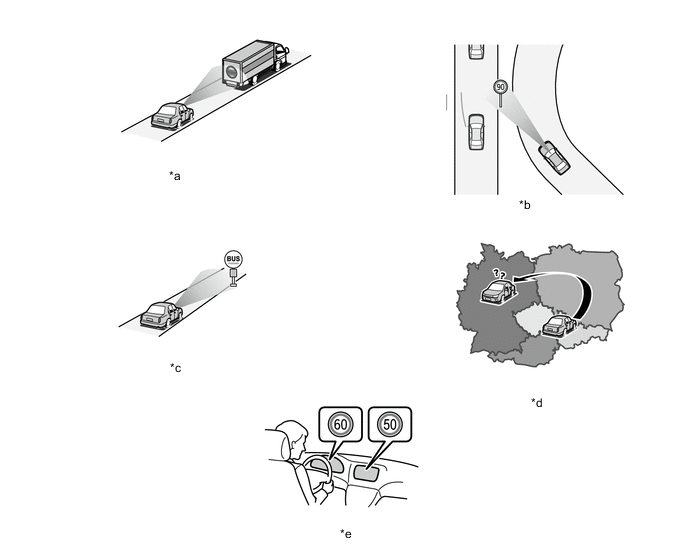
Number Condition *a A sticker, etc. applied to the rear of the preceding vehicle is recognized as a sign *b Other signs are present, such as signs in an adjacent lane, signs that appear after diverging or signs that appear after merging *c An object with a shape resembling a supported sign is recognized as a sign *d System learning is not yet complete after moving to a different region or country* *e As the navigation system provides information on the navigation display based on map information, the speed information displayed on the multi-information display and navigation display may differ. Tech Tips
When moving to a region or country that uses a different speed unit or driving direction, the speed unit or no overtaking direction detected by the system may be incorrectly displayed.
-
-
Precautions for Pre-crash Safety City Sensor
-
The pre-crash safety city sensor emits a laser beam. While looking at the laser beam with the naked eye is harmless, the laser beam should never be looked at using an optical device (magnifying glass).
-
Always keep the windshield glass clean. System performance decreases when mud, snow, ice, etc. is stuck to the windshield glass.
-
Do not attach stickers, including transparent stickers, or other items to the outer side of the windshield in front of the front sensor (shaded area in the illustration).
-
Do not install or attach anything to the inner side of the windshield under the front sensor (shaded area in the illustration).
-
Do not splash liquid on the pre-crash safety city sensor.
-
Do not flash a strong light source, such as an LED flashlight, on the pre-crash safety city sensor
-
Do not apply film to the windshield glass.
-
Do not install an antenna in front of the pre-crash safety city sensor.
-
The RSA system may be temporarily unavailable in colder climate due to the temperature difference between inside and outside the vehicle is so intense that results a fog on the front part of the pre-crash safety city sensor.
-
When the RSA system is unavailable and the PCS OFF warning light is flashing, press the front defroster switch and clear the fog until the PCS OFF warning light on the combination meter assembly disappears.
-
-
Do not damage or let the lenses of the front sensor get dirty. When cleaning the inner side of the windshield, do not let glass cleaner contact the lenses. Also, do not touch the lenses. For proper care of the lenses of the front sensor, contact any authorized Toyota dealer or repairer, or another duly qualified and equipped professional.
-
Since the orientation of the pre-crash safety city sensor is finely adjusted, do not change the installation position or orientation, and do not remove the pre-crash safety city sensor.
-
Do not subject the pre-crash safety city sensor to a strong impact, and do not disassemble it.
-
Only replace the windshield glass with a genuine part.
-
Do not place reflective items on the dashboard.
-
Do not install an electronic device or device that emits strong electric waves near the front sensor
-
-