SFI SYSTEM
-
FUNCTION
-
The Dual VVT-i system is designed to control the intake and exhaust camshafts within a range of 55° and 40° respectively (of crankshaft angle) to provide valve timing that is optimally suited to engine operating conditions. This improves torque in all speed ranges as well as increasing fuel economy and reducing exhaust emissions.
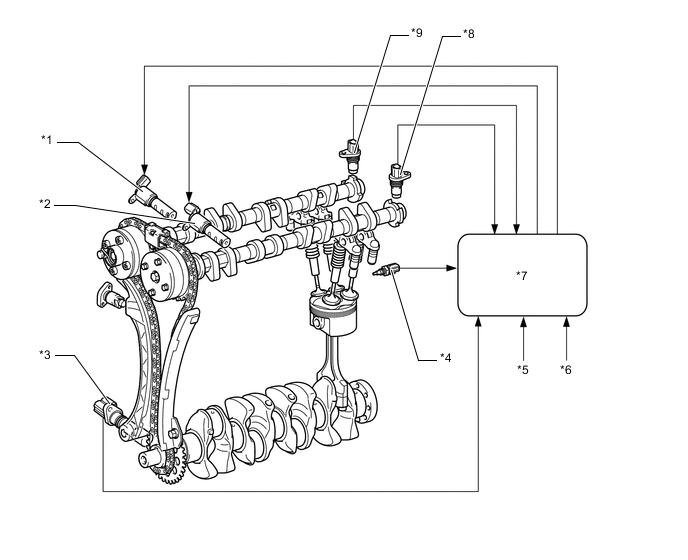
*1 Camshaft Timing Oil Control Valve Assembly (for Exhaust Camshaft) *2 Camshaft Timing Oil Control Valve Assembly (for Intake Camshaft) *3 Crank Position Sensor *4 Engine Coolant Temperature Sensor *5 Throttle Position Sensor *6 Mass Air Flow Meter Sub-assembly *7 ECM *8 Camshaft Position Sensor (for Intake Camshaft) *9 Camshaft Position Sensor (for Exhaust Camshaft) - - -
The Dual VVT-i system delivers excellent benefit vehicle states as shown in the table below.
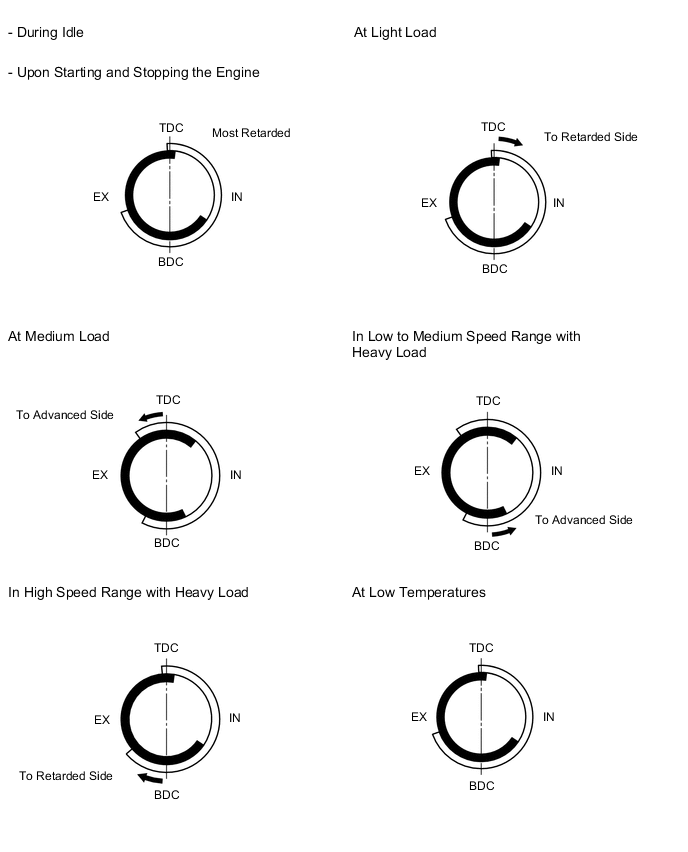
Operation State Objective Effect During Idle Eliminating overlap to reduce blow back to the intake side.
-
Stabilized idle speed
-
Better fuel economy
Upon Starting and Stopping the Engine Eliminating overlap to minimize blow back to the intake side. Improved startability At Light Load Eliminating overlap to reduce blow back to the intake side. Ensured engine stability At Medium Load Increasing overlap to increase internal EGR to reduce pumping losses.
-
Better fuel economy
-
Improved emission control
In Low to Medium Speed Range with Heavy Load Advancing the intake valve close timing for volumetric efficiency improvement. Improved torque in low to medium speed range In High Speed Range with Heavy Load Retarding the intake valve close timing for volumetric efficiency improvement. Improved output At Low Temperatures Eliminating overlap to reduce blow back to the intake side stabilizes the idle speed during fast idle.
-
Stabilized idle speed
-
Better fuel economy
-
-