TELEMATICS SYSTEM DETAILS
-
FUNCTION OF MAIN COMPONENTS
Component Function Map Light Assembly Receives the user's voice through the microphone module. Map Light Assembly Telephone Microphone Assembly When pressed, allows the driver to connect to and communicate w Manual (SOS) Switch Indicator Green
-
Turns on when the system is operating normally.
-
Blinks during a call and turns off when the system is malfunctioning.
Red
-
Illuminates to warn the user when a malfunction occurs in the system.
-
Turns off when the system is operating normally.
Telematics Transceiver (Data Communication Module)
-
Connects to the PSAP and allows the driver to speak with the call center operator when the automatic emergency call service or the manual emergency call service is active.
-
The cellular phone module makes calls.
-
The telematics transceiver (data communication module) receives signals from the GNSS antenna, calculates the position of the vehicle and transmits it to the PSAP.
-
Controls the on/off and blinking actions of the manual (SOS) switch indicator.
-
Dims the manual (SOS) switch indicator when the taillight relay on signal is received.
-
Sends the PSAP operator's voice and beep sounds to the front No. 2 speaker assembly RH.
Mobilephone Battery (Back-up Battery) Is built into the telematics transceiver (data communication module) and supplies power to the telematics transceiver (data communication module) when the automatic emergency call service is activated and the vehicle battery cannot supply power Telephone Antenna Assembly Telephone Antenna Is for a cellular phone antenna which is compatible with the transmission and reception of frequency bands of cellular phones. It transmits signals from the telematics transceiver (data communication module) and receives signals from the call center. Gnss Antenna Receives the signals from GNSS satellites and transmits these signals to the telematics transceiver (data communication module). Airbag Sensor Assembly Sends an activation signal to the telematics transceiver (data communication module) when the airbags deploy. (An automatic emergency call service is made.) Front No. 1 Speaker Assembly RH Outputs the PSAP operator's voice.*1*2 Front No. 2 Speaker Assembly RH Outputs the PSAP operator's voice. Radio Receiver Assembly*1
-
Receives the mute signal from the telematics transceiver (data communication module) and mutes the audio signal when the front No. 2 speaker assembly RH outputs the PSAP operators voice.*1*2
-
Receives microphone voice signals from telematics transceiver (data communication module).
Radio and Display Receiver Assembly*2*3 Stereo Component Amplifier Assembly*3 Receives the mute signal from the telematics transceiver (data communication module) and mutes the audio signal when the front No. 2 speaker assembly RH outputs the PSAP operators voice. Combination Meter Sub-assembly Sends the vehicle speed signal to the telematics transceiver (data communication module), radio and display receiver assembly and stereo component amplifier assembly. DLC3 Allows system diagnosis to be performed when Global TechStream (GTS).
-
*1: Models with 6-speaker Sound System
-
*2: Models with Multimedia System (6-speakers Model)
-
*3: Models with Multimedia System (10-speakers Model)
-
-
FUNCTION
-
Automatic Emergency Call Service
-
If any of the airbags are deployed due to a serious collision, the telematics transceiver (data communication module) receives the deployment signal from the airbag sensor assembly. After receiving the deployment signal, the telematics transceiver (data communication module) automatically makes an emergency call and transmits the vehicle location and user information to the PSAP closest to the vehicle.
-
The system is then automatically connected to a PSAP and the user can talk to a PSAP operator. The PSAP operator contacts the emergency services when the user is unable to answer.
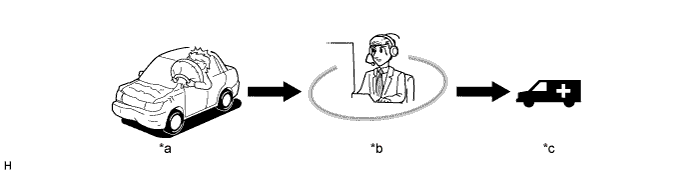
Text in Illustration *a Airbag Deployment or Collision Detection *b Public Safety Answering Point (PSAP) *c Ambulance - -
-
-
Manual Emergency Call Service
-
By pushing the manual (SOS) switch during an on-road emergency, the telematics transceiver transmits the vehicle location and user information, and calls to the PSAP closest to the vehicle.
-
The PSAP operator determines the level of the emergency based on the vehicle location and from the conversation with the user, and contacts the emergency services if necessary.

Text in Illustration *1 Mayday Switch Assembly (Manual (SOS) Switch) - - *a Public Safety Answering Point (PSAP) - -
-
-
-
CONSTRUCTION
-
Manual (SOS) Switch Indicator
-
When the engine switch is turned on (IG), the manual (SOS) switch red indicator illuminates for 10 seconds and then turns off. Then, the manual (SOS) switch green indicator will illuminate for 2 seconds. Illuminates, blinks or turns off depending on the mode type.
-
When the engine switch is turned off, the manual (SOS) switch red indicator and manual (SOS) switch green indicator turn off. However, if the engine switch is turned off when an automatic emergency call is in progress, the call continues and the indicator lights continue operating.
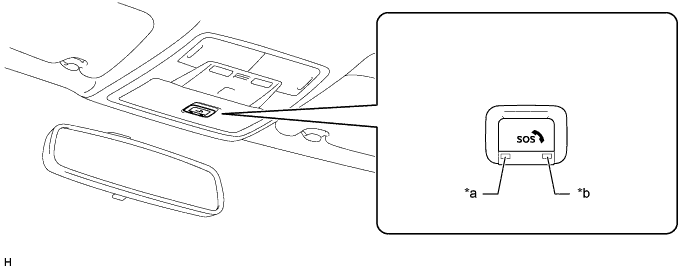
Text in Illustration *a Manual (SOS) Switch Green Indicator *b Manual (SOS) Switch Red Indicator -
Indicators shown in each mode are as follows:
Manual (SOS) Switch Indicator Operation Condition Green Red ON OFF The system is operating. OFF ON
-
A related device is malfunctioning.
-
The mobilephone battery (back-up battery) needs to be replaced.
Blinks OFF An emergency call is being performed. OFF Blinks An emergency call has failed. OFF OFF The engine switch is off. -
-
-
-
DIAGNOSIS
-
If there is a malfunction in the system, the telematics transceiver (data communication module) stores Diagnostic Trouble Codes (DTCs) in its memory. For details, refer to the Repair Manual.
-