PRE-CRASH SAFETY SYSTEM
-
OUTLINE
-
The pre-crash safety system (radar type) predicts the possible collision of the vehicle with an obstacle, based on information received from various sensors. It lessens the damage sustained in the collision by working in unison with other systems: systems that optimize the characteristics of the occupant protection devices such as the seat belt retraction mechanism, and systems that dampen the conditions of a collision, such as the brake control system.
-
This system uses a millimeter wave radar sensor to predict a possible collision with a vehicle or obstacle in front. It retracts the seat belts before the collision and effects brake assist control and brake control*.
-
*: Models with AVS
-
-
Controls during each operation are as follows:
Operation Control Front or rear wheel skid tendency operation Pre-crash seat belt control Sudden braking operation Pre-crash seat belt control Pre-crash safety operation (Models with pre-crash brake control)
-
Pre-crash seat belt control
-
Pre-crash brake assist control
-
Pre-crash brake control
-
Adaptive Variable Suspension system (AVS) control*
Pre-crash safety operation (Models without pre-crash brake control)
-
Pre-crash seat belt control
-
Pre-crash brake assist control
-
Adaptive Variable Suspension system (AVS) control*
-
*: Models with AVS
-
-
-
PRECAUTION
-
When the millimeter wave radar sensor detects an object in front under the conditions described below, the driving support ECU may determine that a collision is unavoidable, and operate the pre-crash safety system. However, this is not abnormal.
-
The conditions are as follows:
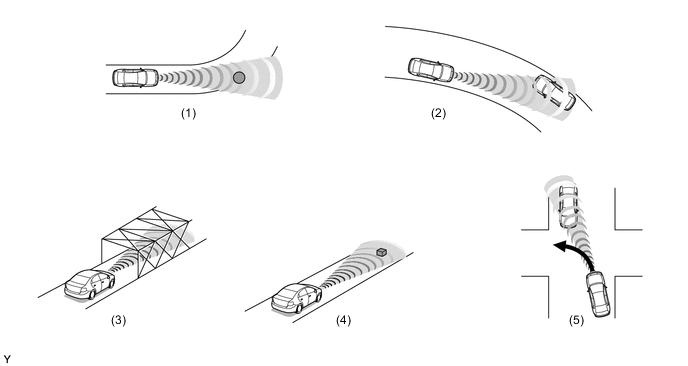
Number Condition (1) Object on road surface at corner entrance (guard rail, street light, sign, signboard) (2) Opposing traffic vehicle during cornering (3) Narrow iron bridge (4) Metal object, steel plate, or bump on road surface (5) Opposing traffic at intersection (6) When vehicle ahead is approached suddenly (7) When passing though an Electronic Toll Collection (ETC) gate (8) Overhead bridge, warning sign, road sign (9) When vehicle height changes radically (nose up, nose down etc.)
-
-
The millimeter wave radar sensor might not be able to detect the following objects as collision objects:
Objects that cannot be detected Plastic items, etc. (safety cones, etc.) Objects that cannot be detected in a stable manner People, Bicycles, Motorcycles, Trees, Animals, Snow, Fences, etc.
-