PRE-COLLISION SYSTEM
-
OUTLINE
-
Lexus Safety System+
-
The Lexus Safety System+ consists of the following drive assist systems and contributes to a safe and comfortable driving experience:
-
PCS (Pre-Collision System)
-
LDA (Lane Departure Alert with steering control)
-
Automatic High Beam
-
RSA (Road Sign Assist)
-
Dynamic radar cruise control
-
-
-
PCS (Pre-Collision System)
-
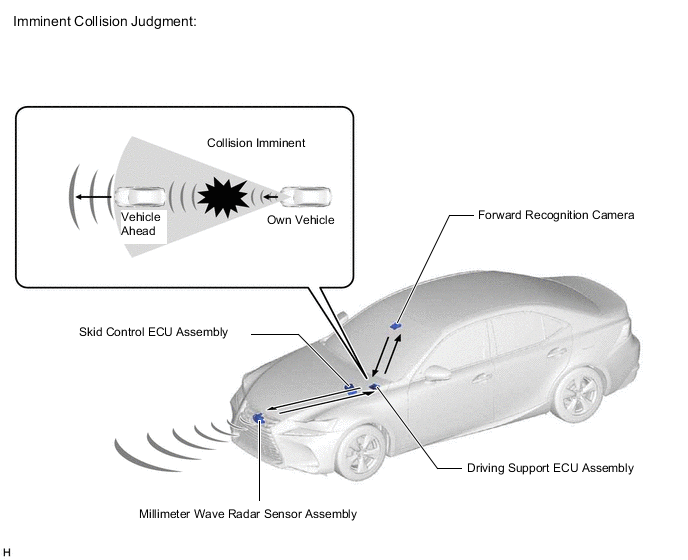
The pre-collision system uses a radar sensor and camera sensor to detect vehicles and pedestrians* in front of your vehicle. When the system determines that the possibility of a frontal collision with a vehicle or pedestrian* is high, a warning operates to urge the driver to take evasive action and the potential brake pressure is increased to help the driver avoid the collision. If the system determines that the possibility of a frontal collision with a vehicle or pedestrian* is extremely high, the brakes are automatically applied to help avoid the collision or help reduce the impact of the collision.
Countries/areas Function availability Regions Europe*1,*2
Australia
New Zealand
Israel
Puerto Rico
The pedestrian detection function is available. Region A Russia
South Africa
Thailand
Taiwan
The pedestrian detection function is not available. Region B *1: Destination package for Canary Islands is included
*2: Except destination package for Russia
Tech Tips
The pre-collision system can be disabled/enabled and the warning timing can be changed.
-
*: Depending on the region in which the vehicle was sold, the pedestrian detection function may not be available. See the following table for details.
-
-
PRECAUTION
-
Lexus Safety System+
-
The Lexus Safety System+ is designed to operate under the assumption that the driver will drive safely, and is designed to help reduce the impact to the occupants and the vehicle in the case of a collision or assist the driver in normal driving conditions.
-
As there is a limit to the degree of recognition accuracy and control performance that this system can provide, do not overly rely on this system. The driver is always responsible for paying attention to the vehicle's surroundings and driving safely.
-
-
Limitations of the pre-collision system
-
The driver is solely responsible for safe driving. Always drive safely, taking care to observe your surroundings.
-
Do not use the pre-collision system instead of normal braking operations under any circumstances. This system will not prevent collisions or lessen collision damage or injury in every situation. Do not overly rely on this system. Failure to do so may lead to an accident, resulting in death or serious injury.
-
Although this system is designed to help avoid a collision or help reduce the impact of the collision, its effectiveness may change according to various conditions, therefore the system may not always be able to achieve the same level of performance. Read the following conditions carefully. Do not overly rely on this system and always drive carefully.
-
Conditions under which the system may operate even if there is no possibility of a collision:
-
Conditions under which the system may not operate properly:
-
-
Do not attempt to test the operation of the pre-collision system yourself, as the system may not operate properly, possibly leading to an accident.
-
-
Pre-collision braking
-
When the pre-collision braking function is operating, a large amount of braking force will be applied.
-
If the vehicle is stopped by the operation of the pre-collision braking function, the pre-collision braking function operation will be canceled after approximately 2 seconds. Depress the brake pedal as necessary.
-
The pre-collision braking function may not operate if certain operations are performed by the driver. If the accelerator pedal is being depressed strongly or the steering wheel is being turned, the system may determine that the driver is taking evasive action and possibly prevent the pre-collision braking function from operating.
-
In some situations, while the pre-collision braking function is operating, operation of the function may be canceled if the accelerator pedal is depressed strongly or the steering wheel is turned and the system determines that the driver is taking evasive action.
-
If the brake pedal is being depressed, the system may determine that the driver is taking evasive action and possibly delay the operation timing of the pre-collision braking function.
-
-
When to disable the pre-collision system
-
In the following situations, disable the system, as it may not operate properly, possibly leading to an accident resulting in death or serious injury:
-
When the vehicle is being towed.
-
When your vehicle is towing another vehicle.
-
When transporting the vehicle via truck, boat, train or similar means of transportation.
-
When the vehicle is raised on a lift with the hybrid system on and the tires are allowed to rotate freely.
-
When inspecting the vehicle using a drum tester such as a chassis dynamometer or speedometer tester, or when using an on vehicle wheel balancer.
-
When a strong impact is applied to the front bumper or front grille, due to an accident or other reasons.
-
If the vehicle cannot be driven in a stable manner, such as when the vehicle has been in an accident or is malfunctioning.
-
When the vehicle is driven in a sporty manner or off-road.
-
When the tires are not properly inflated.
-
When the tires are very worn.
-
When tires of a size other than specified are installed.
-
When tire chains are installed.
-
When a compact spare tire or an emergency tire puncture repair kit is used.
-
If equipment (snow plow, etc.) that may obstruct the radar sensor or camera sensor is temporarily installed to the vehicle.
-
-
-
To avoid malfunction of the radar sensor
-
Observe the following precautions.
Otherwise, the radar sensor may not operate properly, possibly leading to an accident resulting in death or serious injury.
-
Keep the radar sensor and front grille emblem clean at all times.
If the front of the radar sensor or the front or back of the front grille emblem is dirty or covered with water droplets, snow, etc., clean it.
Clean the radar sensor and front grille emblem with a soft cloth so you do not mark or damage them.
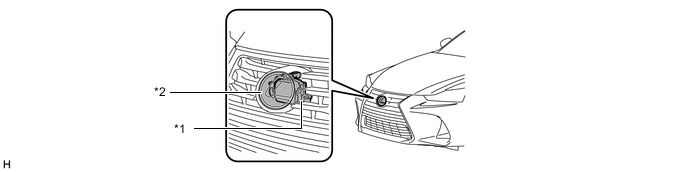
*1 Radar Sensor *2 Front Grille Emblem -
Do not attach accessories, stickers (including transparent stickers) or other items to the radar sensor, front grille emblem or surrounding area.
-
Do not subject the radar sensor or surrounding area to a strong impact.
If the radar sensor, front grille, or front bumper has been subjected to a strong impact, have the vehicle inspected by any authorized Lexus dealer or repairer, or another duly qualified and equipped professional.
-
Do not disassemble the radar sensor.
-
Do not modify or paint the radar sensor, front grille emblem or surrounding area.
If the radar sensor, front grille, or front bumper needs to be removed and installed, or replaced, contact any authorized Lexus dealer or repairer, or another duly qualified and equipped professional.
-
-
-
To avoid malfunction of the camera sensor
-
Observe the following precautions.
Otherwise, the camera sensor may not operate properly, possibly leading to an accident resulting in death or serious injury.
-
Keep the windshield clean at all times.
If the windshield is dirty or covered with an oily film, water droplets, snow, etc., clear the windshield.
If a glass coating agent is applied to the windshield, it will still be necessary to use the windshield wipers to remove water droplets, etc. from the area of the windshield in front of the camera sensor.
If the inner side of the windshield where the camera sensor is installed is dirty, contact any authorized Lexus dealer or repairer, or another duly qualified and equipped professional.
-
Do not attach objects, such as stickers, transparent stickers, and so forth, to the outer side of the windshield in front of the camera sensor (shaded area in the illustration).

*a From the top of the windshield to approximately 1 cm (0.4 in.) below the bottom of the camera sensor. *b Approximately 20 cm (7.9 in.) (Approximately 10 cm (4.0 in.) to the right and left from the center of the camera sensor). -
If the part of the windshield in front of the camera sensor is fogged up or covered with condensation or ice, use the windshield defogger to remove the fog, condensation or ice.
-
If water droplets cannot be properly removed from the area of the windshield in front of the camera sensor by the windshield wipers, replace the wiper insert or wiper blade.
If the wiper inserts or wiper blades need to be replaced, contact any authorized Lexus dealer or repairer, or another duly qualified and equipped professional.
-
Do not attach window tinting to the windshield.
-
Replace the windshield if it is damaged or cracked.
If the windshield needs to be replaced, contact any authorized Lexus dealer or repairer, or another duly qualified and equipped professional.
-
Do not get the camera sensor wet.
-
Do not allow bright lights to shine into the camera sensor.
-
Do not dirty or damage the camera sensor.
When cleaning the inside of the windshield, do not allow glass cleaner to contact the lens. Also, do not touch the lens. If the lens is dirty or damaged, contact any authorized Lexus dealer or repairer, or another duly qualified and equipped professional.
-
Do not subject the camera sensor to a strong impact.
-
Do not change the installation position or direction of the camera sensor or remove it.
-
Do not disassemble the camera sensor.
-
Do not modify any components of the vehicle around the camera sensor (inside rear view mirror, etc.) or ceiling.
-
Do not attach any accessories that may obstruct the camera sensor to the hood, front grille or front bumper. Contact any authorized Lexus dealer or repairer, or another duly qualified and equipped professional for details.
-
If a surfboard or other long object is to be mounted on the roof, make sure that it will not obstruct the camera sensor.
-
Do not modify the headlights or other lights.
-
-
-