BRAKE CONTROL SYSTEM
-
OPERATION
-
Normal Brake Operation (with Regenerative Brake Cooperative Control)
-
During normal braking, the master cylinder cut solenoid valves are closed and the fluid pressure circuits to the wheel cylinders remain independent. Accordingly, the fluid pressure generated by the brake master cylinder sub-assembly will not directly cause the wheel cylinders to actuate.
-
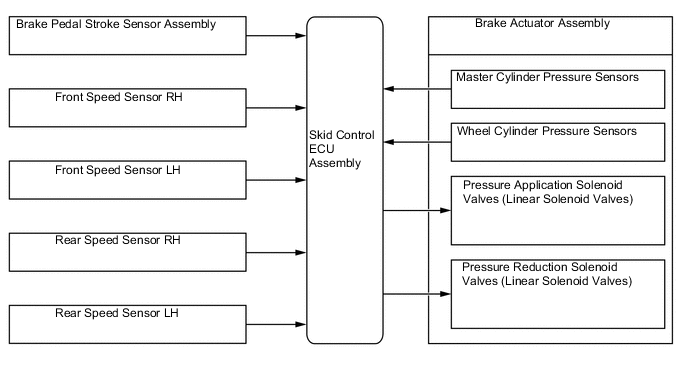
The skid control ECU assembly calculates the braking force required by the driver in accordance with the signals received from the master cylinder pressure sensors and the brake pedal stroke sensor assembly.
-
Then, the skid control ECU assembly calculates the ECU request regenerative brake force value out of the required brake force and transmits this calculated value to the hybrid vehicle control ECU. Upon receiving the value, the hybrid vehicle control ECU generates a regenerative brake force.
-
At the same time, the hybrid vehicle control ECU transmits the actual regenerative brake force value (regenerative braking execution value) to the skid control ECU assembly. The skid control ECU assembly controls the solenoid valves in order to cause the hydraulic brake system to generate a brake force which is obtained by subtracting the regenerative braking execution value from the brake force value required by the driver.
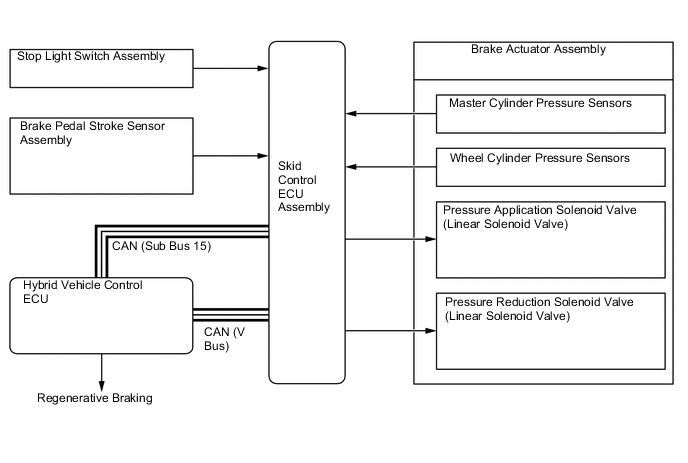
-
The skid control ECU assembly calculates the target wheel cylinder pressure (equivalent to the brake force required by the driver) in accordance with the signals received from the master cylinder pressure sensor and the brake pedal stroke sensor assembly.
-
The skid control ECU assembly compares the wheel cylinder pressure sensor signal and the target wheel cylinder pressure. If the wheel cylinder pressure is lower than the target, the skid control ECU assembly boosts the pressure using the brake actuator assembly.
-
Accordingly, the fluid pressure in the accumulator is fed into the wheel cylinder. Moreover, this operation is the same as when the hydraulic brake force must be increased in order to perform cooperative control in accordance with changes in the regenerative braking force.
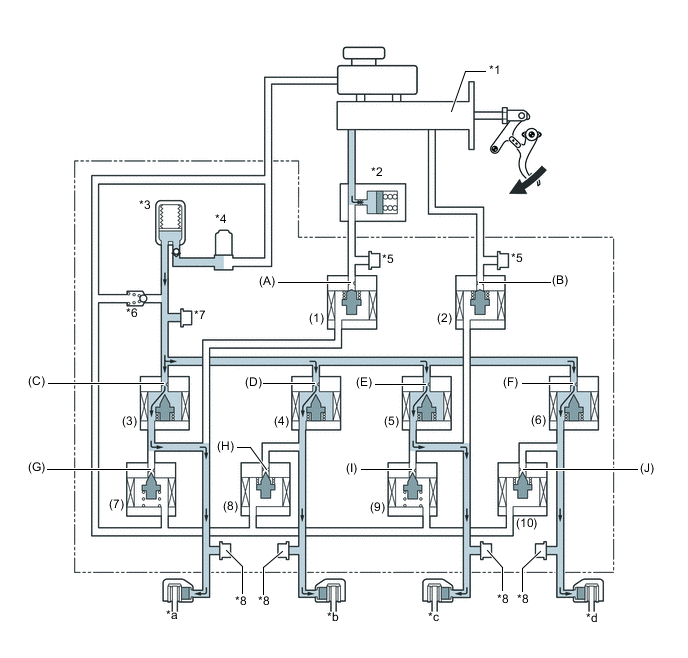
*1 Brake Master Cylinder Sub-assembly *2 Brake Stroke Simulator Cylinder Sub-assembly *3 Accumulator *4 Pump Motor *5 Master Cylinder Pressure Sensor *6 Relief Valve *7 Accumulator Pressure Sensor *8 Wheel Cylinder Pressure Sensor *a Front Brake LH *b Rear Brake RH *c Front Brake RH *d Rear Brake LH -
Each valve operates as shown below:
Item Normal Braking Increase Mode (1) Master Cylinder Cut Solenoid Valve (Switching Solenoid Valve) Port (A) On (Closed) (2) Master Cylinder Cut Solenoid Valve (Switching Solenoid Valve) Port (B) On (Closed) (3) Pressure Application Solenoid Valve (Linear Solenoid Valve) Port (C) On* (4) Pressure Application Solenoid Valve (Linear Solenoid Valve) Port (D) On* (5) Pressure Application Solenoid Valve (Linear Solenoid Valve) Port (E) On* (6) Pressure Application Solenoid Valve (Linear Solenoid Valve) Port (F) On* (7) Pressure Reduction Solenoid Valve (Linear Solenoid Valve) Port (G) Off (Closed) (8) Pressure Reduction Solenoid Valve (Linear Solenoid Valve) Port (H) On (Closed) (9) Pressure Reduction Solenoid Valve (Linear Solenoid Valve) Port (I) Off (Closed) (10) Pressure Reduction Solenoid Valve (Linear Solenoid Valve) Port (J) On (Closed) Tech Tips
*: The solenoid valve constantly regulates the amount of opening of the port in order to control the fluid pressure.
-
The skid control ECU assembly calculates the target wheel cylinder pressure (equivalent to the brake force required by the driver) in accordance with the signals received from the master cylinder pressure sensor and the brake pedal stroke sensor assembly.
-
The skid control ECU assembly compares the wheel cylinder pressure signal with the target wheel cylinder pressure. If they are equal, the skid control ECU assembly holds the pressure using the brake actuator assembly.
-
Accordingly, the wheel cylinder will be held at a constant pressure.
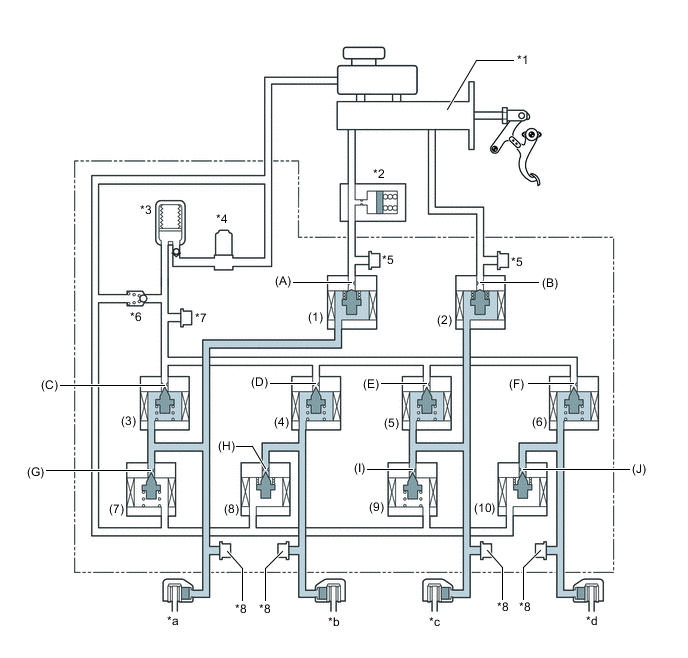
*1 Brake Master Cylinder Sub-assembly *2 Brake Stroke Simulator Cylinder Sub-assembly *3 Accumulator *4 Pump Motor *5 Master Cylinder Pressure Sensor *6 Relief Valve *7 Accumulator Pressure Sensor *8 Wheel Cylinder Pressure Sensor *a Front Brake LH *b Rear Brake RH *c Front Brake RH *d Rear Brake LH -
Each valve operates as shown below:
Item Normal Braking Increase Mode (1) Master Cylinder Cut Solenoid Valve (Switching Solenoid Valve) Port (A) On (Closed) (2) Master Cylinder Cut Solenoid Valve (Switching Solenoid Valve) Port (B) On (Closed) (3) Pressure Application Solenoid Valve (Linear Solenoid Valve) Port (C) Off (Closed) (4) Pressure Application Solenoid Valve (Linear Solenoid Valve) Port (D) Off (Closed) (5) Pressure Application Solenoid Valve (Linear Solenoid Valve) Port (E) Off (Closed) (6) Pressure Application Solenoid Valve (Linear Solenoid Valve) Port (F) Off (Closed) (7) Pressure Reduction Solenoid Valve (Linear Solenoid Valve) Port (G) Off (Closed) (8) Pressure Reduction Solenoid Valve (Linear Solenoid Valve) Port (H) On (Closed) (9) Pressure Reduction Solenoid Valve (Linear Solenoid Valve) Port (I) Off (Closed) (10) Pressure Reduction Solenoid Valve (Linear Solenoid Valve) Port (J) On (Closed) -
The skid control ECU assembly calculates the target wheel cylinder pressure (equivalent to the brake force required by the driver) in accordance with the signals received from the master cylinder pressure sensor and the brake pedal stroke sensor assembly.
-
The skid control ECU assembly compares the wheel cylinder pressure signal with the target wheel cylinder pressure. If wheel cylinder pressure is higher than the target pressure, the skid control ECU assembly reduces the pressure using the brake actuator assembly.
-
Accordingly, the pressure in the wheel cylinder decreases.
-
Moreover, this operation is the same as when the hydraulic brake force must be decreased in order to perform cooperative control in accordance with changes in the regenerative braking force.
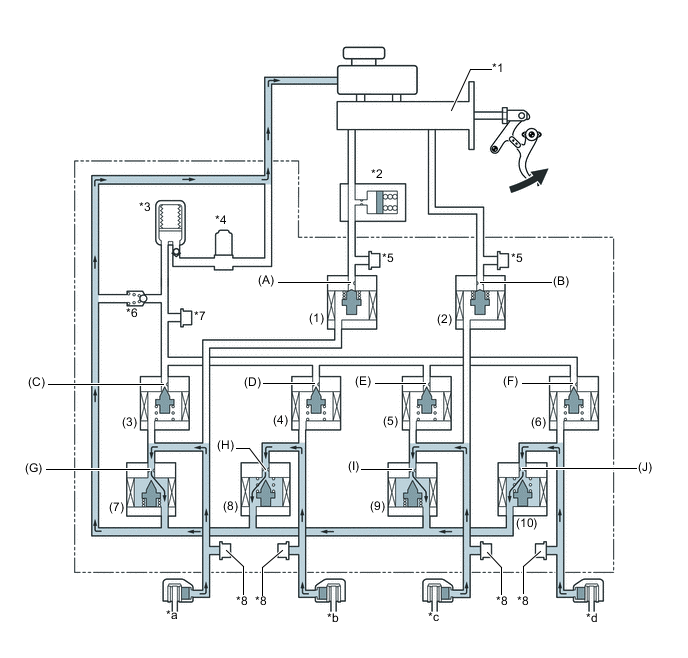
*1 Brake Master Cylinder Sub-assembly *2 Brake Stroke Simulator Cylinder Sub-assembly *3 Accumulator *4 Pump Motor *5 Master Cylinder Pressure Sensor *6 Relief Valve *7 Accumulator Pressure Sensor *8 Wheel Cylinder Pressure Sensor *a Front Brake LH *b Rear Brake RH *c Front Brake RH *d Rear Brake LH -
Each valve operates as shown below:
Item Normal Braking Increase Mode (1) Master Cylinder Cut Solenoid Valve (Switching Solenoid Valve) Port (A) On (Closed) (2) Master Cylinder Cut Solenoid Valve (Switching Solenoid Valve) Port (B) On (Closed) (3) Pressure Application Solenoid Valve (Linear Solenoid Valve) Port (C) Off (Closed) (4) Pressure Application Solenoid Valve (Linear Solenoid Valve) Port (D) Off (Closed) (5) Pressure Application Solenoid Valve (Linear Solenoid Valve) Port (E) Off (Closed) (6) Pressure Application Solenoid Valve (Linear Solenoid Valve) Port (F) Off (Closed) (7) Pressure Reduction Solenoid Valve (Linear Solenoid Valve) Port (G) On* (8) Pressure Reduction Solenoid Valve (Linear Solenoid Valve) Port (H) On* (9) Pressure Reduction Solenoid Valve (Linear Solenoid Valve) Port (I) On* (10) Pressure Reduction Solenoid Valve (Linear Solenoid Valve) Port (J) On* Tech Tips
*: The solenoid valve constantly regulates the amount of opening of the port in order to control the fluid pressure.
-
-
When Electronically Controlled Brake System Stops or during Power Supply Malfunction
-
If the electronically controlled brake system stops or no accumulator pressure is supplied due to a malfunction, the skid control ECU assembly operates the fail-safe function.
-
This function opens the master cylinder cut solenoid valve in the brake actuator assembly, in order to secure a fluid passage between the brake master cylinder sub-assembly and the wheel cylinder. Thus, the brakes can be applied by operating only the front wheel cylinders using the fluid pressure generated by the brake master cylinder sub-assembly.
-
In addition, to inform the driver, the skid control ECU assembly sends a warning signal to the combination meter assembly.
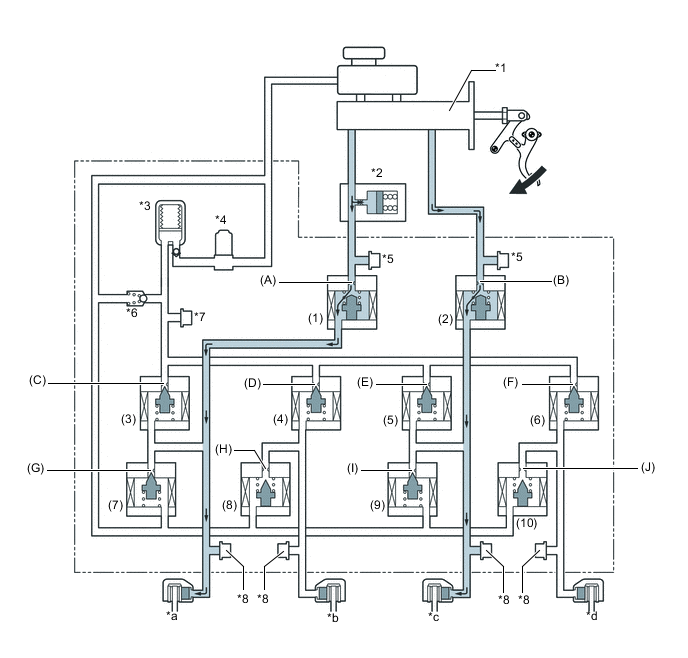
*1 Brake Master Cylinder Sub-assembly *2 Brake Stroke Simulator Cylinder Sub-assembly *3 Accumulator *4 Pump Motor *5 Master Cylinder Pressure Sensor *6 Relief Valve *7 Accumulator Pressure Sensor *8 Wheel Cylinder Pressure Sensor *a Front Brake LH *b Rear Brake RH *c Front Brake RH *d Rear Brake LH -
Each valve operates as shown below:
Item Normal Braking Increase Mode (1) Master Cylinder Cut Solenoid Valve (Switching Solenoid Valve) Port (A) Off (Open) (2) Master Cylinder Cut Solenoid Valve (Switching Solenoid Valve) Port (B) Off (Open) (3) Pressure Application Solenoid Valve (Linear Solenoid Valve) Port (C) Off (Closed) (4) Pressure Application Solenoid Valve (Linear Solenoid Valve) Port (D) Off (Closed) (5) Pressure Application Solenoid Valve (Linear Solenoid Valve) Port (E) Off (Closed) (6) Pressure Application Solenoid Valve (Linear Solenoid Valve) Port (F) Off (Closed) (7) Pressure Reduction Solenoid Valve (Linear Solenoid Valve) Port (G) Off (Closed) (8) Pressure Reduction Solenoid Valve (Linear Solenoid Valve) Port (H) Off (Open) (9) Pressure Reduction Solenoid Valve (Linear Solenoid Valve) Port (I) Off (Closed) (10) Pressure Reduction Solenoid Valve (Linear Solenoid Valve) Port (J) Off (Open)
-
-
ABS and EBD Operation
-
Based on the signals received from the 4 speed sensors, the skid control ECU assembly calculates each wheel speed and checks for wheel slippage. In accordance with the wheel slippage, the skid control ECU assembly controls each pressure application solenoid valve and pressure reduction solenoid valve in order to adjust the fluid pressure of the each wheel cylinder in the following 3 modes: pressure reduction, pressure holding and pressure increase modes.
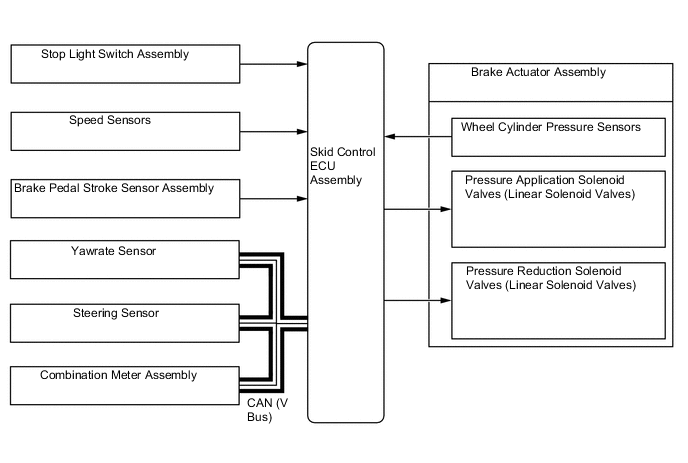
Figure 1. Hydraulic Circuit (Front Brake)
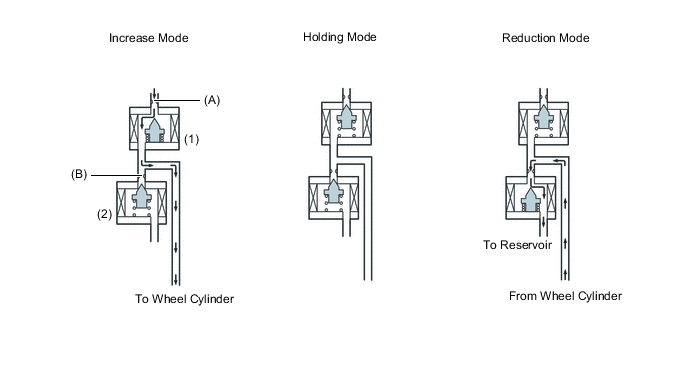
Not Activated Normal Braking - - Activated Increase Mode Holding Mode Reduction Mode Front Brake (1) Pressure Application Solenoid Valve Port (A) On* Off (Closed) Off (Closed) (2) Pressure Reduction Solenoid Valve Port (B) Off (Closed) Off (Closed) On* Wheel Cylinder Pressure Increases Holds Reduces Tech Tips
*: The solenoid valve constantly regulates the amount of opening of the port in order to control the fluid pressure.
Figure 2. Hydraulic Circuit (Rear Brake)
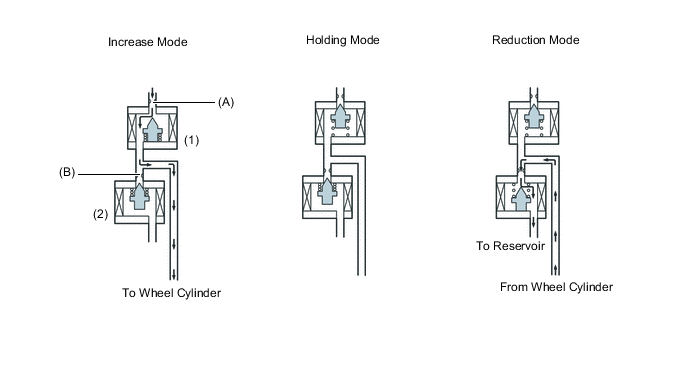
Not Activated Normal Braking - - Activated Increase Mode Holding Mode Reduction Mode Rear Brake (1) Pressure Application Solenoid Valve Port (A) On* Off (Closed) Off (Closed) (2) Pressure Reduction Solenoid Valve Port (B) On (Closed) On (Closed) On* Wheel Cylinder Pressure Increases Holds Reduces Tech Tips
*: The solenoid valve constantly regulates the amount of opening of the port in order to control the fluid pressure.
-
-
Brake Assist Operation
-
In the event of emergency braking, the skid control ECU assembly detects the driver's intention based on the speed of the pressure increase in the brake master cylinder sub-assembly determined by the pressure sensor signals. If the ECU judges the need for the additional brake assist, additional fluid pressure is generated by the pump motor in the brake actuator assembly and directed to the wheel cylinders.
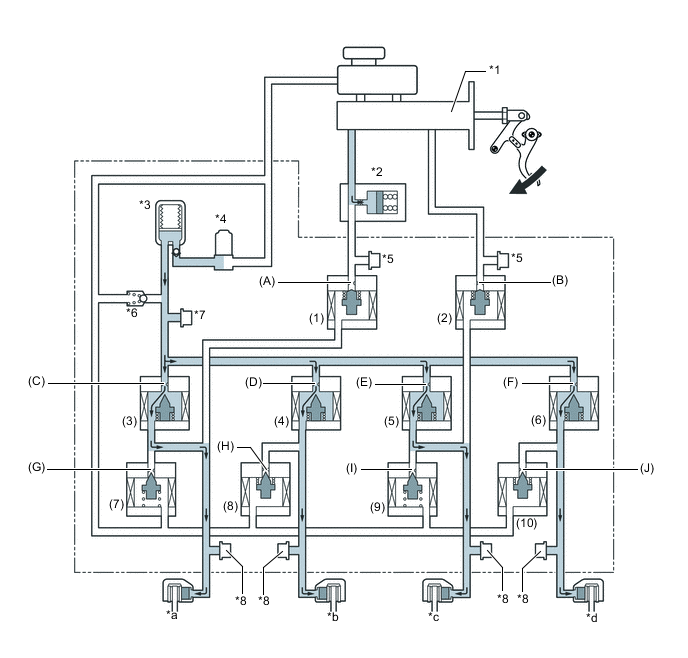
*1 Brake Master Cylinder Sub-assembly *2 Brake Stroke Simulator Cylinder Sub-assembly *3 Accumulator *4 Pump Motor *5 Master Cylinder Pressure Sensor *6 Relief Valve *7 Accumulator Pressure Sensor *8 Wheel Cylinder Pressure Sensor *a Front Brake LH *b Rear Brake RH *c Front Brake RH *d Rear Brake LH -
Each valve operates as shown below:
Item Normal Braking Increase Mode Brake Assist Activated (1) Master Cylinder Cut Solenoid Valve (Switching Solenoid Valve) Port (A) On (Closed) On (Closed) (2) Master Cylinder Cut Solenoid Valve (Switching Solenoid Valve) Port (B) On (Closed) On (Closed) (3) Pressure Application Solenoid Valve (Linear Solenoid Valve) Port (C) On* On* (4) Pressure Application Solenoid Valve (Linear Solenoid Valve) Port (D) On* On* (5) Pressure Application Solenoid Valve (Linear Solenoid Valve) Port (E) On* On* (6) Pressure Application Solenoid Valve (Linear Solenoid Valve) Port (F) On* On* (7) Pressure Reduction Solenoid Valve (Linear Solenoid Valve) Port (G) Off (Closed) Off (Closed) (8) Pressure Reduction Solenoid Valve (Linear Solenoid Valve) Port (H) On (Closed) On (Closed) (9) Pressure Reduction Solenoid Valve (Linear Solenoid Valve) Port (I) Off (Closed) Off (Closed) (10) Pressure Reduction Solenoid Valve (Linear Solenoid Valve) Port (J) On (Closed) On (Closed)
-
-
TRC Operation
-
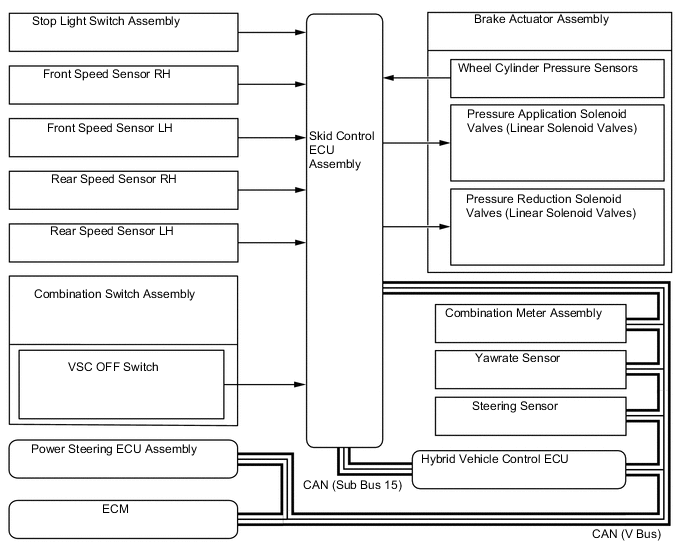
The fluid pressure generated by the pump motor is regulated by the pressure application solenoid valve and pressure reduction solenoid valve to the required pressure. Thus, the wheel cylinders of the drive wheels are controlled in the following 3 modes: pressure reduction, pressure holding and pressure increase modes, to restrain the slippage of the drive wheels.
-
The pressure application solenoid valve and the pressure reduction solenoid valve are turned on and off in accordance with the ABS operation pattern.
-
The diagram shows the hydraulic circuit in the pressure increase mode when the TRC function is activated.
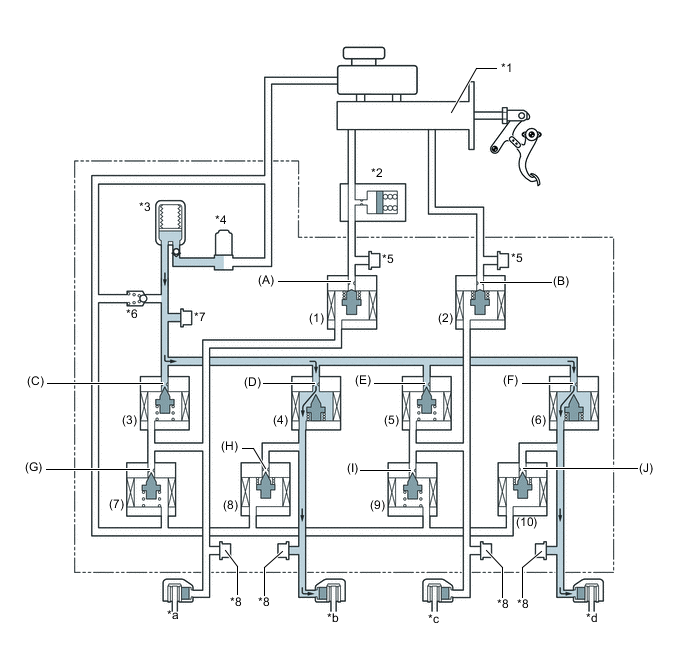
*1 Brake Master Cylinder Sub-assembly *2 Brake Stroke Simulator Cylinder Sub-assembly *3 Accumulator *4 Pump Motor *5 Master Cylinder Pressure Sensor *6 Relief Valve *7 Accumulator Pressure Sensor *8 Wheel Cylinder Pressure Sensor *a Front Brake LH *b Rear Brake RH *c Front Brake RH *d Rear Brake LH -
Each valve operates as shown below:
Item TRC Not Activated TRC Activated Increase Mode Holding Mode Reduction Mode (1) Master Cylinder Cut Solenoid Valve (Switching Solenoid Valve) Port (A) On (Closed) On (Closed) On (Closed) On (Closed) (2) Master Cylinder Cut Solenoid Valve (Switching Solenoid Valve) Port (B) On (Closed) On (Closed) On (Closed) On (Closed) (3) Pressure Application Solenoid Valve (Linear Solenoid Valve) Port (C) Off (Closed) Off (Closed) Off (Closed) Off (Closed) (4) Pressure Application Solenoid Valve (Linear Solenoid Valve) Port (D) Off (Closed) On* Off (Closed) Off (Closed) (5) Pressure Application Solenoid Valve (Linear Solenoid Valve) Port (E) Off (Closed) Off (Closed) Off (Closed) Off (Closed) (6) Pressure Application Solenoid Valve (Linear Solenoid Valve) Port (F) Off (Closed) On* Off (Closed) Off (Closed) (7) Pressure Reduction Solenoid Valve (Linear Solenoid Valve) Port (G) Off (Closed) Off (Closed) Off (Closed) Off (Closed) (8) Pressure Reduction Solenoid Valve (Linear Solenoid Valve) Port (H) Off (Open) On (Closed) On (Closed) On* (9) Pressure Reduction Solenoid Valve (Linear Solenoid Valve) Port (I) Off (Closed) Off (Closed) Off (Closed) Off (Closed) (10) Pressure Reduction Solenoid Valve (Linear Solenoid Valve) Port (J) Off (Open) On (Closed) On (Closed) On* Tech Tips
*: The solenoid valve constantly regulates the amount of opening of the port in order to control the fluid pressure.
-
-
VSC Operation
-
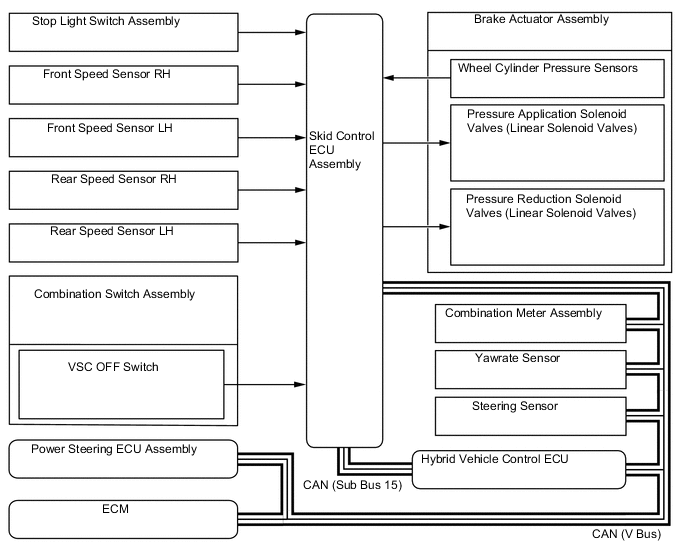
The VSC controls the solenoid valves in order to send the fluid pressure stored in the accumulator to the brake wheel cylinders at the respective wheels, through routes that are different from those used during normal braking. Thus, the function operates in the following 3 modes: pressure reduction, pressure holding and pressure increase modes. As a result, the tendency of the front wheels or the rear wheels to skid is restrained.
-
In the front wheel skid restraining control, the brakes of the front wheel on the outer circle of the turn and the rear wheels are applied. Also, depending on whether the brake is on or off and also depending on the condition of the vehicle, there are circumstances in which the brake might not be applied to the wheels even if the wheel is targeted for braking. The following diagram shows the hydraulic circuit in the pressure increase mode, as it controls the front wheel skid condition while the vehicle is making a right turn.
-
The pressure application solenoid valve and the pressure reduction solenoid valve are turned on and off in accordance with the ABS operation pattern.
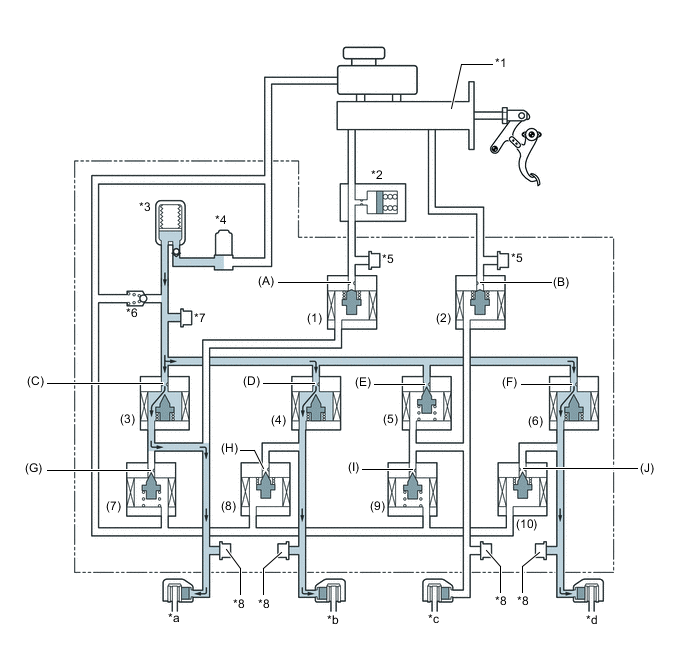
*1 Brake Master Cylinder Sub-assembly *2 Brake Stroke Simulator Cylinder Sub-assembly *3 Accumulator *4 Pump Motor *5 Master Cylinder Pressure Sensor *6 Relief Valve *7 Accumulator Pressure Sensor *8 Wheel Cylinder Pressure Sensor *a Front Brake LH *b Rear Brake RH *c Front Brake RH *d Rear Brake LH -
Each valve operates as shown below:
Item VSC Not Activated VSC Activated Increase Mode Holding Mode Reduction Mode (1) Master Cylinder Cut Solenoid Valve (Switching Solenoid Valve) Port (A) On (Closed) On (Closed) On (Closed) On (Closed) (2) Master Cylinder Cut Solenoid Valve (Switching Solenoid Valve) Port (B) On (Closed) On (Closed) On (Closed) On (Closed) (3) Pressure Application Solenoid Valve (Linear Solenoid Valve) Port (C) Off (Closed) On* Off (Closed) Off (Closed) (4) Pressure Application Solenoid Valve (Linear Solenoid Valve) Port (D) Off (Closed) On* Off (Closed) Off (Closed) (5) Pressure Application Solenoid Valve (Linear Solenoid Valve) Port (E) Off (Closed) Off (Closed) Off (Closed) Off (Closed) (6) Pressure Application Solenoid Valve (Linear Solenoid Valve) Port (F) Off (Closed) On* Off (Closed) Off (Closed) (7) Pressure Reduction Solenoid Valve (Linear Solenoid Valve) Port (G) Off (Closed) Off (Closed) Off (Closed) On* (8) Pressure Reduction Solenoid Valve (Linear Solenoid Valve) Port (H) Off (Open) On (Closed) On (Closed) On* (9) Pressure Reduction Solenoid Valve (Linear Solenoid Valve) Port (I) Off (Closed) Off (Closed) Off (Closed) Off (Closed) (10) Pressure Reduction Solenoid Valve (Linear Solenoid Valve) Port (J) Off (Open) On (Closed) On (Closed) On* Tech Tips
*: The solenoid valve constantly regulates the amount of opening of the port in order to control the fluid pressure.
-
During the rear wheel skid restraining control, the brakes of the front and rear wheels on the outer circle of the turn are applied. Also, depending on whether the brake is on or off and also depending on the condition of the vehicle, there are circumstances in which the brake might not be applied to the wheels even if the wheel is targeted for braking. The following diagram shows the hydraulic circuit in the pressure increase mode, as it controls the rear wheel skid condition while the vehicle is making a right turn.
-
As in rear wheel skid restraint control, the pressure application solenoid valve and the pressure reduction solenoid valve are turned on and off in accordance with the ABS operating pattern.
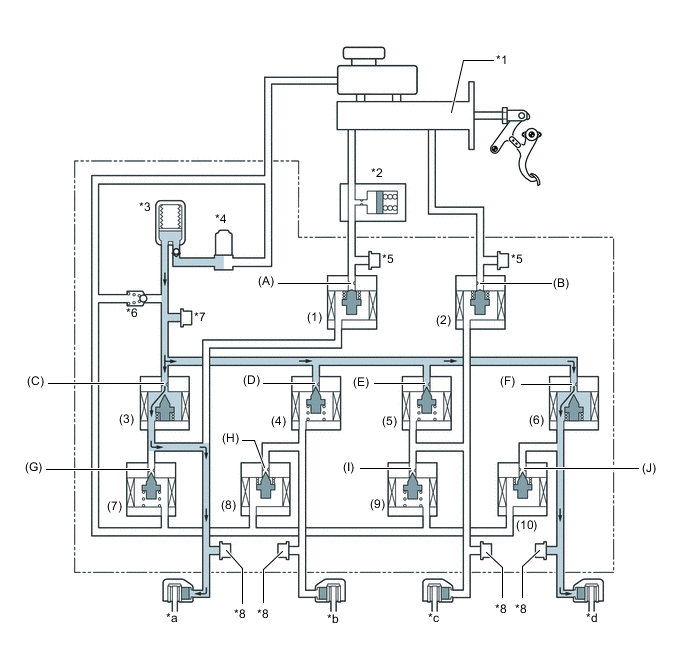
*1 Brake Master Cylinder Sub-assembly *2 Brake Stroke Simulator Cylinder Sub-assembly *3 Accumulator *4 Pump Motor *5 Master Cylinder Pressure Sensor *6 Relief Valve *7 Accumulator Pressure Sensor *8 Wheel Cylinder Pressure Sensor *a Front Brake LH *b Rear Brake RH *c Front Brake RH *d Rear Brake LH -
Each valve operates as shown below:
Item VSC Not Activated VSC Activated Increase Mode Holding Mode Reduction Mode (1) Master Cylinder Cut Solenoid Valve (Switching Solenoid Valve) Port (A) On (Closed) On (Closed) On (Closed) On (Closed) (2) Master Cylinder Cut Solenoid Valve (Switching Solenoid Valve) Port (B) On (Closed) On (Closed) On (Closed) On (Closed) (3) Pressure Application Solenoid Valve (Linear Solenoid Valve) Port (C) Off (Closed) On* Off (Closed) Off (Closed) (4) Pressure Application Solenoid Valve (Linear Solenoid Valve) Port (D) Off (Closed) Off (Closed) Off (Closed) Off (Closed) (5) Pressure Application Solenoid Valve (Linear Solenoid Valve) Port (E) Off (Closed) Off (Closed) Off (Closed) Off (Closed) (6) Pressure Application Solenoid Valve (Linear Solenoid Valve) Port (F) Off (Closed) On* Off (Closed) Off (Closed) (7) Pressure Reduction Solenoid Valve (Linear Solenoid Valve) Port (G) Off (Closed) Off (Closed) Off (Closed) On* (8) Pressure Reduction Solenoid Valve (Linear Solenoid Valve) Port (H) Off (Open) Off (Open) Off (Open) Off (Open) (9) Pressure Reduction Solenoid Valve (Linear Solenoid Valve) Port (I) Off (Closed) Off (Closed) Off (Closed) Off (Closed) (10) Pressure Reduction Solenoid Valve (Linear Solenoid Valve) Port (J) Off (Open) On (Closed) On (Closed) On* Tech Tips
*: The solenoid valve constantly regulates the amount of opening of the port in order to control the fluid pressure.
-
-
Hill-start Assist Control Operation
-
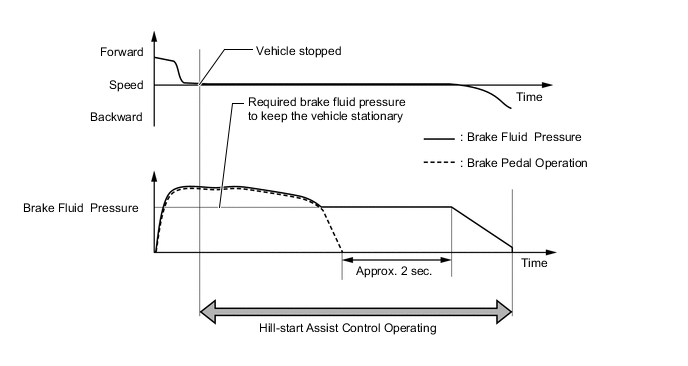
Hill-start Assist Control controls the brakes by maintaining the master cylinder fluid pressure produced by depressing the brake pedal.
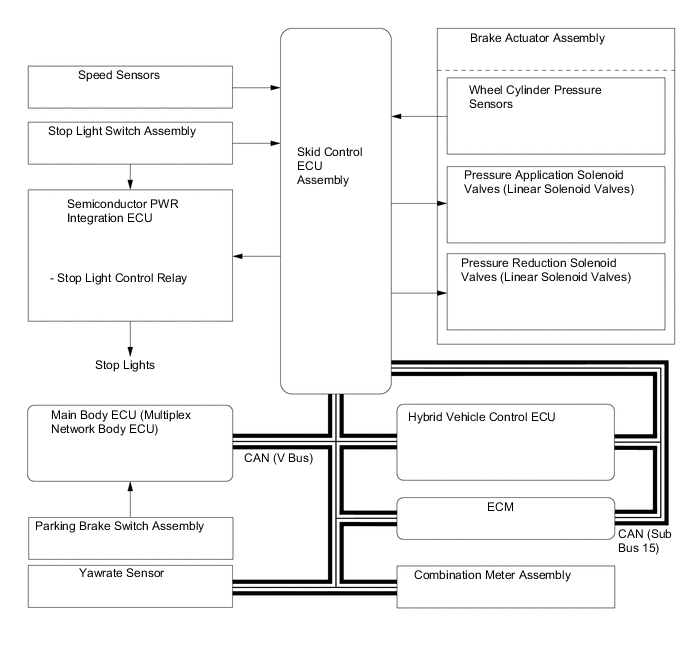
Figure 3. Example of Hill-start Assist Control when Climbing Uphill with Shift Lever in D (Driver Depresses Accelerator Pedal to Start Off after Hill-start Assist Control Operation)
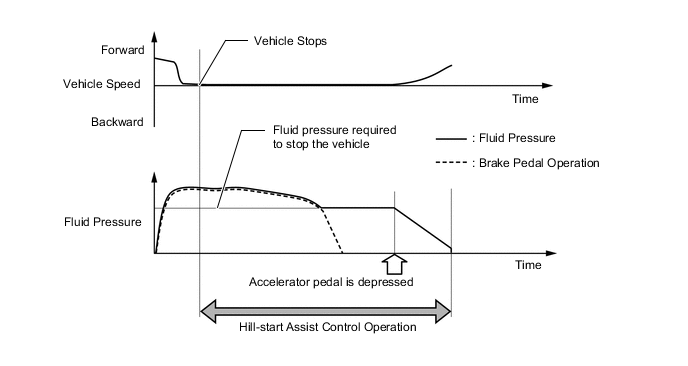
Figure 4. Example of Hill-start Assist Control when Climbing Uphill with Shift Lever in D (Driver Takes No Action after Hill-start Assist Control Operation)
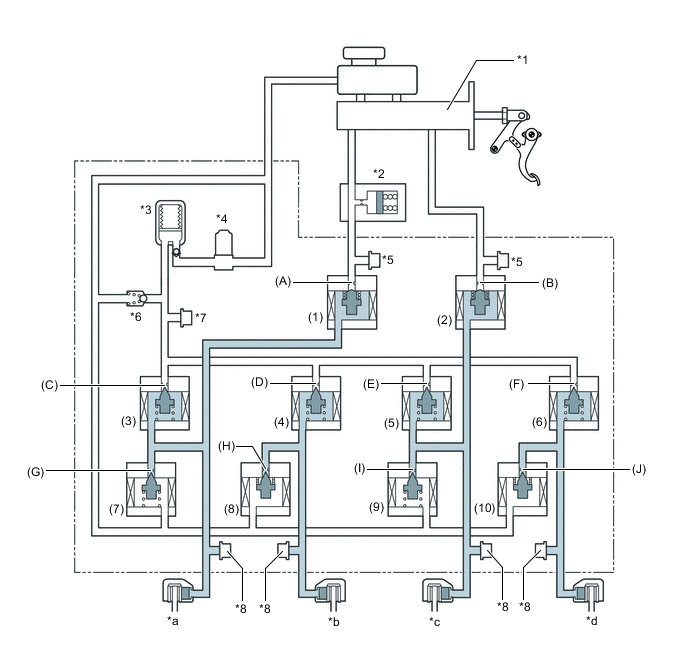
*1 Brake Master Cylinder Sub-assembly *2 Brake Stroke Simulator Cylinder Sub-assembly *3 Accumulator *4 Pump Motor *5 Master Cylinder Pressure Sensor *6 Relief Valve *7 Accumulator Pressure Sensor *8 Wheel Cylinder Pressure Sensor *a Front Brake LH *b Rear Brake RH *c Front Brake RH *d Rear Brake LH Each valve operates as shown below:
Item Hill-start Assist Control Not Activated Hill-start Assist Control Activated Holding Mode Reduction Mode (1) Master Cylinder Cut Solenoid Valve (Switching Solenoid Valve) Port (A) On (Closed) On (Closed) On (Closed) (2) Master Cylinder Cut Solenoid Valve (Switching Solenoid Valve) Port (B) On (Closed) On (Closed) On (Closed) (3) Pressure Application Solenoid Valve (Linear Solenoid Valve) Port (C) Off (Closed) Off (Closed) Off (Closed) (4) Pressure Application Solenoid Valve (Linear Solenoid Valve) Port (D) Off (Closed) Off (Closed) Off (Closed) (5) Pressure Application Solenoid Valve (Linear Solenoid Valve) Port (E) Off (Closed) Off (Closed) Off (Closed) (6) Pressure Application Solenoid Valve (Linear Solenoid Valve) Port (F) Off (Closed) Off (Closed) Off (Closed) (7) Pressure Reduction Solenoid Valve (Linear Solenoid Valve) Port (G) Off (Closed) Off (Closed) On* (8) Pressure Reduction Solenoid Valve (Linear Solenoid Valve) Port (H) Off (Open) ON (Closed) On* (9) Pressure Reduction Solenoid Valve (Linear Solenoid Valve) Port (I) Off (Closed) Off (Closed) On* (10) Pressure Reduction Solenoid Valve (Linear Solenoid Valve) Port (J) Off (Open) On (Closed) On* Tech Tips
*: The solenoid valve constantly regulates the amount of opening of the port in order to control the fluid pressure.
-
-
Radar Cruise Control Brake
-
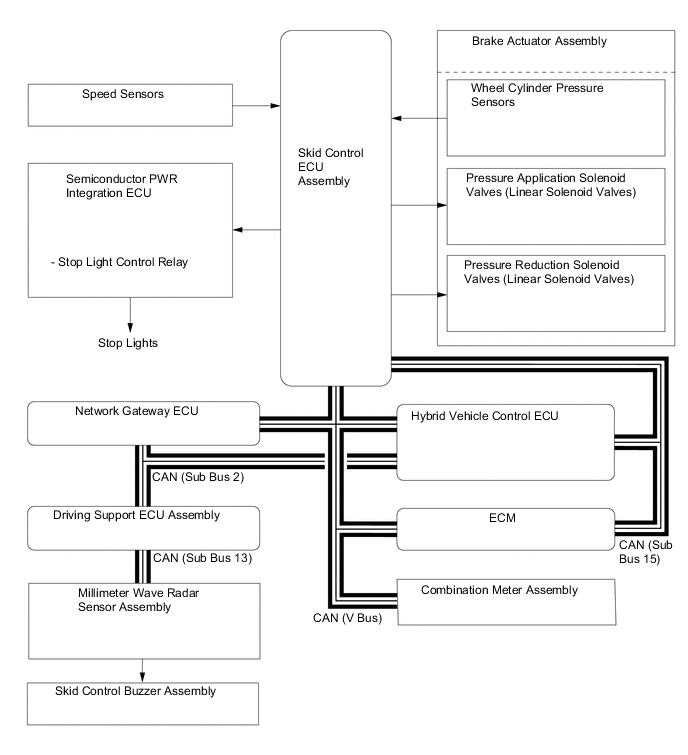
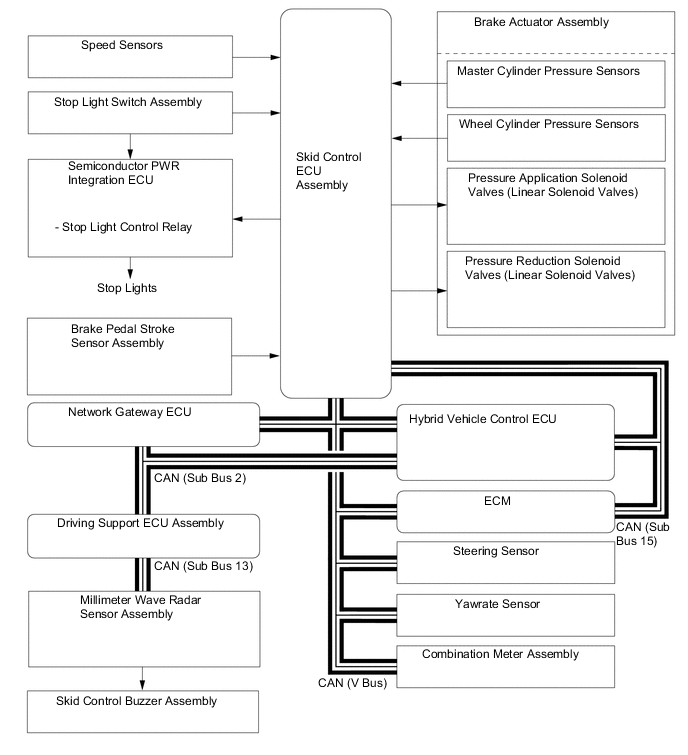
The skid control ECU assembly operates the brakes by receiving a motive force request signal from the driving support ECU assembly while the dynamic radar cruise control system is being activated. This brake control operates in the same way as the normal brake operation.
-
-
Pre-crash Brake
-
If the driving support ECU assembly determines that the possibility of a collision is high, the ECU sends the pre-crash brake assist request signal to the skid control ECU assembly. Upon receiving the signal, the skid control ECU assembly switches the brake assist to standby mode. When the driver depresses the brake pedal, the skid control ECU assembly operates the brake assist based on the master cylinder pressure sensor.
-
If a collision is unavoidable, the skid control ECU assembly actuates the motor in the power supply portion to apply direct pressure to the wheel cylinders even if the driver does not depress the brake pedal. This brake control operates in the same way as the normal brake operation.
-
-
VSC (Cooperative Control with EPS)
-
The operation of the solenoid valves under the cooperative control with EPS is the same as the operation of the brake control functions (ABS, TRC, VSC).
-
-