ENGINE UNIT
-
CONSTRUCTION
-
This controller consists of an outer housing driven by the timing chain sprocket, and a vane coupled to each camshaft.
-
The intake side uses a camshaft timing gear assembly with 3 vanes.
-
When the engine stops, each intake side camshaft timing gear assembly is locked at the most retarded angle by its lock pin. This ensures excellent engine startability.
-
The oil pressure sent from the advance or retard side passages of the intake camshafts causes rotation of the vane relative to the timing chain sprocket, to vary the valve timing continuously.
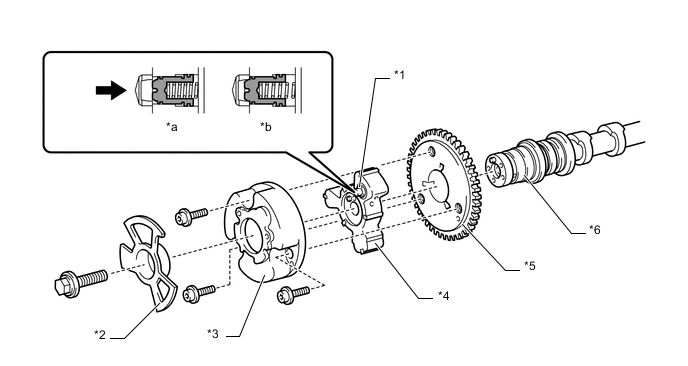
*1 Lock Pin *2 Timing Rotor *3 Outer Housing *4 Vane (Coupled to Intake Camshaft) *5 Timing Chain Sprocket *6 Intake Camshaft *a Engine Operating *b Engine Stopped 
Oil Pressure - - -
This controller consists of an outer housing that is driven by the timing chain sprocket, and a vane that is coupled to each camshaft.
-
The exhaust side uses a camshaft timing exhaust gear assembly with 4 vanes.
-
When the engine stops, each camshaft timing exhaust gear assembly is locked at the most advanced angle. This ensures excellent engine startability.
-
The oil pressure sent from the advance or retard side passages of the exhaust camshafts causes rotation of the vane relative to the timing chain sprocket, to vary the valve timing continuously.
-
An advance assist spring is provided on the camshaft timing exhaust gear assembly. This helps to apply torque in the advance angle direction so that the vane lock pin securely engages with the housing when the engine stops.
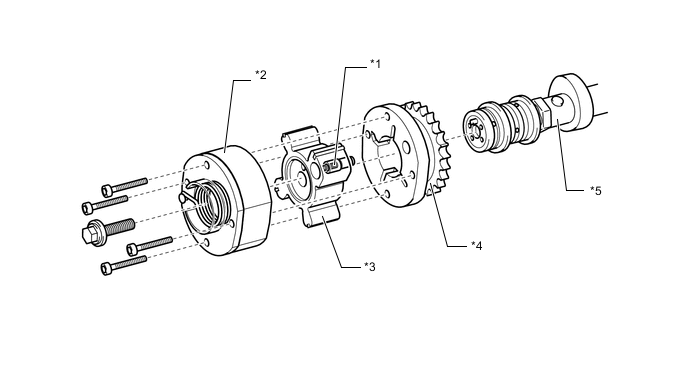
*1 Lock Pin *2 Outer Housing *3 Vane (Coupled to Exhaust Camshaft) *4 Timing Chain Sprocket *5 Exhaust Camshaft - -
-