SFI SYSTEM
-
FUNCTION
-
A cranking hold function is included on models with the smart entry and start system. When the engine switch is pressed with the brake pedal depressed and the shift lever in P or N, this function operates the starter until the engine starts. This prevents application of the starter assembly for an inadequate length of time. It also prevents the engine from being cranked after it has started.
-
This system has the following safety features:
-
While the engine is running, the starter assembly cannot operate.
-
The starter assembly will stop operating once the engine has started, even if the engine switch remains pushed.
-
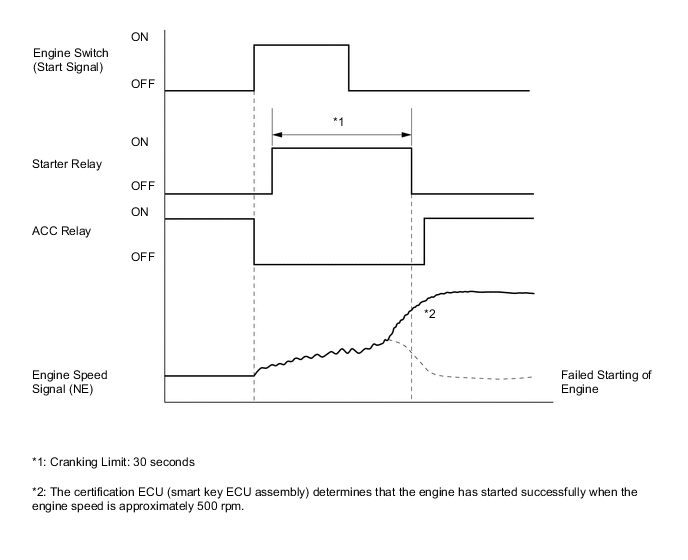
Starter operation is limited to a maximum of approximately 30 seconds to protect the starter motor.
-
-
Models with stop and start system:
-
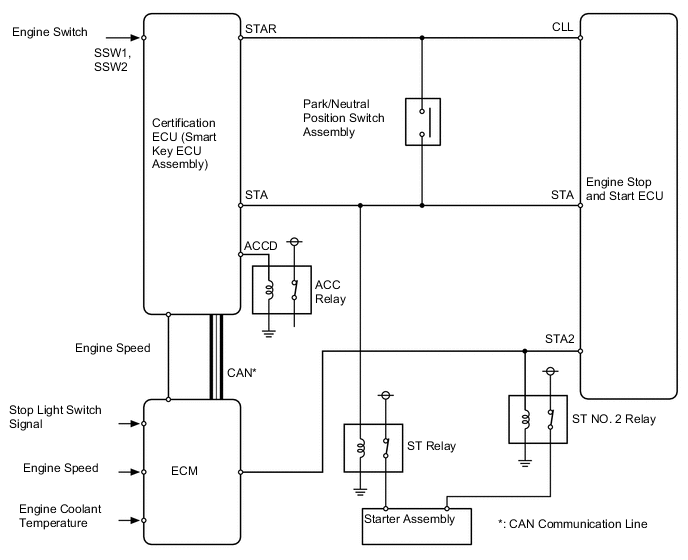
When first starting the engine, if the certification ECU (smart key ECU assembly) receives a start signal from the engine switch, the certification ECU (smart key ECU assembly) sends an operation signal to the ST relay via the park/neutral position switch assembly when the shift lever is in P or N and the engine stop and start ECU sends an operation signal to the ST NO. 2 relay to operate the starter assembly. At this time, the certification ECU (smart key ECU assembly) turns the ACC relay operation signal (ACCD) off to prevent flickering of the meter, clock and audio systems.
-
When starting the engine during idling stop control, the engine stop and start ECU sends operation signals to the ST relay and ST NO. 2 relay according to the vehicle condition to operate the starter assembly.
-
While the engine is cranking, the certification ECU (smart key ECU assembly) and/or engine stop and start ECU continues to send an operation signal to the ST relay and ST NO. 2 relay until it has been detected that the engine has started successfully. Whether the engine has started successfully is determined by the certification ECU (smart key ECU assembly) and ECM, and once it has been determined that the engine has started successfully, the signal output to the certification ECU (smart key ECU assembly) and/or engine stop and start ECU to the ST relay and ST NO. 2 relay are stopped.
-
The engine speed at which the engine is determined to be successfully started is based on the engine coolant temperature.
-
-
Models without stop and start system:
-
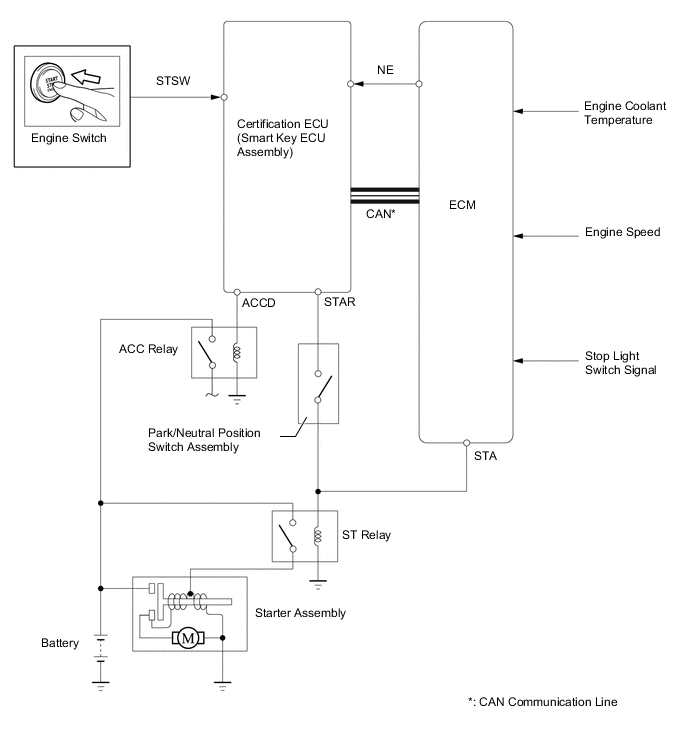
When the certification ECU (smart key ECU assembly) detects a start signal (STSW), the certification ECU (smart key ECU assembly) outputs an ST relay drive signal (STAR). The signal goes through the park/neutral position switch assembly to the ST relay. The ST relay activates the starter assembly when it receives this signal. At this time, the certification ECU (smart key ECU assembly) turns off the ACC relay by turning off the power sent from the ACCD terminal. the ACC relay is turned off to prevent flickering of the meters, clock and audio system.
-
When communication between the certification ECU (smart key ECU assembly) and ECM stops, the certification ECU (smart key ECU assembly) uses the engine speed (NE) signal received from the ECM via a direct line to determine when to turn off the starter assembly.
-
While cranking, the certification ECU (smart key ECU assembly) continues energizing the ST relay until it is determined that the engine has started. When the certification ECU (smart key ECU assembly) has judged that the engine has started, the certification ECU (smart key ECU assembly) stops energizing the ST relay.
-
If the engine does not start even though the starter assembly has cranked for approximately 30 seconds, the ST relay is turned off to protect the starter motor.
-
-