PRE-COLLISION SYSTEM
-
FUNCTION OF MAIN COMPONENTS
Item Function Millimeter Wave Radar Sensor Assembly Radiates millimeter wave radar forward, uses the reflected millimeter waves for detecting the presence of a vehicle ahead, the vehicle-to-vehicle distance, and the relative speed, and then transmits this information to the driving support ECU assembly. Forward Recognition Camera
-
Captures images of the area in front of the vehicle and processes them to detect vehicles and sends information to the driving support ECU assembly.
-
Operates the camera heater when temperature is cold.
Driving Support ECU Assembly Determines whether a collision is imminent based on the information received from the forward recognition camera and millimeter wave radar sensor assembly. It then outputs a brake assist standby request signal and pre-collision brake request signal if required. Forward Recognition Hood with Heater Sub-assembly Camera Heater
-
Heats the sheet heater in accordance with the current from the forward recognition camera to prevent condensation on windshield in front of the forward recognition camera.
-
During operation of the camera heater, the operating current is input to the forward recognition camera.
Brake Booster with Master Cylinder Assembly Skid Control ECU Assembly
-
Receives a brake assist standby request signal from the driving support ECU assembly and switches the brake assist to standby mode. When a master cylinder pressure signal is input, it activates the brake assist.
-
Receives a pre-collision brake request signal from the driving support ECU assembly, and then applies the brakes.
-
Transmits vehicle speed signals to the driving support ECU assembly.
-
Transmits a stop light turn on request signal to the stop light relay (stop light control ECU assembly).
Speed Sensors Detect the wheel speed of each of the 4 wheels and transmits the signal to the skid control ECU assembly. Yawrate Sensor Detects the yaw rate and lateral/longitudinal deceleration of the vehicle and transmits the signal to the skid control ECU assembly and the driving support ECU assembly. Spiral Cable with Sensor Sub-assembly Steering Sensor Detects the angle and direction of steering and transmits a signal to the skid control ECU assembly and the driving support ECU assembly. Stop Light Switch Assembly Detects if the brake pedal is depressed and transmits a signal to the skid control ECU assembly. Stop Light Relay (Stop Light Control ECU Assembly) Receives a stop light turn on request signal from the skid control ECU assembly, and turns on the stop lights. Combination Meter Assembly PCS Warning Light
(PCS OFF indicator Light)
-
Illuminates to warn the driver in accordance with signals from the driving support ECU assembly.
-
Illuminates when the system is malfunctioning or temporarily disabled.
-
Illuminates when the pre-collision system is disabled.
Multi-information Display
-
Displays a warning message to inform or warn the driver of the system condition in accordance with signals from the driving support ECU assembly.
-
Disables the pre-collision system operation when selected PCS OFF mode in setting display function.
-
Changing the pre-collision system warning timing when selected Far/Middle/Near insetting display function.
Master Warning Light Illuminates to warn the driver in accordance with signals from the driving support ECU assembly. Buzzer Sounds to warn the driver in accordance with signals from the driving support ECU assembly when the system is malfunctioning. Steering Pad Switch Assembly Switch the display of multi-information display within combination meter assembly. Skid Control Buzzer Assembly Sounds to warn the driver in accordance with signals from the driving support ECU assembly. Power Management Control ECU
-
Detects the shift position signal and accelerator pedal opening angle and sends that information to the driving support ECU assembly.
-
Performs engine output control based on information from the driving support ECU assembly.
Main Body ECU (Multiplex Network Body ECU) Outputs the specification signal of the vehicle to driving support ECU. Network Gateway ECU Transmits the signal between the CAN communication bus. -
-
FUNCTION
-
The pre-collision system uses a millimeter wave radar sensor assembly and forward recognition camera to detect vehicle and pedestrian* in front of your vehicle.
-
When the system determines that the possibility of a frontal collision with a vehicle or pedestrian* is high, a warning operates to urge the driver to take evasive action and the potential brake pressure is increased to help the driver avoid the collision.
-
If the system determines that the possibility of a frontal collision with a vehicle or pedestrian* is extremely high, the brakes are automatically applied to help avoid the collision or help reduce the impact of the collision.
-
Pre-collision warning
When the system determines that the possibility of a frontal collision is high, a buzzer will sound and a warning message will be displayed on the multi-information display to urge the driver to take evasive action.
-
Pre-collision brake assist
When the system determines that the possibility of a frontal collision is high, the system applies greater braking force in relation to how strongly the brake pedal is depressed.
-
*: Depending on the region in which the vehicle was sold, the pedestrian detection function may not be available.
-
-
OPERATING CONDITION
-
Availability of the pedestrian detection function depends on the region in which the vehicle was sold.
Regions Function availability Region A The pedestrian detection function is available Region B The pedestrian detection function is not available Read the following for details:
-
Region A
(The pedestrian detection function is available)
-
The pre-collision system is enabled and the system determines that the possibility of a frontal collision with a vehicle or pedestrian is high.
-
Each function is operational at the following speeds:
-
Vehicle speed is between approximately 10 and 180 km/h (7 and 110 mph). (For detecting a pedestrian, vehicle speed is between approximately 10 and 80 km/h (7 and 50 mph).)
-
The relative speed between your vehicle and the vehicle or pedestrian ahead is approximately 10 km/h (7 mph) or more.
Pre-collision warning:
-
Vehicle speed is between approximately 30 and 180 km/h (20 and 110 mph). (For detecting a pedestrian, vehicle speed is between approximately 30 and 80 km/h (20 and 50 mph).)
-
The relative speed between your vehicle and the vehicle or pedestrian ahead is approximately 30 km/h (20 mph) or more.
Pre-collision brake assist:
-
Vehicle speed is between approximately 10 and 180 km/h (7 and 110 mph). (For detecting a pedestrian, vehicle speed is between approximately 10 and 80 km/h (7 and 50 mph).)
-
The relative speed between your vehicle and the vehicle or pedestrian ahead is approximately 10 km/h (7 mph) or more.
Pre-collision braking:
The system may not operate in the following situations:
-
If an auxiliary battery terminal has been disconnected and reconnected and then the vehicle has not been driven for a certain amount of time.
-
If the shift position is in R.
-
-
-
Region B
(The pedestrian detection function is not available)
-
The pre-collision system is enabled and the system determines that the possibility of a frontal collision with a vehicle is high.
-
Each function is operational at the following speeds:
-
Vehicle speed is between approximately 15 and 180 km/h (10 and 110 mph).
-
The relative speed between your vehicle and the vehicle ahead is approximately 10 km/h (7 mph) or more.
Pre-collision warning:
-
Vehicle speed is between approximately 30 and 180 km/h (20 and 110 mph).
-
The relative speed between your vehicle and the vehicle ahead is approximately 30 km/h (20 mph) or more.
Pre-collision brake assist:
-
Vehicle speed is between approximately 15 and 180 km/h (10 and 110 mph).
-
The relative speed between your vehicle and the vehicle ahead is approximately 10 km/h (7 mph) or more.
Pre-collision braking:
The system may not operate in the following situations:
-
If an auxiliary battery terminal has been disconnected and reconnected and then the vehicle has not been driven for a certain amount of time.
-
If the shift position is in R.
-
-
-
Cancelation of the pre-collision braking
-
If either of the following occur while the pre-collision braking function is operating, it will be canceled:
-
The accelerator pedal is depressed strongly.
-
The steering wheel is turned sharply or abruptly.
-
-
-
Conditions under which the system may operate even if there is no possibility of a collision
-
In some situations such as the following, the system may determine that there is possibility of a frontal collision and operate.
-
When passing a vehicle or pedestrian*2.
-
When changing lanes while overtaking a preceding vehicle.
-
When overtaking a preceding vehicle that is changing lanes.
-
When overtaking a preceding vehicle that is making a left/right turn.

-
When passing a vehicle in an oncoming lane that is stopped to make a right/left turn.

-
When driving on a road where relative location to vehicle ahead in an adjacent lane may change, such as on a winding road.

-
When rapidly closing on a vehicle ahead.
-
If the front of the vehicle is raised or lowered, such as when the road surface is uneven or undulating.
-
When the approaching objects on the roadside, such as guardrails, utility poles, trees, or walls.
-
When there is a vehicle, pedestrian*2, or object by the roadside at the entrance of a curve.

-
When driving on a narrow path surrounded by a structure, such as in a tunnel or on an iron bridge.
-
When there is a metal object (manhole cover, steel plate, etc.), steps, or a protrusion on the road surface or roadside.
-
When a crossing pedestrian very close to the vehicle*2.

-
When passing through a place with a low structure above the road (low ceiling, traffic sign,etc.).

-
When passing under an object (billboard, etc.) at the top of an uphill road.

-
When rapidly closing on an electric toll gate barrier, parking area barrier, or other barrier that opens and closes.
-
When using an automatic car wash.
-
When driving through or under objects that may contact the vehicle, such as thick grass, tree branches, or a banner.

-
When the vehicle is hit by water, snow, dust, etc. from a vehicle ahead.
-
When driving through steam or smoke.
-
When there are patterns or paint on the road or a wall that may be mistaken for a vehicle or pedestrian*2.
-
When driving near an object that reflects radio waves, such as a large truck or guardrail.
-
When driving near a TV tower, broadcasting station, electric power plant, or other location where strong radio waves or electrical noise may be present.
*2: Depending on the region in which the vehicle was sold, the pedestrian detection function may not be available.
-
-
-
-
SYSTEM CONTROL
-
Pre-collision Brake Assist
-
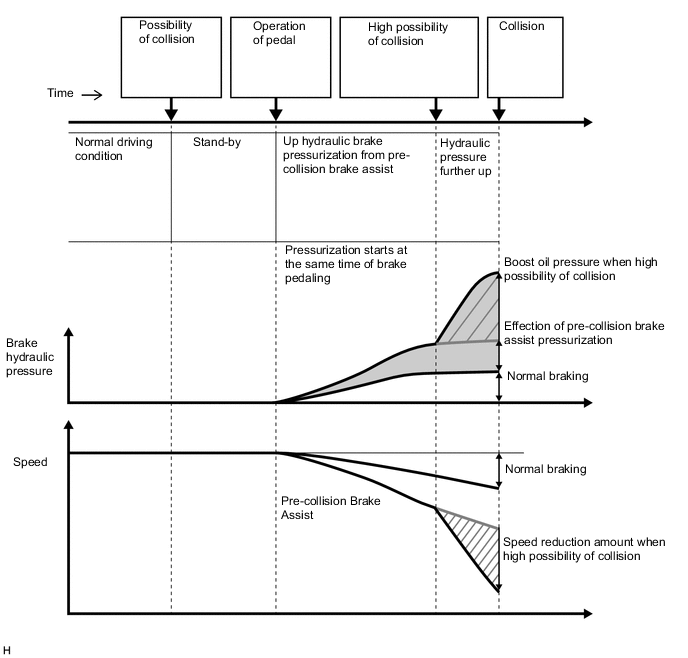
When the driver depresses the brake pedal after the pre-collision system has determined that there is the possibility of a collision, brake fluid pressure is increased. If the possibility of a collision is still high, brake fluid pressure is further increased.
-
-
Pre-collision Brake
-
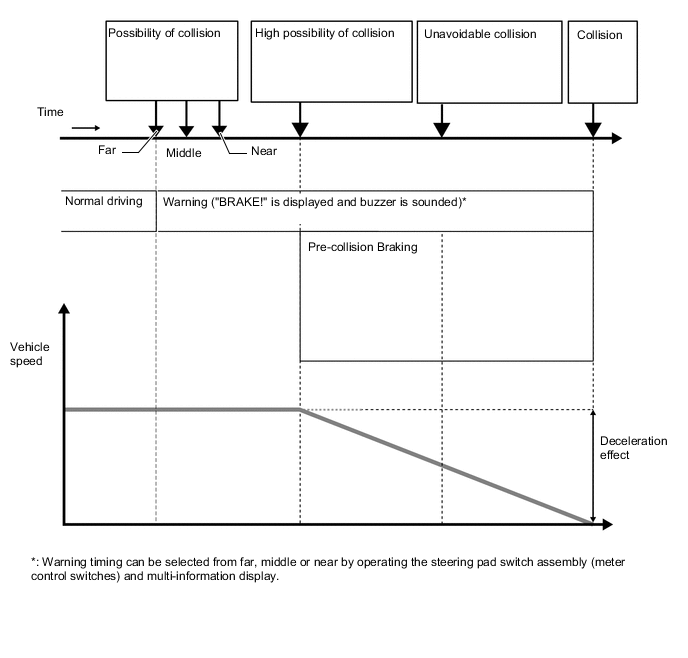
When the pre-collision system detects an object such as a vehicle or pedestrians* in front of the vehicle and determines that the possibility of a collision is high, the system displays a warning message on the multi-information display, and sounds the buzzer to warn the driver.
*: Depending on the region in which the vehicle was sold, the pedestrian detection function may not be available.
-
When the pre-collision system determines high possibility of collision, the system performs pre-collision braking control.
-
-
-
DIAGNOSIS
-
Initial Check
-
The driving support ECU assembly performs an initial check on the system for approximately 3 seconds after the power switch has been turned on (IG).
-
-
Monitor Function
-
After completing the initial check, the pre-collision system becomes ready to operate. During this time, the driving support ECU assembly periodically monitors the system for any malfunctions.
-
-
Diagnostic Trouble Code (DTC)
-
If the driving support ECU assembly detects a malfunction in the pre-collision system, it stores a 5 digit Diagnostic Trouble Code (DTC) in memory.
-
-