PRE-COLLISION SYSTEM
-
OUTLINE
-
Lexus Safety System+
-
The "Lexus Safety System+" consists of the following drive assist systems and contributes to a safe and confortable driving experience:
-
Pre-collision System (PCS)
-
Dynamic Radar Cruise Control System
-
Automatic High Beam (AHB)
-
Lane Departure Alert with steering control (LDA)
-
Road Sign Assist (RSA) system (Models for Europe)
-
-
-
Pre-collision System (PCS)
-
The pre-collision system helps to lessen the damage sustained in a collision by operating in unison with warning device and brake systems.
-
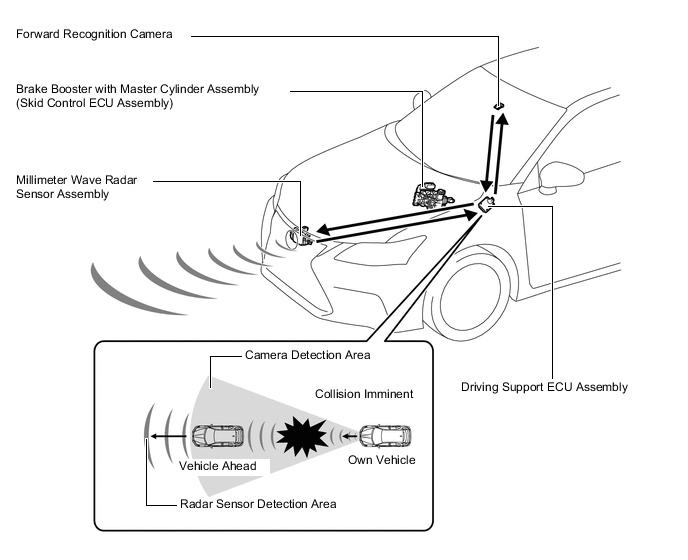
The pre-collision system detects the vehicle and pedestrian in front of the vehicle based on both data from a forward recognition camera and millimeter wave radar sensor.
-
If the pre-collision system determines that the possibility of a collision is high, pre-collision control and pre-collision brake assist control is performed, and if a collision is imminent, pre-collision braking control will be performed to help avoid and reduce the impact of the collision.
-
Depending on the region in which the vehicle was sold, the pedestrian detection function may not be available.
-
The function of pre-collision system for destination are as follows:
Destination Pedestrian Detection Function Pre-collision Brake Assist Function Pre-collision Braking Function Europe X*1*2 X*1 X*1 China - X X Australia X*3 X*3 X*3 Thailand, Taiwan and South Africa - X X Israel X X X X: Available
-: Not available
*1: Destination for Canary Islands is included
*2: Except destination for Ukraine
*3: Destination for New Zealand is included
-
-
-
PRECAUTION
-
Lexus Safety System+
-
The Lexus Safety System+, is designed to operate under the assumption that the driver will drive safely, and is designed to help reduce the impact to the occupants and the vehicle in the case of a collision or assist the driver in normal driving conditions.
-
As there is a limit to the degree of recognition accuracy and control performance that this system can provide, do not overly rely on this system. The driver is always responsible for paying attention to the vehicle's surroundings and driving safely.
-
-
Limitations of the pre-collision system
-
The driver is solely responsible for safe driving. Always drive safely, taking care to observe your surroundings.
Do not use the pre-collision system instead of normal braking operations under any circumstances. This system will not prevent collisions or lessen collision damage or injury in every situation. Do not overly rely on this system. Failure to do so may lead to an accident, resulting in death or serious injury.
-
Although this system is designed to help avoid a collision or help reduce the impact of the collision, its effectiveness may change according to various conditions, therefore the system may not always be able to achieve the same level of performance.
Read the following conditions carefully. Do not overly rely on this system and always drive carefully.
-
Do not attempt to test the operation of the pre-collision system yourself, as the system may not operate properly, possibly leading to an accident.
-
-
Pre-collision braking*1
-
When the pre-collision braking function is operating, a large amount of braking force will be applied.
-
If the vehicle is stopped by the operation of the pre-collision braking function, the pre-collision braking function operation will be canceled after approximately 2 seconds. Depress the brake pedal as necessary.
-
The pre-collision braking function may not operate if certain operations are performed by the driver. If the accelerator pedal is being depressed strongly or the steering wheel is being turned, the system may determine that the driver is taking evasive action and possibly prevent the pre-collision braking function from operating.
-
In some situations, while the pre-collision braking function is operating, operation of the function may be canceled if the accelerator pedal is depressed strongly or the steering wheel is turned and the system determines that the driver is taking evasive action.
-
If the brake pedal is being depressed, the system may determine that the driver is taking evasive action and possibly delay the operation timing of the pre-collision braking function.
*1: Depending on the region in which the vehicle was sold, the pre-collision braking function may not be available.
-
-
Pedestrian detection function*2
-
The pre-collision system detects pedestrians based on the size, profile, and motion of a detected object. However, a pedestrian may not be detected depending on the surrounding brightness and the motion, posture, and angle of the detected object, preventing the system from operating properly.
*2: Depending on the region in which the vehicle was sold, the pedestrian detection function may not be available.

-
-
When to disable the pre-collision system
-
In the following situations, disable the system, as it may not operate properly, possibly leading to an accident resulting in death or serious injury:
-
When the vehicle is being towed.
-
When your vehicle is towing another vehicle.
-
When transporting the vehicle via truck, boat, train or similar means of transportation.
-
When the vehicle is raised on a lift with the power switch on (READY) and the tires are allowed to rotate freely.
-
When inspecting the vehicle using a drum tester such as a chassis dynamometer or speedometer tester, or when using an on vehicle wheel balancer.
-
When a strong impact is applied to the front bumper or front grille, due to an accident or other reasons.
-
If the vehicle cannot be driven in a stable manner, such as when the vehicle has been in an accident or is malfunctioning.
-
When the vehicle is driven in a sporty manner or off-road.
-
When the tires are not properly inflated.
-
When the tires are very worn.
-
When tires of a size other than specified are installed.
-
When tire chains are installed.
-
When a compact spare tire or an emergency tire puncture repair kit is used.
-
If equipment (snow plow, etc.) that may obstruct the millimeter wave radar sensor assembly or forward recognition camera is temporarily installed to the vehicle.
-
-
-
Situations in which the system may not operate properly
-
In some situations such as the following, a vehicle may not be detected by the millimeter wave radar sensor assembly and forward recognition camera, preventing the system from operating properly:
-
If an oncoming vehicle is approaching your vehicle.
-
If a vehicle ahead is a motorcycle or bicycle.
-
When approaching the side or front of a vehicle.
-
If a preceding vehicle has a small rear end, such as an unloaded truck.
-
If a preceding vehicle has a low rear end, such as a low bed trailer.

-
If a vehicle ahead is carrying a load which protrudes past its rear bumper.
-
If a vehicle ahead has extremely high ground clearance.

-
If a vehicle ahead is irregularly shaped, such as a tractor or side car.
-
If the sun or other light is shining directly on a vehicle ahead.
-
If a vehicle cuts in front of your vehicle or emerges from beside a vehicle.
-
If a vehicle ahead makes an abrupt maneuver (such as sudden swerving,acceleration or deceleration).
-
When suddenly cutting behind a preceding vehicle.
-
When a vehicle ahead is not directly in front of your vehicle.

-
When driving in inclement weather such as heavy rain, fog, snow, or a sandstorm.
-
When the vehicle is hit by water, snow, dust, etc. from a vehicle ahead.
-
When driving through steam or smoke.
-
When driving in a place where the surrounding brightness changes suddenly, such as at the entrance or exit of a tunnel.
-
When a very bright light, such as the sun or the headlights of oncoming traffic, shines directly into the forward recognition camera.
-
When the surrounding area is dim, such as at dawn or dusk, or while at night or in a tunnel.
-
After the hybrid system has started the vehicle has not been driven for a certain amount of time.
-
While making a left/right turn and for a few seconds after making a left/right turn.
-
While driving on a curve and for a few seconds after driving on a curve.
-
If your vehicle is skidding.
-
If the front of the vehicle is raised or lowered.

-
If the wheels are misaligned.
-
If a wiper blade is blocking the forward recognition camera.
-
The vehicle is wobbling.
-
The vehicle is being driven at extremely high speeds.
-
When driving on a hill.
-
If the millimeter wave radar sensor assembly or forward recognition camera is misaligned.
-
-
In some situations such as the following, sufficient braking force may not be obtained, preventing the system from performing properly:
-
If the braking functions cannot operate to their full extent, such as when the brake parts are extremely cold, extremely hot, or wet.
-
If the vehicle is not properly maintained (brakes or tires are excessively worn, improper tire inflation pressure, etc.).
-
When the vehicle is being driven on a gravel road or other slippery surface.
-
-
Some pedestrians such as the following may not be detected by the millimeter wave radar sensor assembly and forward recognition camera, preventing the system from operating properly*2:
-
Pedestrians shorter than approximately 1m (3.2 ft.) or taller than approximately 2m (6.5 ft.).
-
Pedestrians wearing oversized clothing (a rain coat, long skirt, etc.), making their silhouette obscure.
-
Pedestrians who are carrying large baggage, holding an umbrella, etc., hiding part of their body.
-
Pedestrians who are bending forward or squatting.
-
Pedestrians who are pushing a stroller, wheelchair, bicycle or other vehicle.
-
Groups of pedestrians which are close together.
-
Pedestrians who are wearing white and look extremely bright.
-
Pedestrians in the dark, such as at night or while in a tunnel.
-
Pedestrians whose clothing appears to be nearly the same color or brightness as their surroundings.
-
Pedestrians near walls, fences, guardrails, or large objects.
-
Pedestrians who are on a metal object (manhole cover, steel plate, etc.) on the road.
-
Pedestrians who are walking fast.
-
Pedestrians who are changing speed abruptly.
-
Pedestrians running out from behind a vehicle or a large object.
-
Pedestrians who are extremely close to the side of the vehicle (outside rear view mirror, etc.).
*2: Depending on the region in which the vehicle was sold, the pedestrian detection function may not be available.
-
-
-
If the PCS warning lights illuminates and a warning message is displayed on the multi-information display
-
The pre-collision system may be temporarily unavailable or there may be a malfunction in the system.
-
In the following situations, the warning light will turn off, the message will disappear and the system will become operational when normal operating conditions return:
-
When the millimeter wave radar sensor assembly or forward recognition camera or the area around either sensor is hot, such as in the sun.
-
When the millimeter wave radar sensor assembly or forward recognition camera or the area around either sensor is cold, such as in an extremely cold environment.
-
When the millimeter wave radar sensor assembly or front grille emblem is dirty or covered with snow, etc.
-
When the part of the windshield in front of the forward recognition camera is fogged up or covered with condensation or ice.
-
If the forward recognition camera is obstructed, such as when the hood is open or a sticker is attached to the windshield near the forward recognition camera.
-
If the PCS warning light continues to illuminates or the warning message does not disappear, the system may be malfunctioning. Have the vehicle inspected by any authorized Lexus dealer or repairer, or another duly qualified and equipped professional immediately.
-
-
-
To avoid malfunction of the millimeter wave radar sensor assembly
-
Observe the following precautions.
-
Otherwise, the millimeter wave radar sensor assembly may not operate properly, possibly leading to an accident resulting in death or serious injury.
-
Keep the millimeter wave radar sensor assembly and front grille emblem clean at all times.
If the front of the millimeter wave radar sensor assembly or the front or back of the front grille emblem is dirty or covered with water droplets, snow, etc., clear it.
Clean the millimeter wave radar sensor assembly and front grille emblem with a soft cloth so you do not mark or damage them.
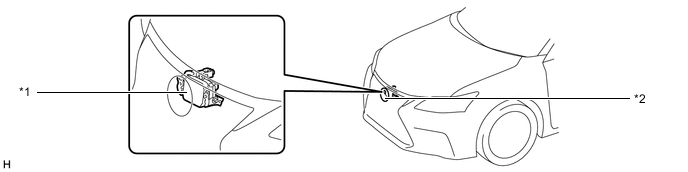
*1 Millimeter Wave Radar Sensor Assembly *2 Front Grille Emblem -
Do not attach accessories, stickers (including transparent stickers) or other items to the millimeter wave radar sensor assembly, front grille emblem or surrounding area.
-
Do not subject the millimeter wave radar sensor assembly or surrounding area to a strong impact.
If the millimeter wave radar sensor assembly, front grille, or front bumper has been subjected to a strong impact, have the vehicle inspected by any authorized Lexus dealer or repairer, or another duly qualified and equipped professional.
-
Do not disassemble the millimeter wave radar sensor assembly.
-
Do not modify or paint the millimeter wave radar sensor assembly, front grille emblem or surrounding area.
-
If the millimeter wave radar sensor assembly, front grille, or front bumper needs to be removed and installed, or replaced, contact any authorized Lexus dealer or repairer, or another duly qualified and equipped professional.
-
-
-
To avoid malfunction of the forward recognition camera
-
Observe the following precautions.
-
Otherwise, the forward recognition camera may not operate properly, possibly leading to an accident resulting in death or serious injury.
-
Keep the windshield clean at all times.
-
If the windshield is dirty or covered with an oily film, water droplets, snow, etc., clear the windshield.
-
If a glass coating agent is applied to the windshield, it will still be necessary to use the windshield wipers to remove water droplets, etc. from the area of the windshield in front of the forward recognition camera.
-
If the inner side of the windshield where the forward recognition camera is installed is dirty, contact any authorized Lexus dealer or repairer, or another duly qualified and equipped professional.
-
Do not attach objects, such as stickers, transparent stickers, etc., and so forth, to the outer side of the windshield in front of the forward recognition camera (shaded area in the illustration).

*a From the top of the windshield to approximately 0.4 in. (1 cm) below the bottom of the forward recognition camera *b Approximately 7.9 in. (20 cm) (Approximately 4.0 in. (10 cm) to the right and left from the center of the forward recognition camera) -
If the part of the windshield in front of the forward recognition camera is fogged up or covered with condensation or ice, use the windshield defogger to remove the fog, condensation or ice.
-
If water droplets cannot be properly removed from the area of the windshield in front of the forward recognition camera by the windshield wipers, replace the wiper insert or wiper blade.
-
Do not attach window tinting to the windshield.
-
Replace the windshield if it is damaged or cracked.
If the windshield needs to be replaced, contact any authorized Lexus dealer or repairer, or another duly qualified and equipped professional.
-
Do not get the forward recognition camera wet.
-
Do not allow bright lights to shine into the forward recognition camera.
-
Do not dirty or damage the forward recognition camera.
When cleaning the inside of the windshield, do not allow glass cleaner to contact the lens. Also, do not touch the lens.
If the lens is dirty or dameged, contact any authorized Lexus dealer or repairer, or another duly qualified and equipped professional.
-
Do not subject the forward recognition camera to a strong impact.
-
Do not change the installation position or direction of the forward recognition camera or remove it.
-
Do not disassemble the forward recognition camera.
-
Do not Modify any components of the vehicle around the forward recognition camera (inside rear view mirror, etc.) or ceiling.
-
Do not attach any accessories that may obstruct the forward recognition camera to the hood, front grille or front bumper. Contact any authorized Lexus dealer or repairer, or another duly qualified and equipped professional for details.
-
If a surfboard or other long object is to be mounted on the roof, make sure that it will not obstruct the forward recognition camera.
-
Do not modify the headlights or other lights.
-
-
-