ENTRY AND START SYSTEM
-
FUNCTION OF MAIN COMPONENTS
-
The main components for the start function have the following functions:
Component Function Power Switch (Transponder Key Amplifier)
-
Transmits the power switch signal to the power management control ECU.
-
Informs the driver of any power source or system abnormality through the illumination stage of the indicator light.
-
Receives the ID code and transmits it to the certification ECU (smart key ECU assembly) when the key battery is too weak to respond to the tuner based on the signals from the room oscillators.
Key Receives the signals from the oscillators and returns the ID code to the door control receiver. Indoor Electrical Key Oscillator (Front, Center and Rear) Receives a request signal from the certification ECU (smart key ECU assembly) and forms the actuation area in the vehicle. Door Control Receiver Receives the ID code from the key and transmits it to the certification ECU (smart key ECU assembly). Power Management Control ECU
-
Switches the power source ("power switch") among 4 modes (off, on (ACC), on (IG), start) in accordance with the shift state and the brake pedal signal.
-
Controls the entry and start system in accordance with the signals received from the switches and each ECU.
-
Receives the signal from the ID code box (immobiliser code ECU) and performs hybrid system.
Certification ECU (Smart Key ECU Assembly)
-
Certifies the ID code received from the door control receiver and transmits the certification results to the ID code box (immobiliser code ECU) and transmission control ECU assembly.
-
Transmits the shift control lock/unlock signals.
-
Transmits the engine immobiliser set/unset request signals.
ID Code Box (Immobiliser Code ECU) Receives the shift lock control unlock or engine immobiliser set/unset request signals from the certification ECU (smart key ECU assembly), certifies them, and transmits each set/unset request signal to the transmission control ECU assembly or Power Management Control ECU. Stop Light Switch Assembly Outputs the state of the brake pedal to the power management control ECU. Transmission Control ECU Assembly Receives the shift control unlock/lock request signal from the ID code box (immobiliser code ECU), and activates the shift control actuator assembly. Combination Meter Assembly Multi-information Display The following warning messages appear to alert the driver.
-
KEY NOT DETECTED
-
SHIFT TO P POSITION
-
DEPRESS BRAKE PEDAL AND PUSH POWER SWITCH TO START
-
KEY BATTERY LOW
-
SHIFT TO P POSITION TO START
-
DEPRESS BRAKE PEDAL, TOUCH POWER SWITCH WITH KEY
Master Warning Light Illuminates simultaneously with multi-information display message to inform the driver of malfunctions in the entry and start system. Buzzer Sounds to inform the driver of malfunctions in the entry and start system. -
-
The main components in the entry function have the following functions:
Component Function Key
-
Outputs information such as the key ID and vehicle ID when request signals that are output by the room and door oscillators are received.
-
Outputs a request signal when the lock or unlock button on the key is pushed.
-
Outputs information such as the key ID and vehicle ID when the radio wave that is output by the transponder key amplifier in the power switch is received.
-
Has an integrated mechanical key that can be used to unlock the doors when the key battery is weak.
Main Body ECU (Multiplex Network Body ECU)
-
Receives a request signal from the certification ECU (smart key ECU assembly) and actuates the door lock motors to unlock or lock all the doors and back door.
-
Transmits the condition of each door and the back door to the certification ECU (smart key ECU assembly).
Certification ECU (Smart Key ECU Assembly)
-
Certifies the ID code received from the door control receiver and transmits the certification results to the main body ECU (multiplex network body ECU).
-
Controls the oscillators and touch sensors.
-
Transmits the door lock/unlock request signals during the entry function.
Outside Door Handle Door Electrical Key Oscillator Receives a request signal from the certification ECU (smart key ECU assembly), and creates an actuation area around each front door. Lock Sensor Transmits door lock request signals to the certification ECU (smart key ECU assembly). Touch Sensor Detects when a person touches the inside of an outer door handle. Outside Electrical Key Oscillator (Back Door) Receives a request signal from the certification ECU (smart key ECU assembly), and forms an actuation area around the back door. Indoor Electrical Key Oscillator (Front, Center and Rear) Receives a request signal from the certification ECU (smart key ECU assembly) and forms a actuation area in the vehicle. Door Control Receiver Receives the ID code from the key and transmits it to the certification ECU (smart key ECU assembly). Back Door Opener Switch Assembly Back Door Opener Switch Transmits a back door open request signal to the certification ECU (smart key ECU assembly). Back Door Lock Switch Transmits a back door lock request signal to the certification ECU (smart key ECU assembly). Combination Meter Assembly Multi-information Display The following warning messages appear to alert the driver.
-
KEY NOT DETECTED
-
SHIFT TO P POSITION AND PUSH POWER SWITCH TO TURN POWER OFF
-
KEY BATTERY LOW
-
KEY DETECTED IN VEHICLE
-
TURN POWER OFF
Master Warning Light Illuminates simultaneously with multi-information display message to inform the driver of malfunctions in the entry and start system. Buzzer Sounds to inform the driver of malfunctions in the entry and start system. Wireless Door Lock Buzzer Sounds to inform the driver of malfunctions in the entry and start system.* *: Models except for Europe and China
-
-
-
OPERATION
-
The special functions of the entry and start system only work when the key is in the actuation area formed by the 6 oscillators (with entry function) or 3 oscillators (without entry function).
-
The indoor electrical key oscillator (front), indoor electrical key oscillator (center), and indoor electrical key oscillator (rear) form the interior actuation area.
-
The door electrical key oscillator LH, door electrical key oscillator RH, and outside electrical key oscillator (back door) form the exterior actuation area.*
*: Models with entry function
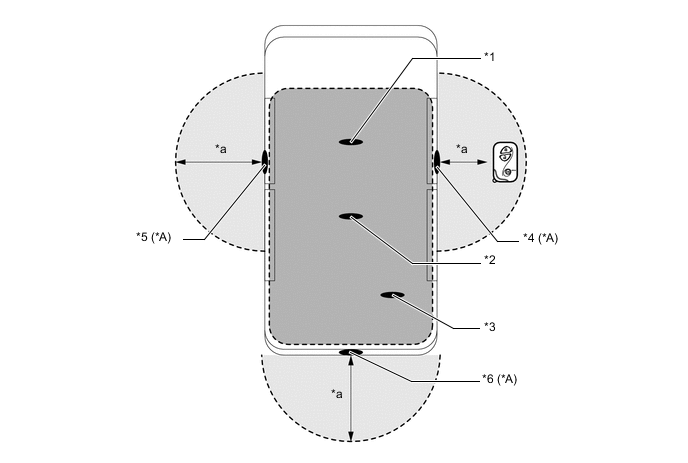
Text in Illustration *A Models with Entry Function - - *1 Indoor Electrical Key Oscillator (Front) *2 Indoor Electrical Key Oscillator (Center) *3 Indoor Electrical Key Oscillator (Rear) *4 Door Electrical Key Oscillator RH *5 Door Electrical Key Oscillator LH *6 Outside Electrical Key Oscillator (Back Door) *a Approximately 0.7 to 1.0 m (2.3 to 3.3 ft.) - - 
Interior Actuation Area 
Exterior Actuation Area Actuation Area Detail Interior The interior actuation area of the indoor electrical key oscillators (front, center and rear) is formed when the driver door is opened or closed, when the power switch is pushed, when a warning is activated, or when a lock sensor is on. Exterior The exterior actuation area formed by the door electrical key oscillators (LH, RH) and outside electrical key oscillator (back door) is approximately 0.7 to 1.0 m (2.3 to 3.3 ft.) from the outside handle of the front doors, or the center of the rear bumper. Around Front Doors The exterior actuation area of the door electrical key oscillators (LH, RH) is formed by transmitting a request signal every 0.25 seconds while the power switch is off and each door is locked. In this way it detects the presence of a key. When locking the door using the lock sensor on the outer door handle, the actuation area is formed when the lock sensor is touched. Around Back Door
-
The exterior actuation area of the outside electrical key oscillator (back door) is formed when the back door opener switch is on.
-
The exterior actuation area of the outside electrical key oscillator (back door) is formed when the door lock switch (back door) is on.
-
-
-
SYSTEM CONTROL
-
Start Function
-
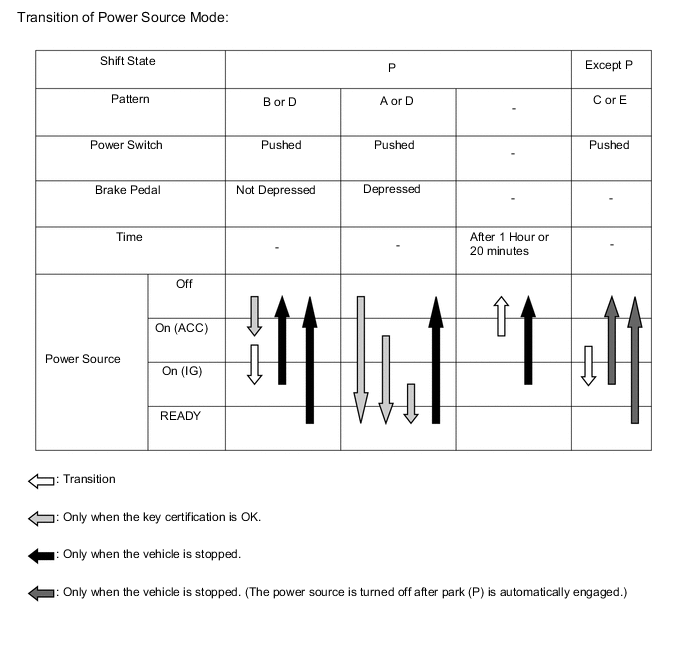
The start function has different power source patterns to suit the brake pedal and shift state.
Pattern Brake Pedal Shift State Power Source Pattern A Depressed P When the power switch is pushed once.
-
Off → READY (The hybrid system is started)
B Not Depressed P Each time the power switch is pushed.
-
Off → On (ACC) → On (IG) → Off
C - Except P Each time the power switch is pushed.
-
On (ACC) → On (IG)
D - P When the power switch is pushed in the on (IG) or READY condition.
-
On (IG) or READY → Off
E - Except P When the power switch is pushed in the on (IG) or READY condition.
-
On (IG) or READY → Off
Note
-
Normally, the operation of the power switch is disabled while the vehicle is being driven. However, in an emergency, by pushing the power switch 3 times or more in a row or pushing the power switch for approximately 2 seconds or more, the driver can stop the hybrid system while the vehicle is in motion.
-
If no signals are transmitted to the power management control ECU assembly due to malfunctions in the stop light switch assembly or transmission control ECU assembly, the hybrid system may not start when the power switch is pushed with the brake pedal depressed. In such cases, performing the following procedure may enable the hybrid system to start: 1) push the power switch to turn the power source from off to on (ACC), and 2) push the power switch again and hold it for 15 seconds or more.
-
The above 2 operations must be applied only in emergency situations. Under normal conditions, the hybrid system must not be stopped by pushing the power switch while driving. Also, it should not be started without depressing the brake pedal or when a shift state other than park (P) has been selected.
-
-
Pattern A: Off → READY (Hybrid system is started)
Step System Operation (1) The driver, carrying the key, enters the vehicle. (2) When the brake pedal is depressed with the following conditions satisfied, the power management control ECU recognizes the stop light switch assembly signal and transmits the key certification request to the certification ECU (smart key ECU assembly):
-
Park (P) has been selected.
-
The power source is off.
(3) The certification ECU (smart key ECU assembly) receives the certification request and transmits a request signal to the oscillators (front, center and rear). These oscillators then form an actuation area. (4) The moment the key receives the request signal, it transmits its ID code to the door control receiver. The signal includes the response code. (5) The door control receiver receives this code and transmits it to the certification ECU (smart key ECU assembly). (6) The certification ECU (smart key ECU assembly) judges and certifies the ID code, and transmits a key certification OK signal to the power management control ECU. (7) Due to the brake pedal being depressed, the power management control ECU turns on the green indicator light of the power switch. (8) The driver pushes the power switch once, while the green indicator light of the power switch is illuminated. 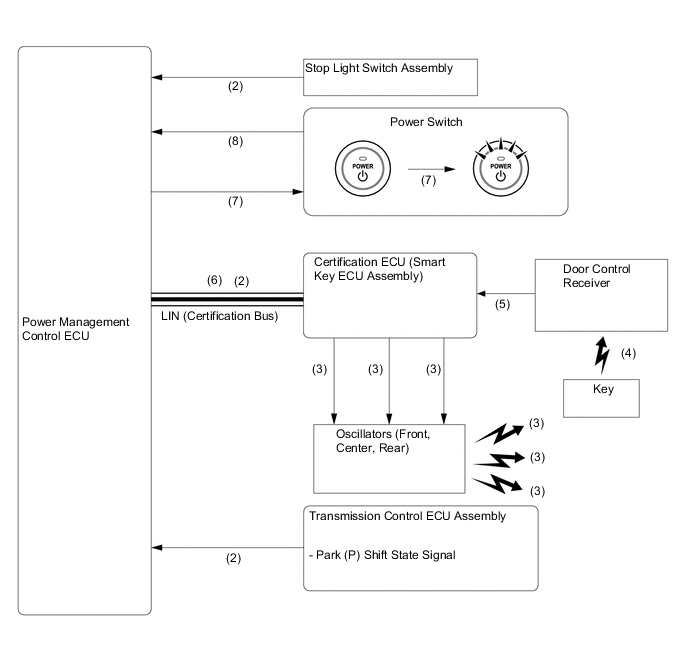
Step System Operation (9) After receiving the key certification OK signal, the power management control ECU turns on the ACC relay, and then turns on the IG1 and IG2 relays. (10) The certification ECU (smart key ECU assembly) checks that the power source has turned from off to on (IG), and transmits a shift control unlock signal to the power management control ECU and ID code box (immobiliser code ECU). (11) The transmission control ECU assembly receives the unlock signal via the ID code box (immobiliser code ECU), and releases the shift control lock. (12) After checking that shift control unlock permission has occurred, the certification ECU (smart key ECU assembly) transmits an engine immobiliser disengage signal to the ID code box (immobiliser code ECU). (13) The ID code box (immobiliser code ECU) certifies the disengage signal of the certification ECU (smart key ECU assembly), transmits the engine immobiliser disengage signal to the power management control ECU, and disengages the engine immobiliser. 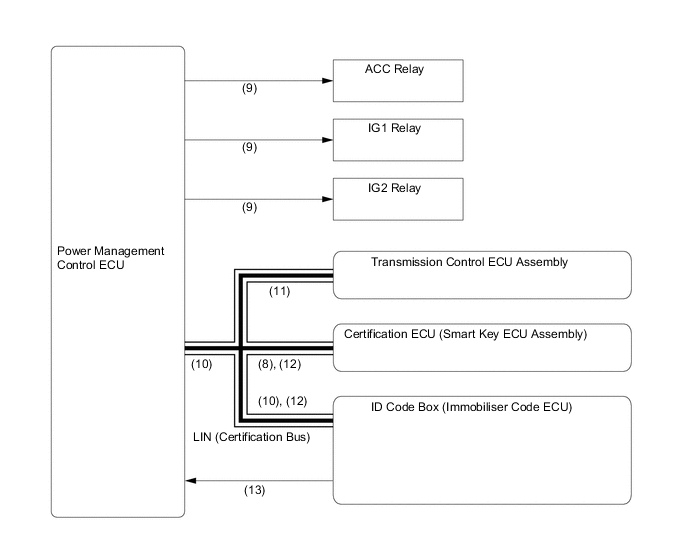
Step System Operation (14) After checking that shift control unlock permission has occurred, the power management control ECU starts the hybrid system. (15) The power management control ECU checks that the hybrid system has started and turns off the indicator light of the power switch. 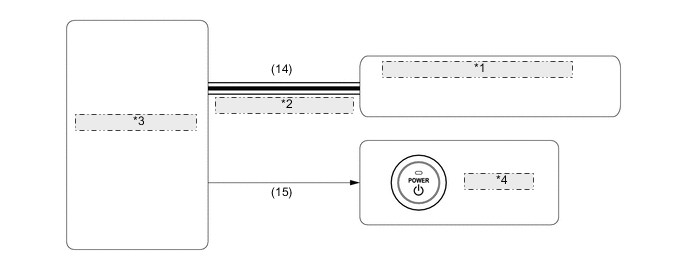
*1 Transmission Control ECU Assembly *2 LIN (Certification Bus) *3 Power Management Control ECU *4 Power Switch -
-
Pattern B: Off → On (ACC) → On (IG) → Off
Off → On (ACC) Step System Operation (1) The driver, carrying the key, enters the vehicle. (2) When the power switch is pushed once with the following conditions satisfied, the power management control ECU recognizes the power switch signal and transmits the key certification request to the certification ECU (smart key ECU assembly).
-
Park (P) has been selected.
-
The brake pedal is not depressed.
-
The power source is off.
(3) This part of the system operation is the same as (3) to (6) in pattern A. (4) The power management control ECU turns on the ACC relays and the amber indicator light of the power switch. (5) The rest of the system operation is the same as (10) to (13) in pattern A. On (ACC) → On (IG) Step System Operation (1) When the power source is on (ACC) and the driver pushes the power switch again, the power management control ECU recognizes the power switch signal and turns on the IG1 and IG2 relays. On (IG) → Off Step System Operation (1) When the power switch is pushed once with the following conditions satisfied, the power management control ECU recognizes the power switch signal and turns off the ACC, IG1 and IG2 relays.
-
Park (P) has been selected.
-
The brake pedal is not depressed.
-
The vehicle speed is 0 km/h (0 mph).
-
The power source is on (IG).
(2) When the power source is changed from on (IG) to off, the power management control ECU will turn off the indicator light of the power switch. (3) When the certification ECU (smart key ECU assembly) recognizes that the power source is off, it transmits the engine immobiliser set signal to the ID code box (immobiliser code ECU). (4) The ID code box (immobiliser code ECU) certifies that the certification ECU (smart key ECU assembly) signal is appropriate, transmits the engine immobiliser set signal to the power management control ECU, and sets the engine immobiliser. (5) The certification ECU (smart key ECU assembly) transmits the shift control lock permission signal to the transmission control ECU assembly. (6) When the transmission control ECU assembly receives the shift control lock request signal, if the ID code box (immobiliser code ECU) certifies that the signal from the certification ECU (smart key ECU assembly) is appropriate, the shift control actuator assembly engages the parking gear. (7) The transmission control ECU assembly transmits the park engagement request signal to the certification ECU (smart key ECU assembly). 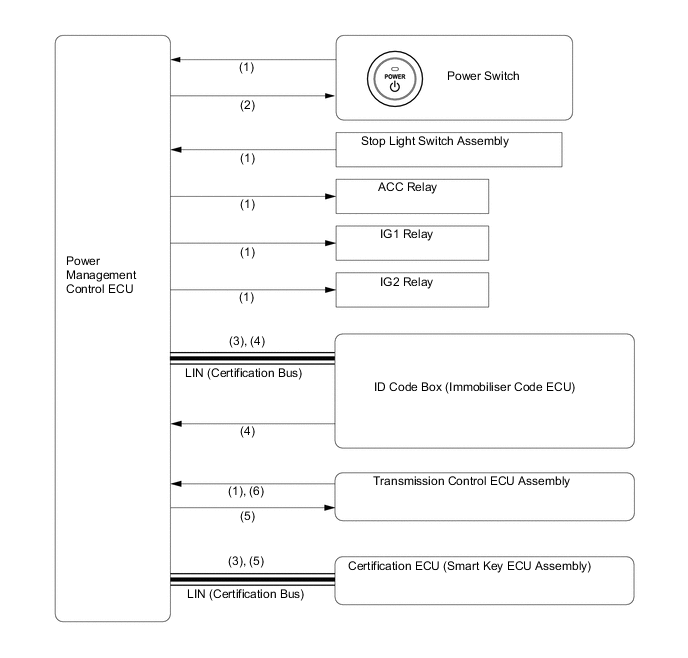
-
-
Pattern C: On (ACC) → On (IG)
Step System Operation (1) The system operations for pattern C (on (ACC) → on (IG)) are the same as those in pattern B. -
Pattern D: On (IG) or READY → Off
Step System Operation (1) When the power switch is pushed once with the following conditions satisfied, the power management control ECU recognizes the power switch signal and turns off the ACC, IG1 and IG2 relays.
-
Park (P) has been selected.
-
The vehicle speed is 0 km/h (0 mph).
-
The power source is READY.
(2) The rest of the system operation is same as (3) to (6) of the "on (IG) → off" in pattern B. -
-
Pattern E: On (IG) or READY → Off
Step System Operation (1) When the power switch is pushed once , the power management control ECU recognizes the power switch signal and turns off the ACC, IG1 and IG2 relays.
-
When a shift state other than park (P) has been selected.
-
The vehicle speed is 0 km/h (0 mph).
-
The power source is READY.
(2) When the power switch is pushed once with the following conditions satisfied, the power management control ECU transmits an automatic park (P) shift state engagement signal to the transmission control ECU assembly. (3) After park has been engaged, the transmission control ECU assembly transmits a completion signal to the power management control ECU. (4) The power management control ECU turns off the ACC, IG1 and IG2 relays. -
-
When the key battery is weak.
Step System Operation (1) To operate the entry and start system when the key battery is weak, depress the brake pedal and hold the key against the power switch as shown in the illustration. (2) The power management control ECU receives the stop light switch assembly signal and transmits a key certification request signal to the certification ECU (smart key ECU assembly). (3) The certification ECU (smart key ECU assembly) does not receive an ID code response from the door control receiver, so it actuates the transponder key amplifier built into the power switch. (4) The transponder key amplifier transmits an engine immobiliser radio wave signal to the key. (5) The key receives the radio wave signal, and returns a radio wave signal response to the transponder key amplifier. (6) The transponder key amplifier combines the key ID codes with the radio wave signal response, and transmits it to the certification ECU (smart key ECU assembly). (7) The certification ECU (smart key ECU assembly) judges and verifies the ID code, and transmits a key certification OK signal to the power management control ECU. The buzzer in the combination meter assembly sounds once and a message appears on the multi-information display for 10 seconds. (8) After the buzzer sounds, if the power switch is pushed within 10 seconds while the brake pedal is depressed, the hybrid system will be started, the same as with normal smart key operation. (9) After the buzzer sounds, if the power switch is pushed within 10 seconds while the brake pedal is not depressed, the power source mode will change to on (ACC) or on (IG), the same as with normal smart key operation. 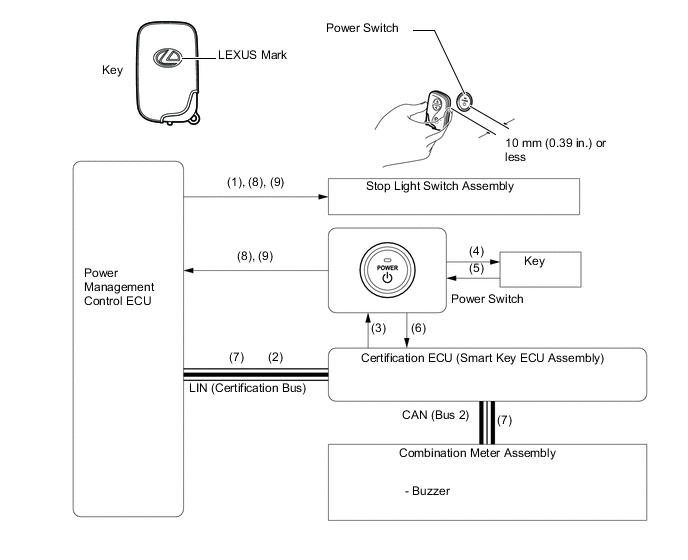
-
-
Entry Function
-
The entry function consists of the following functions:
Function Outline Wireless Door Lock Control This function is a convenient system for locking and unlocking all the doors and back door at a distance. The operation of this function is the same as that in the wireless door lock control system. Entry Illumination When a key enters the exterior actuation area of the door electrical key oscillators (LH and RH), the foot light on the outside rear view mirror, interior light and power switch illumination illuminate. Entry Unlock When a key is located in the exterior actuation area of any door electrical key oscillator, the door will unlock after the inner part of either front outside door handle is touched.
-
The driver outside door handle unlocks the driver door.*2
-
The front passenger outside door handle unlocks all doors.*2
-
The driver outside door handle or front passenger outside door handle unlocks all doors.*1
Entry Lock When a key is located in the exterior actuation area of an electrical key oscillator (driver, front passenger or back door) and the power switch is off, all doors can be locked by simply touching the lock sensor. Back Door Open When a key is in an exterior actuation area of the outside electrical key oscillator (back door), the back door opens manually by simply pushing the back door open switch. Entry Unlock Mode Switching Allows switching between 2 modes that can be operated with the entry unlock function.
-
Driver Door Mode*2
-
All Door Mode*1
Memory Call This function operates the driving position memory system in accordance with the key ID. Prevention of Key Confinement The key confinement prevention function prevents the vehicle from being locked with a key left inside it. This function operates in 2 different situations: when the lock knob is used (keyless lock) and when an outside door handle lock sensor is used (lock sensor). Warning When any of the situations below occur, the entry and start system causes the certification ECU (smart key ECU assembly) to sound the buzzer in the combination meter and the wireless door lock buzzer*3, and indicates a warning on the multi-information display in order to alert the driver.
-
An exit warning is activated if a shift state other than park (P) has been selected.
-
An exit warning is activated if park (P) has been selected and the power switch is in a mode other than off.
-
A warning is activated if the occupant leaves with the key in inappropriate circumstances.
-
A warning is activated if the power switch is operated while the key is outside the actuation area.
-
A warning is activated if the lock button is operated while the key is inside the vehicle.
-
A warning is activated if the key battery is weak.
Battery Saving If the key remains within the exterior actuation area of any electrical key oscillator (driver, front passenger, or luggage compartment door), the system maintains periodic communication with the key. Therefore, if the vehicle remains parked in that state for a long time, the key battery and the vehicle battery could be drained. Key Cancel The following key functions can be cancelled by following certain procedures.
-
Entry unlock/lock
-
Back door open
-
Prevention of key confinement
-
Warning
Key Code Registration A total of 7 keys can be registered. Key registration enables the registering (writing and storing) of transmitter recognition codes in the EEPROM that is contained in the certification ECU (smart key ECU assembly). *1: Default setting is on (models except for G.C.C. Countries and destination package for Australia), default setting is off (models for G.C.C. Countries and destination package for Australia).
*2: Default setting is on (models for G.C.C. Countries and destination package for Australia), default setting is off (except models for G.C.C. Countries and destination package for Australia).
*3: Except models for Europe and China
-
-
The wireless door lock control system allows the following customizable functions:
Function Outline Customizable*1 All Doors Lock Pressing the lock button of the key locks all doors. *2 All Doors Unlock (1-step Unlock) Pressing the unlock button of the key once unlocks all doors. *3 All Doors Unlock (2-step Unlock) Pressing the unlock button of the key twice within 3 seconds unlocks all doors after it first unlocks the driver's door. *4 Answer Back When the doors are being locked or unlocked using the key, the wireless door lock buzzer sounds*5 and the hazard warning lights blink once while locking and twice while unlocking. Also, the answer back function operates when the doors are locked by the automatic relock function. *2 Automatic Relock If none of the doors are opened within 30 seconds after they are unlocked using the wireless door lock remote control, all the doors will be locked again automatically. *2 Panic Alarm*6 Keeping the panic button of the key pushed longer than about 0.8 seconds causes the following to activate as an alarm:
-
The horn is sounded.
-
The hazard warning lights are flashed.
*2 Repeat If a door is not locked in response to the locking operation of the key, the main body ECU (multiplex network body ECU) will output a lock signal again after 1 second elapses. Standard (Not Customizable) Security Sends a door lock/unlock operation request signal as a rolling code. Standard (Not Customizable) Door Ajar Warning*5 If any door is open or ajar, pushing the lock button of the key will cause the wireless door lock buzzer to sound for about 10 seconds as a warning. Standard (Not Customizable) *1: The customize settings can be turned on/off using the customized body electronics system. For details, refer to the Repair Manual.
*2: Default setting is on
*3: Default setting is on (except models for G.C.C. Countries and destination package for Australia), default setting is off (models for G.C.C. Countries and destination package for Australia)
*4: Default setting is on (models for G.C.C. Countries and destination package for Australia), default setting is off (except models for G.C.C. Countries and destination package for Australia)
*5: Except models for Europe and China
*6: Models with Panic Alarm
-
-
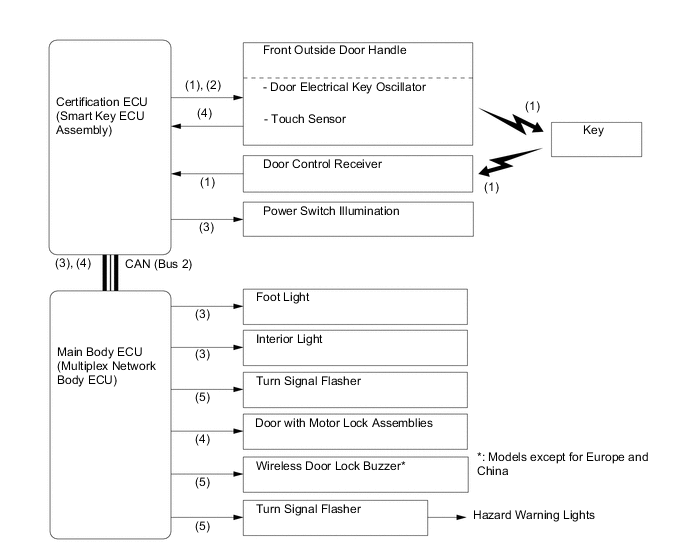
Entry Unlock
Step System Operation (1) When the key enters the exterior actuation area of a front door, the certification ECU (smart key ECU assembly) judges and certifies the key ID code received from the door control receiver. (2) After the key certification OK is confirmed, the certification ECU (smart key ECU assembly) transmits an unlock stand-by signal to the touch sensor of the relevant door. (3) At the same time, the certification ECU (smart key ECU assembly) turns on the power switch illumination and transmits lighting signals to the main body ECU (multiplex network body ECU) to turn on the interior lights and foot lights on the outside rear view mirror (entry illumination function). (4)
-
If the touch sensor of the relevant door is touched in this condition, the certification ECU (smart key ECU assembly) transmits a door unlock request signal to the main body ECU (multiplex network body ECU), and unlocks all doors.
-
The driver outside door handle unlocks the driver door.*2
-
The front passenger outside door handle unlocks all doors.*2
-
The driver outside door handle or front passenger door unlocks the all doors.*1
-
The back door lock switch assembly (back opener switch) unlocks all doors.
(5) The main body ECU (multiplex network body ECU) sounds the wireless door lock buzzer twice*3, and flashes the hazard warning lights twice, as an answer back for entry unlock. *1: Default setting is on (except models for G.C.C. Countries and destination package for Australia), default setting is off (models for G.C.C. Countries and destination package for Australia).
*2: Default setting is on (models for G.C.C. Countries and destination package for Australia), default setting is off (except models for G.C.C. Countries and destination package for Australia).
*3: Except models for Europe and China
-
-
Entry Unlock Mode Switching
Step System Operation (1) When the power switch is off, push the lock button and one of the other buttons on the key at the same time for approximately 5 seconds while the key is in the actuation area. (2) The certification ECU (smart key ECU assembly) receives this signal from the door control receiver and switches the entry unlock mode. (3) The main body ECU (multiplex network body ECU) sounds the wireless door lock buzzer* to inform the user that the mode has been switched. (4) If the entry unlock mode needs to be switched again, push the lock button and one of the other three buttons on the key at the same time for approximately 5 seconds after the LED of the key goes off. *: Except models for Europe and China
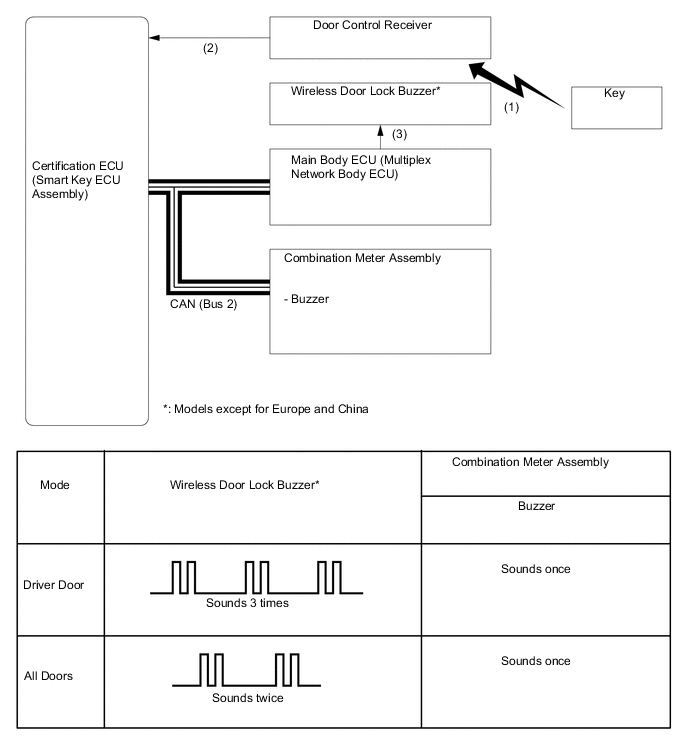
Tech Tips
This function only switches the entry unlock mode of the entry and start system. It is not applied to the unlock function using the wireless door lock control.
-
Entry Lock
Step System Operation (1) An entry lock signal is transmitted to the certification ECU (smart key ECU assembly) when the user, while carrying the key, touches the lock sensor after exiting the vehicle. (2) The certification ECU (smart key ECU assembly) transmits a request signal for the indoor electrical key oscillators (front , center and rear) and electrical key oscillators (driver, front passenger and back door) to form actuation areas. (3) The key receives this signal and returns the ID code to the door control receiver. (4) The certification ECU (smart key ECU assembly) receives the ID code from the door control receiver, and then judges and certifies the ID code. It then checks the location of the key and the ECU transmits a door lock signal to the main body ECU (multiplex network body ECU). (5) The main body ECU (multiplex network body ECU) receives this signal and , if all the doors are closed, actuates the lock motors. (6) The main body ECU (multiplex network body ECU) blinks the hazard warning lights once and sounds the wireless door lock buzzer once* as an answerback for the entry lock function. *: Except models for Europe and China
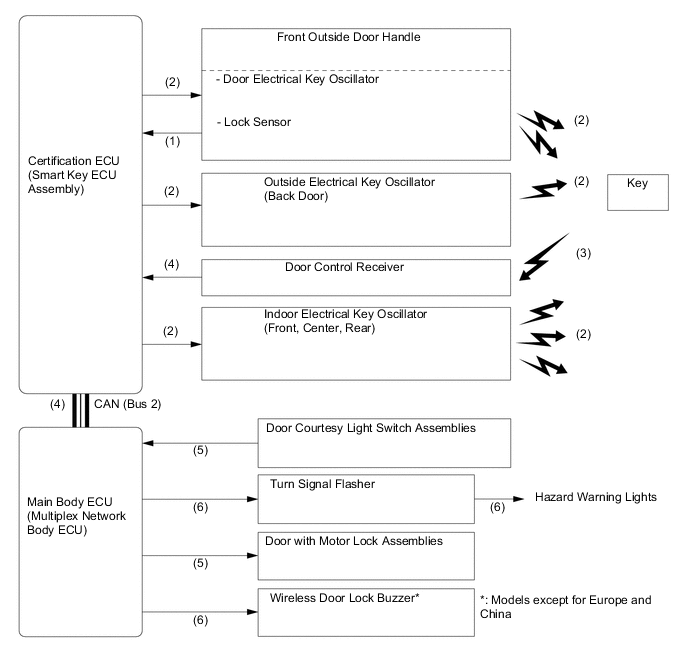
-
Entry Back Door Open
Step System Operation (1) The driver pushes the back door open switch while carrying the key. (2) The certification ECU (smart key ECU assembly) receives a signal from the back door open switch and transmits a request signal for the outside electrical key oscillator (back door) to form the actuation area. (3) The outside electrical key oscillator (back door) emits signals to from the actuation area. (4) The key receives this signal and returns the ID code to the door control receiver. (5) The door control receiver sends the ID code to the certification ECU (smart key ECU assembly). (6) After certifying the ID code, the certification ECU (smart key ECU assembly) transmits a back door open signal to the main body ECU (multiplex network body ECU). The main body ECU (multiplex network body ECU) receives this signal and actuates the motor to open the back door. 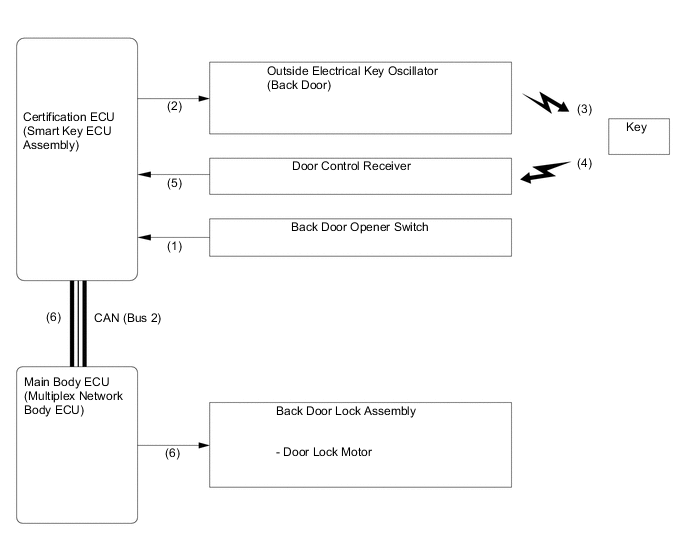
-
Memory Call Function
-
The key linked memory call function uses the ID of a key to automatically restore the seat position (using the driving position memory system), tilt and telescopic position and outside rear view mirror position, increasing driver convenience.
Condition Outline Memory Registration When all the following conditions are met, the key ID will be recorded.
-
The driver door is closed.
-
The power switch is on (IG).
-
The memory switch (M1, M2 or M3) button is pushed and held.
-
The lock or unlock side of the driver door control switch is pushed.
Memory Call Operation After the door is unlocked using the entry system or wireless door lock control function, when the driver door is opened, the memory call function operates. Memory Call Cancel When all the following conditions are met, the memory call function will be disabled.
-
The power switch is on (IG).
-
The driver door is closed.
-
The SET button is pushed and held.
-
The lock or unlock side of the driver door control switch is pushed.
-
-
Memory Registration
Step System Operation (a) Carrying the key to be linked to the seat position memory system, close the door and turn the power switch on (IG). Push and hold the memory switch that is to be linked to the key. (b) While continuing to hold the memory switch, push the lock or unlock side of the driver door control switch. (c) During key ID detection, the buzzer in the position control ECU and switch assembly sounds continuously. (d) The main body ECU (multiplex network body ECU) registers the key ID and each position into memory. (e) When the main body ECU (multiplex network body ECU) completes recording, it beeps the buzzer in the position control ECU and switch assembly for 0.5 seconds as an answer back. When recording faults, it beeps the buzzer in the position control ECU and switch assembly for 3 seconds as an answer back. 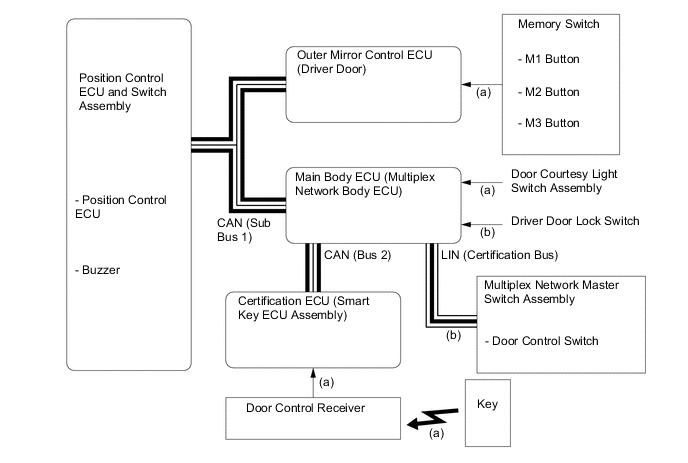
-
Memory Call Operation
Step System Operation (a) When the unlock button on the key is pushed or the key enters the actuation area, the key ID is sent to the certification ECU (smart key ECU assembly) through the door control receiver. (b) The certification ECU (smart key ECU assembly) transmits the key ID to the main body ECU (multiplex network body ECU). (c) If the driver door is opened, the main body ECU (multiplex network body ECU) outputs a key ID memory restoration signal from certification ECU (smart key ECU assembly) to each ECU and activates the drive seat motors. (d) When each ECU receives this signal, it activates its respective actuator. 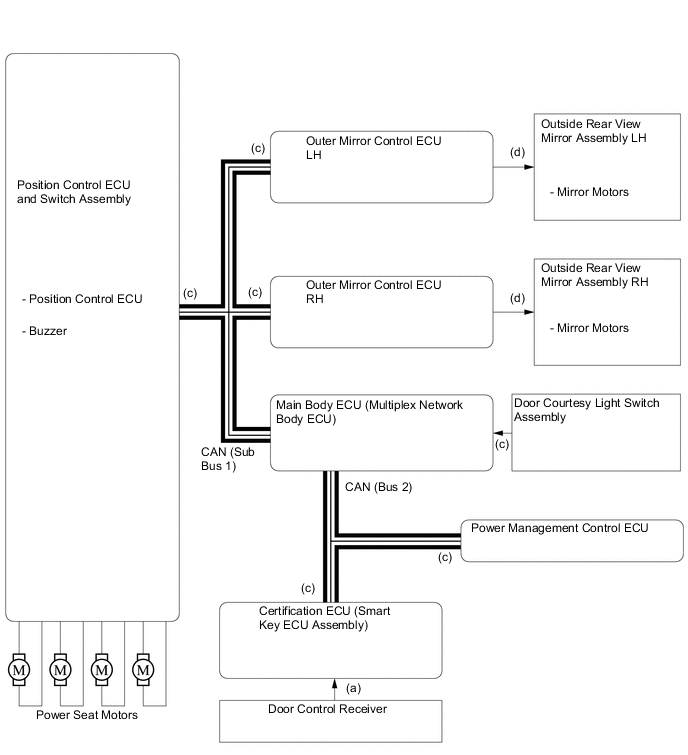
-
Memory Call Cancel
Step System Operation (a) Carrying the key to be linked to the seat position memory system, close the door and turn the power switch on (IG). (b) Push and hold the SET switch, then push the lock or unlock side of the driver door lock switch. (c) During key ID detection, the buzzer in the position control ECU and switch assembly sounds continuously. (d) If the key ID has already been registered, the main body ECU (multiplex network body ECU) will cancel the key ID memory call function. To use the key ID memory call function again, it is necessary to re-register the key ID. (e) When the main body ECU (multiplex network body ECU) completes canceling, it beeps the buzzer in the position control ECU and switch assembly twice for 0.1 second as an answer back.
When canceling is unsuccessful, it beeps the buzzer in the position control ECU and switch assembly for 3 seconds as an answer back.
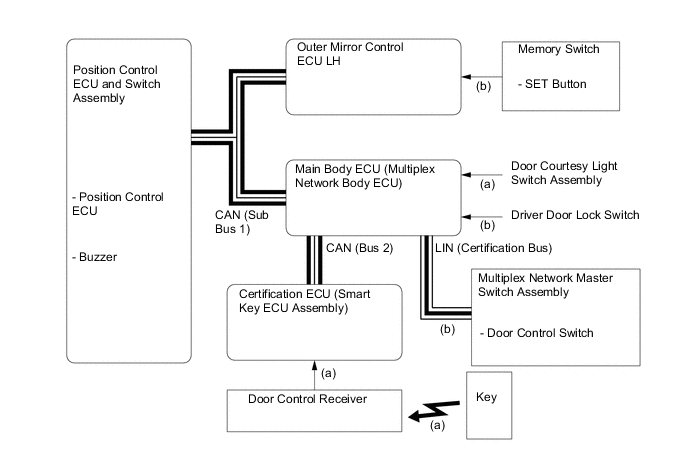
-
-
Prevention of Key Confinement
-
The key confinement prevention function prevents the key from being locked inside the vehicle. This function operates in 2 different situations: keyless lock and lock sensor.
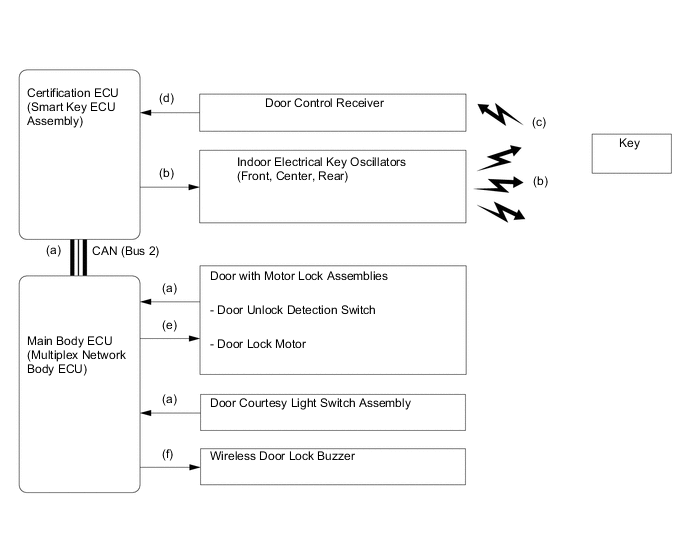
Keyless Lock (Doors locked using lock knobs:) Step System Operation (a) When the door is locked by the lock knob in the inside door handle while the key is still in the vehicle, the main body ECU (multiplex network body ECU) receives this signal and transmits the door condition signal to the certification ECU (smart key ECU assembly). (b) The certification ECU (smart key ECU assembly) transmits a request signal for the indoor electrical key oscillators (front, center, rear) form actuation areas. (c) The key receives this signal and returns the ID code to the door control receiver. (d) The certification ECU (smart key ECU assembly) receives the ID code from the door control receiver, and then judges and certifies the ID code, and checks the location of the key. The ECU transmits a door unlock signal to the main body ECU (multiplex network body ECU). (e) The main body ECU (multiplex network body ECU) receives this signal and unlocks the door lock assemblies. (f) The main body ECU (multiplex network body ECU) sounds the wireless door lock buzzer*. *: Except models for Europe and China
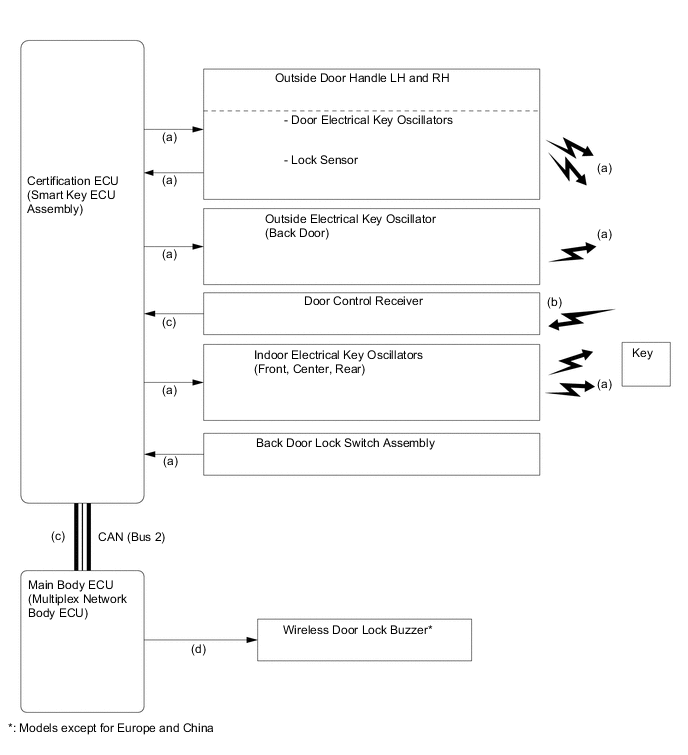
Lock Sensor (Doors locked using outside handle lock sensor:) Step System Operation (a) When the doors are locked from the lock sensor while the key is still in the vehicle, the certification ECU (smart key ECU assembly) receives this signal and transmits a request signal for the indoor electrical key oscillators (front, center, rear), door electrical key oscillators (LH and RH) and outside electrical key oscillator (back door) to form actuation areas. (b) The key receives this signal and returns the ID code to the door control receiver. (c) The certification ECU (smart key ECU assembly) receives the ID code from the door control receiver, and then judges and certifies the ID code, and checks the location of the key. The certification ECU (smart key ECU assembly) sends a wireless buzzer request signal to the main body ECU (multiplex network body ECU). (d) The main body ECU (multiplex network body ECU) sounds the wireless door lock buzzer*. *: Except models for Europe and China
-
-
-
Warning
-
When any of the situations below occur, the entry and start system sounds the wireless door lock buzzer*, sounds a buzzer in the combination meter assembly, displays a message on the multi-information display, and/or illuminates the power switch indicator in order to alert the driver.
*: Except models for Europe and China
Situation Condition A The hybrid system is left running and a shift state other than park (P) is still selected when the driver gets out of the vehicle. B The key reminder sounds. C The hybrid system is left running with park (P) selected when the driver gets out of the vehicle. D A door is ajar. E The hybrid system is left operating when a passenger gets out of the vehicle while holding the key. F The key is not within the actuation areas. G The key is left in the vehicle. H The key battery is weak. I The power management control ECU is malfunctioning. J The hybrid system cannot be started (driver error). K The hybrid system cannot be started (system error). L An attempt is made to turn off the vehicle with a shift state other than park (P) selected. M Auto power off operation occurs. N Immobiliser system certification completion occurs. O The vehicle is driven without a key. -
Situation A
-
There are 2 patterns for situation A.
-
Pattern 1:
When a shift state other than park (P) has been selected, the power switch is in a mode other than off and the driver opens the door and attempts to get out of the vehicle.
In this situation, the following control is performed:
Possible Effects without Warning Sudden vehicle movement, Vehicle theft, Vehicle roll-away Warning Active Condition The warning is activated when all of the following conditions are met:
-
The power switch is in a mode other than off.
-
A shift state other than park (P) has been selected.
-
The vehicle speed is 5 km/h (3.1 mph).
-
The driver door is opened.
Warning Method Combination Meter Assembly Buzzer Sounds continuously Master Warning Light Blinks Multi-information Display The following warning message is displayed:
-
SHIFT TO P POSITION*1
-
Shift to P position*2
Wireless Door Lock Buzzer - Power Switch Illumination - Warning Stop Condition The warning is stopped when one of the following conditions is met:
-
The power switch is turned off.
-
The P position switch (transmission shift main switch) is pushed.
-
The vehicle speed is above 5 km/h (3.1 mph).
-
The driver door is closed.
*1: Models with monochrome type multi-information display
*2: Models with color type multi-information display
-
-
Pattern 2:
During pattern 1, the driver closes the door and attempts to leave the vehicle while holding the key.
In this situation, the following control is performed:
Possible Effects without Warning Sudden vehicle start-off, Vehicle theft, Vehicle roll-away Warning Active Condition The warning is activated when all of the following conditions are met:
-
A shift state other than park (P) has been selected.
-
The power switch is in a mode other than off.
-
The vehicle speed is 0 km/h (0 mph).
-
The key is not in the vehicle.
-
The driver door is opened → closed.
Warning Method Combination Meter Assembly Buzzer Sounds continuously Master Warning Light Blinks Multi-information Display The following warning messages are alternately displayed:
-
SHIFT TO P POSITION*1
-
Shift to P position*2
-
KEY NOT DETECTED*1
-
Key not detected*2
Wireless Door Lock Buzzer*3 Sounds continuously Power Switch Illumination - Warning Stop Condition The warning is stopped when one of the following conditions is met: Combination Meter Assembly Buzzer
-
The power switch is turned off.
-
The P position switch (transmission shift main switch) is pushed.
-
The vehicle speed is above 0 km/h (0 mph).
-
Key not detected*2
Wireless Door Lock Buzzer* Combination Meter Assembly Master Warning Light No messages are displayed on the multi-information display. Multi-information Display ("KEY NOT DETECTED*1/Key not detected*2" message displayed)
-
The power switch is turned off.
-
The key is detected in the vehicle.
Multi-information Display ("SHIFT TO P POSITION*1/Shift to P position*2" message displayed)
-
The power switch is turned off.
-
The P position switch (transmission shift main switch) is pushed.
-
The vehicle speed is above 0 km/h (0 mph).
-
*1: Models with monochrome type multi-information display
*2: Models with color type multi-information display
*3: Except models for Europe and China
-
-
Situation B
-
There are 2 patterns for situation B.
-
Pattern 1:
When the driver door is open, the driver turns the power switch on (ACC) and attempts to leave the vehicle.
-
Pattern 2:
When the driver door is open, the driver turns the power switch from on (IG) to off and attempts to leave the vehicle.
In these situations, the following control is performed:
Possible Effects without Warning Vehicle theft Warning Active Condition The warning is activated when one of the following conditions is met:
-
The power switch is on (ACC) and the driver door is opened.
Warning Method Combination Meter Assembly Buzzer Sounds continuously at short and even intervals Master Warning Light - Multi-information Display - Wireless Door Lock Buzzer - Power Switch Illumination - Warning Stop Condition The warning is stopped when one of the following conditions is met:
-
The power switch is turned on (IG).
-
The driver door is closed.
-
The power switch is turned off and the park is engaged.
-
-
Situation C
-
There are 2 patterns for situation C.
-
Pattern 1:
Park (P) has been selected, the power switch is in a mode other than off, and the driver closes the driver door and attempts to leave the vehicle while holding the key.
In this situation, the following control is performed:
Possible Effects without Warning Vehicle theft, Hybrid system cannot be restarted, Discharged battery Warning Active Condition The warning is activated when all of the following conditions are met:
-
Park (P) has been selected.
-
The power switch is in a mode other than off.
-
The key is not detected in the vehicle.
-
The driver door is opened → closed.
-
The vehicle speed is 0 km/h (0 mph)
Warning Method Combination Meter Assembly Buzzer Sounds once Master Warning Light Blinks Multi-information Display The following warning message is displayed:
-
KEY NOT DETECTED*1
-
Key not detected*2
Wireless Door Lock Buzzer*3 Sounds 3 times Power Switch Illumination - Warning Stop Condition The warning is stopped when either of the following conditions is met:
-
The power switch is turned off.
-
The key is detected in the vehicle.
-
The vehicle speed is above 0 km/h (0 mph)
*1: Models with monochrome type multi-information display
*2: Models with color type multi-information display
*3: Except models for Europe and China
-
-
Pattern 2:
During pattern 1, the driver touches the lock sensor on the door outside handle.
In this situation, the following control is performed:
Possible Effects without Warning Vehicle theft, Discharged battery Warning Active Condition The warning is activated when all of the following conditions are met:
-
The power switch is in a mode other than off.
-
Park (P) has been selected.
-
All doors are closed.
-
The key is not detected in the vehicle interior.
-
The lock sensor on the outer door handle is on (touched).
-
The vehicle speed is 0 km/h (0 mph)
Warning Method Combination Meter Assembly Buzzer Sounds once Master Warning Light Blinks Multi-information Display The following warning message are alternately displayed:
-
TURN POWER OFF*1, *4
-
Turn Power OFF*2
-
KEY NOT DETECTED*1
-
Key not detected*2
Wireless Door Lock Buzzer*3 Sounds for 5 seconds Power Switch Illumination - Warning Stop Condition The warning is stopped when one of the following conditions is met: Combination Meter Assembly Master Warning Light
-
When TURN POWER OFF is displayed
- The power switch is turned off.
- The shift lever is moved to select a shift state other than park (P).
- The vehicle speed is above 0 km/h (0 mph).
-
When KEY NOT DETECTED is displayed
- The power switch is turned off.
- The key is detected in the vehicle.
Multi-information Display Wireless Door Lock Buzzer*2
-
Any door is opened.
-
The power switch is turned off.
-
The shift lever is moved to select a shift state other than park (P).
-
The vehicle speed is above 0 km/h (0 mph).
-
The key is detected in the vehicle.
*1: Models with monochrome type multi-information display
*2: Models with color type multi-information display
*3: Except models for Europe and China
*4: Displayed for 60 seconds (and then automatically turned off).
-
-
-
Situation D
-
The lock sensor on the door outside handle is pushed to perform entry lock, however, a door is open.
In this situation, the following control is performed:
Possible Effects without Warning Vehicle theft Warning Active Condition The warning is activated when all of the following conditions are met:
-
The power switch is off.
-
Any door is open.
-
The lock sensor on the outer door handle is on (touched).
Warning Method Combination Meter Assembly Buzzer - Master Warning Light - Multi-information Display - Wireless Door Lock Buzzer* Sounds for 5 seconds Power Switch Illumination - Warning Stop Condition The warning is stopped when one of the following conditions is met:
-
The power switch is turned to a mode other than off.
-
All doors are closed.
-
An unlock operation is performed using the wireless door lock remote function.
-
The touch sensor on the inside of an outer door handle is used to perform entry unlock.
-
5 seconds have elapsed since the wireless door lock buzzer* was activated.
*: Except models for Europe and China
-
-
-
Situation E
-
When the hybrid system is operating, a passenger leaves the vehicle while holding the key.
In this situation, the following control is performed:
Possible Effect without Warning Hybrid system cannot be restarted. Warning Active Condition The warning is activated when all of the following conditions are met:
-
The power switch is in a mode other than off.
-
A door other than the driver door is opened → closed.
-
The vehicle speed is 0 km/h (0 mph).
-
The key is not detected in the vehicle.
Warning Method Combination Meter Assembly Buzzer Sounds once Master Warning Light Blinks Multi-information Display The following warning message is displayed:
-
KEY NOT DETECTED*1
-
Key not detected*2
Wireless Door Lock Buzzer*3 Sounds 3 times Power Switch Illumination - Warning Stop Condition The warning is stopped when either of the following conditions is met:
-
The power switch is turned off.
-
The key is detected again or returned to the vehicle.
*1: Models with monochrome type multi-information display
*2: Models with color type multi-information display
*3: Except models for Europe and China
-
-
-
Situation F
-
When the key is not in the vehicle or the key battery is dead, the driver attempts to start the hybrid system or turn the power switch on (IG).
In this situation, the following control is performed:
Possible Effect without Warning Usability function (user becomes confused) Warning Active Condition The warning is activated when both of the following conditions are met:
-
The power switch is pushed.
-
The key is not in the vehicle (or the key battery is dead).
Warning Method Combination Meter Assembly Buzzer Sounds once Master Warning Light Blinks for 10 seconds Multi-information Display The following warning message is displayed for 15 seconds (and then automatically turned off).
-
KEY NOT DETECTED*1
-
Key not detected*2
Wireless Door Lock Buzzer - Power Switch Illumination - Warning Stop Condition Check if the key is in the actuation area.
If the key is in the actuation area, push the wireless door lock switch and confirm that the indicator light on the key comes on. If the indicator does not come on, replace the key battery with a new one.
*1: Models with monochrome type multi-information display
*2: Models with color type multi-information display
-
-
-
Situation G
-
There are 2 patterns for situation G.
-
Pattern 1:
The lock sensor on a door outside handle is pushed to perform entry lock with the key left in the vehicle.
In this situation, the following control is performed:
Possible Effect without Warning Vehicle theft Warning Active Condition The warning is activated when all of the following conditions are met:
-
The power switch is off.
-
All doors are closed.
-
The key is in the vehicle.
-
Any door is unlocked.
-
The lock sensor on the outer door handle is on.
Warning Method Combination Meter Assembly Buzzer Sounds once Master Warning Light Blinks Multi-information Display The following warning message is displayed for 60 seconds (and then automatically turned off).
-
KEY DETECTED IN VEHICLE*1
-
Key detected in vehicle*2
Wireless Door Lock Buzzer*3 Sounds for 5 seconds Power Switch Illumination - Warning Stop Condition The warning is stopped when any of the following conditions is met: Combination Meter Assembly Master Warning Light
-
The power switch is turned to a mode other than off.
-
The vehicle speed is above 0 km/h (0 mph).
-
Lock operation is detected.
Multi-information Display Wireless Door Lock Buzzer*
-
Any door is opened.
-
The power switch is turned to a mode other than off.
-
The vehicle speed is above 0 km/h (0 mph).
-
Lock operation is detected.
*1: Models with monochrome type multi-information display
*2: Models with color type multi-information display
*3: Except models for Europe and China
-
-
Pattern 2:
The door is locked by the lock knob in the inside door handle with the key left in the vehicle.
In this situation, the following control is performed:
Possible Effect without Warning Vehicle theft Warning Active Condition The warning is activated when all of the following conditions are met:
-
The door is locked by the lock knob on the inside door handle.
-
The key is in the vehicle.
Warning Method Combination Meter Assembly Buzzer Sounds once Master Warning Light Blinks Multi-information Display The following warning message is displayed for 60 seconds (and then automatically turned off).
-
KEY DETECTED IN VEHICLE*1
-
Key detected in vehicle*2
Wireless Door Lock Buzzer*3 Sounds for 5 seconds Power Switch Illumination - Warning Stop Condition The key is removed from the vehicle and the lock sensor is on. Combination Meter Assembly Master Warning Light
-
The power switch is turned to a mode other than off.
-
The vehicle speed is above 0 km/h (0 mph).
-
Lock operation is detected.
Multi-information Display Wireless Door Lock Buzzer*
-
Any door is opened.
-
The power switch is turned to a mode other than off.
-
The shift lever is moved to any position.
-
The vehicle speed is above 0 km/h (0 mph).
-
Lock operation is detected.
*1: Models with monochrome type multi-information display
*2: Models with color type multi-information display
*3: Except models for Europe and China
-
-
-
Situation H
-
The vehicle is driven using a key that has a low battery.
In this situation, the following control is performed:
Possible Effect without Warning Entry and start system does not function Warning Active Condition The warning is activated when both of the following conditions are met:
-
The power switch is turned off after being left on (IG) for more than 20 minutes.
-
The key battery voltage is low.
Warning Method Combination Meter Assembly Buzzer Sounds once Master Warning Light Illuminates for 15 seconds Multi-information Display The following warning message is displayed for 15 seconds (and then automatically turned off).
-
KEY BATTERY LOW*1
-
Key Battery Low*2
Wireless Door Lock Buzzer - Power Switch Illumination - Warning Stop Condition The key battery is replaced with a new one. *1: Models with monochrome type multi-information display
*2: Models with color type multi-information display
-
-
-
Situation I
-
A malfunction of the power management control ECU is detected.
In this situation, the following control is performed:
Possible Effect without Warning Power may be lost Warning Active Condition A malfunction of the power management control ECU is detected. Warning Method Combination Meter Assembly Buzzer - Master Warning Light - Multi-information Display - Wireless Door Lock Buzzer - Power Switch Illumination The amber indicator blinks at 2 second intervals for 15 seconds. Warning Stop Condition The power management control ECU returns to normal or is repaired.
-
-
Situation J
-
There are 2 patterns for situation J.
-
Pattern 1:
A warning message appears on the multi-information display when the driver does not follow the proper procedure to start the vehicle.
In this situation, the following control is performed:
Possible Effect without Warning Usability function (user cannot start vehicle) Warning Active Condition The warning is activated when all of the following conditions are met:
-
The power switch is off.*3
-
Driver door is closed → opened.*3
-
The power switch is turned from off to on (ACC) more than twice with the hybrid system off and brake pedal not depressed.
Warning Method Combination Meter Assembly Buzzer Sounds once Master Warning Light Blinks Multi-information Display The following warning message is displayed for 10 seconds (and then automatically turned off).
-
DEPRESS BRAKE PEDAL AND PUSH POWER SWITCH TO START*1
-
Depress brake pedal and push POWER switch to start*2
Wireless Door Lock Buzzer - Power Switch Illumination - Warning Stop Condition The power switch is turned off or on (IG). *1: Models with monochrome type multi-information display
*2: Models with color type multi-information display
*3: Precondition
-
-
Pattern 2:
A message indicating how to start the hybrid system appears on the multi-information display when the shift state is one in which the hybrid system cannot be started.
In this situation, the following control is performed:
Possible Effect without Warning Usability function (user cannot start vehicle) Warning Active Condition The warning is activated when all of the following conditions are met:
-
The hybrid system is stopped.
-
The vehicle speed is less than 5 km/h (3.1 mph).
-
More than 0.5 seconds have elapsed since the power switch was turned on (IG).
-
Neutral (N) has been selected.
Warning Method Combination Meter Assembly Buzzer Sounds once Master Warning Light Blinks Multi-information Display The following warning message is displayed:
-
SHIFT TO P POSITION TO START*1
-
Shift to P position to Start*2
Wireless Door Lock Buzzer - Power Switch Illumination - Warning Stop Condition The warning is stopped when one of the following conditions is met:
-
The P position switch (transmission shift main switch) is pushed.
-
The vehicle speed is above 5 km/h (3.1 mph).
-
The power switch is turned off or on (ACC).
-
The hybrid system is started.
*1: Models with monochrome type multi-information display
*2: Models with color type multi-information display
-
-
-
Situation K
-
There are 2 patterns for situation K.
-
Pattern 1:
When the power switch is pushed, the key cannot be detected in the vehicle 2 times in a row.
In this situation, the following control is performed:
Possible Effect without Warning Usability function (user cannot start vehicle) Warning Active Condition The warning is activated when all of the following conditions are met:
-
The immobiliser system is set.
-
The key is not detected in the vehicle.
-
When the power switch is turned on (ACC) or on (IG), a certification error occurs 2 times in a row.
Warning Method Combination Meter Assembly Buzzer Sounds once Master Warning Light Blinks for 60 seconds Multi-information Display The following warning message is displayed for 60 seconds (and then automatically turned off).
-
DEPRESS BRAKE PEDAL, TOUCH POWER SWITCH WITH KEY*1
-
Depress brake pedal, touch POWER switch with key*2
Wireless Door Lock Buzzer - Power Switch Illumination - Warning Stop Condition The warning is stopped when one of the following conditions is met:
-
The immobiliser system certification result is OK.
-
The key is detected in the vehicle.
-
Key certification in the vehicle has stopped either because 30 seconds have passed since any of the doors was opened and closed, or because the brake pedal is depressed.
*1: Models with monochrome type multi-information display
*2: Models with color type multi-information display
-
-
Pattern 2:
The driver attempts to start the hybrid system after unlocking the driver door using the mechanical key.
In this situation, the following control is performed:
Possible Effect without Warning Usability function (user cannot start vehicle) Warning Active Condition The warning is activated when all of the following conditions are met:
-
The driver door is unlocked using the mechanical key.
-
The immobiliser system is set.
-
The power switch is pushed.
-
The key is not detected in the vehicle.
Warning Method Combination Meter Assembly Buzzer Sounds once Master Warning Light Blinks Multi-information Display The following warning message is displayed for 60 seconds (and then automatically turned off).
-
DEPRESS BRAKE PEDAL, TOUCH POWER SWITCH WITH KEY*1
-
Depress brake pedal, touch POWER switch with key*2
Wireless Door Lock Buzzer - Power Switch Illumination - Warning Stop Condition The warning is stopped when one of the following conditions is met:
-
The immobiliser system certification result is OK.
-
The key is detected in the vehicle.
-
Key certification in the vehicle has stopped either because 30 seconds have passed since any of the doors was opened and closed, or because the brake pedal is depressed.
*1: Models with monochrome type multi-information display
*2: Models with color type multi-information display
-
-
-
Situation L
-
A warning message appears on the multi-information display when the driver attempts to turn the power switch off with a shift state other than park (P) selected.
In this situation, the following control is performed:
Possible Effect without Warning Usability function (user becomes confused) Warning Active Condition The warning is activated when both of the following conditions are met:
-
A shift state other than park (P) has been selected.
-
The power switch is turned from on (IG) to on (ACC)*3.
Warning Method Combination Meter Assembly Buzzer Sounds once Master Warning Light Blinks for 10 seconds Multi-information Display The following warning message is displayed for 10 seconds (and then automatically turned off).
-
SHIFT TO P POSITION AND PUSH POWER SWITCH TO TURN POWER OFF*1
-
Shift to "P" position and push power switch to turn power off*2
Wireless Door Lock Buzzer - Power Switch Illumination - Warning Stop Condition The warning is stopped when either of the following conditions is met:
-
The P position switch (transmission shift main switch) is pushed.
-
The power switch is in a mode other than on (ACC).
*1: Models with monochrome type multi-information display
*2: Models with color type multi-information display
*3: The driver has attempted to turn the power switch off, but the system has selected on (ACC) due to the shift state. Situation A may follow this if the driver does not correct the problem.
-
-
-
Situation M
-
A warning message appears on the multi-information display when automatic power off operation occurs.
In this situation, the following control is performed:
Possible Effect without Warning Vehicle battery discharges Warning Active Condition The warning is activated when all of the following conditions are met:
-
Park (P) has been selected.*3
-
The power switch is on (ACC) or on (IG).
-
The vehicle speed is 0 km/h (0 mph).
-
The hybrid system is stopped.
-
The power source is turned off by the automatic power off function.
Warning Method Combination Meter Assembly Buzzer - Master Warning Light - Multi-information Display The following warning message is displayed for 10 seconds (and then automatically turned off).
-
AUTO POWER OFF TO CONSERVE BATTERY*1
-
Auto Power OFF to Conserve Battery*2
Wireless Door Lock Buzzer - Power Switch Illumination - Warning Stop Condition The power switch is turned to a mode other than off. *1: Models with monochrome type multi-information display
*2: Models with color type multi-information display
*3: Precondition
-
-
-
Situation N
-
A warning message appears on the multi-information display when a key with a depleted battery is touched to the power switch while depressing the brake.
In this situation, the following control is performed:
Possible Effect without Warning Usability function (user cannot start vehicle) Warning Active Condition Key certification result is OK*3 Warning Method Combination Meter Assembly Buzzer Sounds once Master Warning Light Blinks for 10 seconds Multi-information Display The following warning message is displayed for 10 seconds:
-
DEPRESS BRAKE PEDAL AND PUSH POWER SWITCH TO START*1
-
Depress brake pedal and push POWER switch to start*2
Wireless Door Lock Buzzer - Power Switch Illumination The amber indicator blinks at 2 second intervals. Warning Stop Condition The warning is stopped when either of the following conditions is met:
-
The hybrid system is started.
-
The key is detected in the vehicle.
-
10 seconds has elapsed since the warning message was displayed.
-
The immobilizer system is activated and key detection is performed inside the vehicle for up to 30 seconds after the door was opened.
*1: Models with monochrome type multi-information display
*2: Models with color type multi-information display
*3: This situation occurs following Situation K.
-
-
-
Situation O
-
A warning message appears on the multi-information display when the vehicle starts moving without a registered key in the vehicle.
In this situation, the following control is performed:
Possible Effect without Warning Hybrid system cannot be restarted. Warning Active Condition When vehicle speed is detected for the first time after the key is removed from the vehicle, the warning is activated. Warning Method Combination Meter Assembly Buzzer Sounds once Master Warning Light Blinks Multi-information Display The following warning message is displayed:
-
KEY NOT DETECTED*1
-
Key not detected*2
Wireless Door Lock Buzzer - Power Switch Illumination - Warning Stop Condition The warning is stopped when either of the following conditions is met:
-
The power switch is turned off.
-
The key is detected in the vehicle.
*1: Models with monochrome type multi-information display
*2: Models with color type multi-information display
-
-
-
-
Battery Saving
-
Battery saving preserves the vehicle and key batteries. It is activated when the vehicle remains parked for a long time and when the key is left inside the exterior actuation area.
Condition Control Reinstatement Condition When the vehicle remains parked for a long time. Control 1:
-
No response from key for more than 5 days
-
Door electrical key oscillator and outside electrical key oscillator stop emitting signals for creating the actuation area.
When the power switch is turned on (IG), the control is canceled and the system is returned to normal. Control 2:
-
No response from key for more than 14 days
-
Door electrical key oscillator and outside electrical key oscillator stop emitting signals for creating the actuation area.
-
Front passenger door lock sensor and unlock sensor are disabled.
-
When the power switch is turned on (IG), the control is canceled and the system is returned to normal. When one of the following conditions is met, the control is returned to control 1:
-
The doors are locked or unlocked using wireless remote control.
-
The doors are locked or unlocked by touching the lock/unlock sensor on the driver door.
-
A door is locked or unlocked using the mechanical key.
-
Door is opened → closed.
When the key is left within the exterior detection area.
-
This state continues longer than 10 minutes
-
Electrical key oscillator that is detecting the key stops emitting signals for creating the actuation area.
-
The control is stopped when one of the following conditions is met:
-
The doors are locked or unlocked using wireless remote control.
-
The doors are locked or unlocked by touching the lock/unlock sensor on the front door.
-
A door is locked or unlocked using the mechanical key.
-
-
In addition to the above functions, the auto power off function helps to reduce drain on the vehicle auxiliary battery by turning the power source mode to off when approximately 60 minutes have elapsed since (a) the P position switch (transmission shift main switch) was pushed and the power source was turned to on (ACC), or (b) the hybrid system off with the park (P) selected, the power source on (IG) and the vehicle stationary.
-
-
Key Cancel
-
The following system functions can be deactivated by using the key cancel operating procedure.
-
Entry Lock
-
Entry Unlock
-
Prevention of Key Confinement
-
Warning
-
-
The system functions can be deactivated by using the following key cancel operating procedure when the power switch is off and the driver door is closed and unlocked.
Key Cancel operating procedure
-
The operation procedure is as follows:
-
Press the unlock switch of the electrical key transmitter sub-assembly once.
-
Within 5 seconds of the step above, open the driver door (Driver Door: Close → Open).
-
Within 5 seconds of the step above, press the unlock switch of the electrical key transmitter sub-assembly twice.
-
Repeat close → open for the driver door twice* (Driver Door: Open → Close → Open → Close → Open).
-
Press the unlock switch of the electrical key transmitter sub-assembly twice.*
-
Repeat close → open for the driver door once* (Driver Door: Open → Close → Open).
-
Within 5 seconds of the step above, close the driver door.
When the cancel procedure is complete, the buzzer sounds twice. Meanwhile, when the procedure is performed again to resume the system, the buzzer sounds once.
*: Perform all these 3 steps within 30 seconds of the previous step.
-
-
-
Key Code Registration Function
-
The table below shows the 4 special ID code registration function modes through which up to 7 different codes can be registered. The codes are electronically registered (written to and stored) in the EEPROM. For details, refer to the Repair Manual.
Mode Function Add Adds a newly received code while preserving previously registered codes. This mode is used when adding a new transmitter. Confirm Confirms how many codes are currently registered. When adding a new code, this mode is used to check how many codes already exist.
-
-
-
CONSTRUCTION
-
Key
-
The key consists of a mechanical key, transmitter for the wireless door lock control, transceiver for the entry function, and transponder chip for the engine immobiliser function.
-
This mechanical key operates the driver door lock cylinder, but cannot be used to start the hybrid system.
-
The transmitter for the wireless door lock control has a lock button and unlock button.
-
The transceiver in the key receives the signals from the oscillators and returns the ID code of the key to the door control receiver.
-
The transponder chip for the engine immobiliser function returns a signal to the power switch as a response to the radio wave received from the power switch.
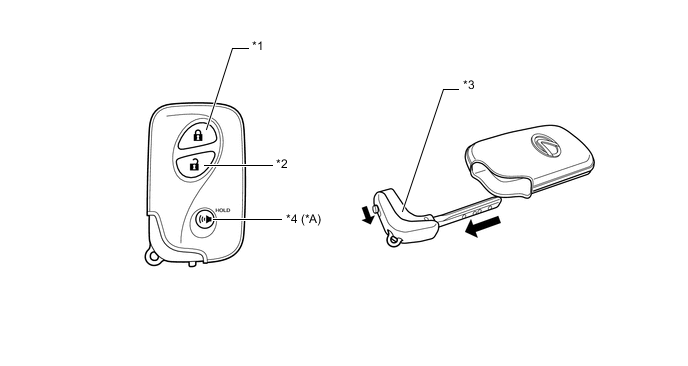
Text in Illustration *A Models with Panic Alarm *1 Lock Button *2 Unlock Button *3 Mechanical Key *4 Panic Button
-
-
Power Switch
-
The power switch consists of a momentary type switch, indicator light (amber and green color LEDs), illumination, antenna coil, and transponder key amplifier.
-
The driver can determine the present power source mode* and check whether or not the hybrid system can start in accordance with the illumination state of the indicator light.
-
When the power management control ECU detects an abnormality with the entry and start system, it makes the amber indicator light flash. If the hybrid system is stopped in this state, it might not be possible to restart it.
*: In this chapter, the expression "power source" has been used in some locations to allow precise explanations. The power source condition is also expressed using conventional expressions such as "power switch off", "power switch on (ACC)" and "power switch on (IG)".
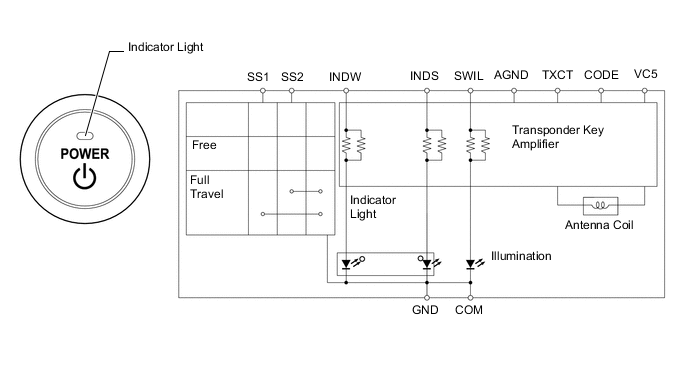
Power Source Condition Indicator Light Condition Brake pedal not depressed Brake pedal depressed with P selected Off OFF ON (Green) On (ACC), On (IG) ON (Amber) ON (Green) READY OFF OFF Entry and Start System Malfunction Blinks (Amber) for 15 seconds Blinks (Amber) for 15 seconds
-
-
Power Management Control ECU
-
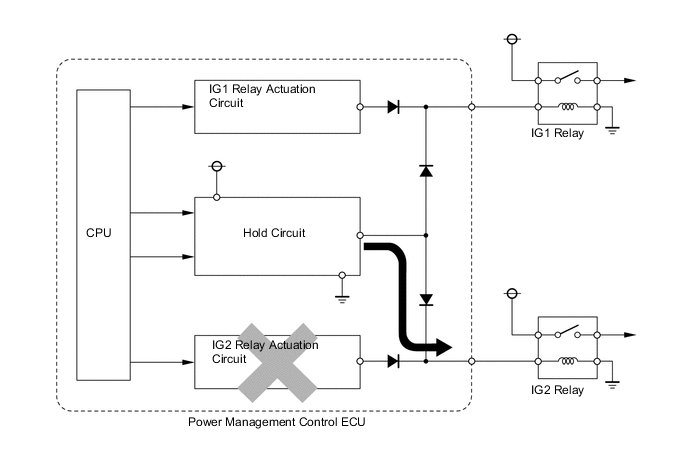
The power management control ECU includes the IG1 relay and IG2 relay actuation circuits, CPU, and hold circuit.
-
The hold circuit is installed to prevent the power supply to the relays from being cut off when an abnormality occurs in IG1 relay and/or IG2 relay actuation circuits while driving.
Tech Tips
The power management control ECU constantly stores the present power source mode in its memory. Therefore, if the power to the power management control ECU is interrupted due to the removal of the battery, the power management control ECU restores the power source after the battery is reconnected.
For this reason, if the battery is removed when the power source is in a mode other than off, the power will be restored to the vehicle at the same time the power is restored to the power management control ECU (by reconnecting the battery).
Therefore, before removing the battery, be sure to turn the power source off.
-
-
-
DIAGNOSIS
-
Start Function
-
The power management control ECU and certification ECU (smart key ECU assembly) can detect malfunctions in the entry and start system when the power source is on (IG).
-
When the ECUs detect a malfunction, the amber indicator light of the power switch flashes to warn the driver. At the same time, the ECUs store a 5-digit Diagnostic Trouble Code (DTC) in their memories.
-
The indicator light warning continues for 15 seconds even after the power switch is turned to off.
-
The 5-digit DTCs can be read after connecting the intelligent tester to the DLC3.
-
The entry and start system may not operate successfully if a malfunction occurs.
-
-