INTAKE SYSTEM
-
CONSTRUCTION
-
Diesel Throttle Body
-
A linkless-type diesel throttle body is used, achieve excellent throttle control.
-
A DC motor with excellent response and minimal power consumption is used for the throttle control motor. The ECM performs the duty ratio control of the direction and the amperage of the current that flows to the throttle control motor in order to regulate the opening angle of the throttle valve.
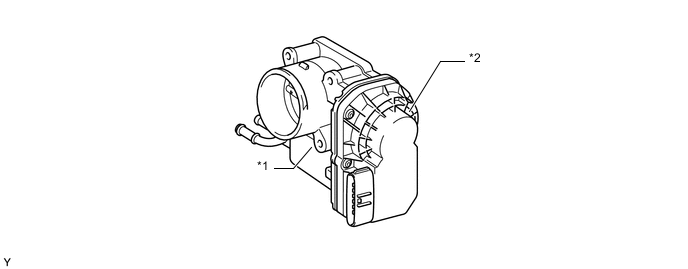
Text in Illustration *1 Throttle Control Motor *2 Throttle Position Sensor
-
-
Turbocharger Sub-assembly (Models without DPF Catalyst)
-
The variable nozzle vane type turbocharger sub-assembly drives the vacuum type actuator according to engine condition, and controls the nozzle vane in order to achieve high engine output, low fuel consumption and low emissions.
-
The turbocharger sub-assembly is cooled by the engine oil.
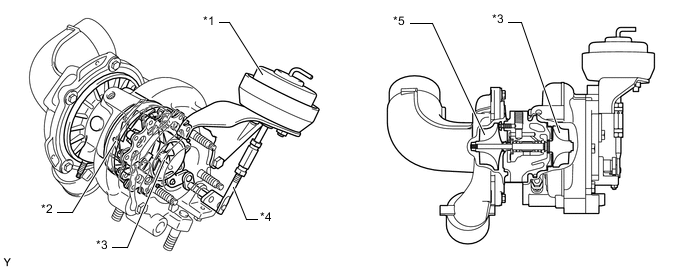
Text in Illustration (Models without DPF Catalyst) *1 Actuator *2 Nozzle Vane *3 Turbine Wheel *4 Actuator Linkage *5 Impeller Wheel - -
-
-
Turbocharger Sub-assembly (Models with DPF Catalyst)
-
Variable nozzle vane type turbocharger consists primarily of a turbine, nozzle vane, unison ring, nozzle ring, and turbocharger variable nozzle motor (DC motor and nozzle vane position sensor).
-
This turbocharger has realized improvements in low-speed torque, fuel consumption, and emission reduction. Both Toque improvement at low speed and Low fuel consumption are achieved by adopting small size Turbocharger because it enables to get high boost pressure at Low speed. Response for Boost pressure change is improved by changing control from actuator to DC motor.
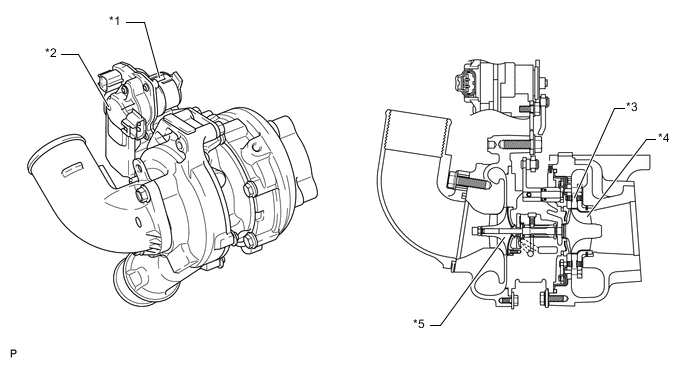
Text in Illustration (Models with DPF Catalyst) *1 DC Motor *2 Nozzle Vane Position Sensor *3 Nozzle Vane *4 Turbine Wheel *5 Impeller Wheel - - -
The exhaust gas from the exhaust manifold goes through the nozzle vane inside the turbocharger housing, and flows to the exhaust pipe through the turbine. The speed of the turbine (supercharging pressure) differs depending on the flow velocity of the exhaust gas going through the turbine. The flow velocity of the exhaust gas is controlled by the nozzle vane opening.
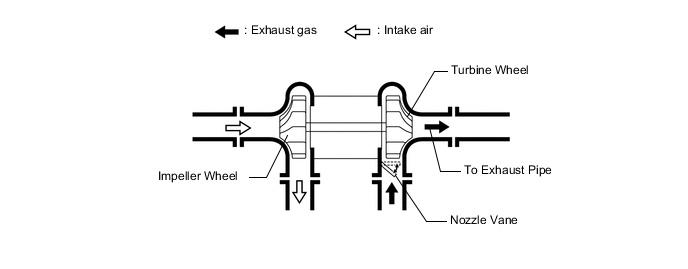
-
-
-
OPERATION
-
Turbocharger Sub-assembly (Models without DPF Catalyst)
-
At Low Load Range or Low Speed Range
-
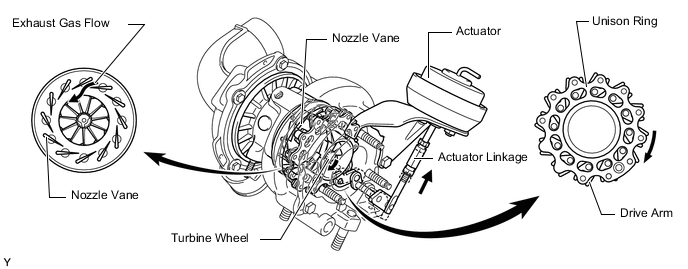
When the engine is running in a low load range or a low speed range, the actuator pulls up the actuator linkage. The actuator linkage is connected to the unison ring. At the same time, the drive arms installed in the unison ring move to change the nozzle vane angle toward closing direction. As a result, the exhaust gas travels to the turbine at a faster speed, and engine torque is improved.
-
-
At High Load Range or High Speed Range
-
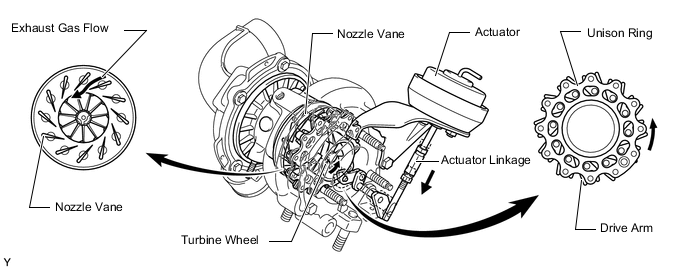
When the engine is running in a high load range or a high speed range, the actuator pulls down the actuator linkage. With this, the drive arm moves and this opens the nozzle vane and holds the specified supercharging pressure. Thus, exhaust gas back pressure is lowered, and output and fuel consumption are improved.
-
-
-
Turbocharger Sub-assembly (Models with DPF Catalyst)
-
At Low Load Range or Low Speed Range
-
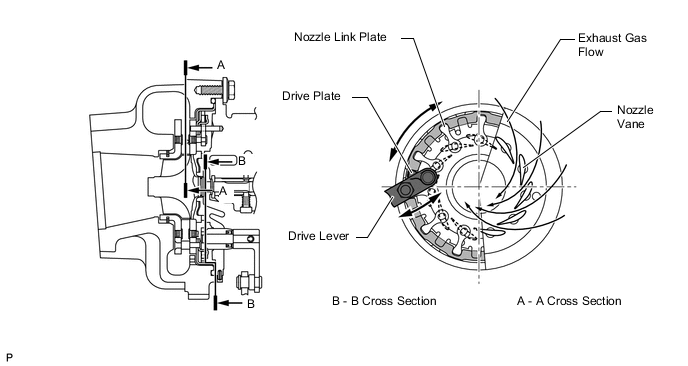
When the engine is running in a low speed range, the turbocharger variable nozzle motor moves the drive lever close side by a signal from the ECM.
This results in increasing the velocity of the exhaust gas flowing to the turbine, as well as the speed of the turbine. As a result, torque is improved when the engine is running at low speeds.
-
-
At High Load Range or High Speed Range
-
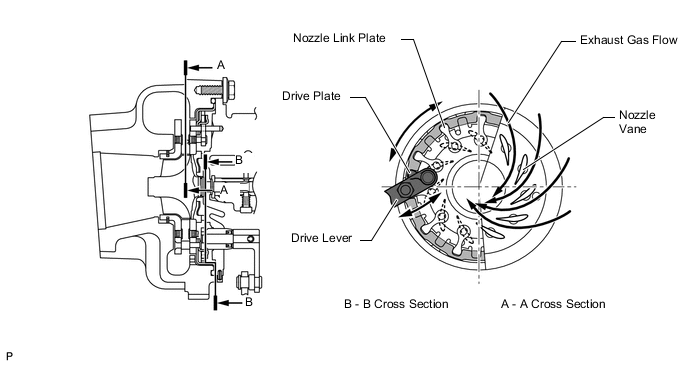
When the engine is running in medium-to-high speed range, the nozzle vanes are opened and the discharging pressure is maintained at a certain level.
-
-
-