BRAKE CONTROL SYSTEM (for Vacuum Brake Booster) DETAILS
-
FUNCTION OF MAIN COMPONENTS
Models without VSC Component Function Combination Meter Assembly Brake System Warning Light
-
Lights up to alert the driver when the skid control ECU detects a malfunction in the EBD.
-
Lights up to alert the driver when the brake fluid level is low.
-
Lights up to inform the driver of the parking brake condition.
ABS Warning Light Lights up to alert the driver when the skid control ECU detects a malfunction in the ABS or brake assist. Front and Rear Speed Sensors Detects the wheel speed of each of the 4 wheels. Yaw Rate Sensor Assembly
(with Built-in Deceleration Sensor)
-
Detects the vehicle's longitudinal and lateral acceleration.
-
Detects the vehicle's yaw rate.
Stop Light Switch Assembly Detects the brake pedal depressing signal. Parking Brake Switch Assembly Detects that the parking brake lever is pulled up. Brake Pedal Load Sensing Switch Detects the brake pedal load. Center Differential Lock Detection Switch
(Built into Transfer Shift Actuator Assembly)
Detects the transfer drive mode. Brake Actuator Assembly Changes the fluid path based on the signals from the skid control ECU during the operation of the brake control system functions, in order to control the fluid pressure applied to the wheel cylinders. Master Cylinder Pressure Sensor
(Built into Brake Actuator Assembly)
Detects the master cylinder pressure. Motor Relay
(Built into Skid Control ECU)
Supplies power to the pump motor. Motor Cut Relay
(Built into Skid Control ECU)
Cuts off power to the pump motor. Solenoid Relay
(Built into Skid Control ECU)
Supplies power to the solenoid valves. Skid Control ECU Judges the vehicle driving conditions based on the signals from each sensor, and sends the brake control signals to the brake actuator. Models with VSC Component Function Combination Meter Assembly Brake System Warning Light
-
Lights up to alert the driver when the skid control ECU detects a malfunction in the EBD.
-
Lights up to alert the driver when the brake fluid level is low.
-
Lights up to inform the driver of the parking brake condition.
ABS Warning Light Lights up to alert the driver when the skid control ECU detects a malfunction in the ABS or brake assist. Slip Indicator Light
-
Blinks to inform the driver when the TRC or VSC is operational.
-
Lights up to alert the driver when the skid control ECU detects a malfunction in the TRC and/or VSC.
TRC OFF Indicator Light Lights up to inform the driver that the TRC OFF mode has been entered using the VSC OFF switch. VSC OFF Indicator Light Lights up to inform the driver that the VSC OFF mode has been entered using the VSC OFF switch. Front and Rear Speed Sensors Detects the wheel speed of each of the 4 wheels. Yaw Rate Sensor Assembly
(with Built-in Deceleration Sensor)
-
Detects the vehicle's longitudinal and lateral acceleration.
-
Detects the vehicle's yaw rate.
Steering Angle Sensor Detects the direction and angle of the steering wheel. Stop Light Switch Assembly Detects the brake pedal depressing signal. Parking Brake Switch Assembly Detects that the parking brake lever is pulled up. Brake Pedal Load Sensing Switch Detects the brake pedal load. VSC OFF Switch Enables the driver to select "Normal Mode", "TRC OFF Mode", or "VSC OFF Mode". Center Differential Lock Detection Switch
(Built into Transfer Shift Actuator Assembly)
Detects the transfer drive mode. Brake Actuator Assembly Changes the fluid path based on the signals from the skid control ECU during the operation of the brake control system functions in order to control the fluid pressure applied to the wheel cylinders. Master Cylinder Pressure Sensor
(Built into Brake Actuator Assembly)
Detects the master cylinder pressure. Motor Relay
(Built into Skid Control ECU)
Supplies power to the pump motor. Motor Cut Relay
(Built into Skid Control ECU)
Cuts off power to the pump motor. Solenoid Relay
(Built into Skid Control ECU)
Supplies power to the solenoid valves. Skid Control ECU Judges the vehicle driving conditions based on the signals from each sensor, and sends the brake control signals to the brake actuator. ECM
-
Sends the throttle position signal, accelerator pedal position signal, engine speed signal etc., to the skid control ECU.
-
Controls the engine output based on the signals received from the skid control ECU.
4WD Control ECU Sends the transfer drive mode. -
-
OPERATING CONDITION
-
The brake control function varies by the drive mode as shown in the following table:
Drive Mode Brake Control Function ABS EBD Brake Assist TRC VSC H4F ○ ○ ○ ○ ○ H4L ○ ○ ○ ○ ○ L4L ○ ○ ○ ○ X Tech Tips
○: Controls
X: Does not control
-
-
SYSTEM CONTROL
Control Outline Anti-lock Brake System (ABS) The ABS helps prevent the wheels from locking when the brakes are applied firmly or when braking on a slippery surface. Electronic Brake Force Distribution (EBD) The EBD control utilizes ABS, achieving proper brake force distribution between the front and rear wheels in accordance with the driving conditions. In addition, during braking while cornering, it also controls the brake forces of the right and left wheels, helping maintain vehicle behavior. Brake Assist
-
The primary purpose of brake assist is to provide an auxiliary brake force to assist a driver who cannot generate a large brake force during emergency braking, thus helping ensure the vehicle's braking performance.
-
If the brake booster malfunctions and the skid control ECU judges that the brake pedal force applied by the driver is not sufficient to ensure adequate braking force, brake assist is used to enhance the braking force.
Traction Control (TRC) The TRC helps restrain the slippage of the drive wheels if the driver depresses the accelerator pedal excessively when starting off or while accelerating on a slippery surface. Vehicle Stability Control (VSC) The VSC helps restrain sideways slippage of the vehicle during a strong front wheel skid or strong rear wheel skid, such as may occur while cornering.
-
Anti-lock Brake System (ABS)
-
The ABS prevents the wheels from locking during sudden braking or braking on a slippery surface. This provides the proper braking force when the vehicle slips, thus ensuring vehicle stability and excellent braking performance.
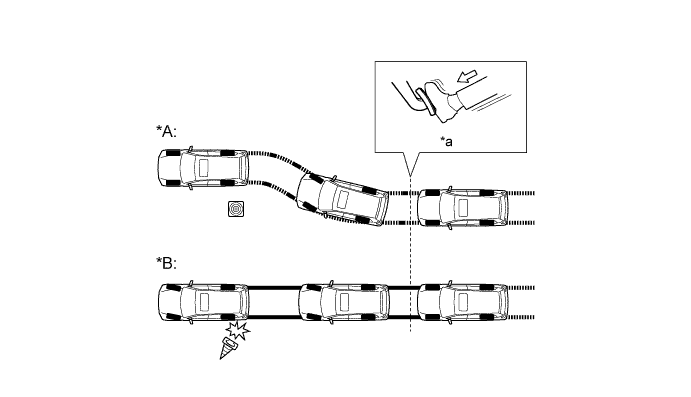
Text in Illustration (Illustration Provides Conceptual Image) *A Models with ABS *B Models without ABS *a Brake Operation - -
-
-
Electronic Brake Force Distribution (EBD)
-
This function controls the brake force that acts on the rear wheels in accordance with the changes in the vehicle conditions such as load factors or deceleration, in order to ensure excellent braking performance.
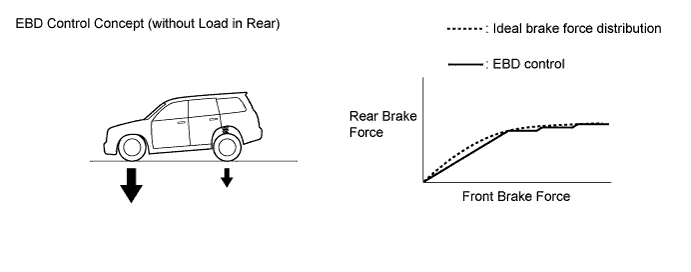
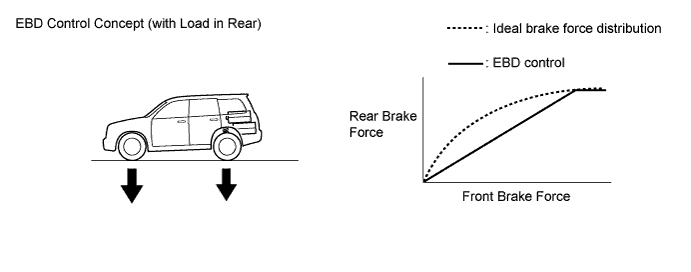
-
During cornering braking, this function controls the brake force that acts on the left and right wheels in accordance with the vehicle conditions. This ensures vehicle stability and excellent braking performance.

Text in Illustration 
Control Moment 
Brake Force
-
-
Brake Assist
-
During the brake assist, the skid control ECU calculates the speed of the brake pedal application based on the signals from the master cylinder pressure sensor and then determines the intention of the driver to make an emergency brake application. If the skid control ECU determines that the driver intends to make an emergency brake application, this function activates the brake actuator to increase the brake fluid pressure, which increases the brake force.
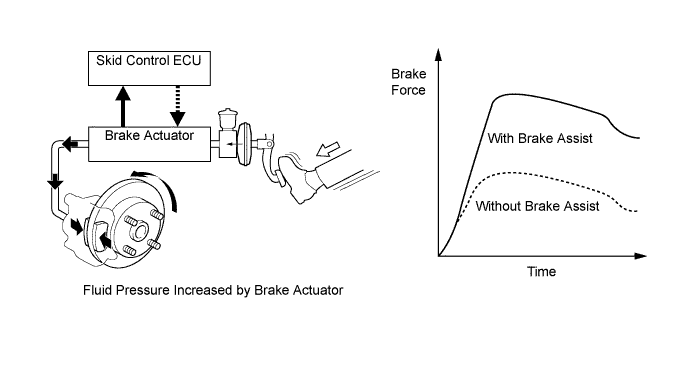
-
-
Traction Control (TRC)
-
The TRC helps prevent the drive wheels from slipping if the driver depresses the accelerator pedal excessively when starting off or accelerating on a slippery surface. Simultaneously with the hydraulic brake control of the drive wheels, the skid control ECU makes a request to the ECM to effect engine output control. This produces the drive force that suits the driving conditions, in order to ensure the proper start-off acceleration.
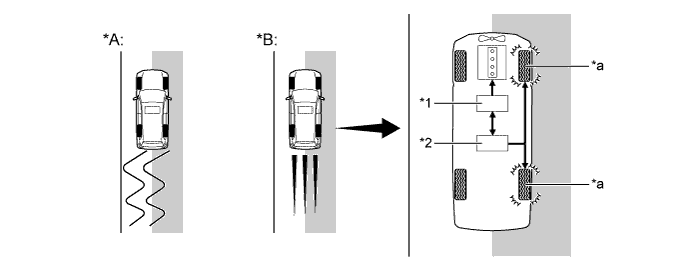
Text in Illustration (Driving on Road with Different Surface Friction Characteristics) *A Models without TRC *B Models with TRC *1 ECM
- Engine Output Control
*2 Brake Actuator Assembly
- Hydraulic Brake Control
*a Brake Slipping Drive Wheel - - 
Slippery Surface - -
-
-
Vehicle Stability Control (VSC)
-
The following are 2 examples that can be considered circumstances in which the tires exceed their lateral grip limit. The VSC is designed to help control the vehicle behavior by controlling the engine output and the brakes of each wheel when the vehicle is under one of the conditions indicated below:
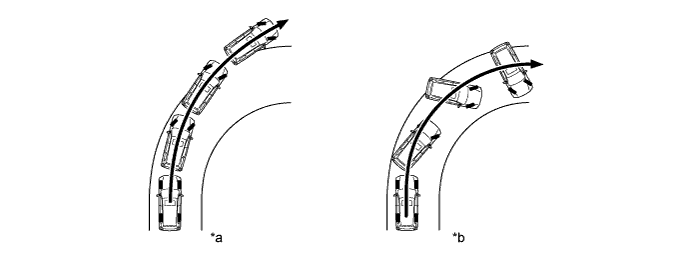
Text in Illustration *a Front Wheel Skid Tendency (Understeer)
- When the front wheels lose grip in relation to the rear wheel
*b Rear Wheel Skid Tendency (Oversteer)
- When the rear wheels lose grip in relation to the front wheels
-
To determine the condition of the vehicle, sensors detect the steering angle, vehicle speed, vehicle yaw rate, and vehicle's lateral acceleration, which are then calculated by the skid control ECU.
-
Whether or not the vehicle is experiencing a front wheel skid is determined by the difference between the target yaw rate and the vehicle's actual yaw rate. When the vehicle's actual yaw rate is smaller than the target yaw rate (which is determined based on the vehicle speed and steering angle) that should be generated when the driver operates the steering wheel, it means the vehicle is making a turn at a greater angle than the target locus of travel. Thus, the skid control ECU determines that there is a large front wheel skid tendency.
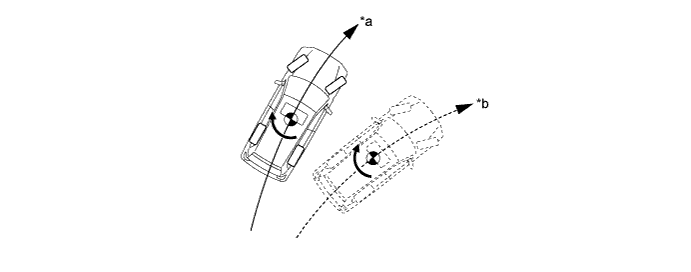
Text in Illustration *a Actual Locus of Travel (Actual Yaw Rate) *b Locus of Travel Based on Target Yaw Rate -
Whether or not the vehicle is experiencing a rear wheel skid is determined by the values of the vehicle's slip angle and the vehicle's slip angular velocity (time-dependent changes in the vehicle's slip angle). When the vehicle's slip angle is large, and the slip angular velocity is also large, the skid control ECU determines that the vehicle has a large rear wheel skid tendency.

Text in Illustration *a Travel Direction of Vehicle's Center of Gravity *b Movement of Vehicle *c Slip Angle - - -
When the skid control ECU determines that the vehicle exhibits a tendency to experience a front wheel skid or a rear wheel skid, it decreases the engine output and applies the brakes of the front or rear wheels to control the vehicle's yaw moment. The basic operation of the VSC is described below. However, the control method differs depending on the vehicle's characteristics and driving conditions.
-
When the skid control ECU determines that there is a large front wheel skid tendency, it takes countermeasures in accordance with the extent of that tendency. The skid control ECU controls the engine output and applies the brakes of the rear wheel on the inner circle of the turn in order to help restrain the front wheel skid tendency.
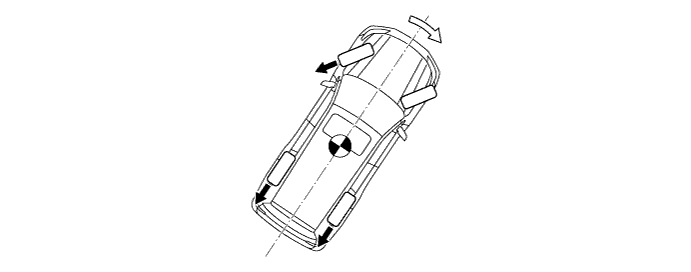
Text in Illustration (Front Wheel Skid Dampening at Right Turn) Control Moment Brake Force -
When the skid control ECU determines that there is a large rear wheel skid tendency, it takes countermeasures in accordance with the extent of that tendency. It applies the brakes of the front and rear wheels of the outer circle of the turn, and generates an outward moment of inertia in the vehicle, in order to restrain the rear wheel skid tendency. Along with the reduction in the vehicle speed caused by the braking force, excellent vehicle stability is ensured. In some cases, the skid control ECU applies the brake of the rear wheels, as necessary.
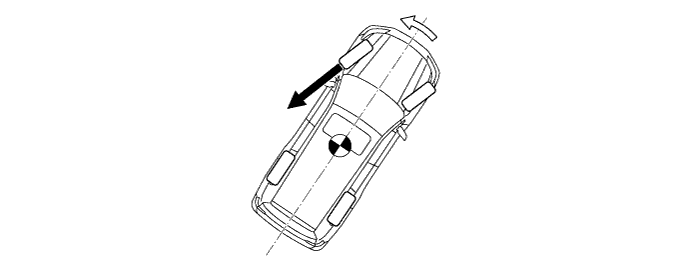
Text in Illustration (Rear Wheel Skid Dampening at Right Turn) Control Moment Brake Force
-
-
-
FUNCTION
-
VSC OFF Switch
-
The operation of the VSC and TRC functions can be stopped by the VSC OFF switch. While the vehicle is running off the shoulder of the road or running on a dirt road, the engine output control is stopped to maintain drive torque.
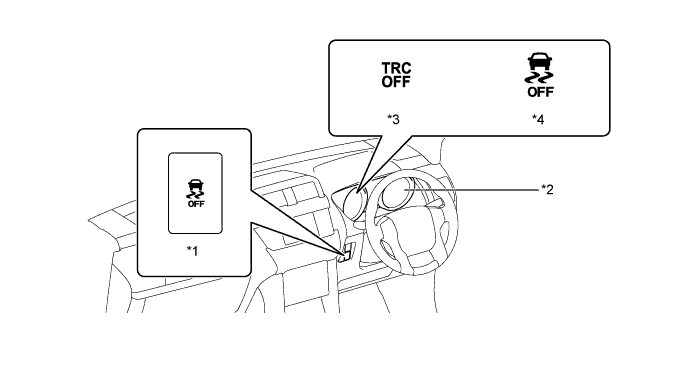
Text in Illustration *1 VSC OFF Switch *2 Combination Meter Assembly *3 TRC OFF Indicator Light *4 VSC OFF Indicator Light -
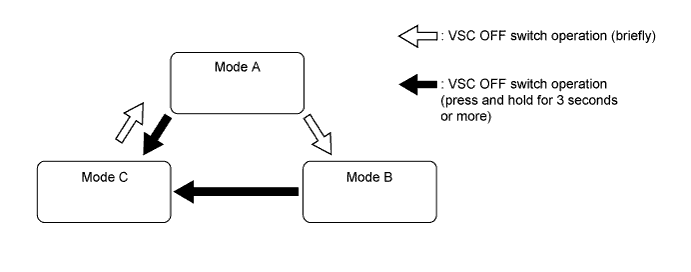
The VSC OFF switch can select 3 modes (mode A, mode B, and mode C).
-
Briefly pressing the VSC OFF switch in mode A selects mode B.
-
Pressing and holding the VSC OFF switch for 3 seconds or more with the vehicle stopped selects mode C.
-
Briefly pressing the VSC OFF switch in mode B or mode C or turning the ignition switch off returns to mode A.
-
When TRC is not operating, the TRC OFF indicator light will illuminate.
-
When VSC is not operating, the VSC OFF indicator light will illuminate.
Function of VSC OFF Switch Transfer Drive Mode Brake Control Function VSC OFF Switch Mode Mode A Mode B Mode C H4F TRC Operates Does Not Operate Does Not Operate VSC Operates Operates Does Not Operate H4L TRC Operates Does Not Operate Does Not Operate VSC Operates Does Not Operate Does Not Operate L4L TRC Operates - Does Not Operate VSC Does Not Operate - Does Not Operate
-
-
-
CONSTRUCTION
-
Yaw Rate Sensor Assembly
-
This sensor has a built-in deceleration sensor.
-
The yaw rate sensor detects the vehicle's yaw rate.
-
The deceleration sensor detects the vehicle's longitudinal and lateral acceleration
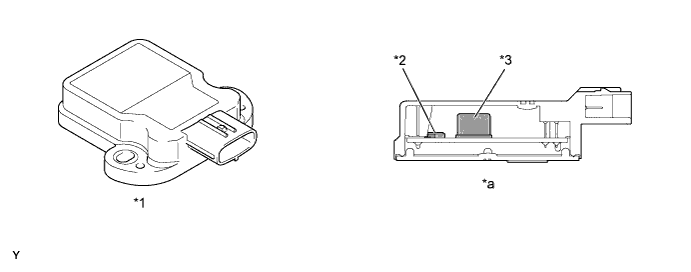
Text in Illustration *1 Yaw Rate Sensor Assembly *2 Deceleration Sensor *3 Yaw Rate Sensor - - *a Cross Section - -
-
-
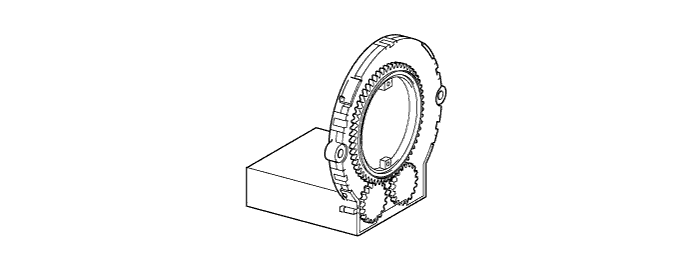
Steering Angle Sensor (Models with VSC)
-
The steering angle sensor detects the steering direction and angle, and sends this information to the skid control ECU.
-
-
Speed Sensor
-
Active type speed sensors, which can detect the rotational direction of the wheel, have been provided. This type of sensor contains a Hall IC, which consists of 2 Magnetic Resistance Elements (MREs).
-
The magnet type rotor, which consists of N and S poles that are arranged in a circle, is integrated with the hub bearing inner race.
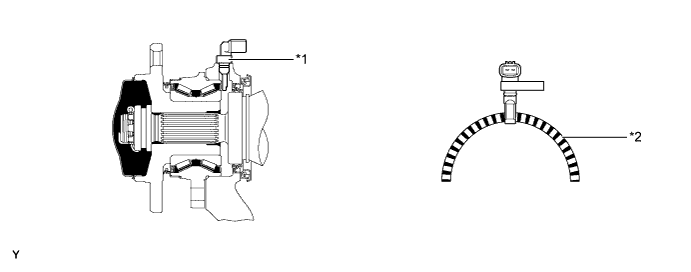
Text in Illustration (Front Axle) *1 Front Speed Sensor *2 Sensor Rotor 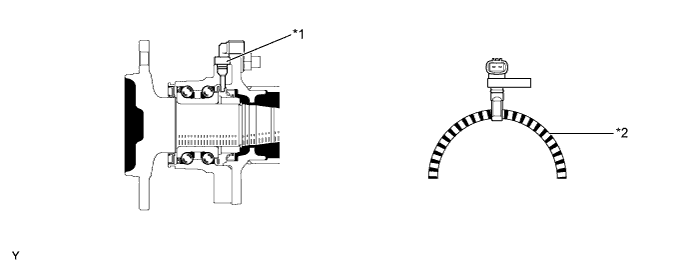
Text in Illustration (Rear Axle) *1 Rear Speed Sensor *2 Sensor Rotor
-
-
Stop Light Switch Assembly
-
A non-contact type stop light switch assembly with high durability is used.
-
The movement of the magnet placed on the shaft is detected by the magnetic sensor.
-
2 magnetic sensors are installed and they output stop light illumination signals and cruise control system cancel signals.
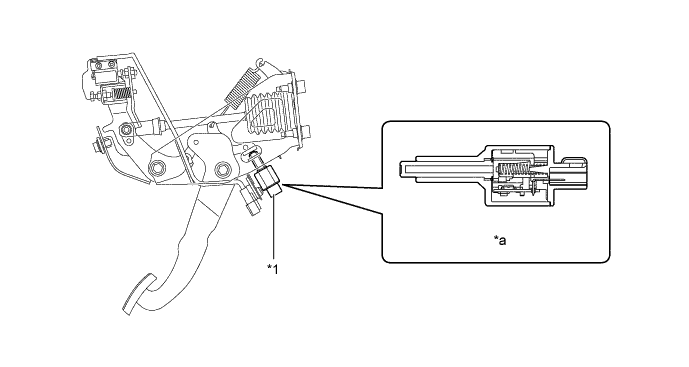
Text in Illustration *1 Stop Light Switch Assembly - - *a Stop Light Switch Assembly Cross Section - -
-
-
Brake Actuator Assembly
-
The brake actuator assembly consists of an actuator portion and a skid control ECU.
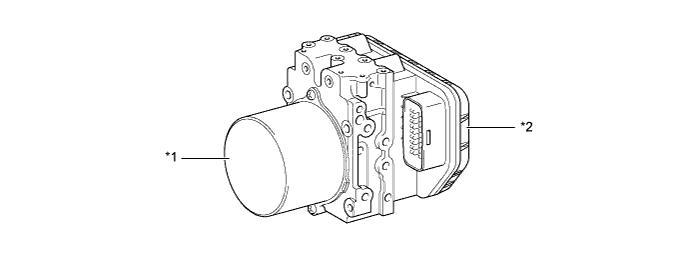
Text in Illustration *1 Actuator Portion *2 Skid Control ECU 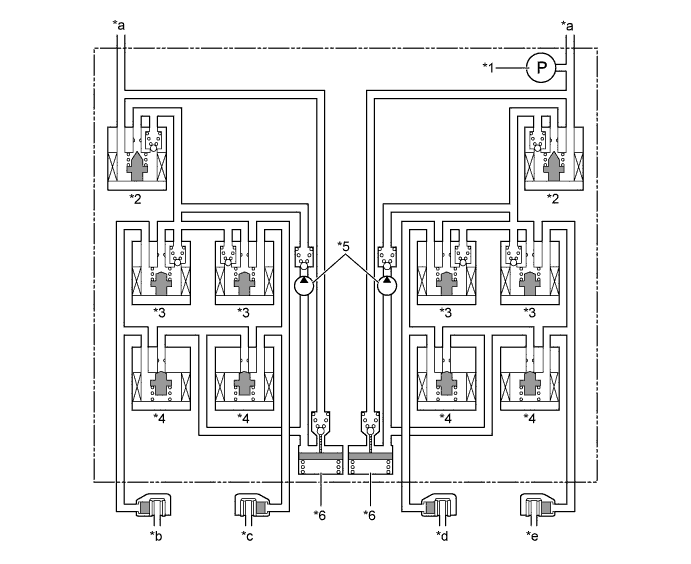
Text in Illustration *1 Master Cylinder Pressure Sensor *2 Master Cylinder Cut Solenoid Valve *3 Pressure Holding Solenoid Valve *4 Pressure Reduction Solenoid Valve *5 Pump *6 Reservoir *a From Master Cylinder *b Front Brake LH *c Front Brake RH *d Rear Brake RH *e Rear Brake LH - -
-
-
-
OPERATION
-
Speed Sensor
-
The active type speed sensor uses a Hall IC to detect magnetic field changes caused when the sensor rotor rotates, and outputs the detected information to the skid control ECU as digital pulses.
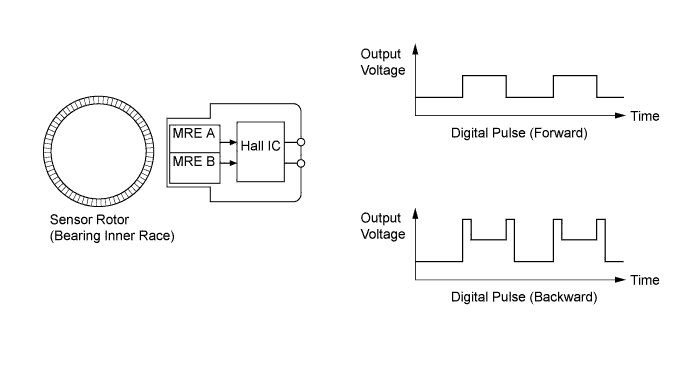
-
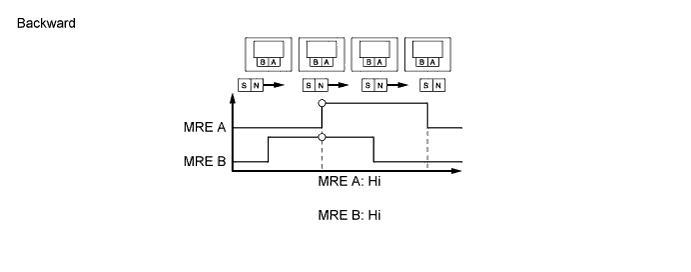
To detect the rotation direction, the output waves are used to determine the relationship of the pulses that are generated by the 2 Magnetic Resistance Elements (MREs).
-
Upon receiving this signal, the Hall IC outputs a forward or backward wave.
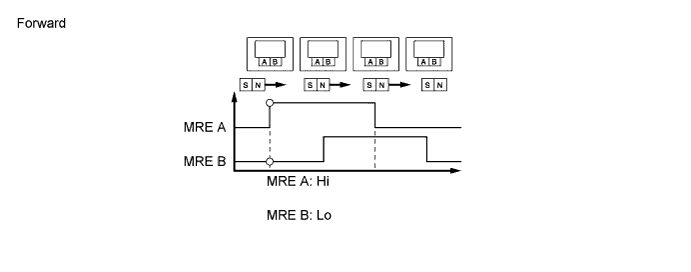
-
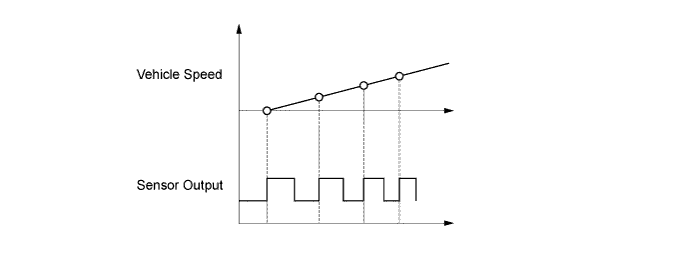
The frequency of the output pulses is used to detect the vehicle speed. Because the active type sensor outputs digital pulses, it can detect vehicle speeds even when the vehicle is nearly stationary.
-
-
ABS and EBD
-
Based on the signals received from the 4 speed sensors, the skid control ECU calculates the speed of each wheel, and checks the wheel slipping conditions. In accordance with the slipping condition, the skid control ECU controls each solenoid valve in the brake actuator in order to adjust the fluid pressure of each wheel cylinder in the following 3 modes: pressure increase, pressure holding, and pressure reduction modes.
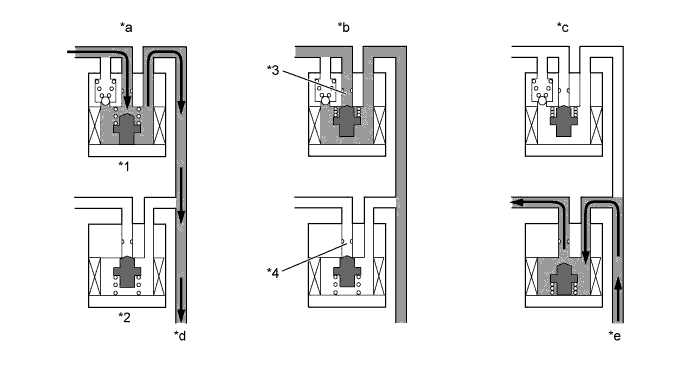
Text in Illustration *1 Pressure Holding Solenoid Valve *2 Pressure Reduction Solenoid Valve *3 Port A *4 Port B *a Pressure Increase Mode *b Pressure Holding Mode *c Pressure Reduction Mode *d To Wheel Cylinder *e From Wheel Cylinder - - Brake Actuator Operation in ABS and EBD Pressure Mode Increase Mode Holding Mode Reduction Mode Pressure Holding Solenoid Valve [Port (a)] Off (Open) On (Closed) On (Closed) Pressure Reduction Solenoid Valve [Port (b)] Off (Closed) Off (Closed) On (Open) Wheel Cylinder Pressure Increases Holds Reduces
-
-
Brake Assist
-
In the event of emergency braking, the skid control ECU determines the driver's intention based on the speed of the pressure increase in the master cylinder determined by the master cylinder pressure sensor signal. If the skid control ECU judges the need for additional brake assist, pressure is generated by the pump in the brake actuator and directed to the wheel cylinder to apply a large amount of fluid pressure.
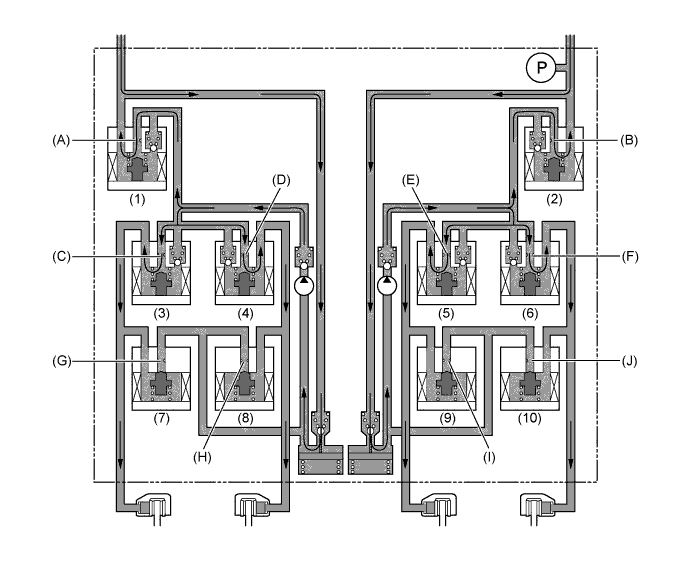
Brake Actuator Operation in Brake Assist Item Brake Assist Not Activated Brake Assist Activated Pump Off On Master Cylinder Cut Solenoid Valve (1) Port (A) Off (Open) On* (2) Port (B) Off (Open) On* Pressure Holding Solenoid Valve (3) Port (C) Off (Open) ← (4) Port (D) Off (Open) ← (5) Port (E) Off (Open) ← (6) Port (F) Off (Open) ← Pressure Reduction Solenoid Valve (7) Port (G) Off (Closed) ← (8) Port (H) Off (Closed) ← (9) Port (I) Off (Closed) ← (10) Port (J) Off (Closed) ← Tech Tips
*: The solenoid valve controls the hydraulic pressure between "open" and "closed" in accordance with the operating condition by adjusting continually.
-
-
TRC
-
The fluid pressure generated by the pump is regulated by the master cylinder cut solenoid valve to the required pressure. Thus, the wheel cylinders of the drive wheels are controlled in the following 3 modes: pressure increase, pressure holding, and pressure reduction modes to control the slippage of the drive wheels. The pressure holding solenoid valve and the pressure reduction solenoid valve are turned on or off in accordance with the ABS and EBD operation patterns.
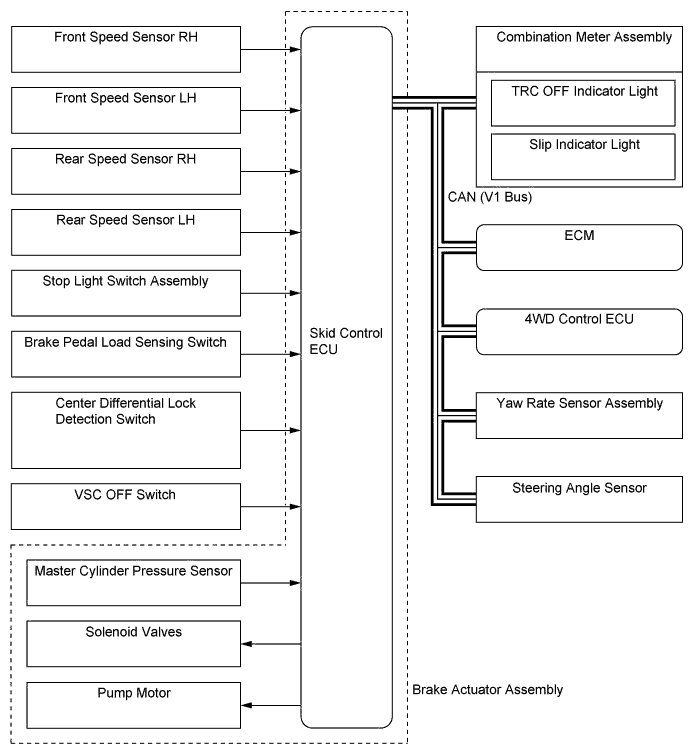
Brake Actuator Operation in TRC Item TRC Operation Not Activated Pressure Increase Mode Pressure Holding Mode Pressure Reduction Mode Pump Off On ← ← Master Cylinder Cut Solenoid Valve (1) Port (A) Off (Open) On* ← ← (2) Port (B) Off (Open) On* ← ← Front Brake Pressure Holding Solenoid Valve (3) Port (C) Off (Open) ← Off (Closed) ← (4) Port (D) Off (Open) ← Off (Closed) ← Pressure Reduction Solenoid Valve (7) Port (G) Off (Closed) ← ← Off (Open) (8) Port (H) Off (Closed) ← ← Off (Open) Wheel Cylinder Pressure Left - Increases Holds Reduces Right - Increases Holds Reduces Rear Brake Pressure Holding Solenoid Valve (5) Port (E) Off (Open) ← Off (Closed) ← (6) Port (F) Off (Open) ← Off (Closed) ← Pressure Reduction Solenoid Valve (9) Port (I) Off (Closed) ← ← Off (Open) (10) Port (J) Off (Closed) ← ← Off (Open) Wheel Cylinder Pressure Right - Increases Holds Reduces Left - Increases Holds Reduces Tech Tips
*: The solenoid valve controls the hydraulic pressure between "open" and "closed" in accordance with the operating condition by adjusting continually.
-
-
VSC
-
The VSC, by way of solenoid valves, controls the fluid pressure generated by the pump and applies it to the brake wheel cylinder of each wheel in the following 3 modes: pressure increase, pressure holding, and pressure reduction modes. As a result, the tendency to front wheel skid or rear wheel skid is controlled.
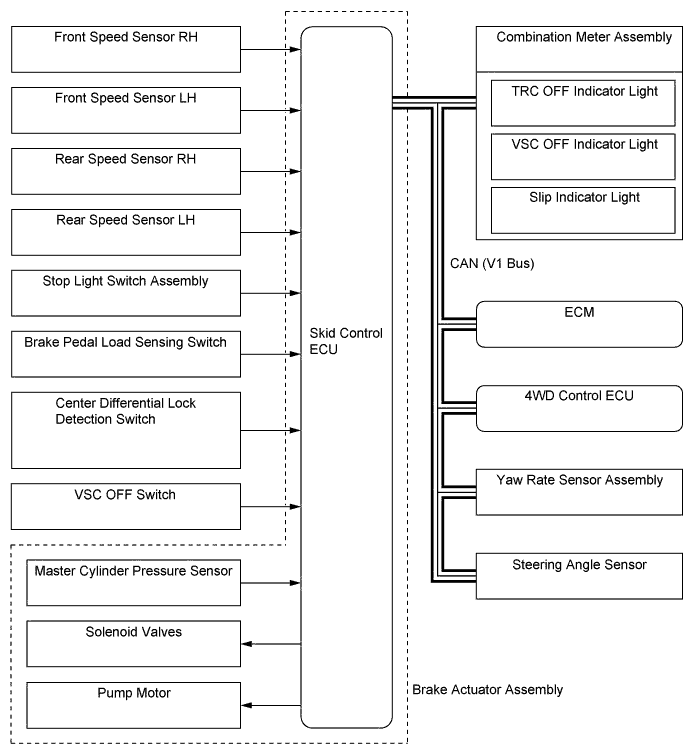
-
In the front wheel skid restraining control, the brake of the front wheel on the outer circle of the turn and the rear wheels are applied. Also, depending on whether the brake is on or off and also depending on the condition of the vehicle, there are circumstances in which the brake might not be applied to the wheels even if the wheel is targeted for braking. The following diagram shows the hydraulic circuit in the pressure increase mode, as it controls the front wheel skid condition while the vehicle is making a right turn. In other operating modes, the pressure holding valve and the pressure reduction valve are turned on or off in accordance with the ABS and EBD operation patterns.
Brake Actuator Operation in VSC (Front Wheel Skid Restraining) Item TRC Operation Not Activated Pressure Increase Mode Pressure Holding Mode Pressure Reduction Mode Pump Off On ← ← Master Cylinder Cut Solenoid Valve (1) Port (A) Off (Open) On* ← ← (2) Port (B) Off (Open) On* ← ← Front Brake Pressure Holding Solenoid Valve (3) Port (C) Off (Open) ← On (Closed) ← (4) Port (D) Off (Open) On (Closed) ← ← Pressure Reduction Solenoid Valve (7) Port (G) Off (Closed) ← ← On (Open) (8) Port (H) Off (Closed) ← ← ← Wheel Cylinder Pressure Left - Increases Holds Reduces Right - - - - Rear Brake Pressure Holding Solenoid Valve (5) Port (E) Off (Open) ← Off (Closed) ← (6) Port (F) Off (Open) ← Off (Closed) ← Pressure Reduction Solenoid Valve (9) Port (I) Off (Closed) ← ← On (Open) (10) Port (J) Off (Closed) ← ← On (Open) Wheel Cylinder Pressure Right - Increases Holds Reduces Left - Increases Holds Reduces Tech Tips
*: The solenoid valve controls the hydraulic pressure between "open" and "closed" in accordance with the operating condition by adjusting continually.
-
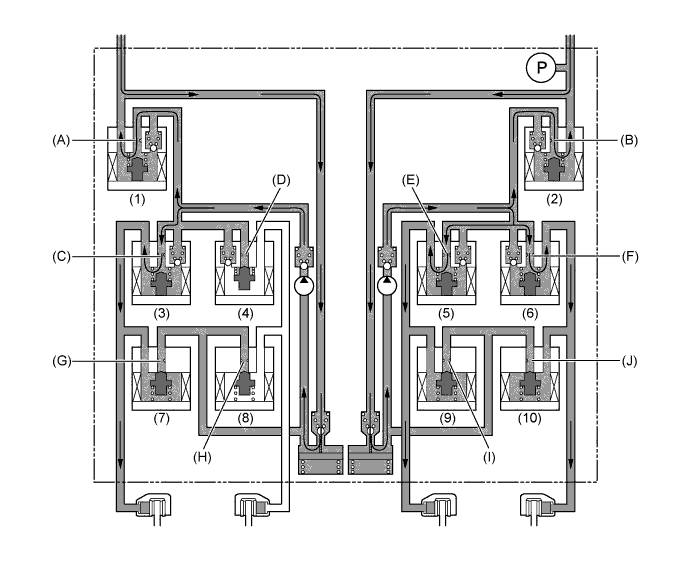
During the rear wheel skid restraining control, the brakes of the front wheel on the outer circle of the turn are applied. Also, depending on whether the brake is on or off and also depending on the condition of the vehicle, there are circumstances in which the brake might not be applied to the wheels even if the wheel is targeted for braking. The following diagram shows the hydraulic circuit in the pressure increase mode, as it controls the rear wheel skid condition while the vehicle is making a right turn. In other operating modes, the pressure holding valve and the pressure reduction valve are turned on or off in accordance with the ABS and EBD operation patterns.
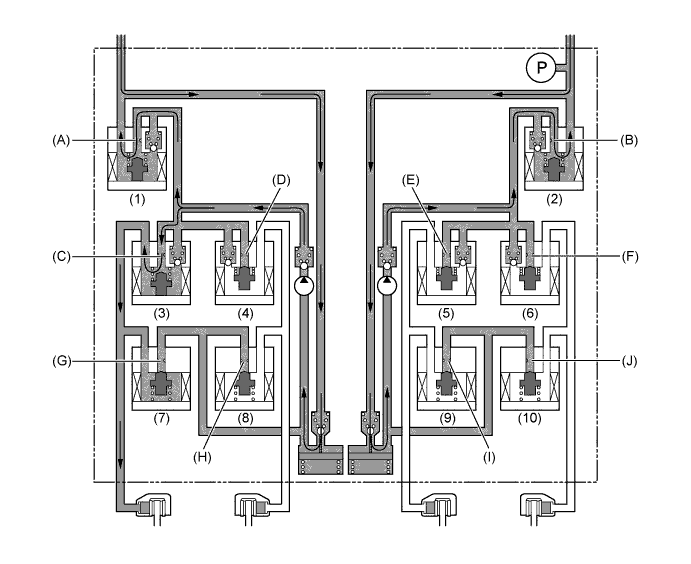
Brake Actuator Operation in VSC (Rear Wheel Skid Restraining) Item TRC Operation Not Activated Pressure Increase Mode Pressure Holding Mode Pressure Reduction Mode Pump Off On ← ← Master Cylinder Cut Solenoid Valve (1) Port (A) Off (Open) On* ← ← (2) Port (B) Off (Open) On* ← ← Front Brake Pressure Holding Solenoid Valve (3) Port (C) Off (Open) ← On (Closed) ← (4) Port (D) Off (Open) On (Closed) ← ← Pressure Reduction Solenoid Valve (7) Port (G) Off (Closed) ← ← On (Open) (8) Port (H) Off (Closed) ← ← ← Wheel Cylinder Pressure Left - Increases Holds Reduces Right - - - - Rear Brake Pressure Holding Solenoid Valve (5) Port (E) Off (Open) On (Closed) ← ← (6) Port (F) Off (Open) On (Closed) ← ← Pressure Reduction Solenoid Valve (9) Port (I) Off (Closed) ← ← ← (10) Port (J) Off (Closed) ← ← ← Wheel Cylinder Pressure Right - - - - Left - - - - Tech Tips
*: The solenoid valve controls the hydraulic pressure between "open" and "closed" in accordance with the operating condition by adjusting continually.
-
-
-
FAIL-SAFE
-
If a failure occurs in the skid control ECU, sensors, or brake actuator, the system continues effecting brake control by excluding the failed area and using only the areas that are operating normally.
-
-
DIAGNOSIS
-
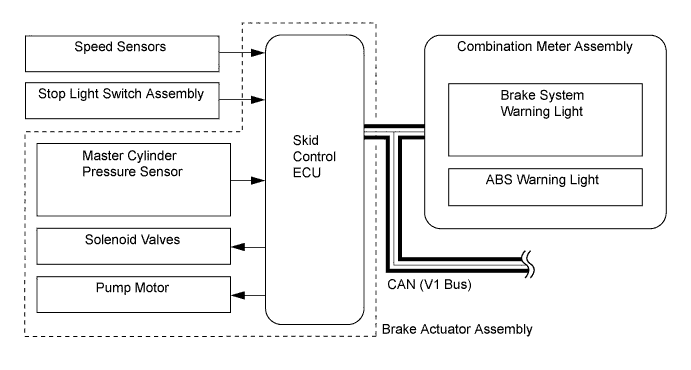
If the skid control ECU detects a malfunction in the brake control system, the warning or indicator lights illuminate. At the same time, a Diagnostic Trouble Code (DTC) is stored in the memory of the skid control ECU.
-
This system has a sensor signal check (test mode) function.
-
For details of DTC and check function, refer to the Repair Manual.
-