DYNAMIC RADAR CRUISE CONTROL SYSTEM GENERAL
-
OUTLINE
-
The dynamic radar cruise control system has 2 modes: constant speed control mode, and vehicle-to-vehicle distance control mode.
-
The cruise control switch is used for switching between the 2 modes. The mode in which the cruise control system starts is the vehicle-to-vehicle distance control mode.
-
The dynamic radar cruise control system is controlled by the driving support ECU, millimeter wave radar sensor and ECM.
-
The combination meter assembly informs the driver of the control conditions.
Mode Outline Constant Speed Control The constant speed control mode is the same as in the cruise control system. However, the set speed is between 50 km/h (30 mph) and 200 km/h (125 mph). Vehicle-to-vehicle Distance Control In the vehicle-to-vehicle distance control mode, the system recognizes and determines the lane in which the driver's own vehicle and the vehicle ahead are traveling. Thus, the system is able to maintain the proper vehicle-to-vehicle distance in accordance with the vehicle speed, and allows the vehicle to be driven under follow-up control.
-
The driver can operate the distance control switch on the steering wheel to select the vehicle-to-vehicle distance in 3 stages: long, middle, and short.
-
This mode consists mainly of 4 controls: constant speed control, deceleration control, follow-up control, and acceleration control.
-
The illustrations below show control examples while the driver's own vehicle is traveling at 100 km/h (62 mph), and the vehicle ahead is traveling at 80 km/h (50 mph).
-
The driving support ECU increases and decreases the vehicle speed by controlling the engine and brakes through transmitting the target acceleration rate, target deceleration rate and brake request signals to the skid control ECU and ECM.
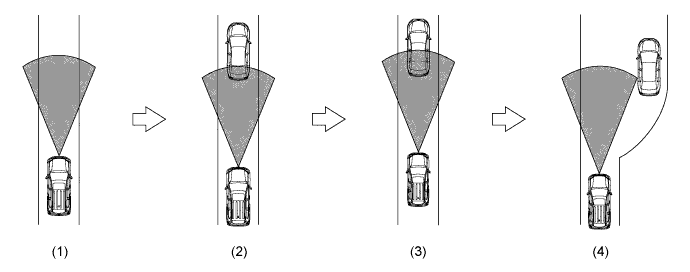
Condition Function Operation Example (1) Constant Speed Control 100 km/h (62 mph) (2) Deceleration Control From 100 km/h to 80 km/h (from 62 mph to 50 mph) (3) Follow-up Control 80 km/h (50 mph) (4) Acceleration Control From 80 km/h to 100 km/h (from 50 mph to 62 mph) -
-
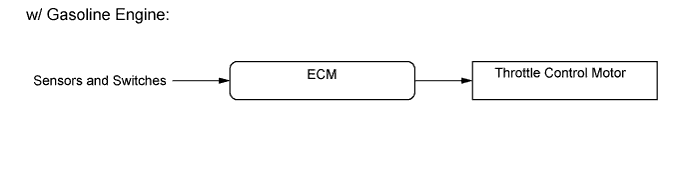
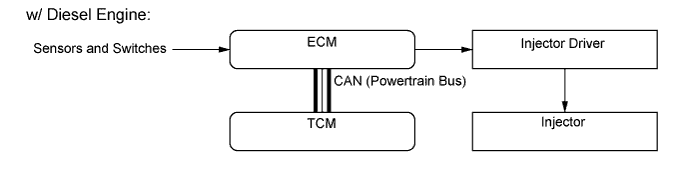
The constant speed control mode is controlled by the ECM, which outputs signals to the throttle control motor on models with gasoline engine, and outputs signals to the injector driver and the TCM on models with diesel engine.
-
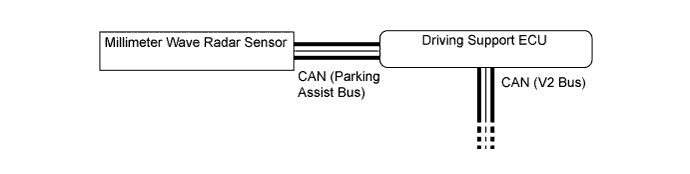
The vehicle-to-vehicle distance control mode is controlled by the driving support ECU and the millimeter wave radar sensor. The driving support ECU outputs signals to the ECUs while exchanging the data between the driving support ECU and the millimeter wave radar sensor.
-
-
PRECAUTION
-
For the constant speed control usage precautions, please see the cruise control system precautions.
-
Observe the following precautions when using the vehicle-to-vehicle distance control:
-
The vehicle-to-vehicle distance control is a vehicle speed control device intended for use on motorways or roads where the traffic is light or moderate.
-
Do not overly rely on the vehicle-to-vehicle distance control. There is a limit to the amount of control it can exert over vehicle distance. Always drive carefully and safely, being attentive of the surrounding environment and the distance between vehicles in front, and using the accelerator and brake pedals as appropriate to maintain the proper distance between other vehicles.
-
The vehicle-to-vehicle distance control is not designed to bring the vehicle to a complete stop. Although it will automatically apply the brakes, there are limits to the amount of brake control it can exert. In certain situations, such as the vehicle in front slowing drastically or another vehicle suddenly cutting in, automatic deceleration will be insufficient to maintain a safe distance. In these situations, a buzzer and display will warn the driver to apply the brakes manually.
-
The vehicle-to-vehicle distance control is not a collision avoidance system and does not provide an excuse for inattentive and careless driving.
-
-
To avoid serious injury or death, do not use the vehicle-to-vehicle distance control under the following road conditions. The vehicle-to-vehicle distance control may automatically cancel if it detects poor weather.
-
In poor weather (such as rain, fog, snow, sandstorms and so on). Vehicle-to-vehicle distance may not be measured accurately. Also, if the wipers are operated at high speed, the vehicle-to-vehicle distance control will automatically cancel and enter stand-by mode.
-
If the front glass of the millimeter wave radar sensor is coated with raindrops or snowflakes. Vehicle-to-vehicle distance may not be measured accurately.
-
On roads with heavy traffic or sharp bends. An appropriate speed may not be maintained, resulting in death or serious injury.
-
On slippery road surfaces (icy or snow-covered roads). The tires may spin, causing a loss of control.
-
On steep downhill slopes. If no vehicles are detected ahead, insufficient engine braking may cause the preset speed to be exceeded, possibly resulting in death or serious injury. Even if a vehicle is detected ahead, the delay in deceleration timing could result in death or serious injury.
-
When the vehicle is being repeatedly accelerated and decelerated in traffic.
-
When exiting the main lanes of a motorway to enter an interchange, service area, parking area and so on while using the vehicle-to-vehicle distance control, and after having followed a slower vehicle, the sensor may not be able to detect the vehicle ahead and vehicle speed may be accelerated to the set speed. This may result in serious injuries and death.
-
On road with steep, short inclines and declines, the sensor may not be able to detect the vehicle ahead and may reduce the vehicle-to-vehicle distance by too much. This may result in serious injuries and death.
-
Trailer towing may lead to performance decline.
-
-
Certain conditions make vehicle detection difficult or impossible. As the vehicle-to-vehicle distance control operates primarily by detecting the reflectors of the vehicle ahead, the distance may not be accurately detected in the following cases, resulting in improper vehicle-to-vehicle distance judgement.
-
The vehicle ahead has higher ground clearance.
-
The rear section of the vehicle ahead is extremely dirty.
-
The vehicle ahead or other vehicles around own vehicle are flinging up water or snow.
-
Excessive exhaust gas (black smoke) is coming from the vehicle ahead or other vehicles nearby, obscuring the area ahead of the vehicle.
-
Heavy luggage loaded in the luggage compartment or on top of the rear seats is causing the nose of the vehicle to rise.
-
-
The millimeter wave radar sensor automatically detects dirt sticking to the sensor glass of the vehicle, and if detected, a warning code is shown on the multi-information display. However, if the sensor glass is obscured by a transparent or translucent vinyl bag, ice, etc., dirt may not be detected, resulting in improper vehicle-to-vehicle distance judgement. Continue driving with due care. If dirt is detected, the vehicle-to-vehicle distance control is automatically canceled. Always keep the sensor glass clean.
-
Depending on the curves of the road and the manner in which the vehicle is being maneuvered, nearby vehicles and objects may be temporarily detected, resulting in activation of the approach warning or a reduction in vehicle-to-vehicle distance caused by a failure to detect vehicles directly ahead.
-
The deceleration control and the approach warning will not operate if the vehicle ahead is at a stop or is driving very slowly. Take appropriate care at tollgates, delays, etc. and be aware of stopped or slow-moving vehicles.
-
Owing to the limited detection area of the millimeter wave radar, detection of vehicles suddenly cutting in front at close range may be delayed, and detection of motorcycles traveling on the outside of a lane may fail. Thus, the system may be unable to maintain proper vehicle-to-vehicle distance.
-
To avoid accidental vehicle-to-vehicle distance control engagement, keep the main switch off when not using the vehicle-to-vehicle distance control.
-
When vehicle-to-vehicle distance control is on (in follow-up control), vehicle speed is regulated in proportion to the speed of the vehicle ahead, and increasing the set speed using the cruise control switch will not cause the vehicle to accelerate. However, if the set speed has been increased, the vehicle speed may increase unexpectedly if the vehicle ahead leaves the lane. Confirm the setting on the multi-information display.
-
Select the vehicle-to-vehicle distance taking traffic conditions into consideration. The approximate distances for each vehicle-to-vehicle distance setting when driving at 80 km/h (50 mph) are applied as follows:
-
Long: approximately 50 m (160 ft.)
-
Middle: approximately 40 m (130 ft.)
-
Short: approximately 30 m (100 ft.)
-
If the vehicle speed is below 80 km/h (50 mph), the distance will be shorter than the above.
-
-
During long downhill driving, the vehicle-to-vehicle distance may be shorter than the selected distance.
-
When the multi buzzer sounds frequently, do not use the vehicle-to-vehicle distance control.
-
In the following situations, the approach warning may not activate even if the vehicle is close to the vehicle ahead:
-
The vehicle ahead is cruising at almost the same speed.
-
The vehicle ahead is cruising at a faster speed.
-
Immediately after the speed has been set.
-
The accelerator pedal is depressed.
-
Immediately following the release of the accelerator pedal.
-
-
While vehicle-to-vehicle distance control is on (in follow-up control), acceleration and deceleration are automatically performed in proportion to the speed of the vehicle detected ahead. However, when the acceleration is necessary to change lanes, the vehicle ahead decelerates abruptly, or another vehicle suddenly cuts in, operate the accelerator and brake pedals manually.
-
If the master warning light comes on, the multi buzzer sounds, and a warning code, "FAIL", appears on the display while cruising in vehicle-to-vehicle distance control mode, turn the main switch off and perform setting once again. If setting cannot be performed, or if the cruise control is immediately canceled after setting, there may be a malfunction in the system. Although it is safe to continue driving, contact a Toyota dealer for an inspection.
-
To ensure that the vehicle-to-vehicle distance control functions properly while driving, observe the following precautions:
-
Always keep the millimeter wave radar sensor glass clean. When cleaning, use a soft cloth and be careful not to damage the sensor.
-
Do not disassemble the sensor or subject the sensor or its surrounding area to strong impacts. Doing so will cause the sensor to malfunction.
-
Do not affix stickers (including transparent stickers) or attach accessories around the millimeter wave radar sensor. This will cause the millimeter wave radar sensor to malfunction.
-
-
In the constant speed control, the multi buzzer does not sound to warn the driver if the vehicle is too close to the vehicle ahead, as neither the presence of the vehicle ahead nor the vehicle-to-vehicle distance is detected. Stay a safe distance away from the vehicle ahead.
-
The vehicle-to-vehicle distance control mode and the constant speed control mode both control the vehicle in different ways. When using vehicle-to-vehicle distance control, always confirm the selected mode on the display of the combination meter assembly.
-