BRAKE CONTROL SYSTEM DETAILS
-
FUNCTION OF MAIN COMPONENTS
Component Function Brake Actuator Assembly
-
Solenoid Valve
-
Master Cylinder Cut Solenoid Valve
-
Reservoir Cut Solenoid Valve
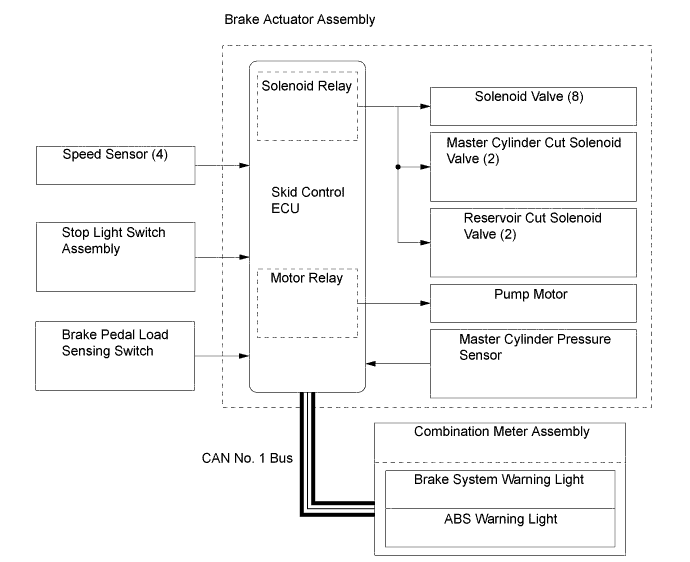
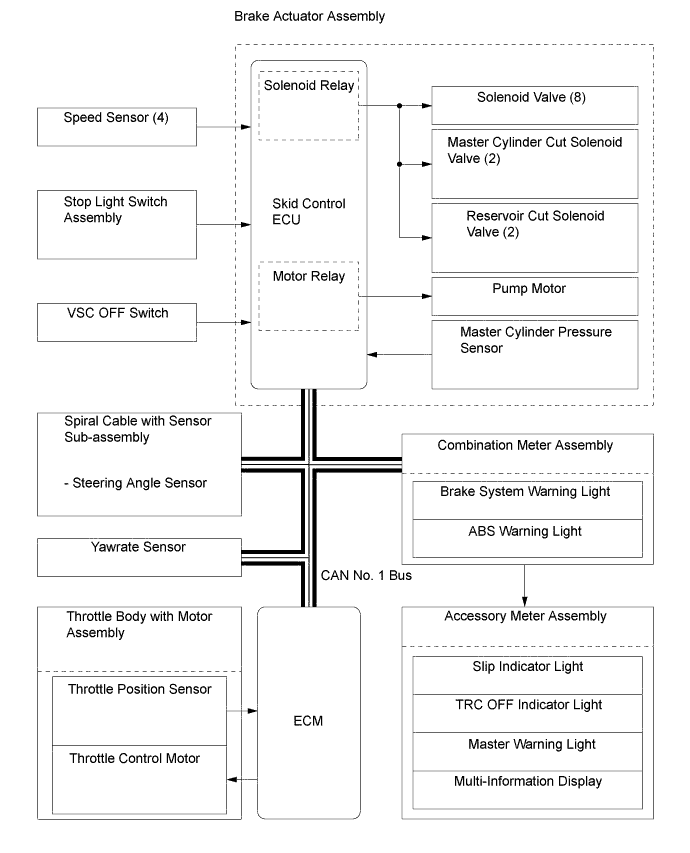
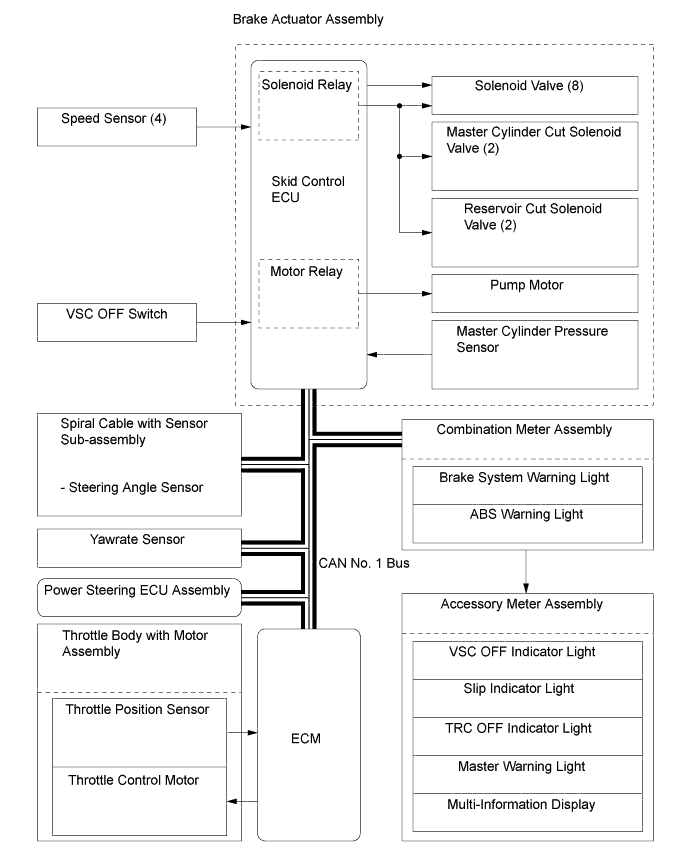
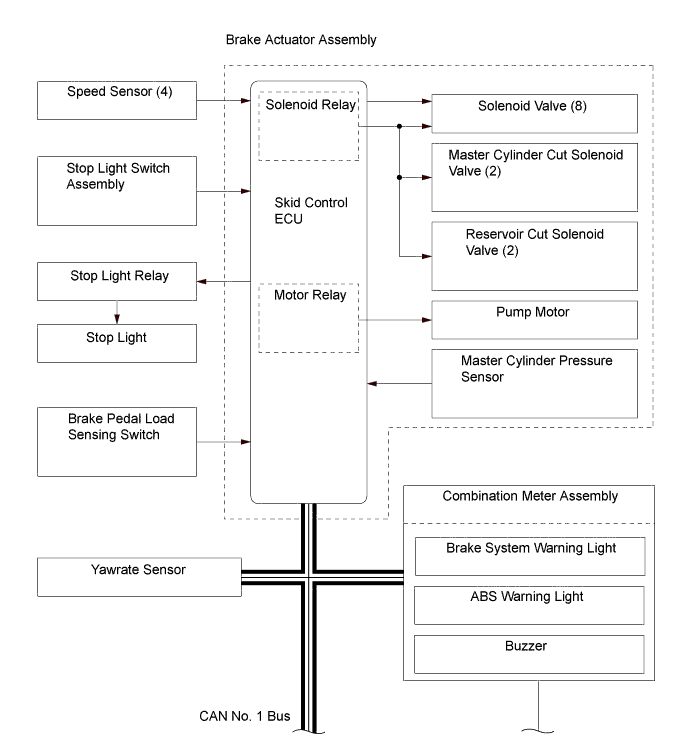
Changes the fluid path based on the signals from the skid control ECU during the operation of the brake control system functions in order to control the fluid pressure applied to each wheel cylinder. Master Cylinder Pressure Sensor Built into in the brake actuator, detects the master cylinder pressure. Skid Control ECU Judges the vehicle driving condition based on the signals from each sensor, and sends the brake control signals to the brake actuator. Motor Relay Supplies power to the pump motor. Solenoid Relay Supplies power to the solenoid valves. Pump Motor Drives the pumps inside the brake actuator. Combination Meter Assembly Brake System Warning Light
-
Illuminates to alert the driver when the skid control ECU detects a malfunction in the EBD system.
-
Illuminates to alert the driver when the skid control ECU detects a malfunction in the brake booster.
-
Illuminates to alert the driver when the brake fluid level is low.
-
Illuminates to inform the driver when the parking brake is applied.
ABS Warning Light Illuminates to alert the driver when the skid control ECU detects a malfunction in the ABS. Buzzer Sounds to alert the driver when the vehicle is being driven with the parking brake still engaged. Accessory Meter Assembly Slip Indicator Light
-
Blinks to inform the driver when TRC or VSC is operating.
-
Illuminates to alert the driver when the skid control ECU detects a malfunction in the TRC or VSC.
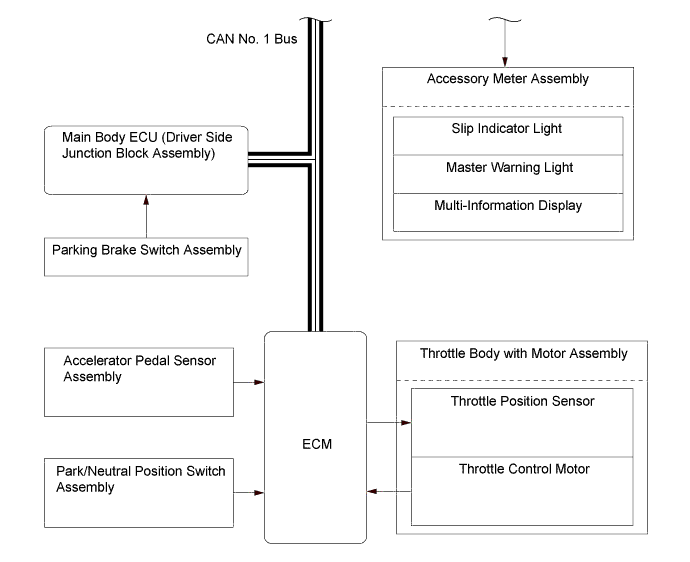
TRC OFF Indicator Light Illuminates to inform the driver when TRC OFF mode is selected. VSC OFF Indicator Light Illuminates to inform the driver when VSC OFF mode is selected. Master Warning Light Illuminates to alert the driver when the skid control ECU detects a malfunction in the brake control system. Multi-information Display Displays a warning message to alert the driver when the skid control ECU detects a malfunction in the brake control function. Throttle Body with Motor Assembly Throttle Position Sensor Detects the throttle valve opening angle and outputs it to the ECM. Throttle Control Motor Adjusts the throttle valve opening angle in accordance with signals from the ECM. Park/Neutral Position Switch Assembly Detects the shift lever position. Stop Light Relay Illuminates the stop lights when Hill-start Assist Control is operating. Spiral Cable with Sensor Sub-assembly Steering Angle Sensor Detects the steering direction and angle of the steering wheel. Yawrate Sensor
-
Detects the vehicle's longitudinal and lateral acceleration and deceleration.
-
Detects the vehicle's yaw rate.
Speed Sensor Detect the wheel speed of each of the 4 wheels. Stop Light Switch Assembly Detects brake pedal operation. Brake Pedal Load Sensing Switch
-
Detects the brake pedal depressing force.
-
Illuminates the stop lights when Hill-start Assist Control is operating.
Parking Brake Switch Assembly Detects the parking brake pedal status. VSC OFF Switch Enables the driver to select Normal mode, TRC OFF mode, or VSC OFF mode. Accelerator Pedal Sensor Assembly Detects the accelerator pedal depression angle. ECM
-
Sends the throttle position signal, accelerator pedal position signal, engine speed signal etc., to the skid control ECU.
-
Based on the signals received from the skid control ECU, controls the engine output.
Main Body ECU (Driver Side Junction Block Assembly) Detects the parking brake signal and outputs it to the skid control ECU via CAN communication. Power Steering ECU Assembly Operates cooperatively with the skid control ECU to control the steering assist torque. -
-
SYSTEM CONTROL
Control Outline Steering Cooperative Control VSC and cooperative control with EPS effects coordinated control consisting of VSC and EPS. By integrating these preventive safety functions, VSC and cooperative control with EPS ensures excellent driving stability and maneuverability of the vehicle. Anti-lock Brake System (ABS) The ABS helps prevent the wheels from locking when the brakes are applied firmly or when braking on a slippery surface. Electronic Brake Force Distribution (EBD) EBD control utilizes ABS, realizing proper brake force distribution between the front and rear wheels in accordance with the driving conditions. In addition, during braking while cornering, it also controls the brake forces of the right and left wheels, helping maintain vehicle behavior. Brake Assist The primary purpose of Brake Assist is to provide supplementary brake force to assist a driver who cannot generate a large brake force during emergency braking, thus helping ensure the vehicle's braking performance. Traction Control (TRC) Helps restrain the slippage of the drive wheels if the driver depresses the accelerator pedal excessively when starting off or accelerating on a slippery surface. Vehicle Stability Control (VSC) Helps restrain sideways slippage of the vehicle during a strong understeer tendency or strong oversteer tendency while cornering. Hill-start Assist Control When the vehicle starts off on a steep or a slippery hill, Hill-start Assist Control detects the backward movement of the vehicle and effects 4-wheel hydraulic pressure control to prevent the vehicle from moving backward.
-
Steering Cooperative Control
-
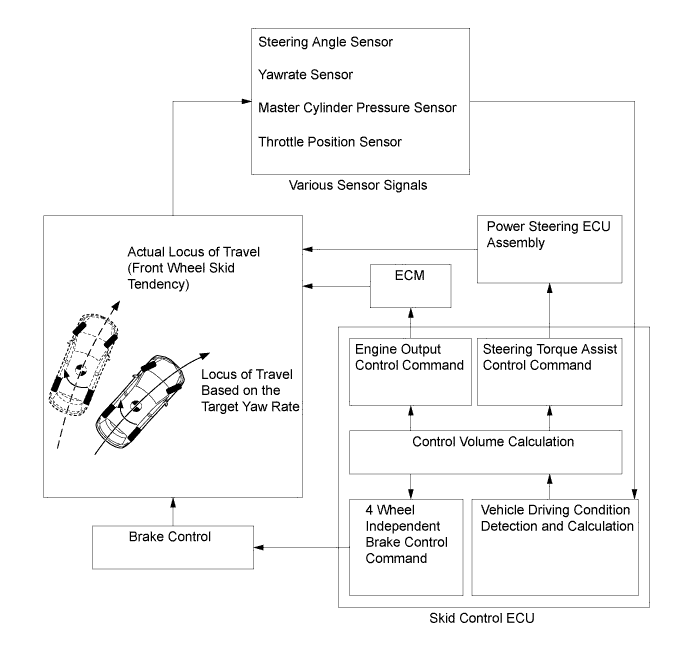
VSC and cooperative control with EPS coordinates EPS and the brake control systems to perform brake control on split friction roads, rear wheel skid control and understeer control.
-
If the vehicle loses stability due to wheel slippage, this function performs brake control by applying brake pressure to the wheels. At the same time, the EPS provides steering torque assist control to facilitate the driver's steering maneuver.
-
When braking on a split friction road, the vehicle tends to deflect toward the higher friction side due to the difference between the braking forces on the left and right sides. In this state, the power steering ECU assembly receives command signals from the skid control ECU. Based on these signals, the power steering ECU assembly operates the motor for the EPS to reduce the effect of the difference between the braking forces on the left and right sides, assisting steering operation. This enables the driver to operate the steering wheel to make steering corrections easily.
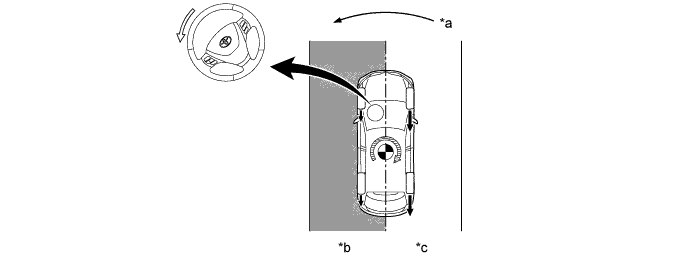
Text in Illustration *a Anti Spin Moment *b Low Friction *c High Friction - - 
Braking Force 
Steering Torque Assist 
Spin Moment - - -
When accelerating on a split friction road, the vehicle tends to deflect toward lower friction side due to the driving force difference between the left and right sides. In this state, the skid control ECU performs brake control of the drive wheel on the low friction side (TRC function) and transmits command signals to the power steering ECU assembly. Based on these signals, the power steering ECU assembly operates the motor for the EPS to reduce the effect of the driving force difference between the left and right sides, assisting steering operation. As a result, proper driving force and vehicle stability is ensured.
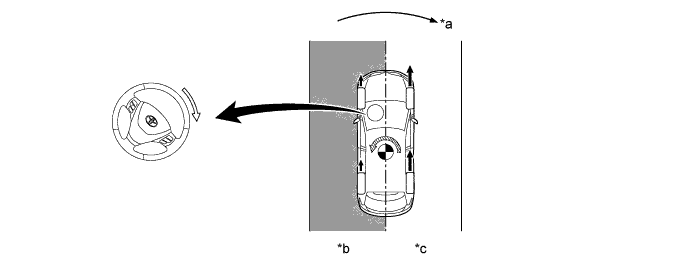
Text in Illustration *a Anti Spin Moment *b Low Friction *c High Friction - - Driving Force Steering Torque Assist Spin Moment -
When front wheel skidding is detected, engine output is limited and brake control is performed based on the amount of understeer tendency. Accordingly, a moment of force is generated in the vehicle turning direction to limit understeer tendency.
-
In the case of understeer tendency, steering torque assist is provided to warn the driver of the understeer.
-
If the driver turns the steering wheel excessively, steering torque assist is provided. This is done to prevent excessive steering input.
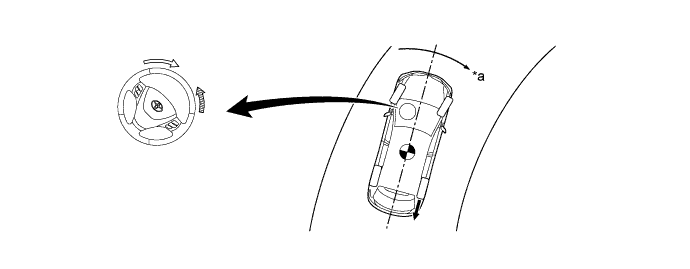
Text in Illustration *a Moment of force to restrict front wheel skid - - Braking Force Steering Torque Assist (To warn driver of understeer) Steering Torque Assist (To prevent excessive steering input) - - -
When rear wheel skidding is detected, brake force is applied to mainly the outer wheels according to the amount of oversteer tendency. Accordingly, an anti-spin moment is generated to limit the oversteer tendency.
-
In this state, the power steering ECU assembly receives command signals from the skid control ECU. Based on these signals, the power steering ECU assembly operates the motor for the EPS to provide steering assist to help the driver compensate for the oversteer tendency. This enables easier steering inputs for the driver.
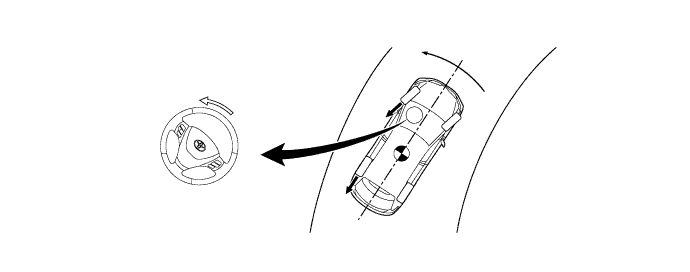
Text in Illustration Braking Force Steering Torque Assist
-
-
Anti-lock Brake System (ABS)
-
The ABS prevents the wheels from locking during sudden braking or braking on a slippery surface. This provides the proper braking force when the vehicle slips, thus ensuring vehicle stability and excellent braking performance.
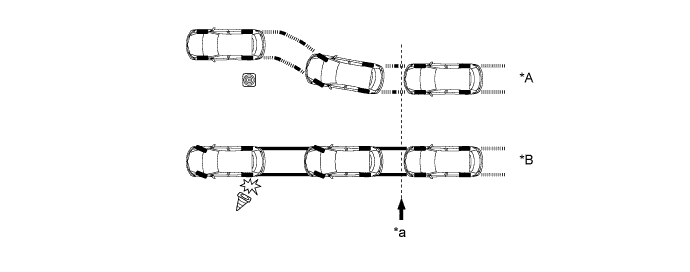
Text in Illustration *A With ABS *B Without ABS *a Brake Operation - -
-
-
Electronic Brake Force Distribution (EBD)
-
This function controls the brake force that acts on the rear wheels in accordance with the changes in the vehicle conditions such as load factors or deceleration, in order to ensure excellent braking performance.
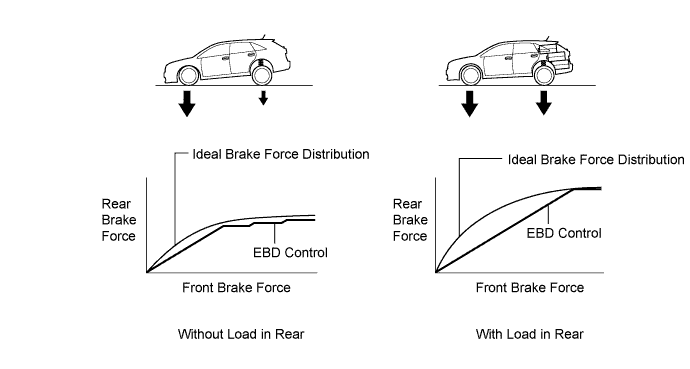
-
During cornering braking, this function controls the brake force that acts on the left and right wheels in accordance with the vehicle conditions at that time. This ensures vehicle stability and excellent braking performance.

Text in Illustration *a Control Moment - - Braking Force - -
-
-
Brake Assist
-
With brake assist, based on the signals from the master cylinder pressure sensor, the skid control ECU calculates the speed with which and the amount the brake pedal is applied to determine if the driver is attempting emergency braking. If the skid control ECU determines that the driver is attempting emergency braking, the brake assist function activates the brake actuator to increase the brake fluid pressure, which increases the brake force.
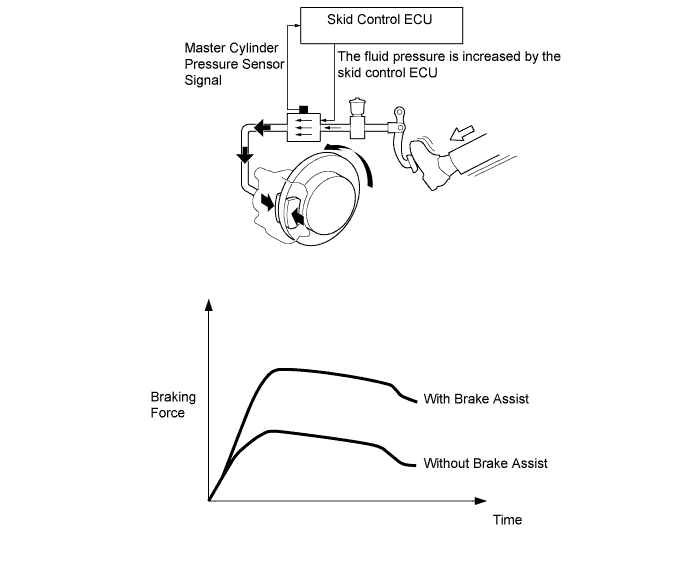
-
-
Traction Control (TRC)
-
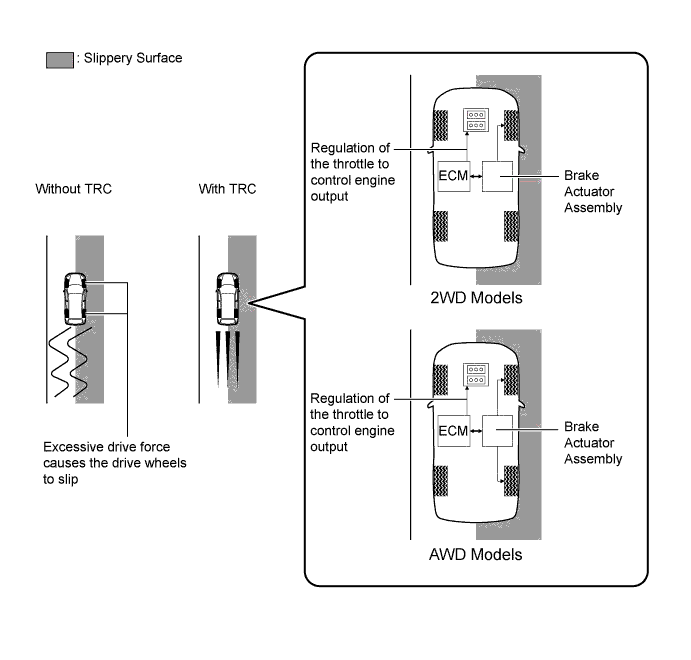
TRC helps prevent the drive wheels from slipping if the driver depresses the accelerator pedal excessively when starting off or accelerating on a slippery surface. Used simultaneously with hydraulic brake control over the drive wheels, the skid control ECU requests the ECM to perform engine output control. This produces drive force suited to the driving conditions in order to ensure proper start-off acceleration.
-
-
Vehicle Stability Control (VSC)
-
The following 2 examples can be considered as circumstances in which the tires exceed their lateral grip limit. VSC is designed to help control the vehicle behavior by controlling the engine output and the brakes at each wheel when the vehicle is subject to one of the conditions indicated below.
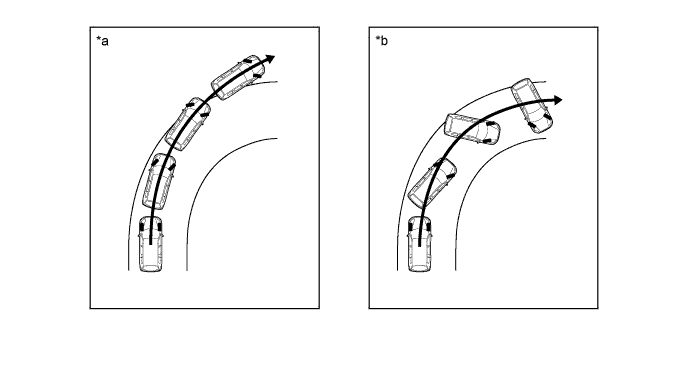
Text in Illustration *a Front Wheel Skid Tendency *b Rear Wheel Skid Tendency -
To determine the condition of the vehicle, sensors detect the steering angle, vehicle speed, vehicle yaw rate, and the vehicle lateral acceleration, which are then calculated by the skid control ECU.
-
Whether or not the vehicle is experiencing a front wheel skid is determined by the difference between the target yaw rate and the vehicle's actual yaw rate. When the vehicle's actual yaw rate is smaller than the target yaw rate (a target yaw rate is determined based on the vehicle speed and steering angle) that should be generated when the driver operates the steering wheel, it means the vehicle is making a turn at a greater angle than the target locus of travel. Thus, the skid control ECU determines that there is a large understeer tendency.
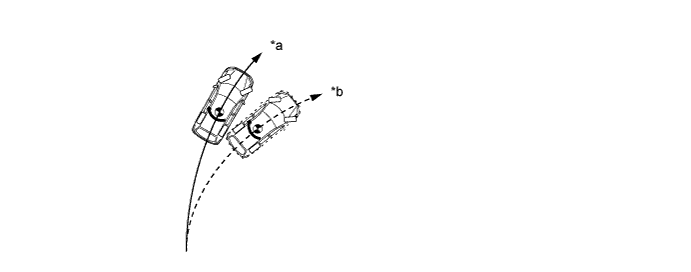
Text in Illustration *a Actual Locus of Travel (Actual Yaw Rate) *b Locus of Travel Based on the Target Yaw Rate -
Whether or not the vehicle is experiencing oversteer is determined by the values of the vehicle's slip angle and the vehicle's slip angular velocity (time-dependent changes in the vehicle's slip angle). When the vehicle's slip angle is large, and the slip angular velocity is also large, the skid control ECU determines that the vehicle has a large oversteer tendency.

Text in Illustration *a Slip Angle *b Movement of Vehicle *c Direction of Travel of the Vehicle's Center of Gravity - - -
When the skid control ECU determines that the vehicle exhibits a tendency to experience either a front wheel skid or a rear wheel skid, it decreases the engine output and applies the brakes of the front or rear wheels to control the vehicle's yaw moment. The basic operation of the VSC functions is described below. However, the control method differs depending on the vehicle's characteristics and driving conditions.
-
When the skid control ECU determines that there is a large understeer tendency, it takes countermeasures in accordance with the extent of that tendency. The skid control ECU controls the engine output and applies the brake of the rear wheel of the inner circle of the turn in order to help restrain the understeer tendency.

Text in Illustration (Making a Right Turn:) *a Control Moment - - Braking Force - - -
When the skid control ECU determines that there is a large oversteer tendency, it takes countermeasures in accordance with the extent of that tendency. It applies the brakes of the front wheel and rear wheel of the outer circle of the turn, and generates an outward moment of inertia in the vehicle, in order to restrain the oversteer tendency. Along with the reduction in the vehicle speed caused by the braking force, excellent vehicle stability is ensured.

Text in Illustration *a Control Moment - - Braking Force - -
-
-
Hill-start Assist Control
-
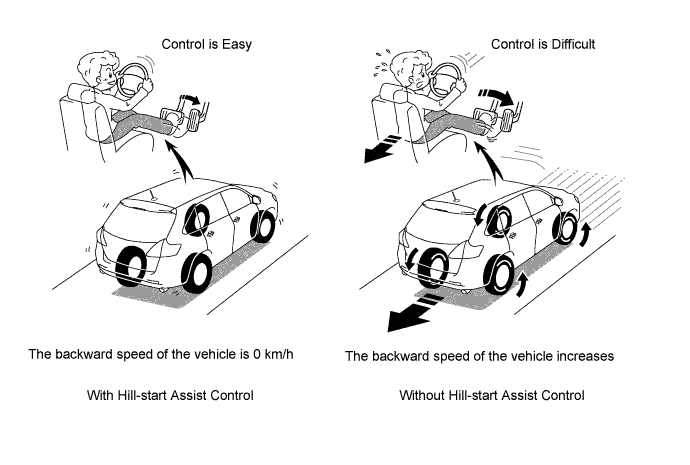
When the vehicle starts off on a steep or slippery hill, the vehicle could descend backward while the driver switches from the brake pedal to the accelerator pedal, thus making it difficult for the vehicle to start off. To prevent this from occurring, the hill-start assist control temporarily (approximately 2 seconds maximum) applies the brakes to all the wheels in order to prevent the vehicle from moving backward.
-
Without the hill-start assist control, the driver must quickly and precisely switch from the brake pedal to the accelerator pedal. With the hill-start assist control, however, the driver can start off easily and operate the pedal in a relaxed manner because the hill-start assist control prevents the vehicle from moving backward.
-
-
-
FUNCTION
-
VSC OFF Switch
-
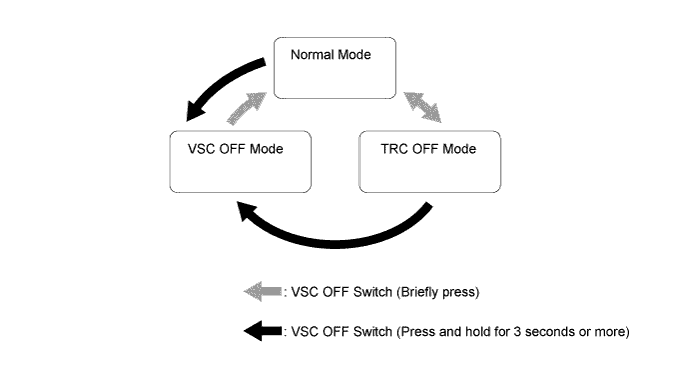
Using the VSC OFF switch can stop the operation of the VSC and TRC functions. This is used to stop engine output control and maintain drive torque when driving on the shoulder or on dirt roads.
-
The VSC OFF switch can select 3 modes (Normal mode, TRC OFF mode, VSC OFF mode).
-
After the ignition switch is turned off in TRC OFF mode or VSC OFF mode, turning the ignition switch ON again selects normal mode.
-
The operations of the brake control functions in each mode are as follows:
Item Brake Control Function TRC OFF Indicator Light VSC OFF Indicator Light TRC VSC Normal Mode ○ ○ - - TRC OFF Mode x ○ Illuminates - VSC OFF Mode x x* Illuminates Illuminates
-
○: Controllable
-
x: Not controllable
Tech Tips
*: Control will be performed during braking or if the yaw rate is large.
-
-
-
-
CONSTRUCTION
-
Steering Angle Sensor
-
The steering angle sensor detects the steering direction and angle, and sends this signal to the skid control ECU.

-
-
Yawrate Sensor
-
The yawrate sensor detects the vehicle's yaw rate.
-
The deceleration sensor detects the longitudinal acceleration and deceleration.

-
-
Speed Sensor
-
An active type speed sensor is used. This sensor contains a Hall IC.
-
The magnet type rotor, which consists of N and S poles that are arranged in a circle, is integrated with the hub bearing inner race.
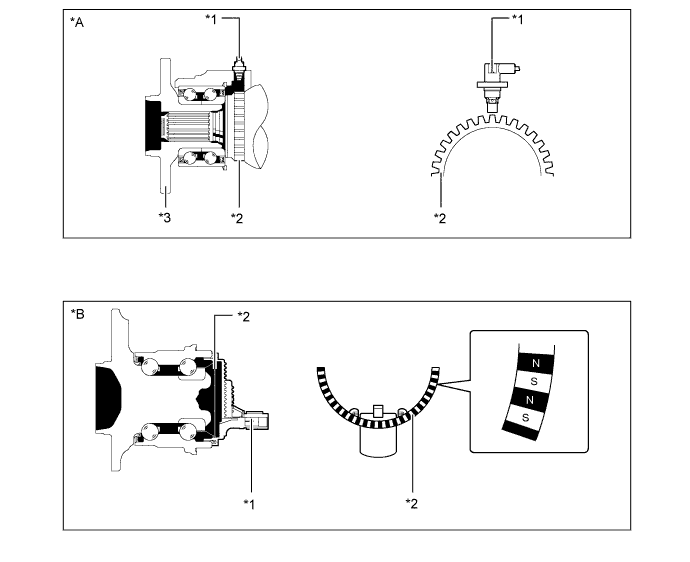
Text in Illustration *A Front Speed Sensor (2WD Models), Front/Rear Speed Sensor (AWD Models) *B Rear Speed Sensor (2WD Models) *1 Speed Sensor *2 Sensor Rotor *3 Axle Hub - -
-
-
Brake Actuator Assembly
-
The brake actuator assembly consists of the brake actuator portion and skid control ECU.
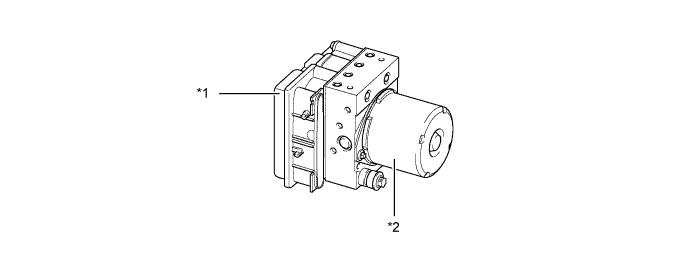
Text in Illustration *1 Skid Control ECU *2 Brake Actuator Portion -
The brake actuator assembly is constructed with the following hydraulic circuit:
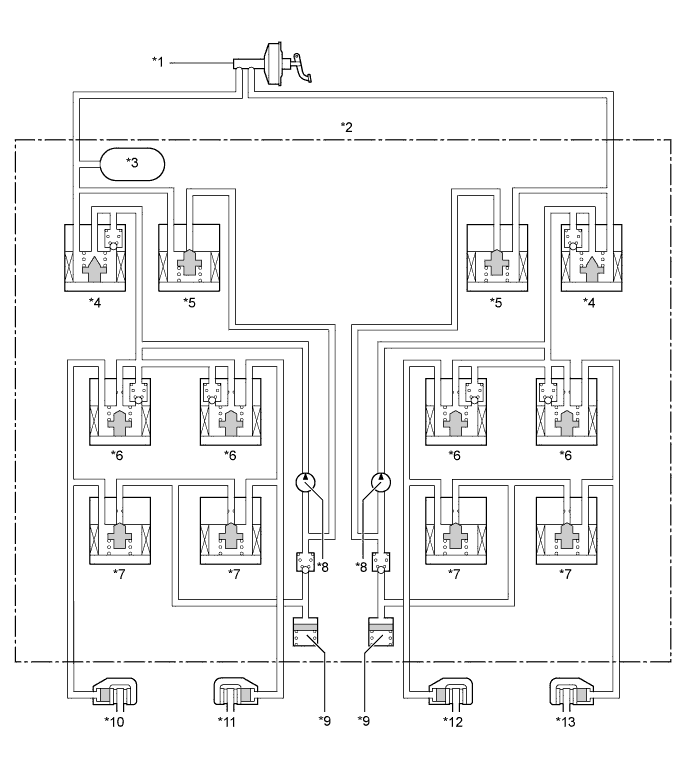
Text in Illustration *1 Brake Master Cylinder Sub-assembly *2 Brake Actuator Assembly *3 Master Cylinder Pressure Sensor *4 Master Cylinder Cut Solenoid Valve *5 Reservoir Cut Solenoid Valve *6 Pressure Holding Solenoid Valve *7 Pressure Reduction Solenoid Valve *8 Pump *9 Reservoir *10 Front Brake Caliper (Left Side) *11 Rear Brake Caliper (Right Side) *12 Rear Brake Caliper (Left Side) *13 Front Brake Caliper (Right Side) - -
-
-
-
OPERATION
-
Speed Sensor
-
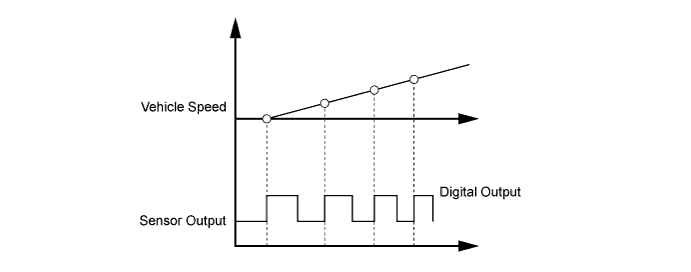
An active type speed sensor uses a sensor IC to detect magnetic field changes caused when the sensor rotor rotates, and the sensor outputs the detected information to the skid control ECU as digital pulses (vehicle speed signal).
-
To detect the vehicle speed, the frequency of the output pulses is used. Because the active type sensor outputs digital pulses, it can detect vehicle speeds even when the vehicle is nearly stationary.
-
-
ABS and EBD
-
Based on the signals received from the 4 speed sensors, the skid control ECU calculates each wheel speed and deceleration, and checks wheel slipping conditions. According to the slipping condition, the skid control ECU controls the pressure holding valve and pressure reduction valve in order to adjust the fluid pressure of the each wheel cylinder in the following 3 modes: pressure reduction, pressure holding, and pressure increase modes.
Not Activated Normal Braking - - Activated Increase Mode Holding Mode Reduction Mode Hydraulic Circuit 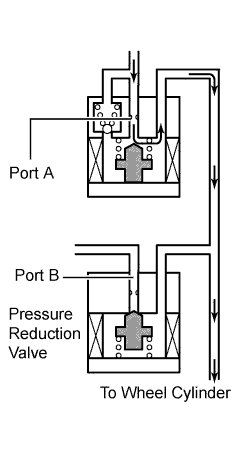
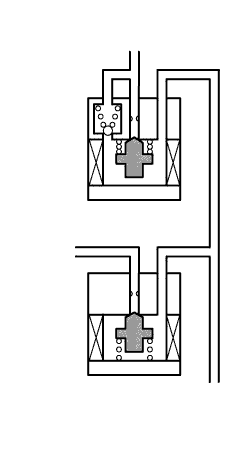
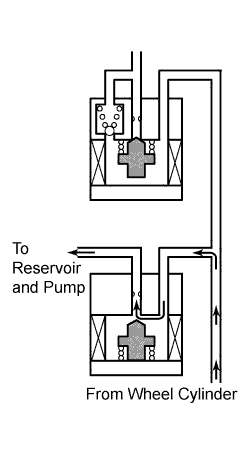
Pressure Holding Valve (Port A) OFF (Open) ON (Closed) ON (Closed) Pressure Reduction Valve (Port B) OFF (Closed) OFF (Closed) ON (Open) Brake Wheel Cylinder Pressure Increased Held Reduced
-
-
Brake Assist
-
In the event of emergency braking, the skid control ECU detects the driver's intention based on the speed of the pressure increase in the master cylinder determined by the master cylinder pressure sensor signal. If the skid control ECU judges the need for additional brake assist, pressure is generated by the pump in the brake actuator assembly and directed to the wheel cylinder to apply a greater fluid pressure than the master cylinder. Also in the following cases, the skid control ECU provides brake assist.
-
In the event of a brake booster failure, the skid control ECU judges the failure using the brake load sensing switch and master cylinder pressure sensor signals.
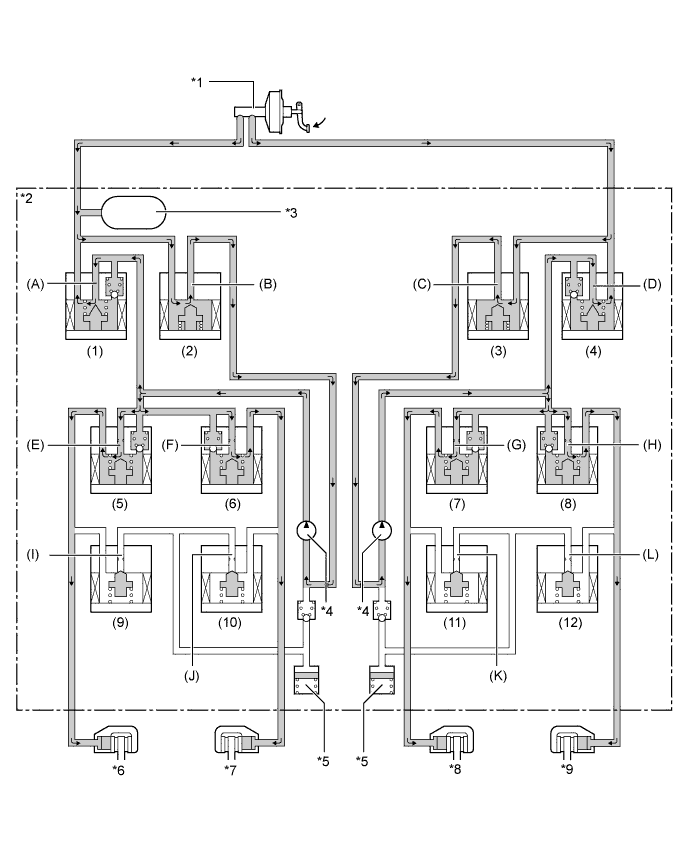
Text in Illustration (Brake Assist Operation:) *1 Brake Master Cylinder Sub-assembly *2 Brake Actuator Assembly *3 Master Cylinder Pressure Sensor *4 Pump *5 Reservoir *6 Front Brake Caliper (Left Side) *7 Rear Brake Caliper (Right Side) *8 Rear Brake Caliper (Left Side) *9 Front Brake Caliper (Right Side) - - Item Port Brake Assist Not Activated Brake Assist Activated Master Cylinder Cut Solenoid Valves (1), (4) (A), (D) OFF (Open) ON* Reservoir Cut Solenoid Valve (2), (3) (B), (C) OFF (Closed) ON Pressure Holding Solenoid Valves (5), (6), (7), (8) (E), (F), (G), (H) OFF (Open) OFF
(Open)
Pressure Reduction Solenoid Valves (9), (10), (11), (12) (I), (J), (K), (L) OFF (Closed) OFF
(Closed)
Pump OFF ON
-
*: Hydraulic pressure is controlled by continuously cycling the solenoid valves between open and closed, according to the operating conditions.
-
-
-
TRC
-
The master cylinder cut solenoid valve regulates the fluid pressure generated by the pump to the required pressure. Thus, the wheel cylinders of the drive wheels are controlled in the following 3 modes: pressure reduction, pressure holding, and pressure increase modes to control the slippage of the drive wheels. The diagram on the next page shows the hydraulic circuit in the pressure increase mode when TRC is activated. The pressure holding solenoid valve and the pressure reduction solenoid valve are turned ON/OFF according to the ABS and EBD operation pattern.
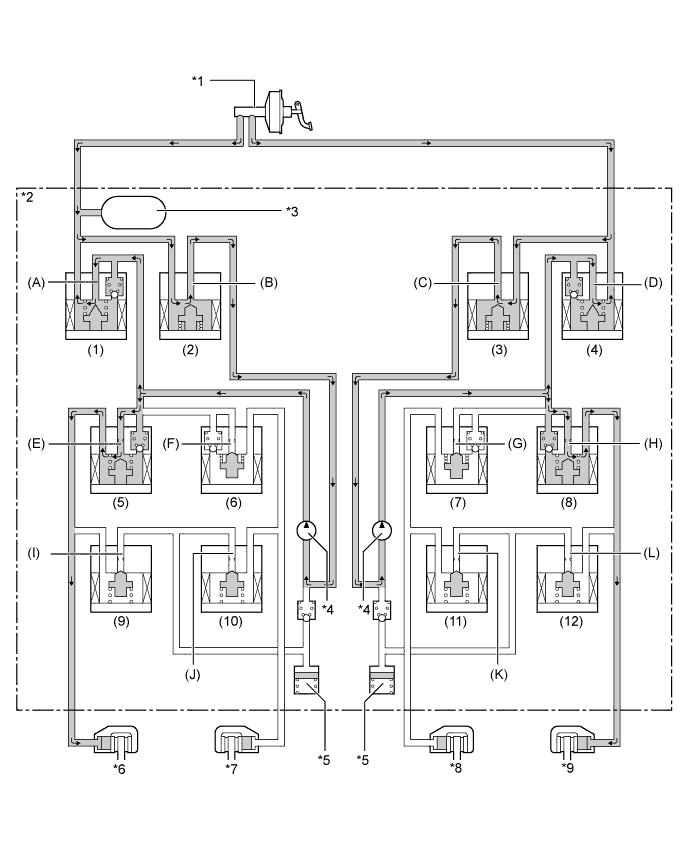
Text in Illustration (TRC Operation (2WD Models):) *1 Brake Master Cylinder Sub-assembly *2 Brake Actuator Assembly *3 Master Cylinder Pressure Sensor *4 Pump *5 Reservoir *6 Front Brake Caliper (Left Side) *7 Rear Brake Caliper (Right Side) *8 Rear Brake Caliper (Left Side) *9 Front Brake Caliper (Right Side) - - Item Port TRC Not Activated TRC Activated Increase Mode Holding Mode Reduction Mode Master Cylinder Cut Solenoid Valve (1), (4) (A), (D) OFF (Open) ON* ON* ON* Reservoir Cut Solenoid Valve (2), (3) (B), (C) OFF (Closed) ON (Open) OFF (Closed) OFF (Closed) Front Brakes Pressure Holding Solenoid Valve (5), (8) (E), (H) OFF (Open) OFF (Open) ON (Closed) OFF (Open) Pressure Reduction Solenoid Valve (9), (12) (I), (L) OFF (Closed) OFF (Closed) OFF (Closed) OFF (Closed) Brake Wheel Cylinder Pressure Right - - - Increased Held Reduced Left - - - Increased Held Reduced Rear Brakes Pressure Holding Solenoid Valve (6), (7) (F), (G) OFF (Open) ON (Closed) ON (Closed) ON (Closed) Pressure Reduction Solenoid Valve (10), (11) (J), (K) OFF (Closed) OFF (Closed) OFF (Closed) ON (Open) Brake Wheel Cylinder Pressure Right - - - - - - Left - - - - - - Pump OFF ON ON ON
-
*: Hydraulic pressure is controlled by continuously cycling the solenoid valves between open and closed, according to the operating conditions.
-
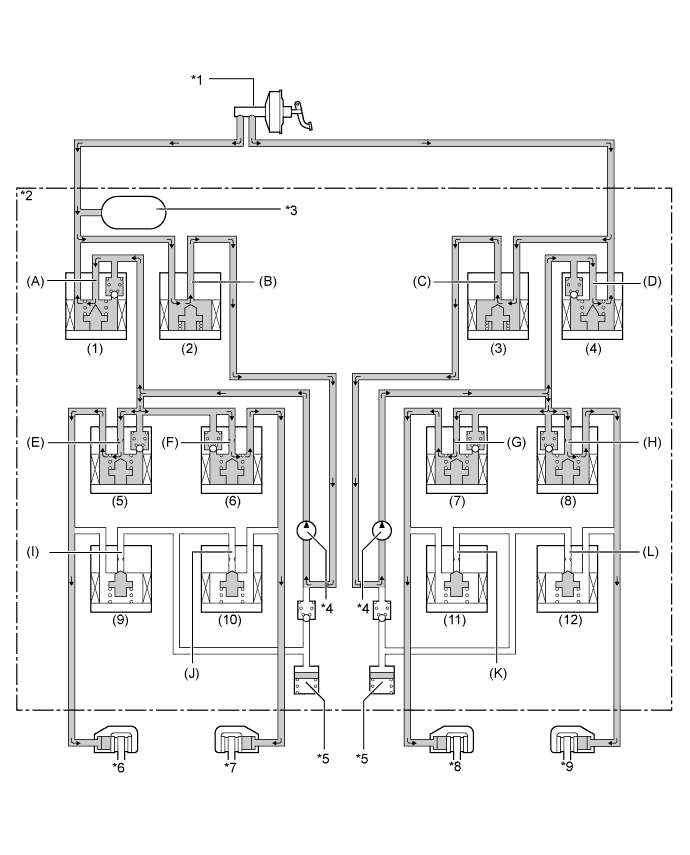
Text in Illustration (TRC Operation (AWD Models):) *1 Brake Master Cylinder Sub-assembly *2 Brake Actuator Assembly *3 Master Cylinder Pressure Sensor *4 Pump *5 Reservoir *6 Front Brake Caliper (Left Side) *7 Rear Brake Caliper (Right Side) *8 Rear Brake Caliper (Left Side) *9 Front Brake Caliper (Right Side) - - Item Port TRC Not Activated TRC Activated Increase Mode Holding Mode Reduction Mode Master Cylinder Cut Solenoid Valve (1), (4) (A), (D) OFF (Open) ON* ON* ON* Reservoir Cut Solenoid Valve (2), (3) (B), (C) OFF (Close) ON (Open) OFF (Close) OFF (Close) Front Brakes Pressure Holding Solenoid Valve (5), (8) (E), (H) OFF (Open) OFF (Open) ON (Closed) ON (Closed) Pressure Reduction Solenoid Valve (9), (12) (I), (L) OFF (Closed) OFF (Closed) OFF (Closed) ON (Open) Brake Wheel Cylinder Pressure Right - - - Increased Held Reduced Left - - - Increased Held Reduced Rear Brakes Pressure Holding Solenoid Valve (6), (7) (F), (G) OFF (Open) OFF (Open) ON (Closed) ON (Closed) Pressure Reduction Solenoid Valve (10,) (11) (J), (K) OFF (Closed) OFF (Closed) OFF (Closed) ON (Open) Brake Wheel Cylinder Pressure Right - - - Increased Held Reduced Left - - - Increased Held Reduced Pump OFF ON ON ON -
*: Hydraulic pressure is controlled by continuously cycling the solenoid valves between open and closed, according to the operating conditions.
-
-
-
VSC
-
VSC, by way of solenoid valves, controls the fluid pressure that is generated by the pump and applies it to the brake wheel cylinder of each wheel in the following 3 modes: pressure reduction, pressure holding, and pressure increase modes. As a result, the tendency to front wheel skid or rear wheel skid is controlled.
-
In the front wheel skid restraining control, the brake of the wheels of the inner circle of the turn is applied. Also, depending on whether the brakes are applied and the vehicle condition, there are circumstances in which the brake might not be applied to an individual wheel even if it was targeted for braking. The diagram below shows the hydraulic circuit in the pressure increase mode, as it controls the front wheel skid condition while the vehicle is making a right turn. In other operating mode, the pressure holding valve and the pressure reduction valve are turned ON/OFF according to the ABS and EBD operation pattern.
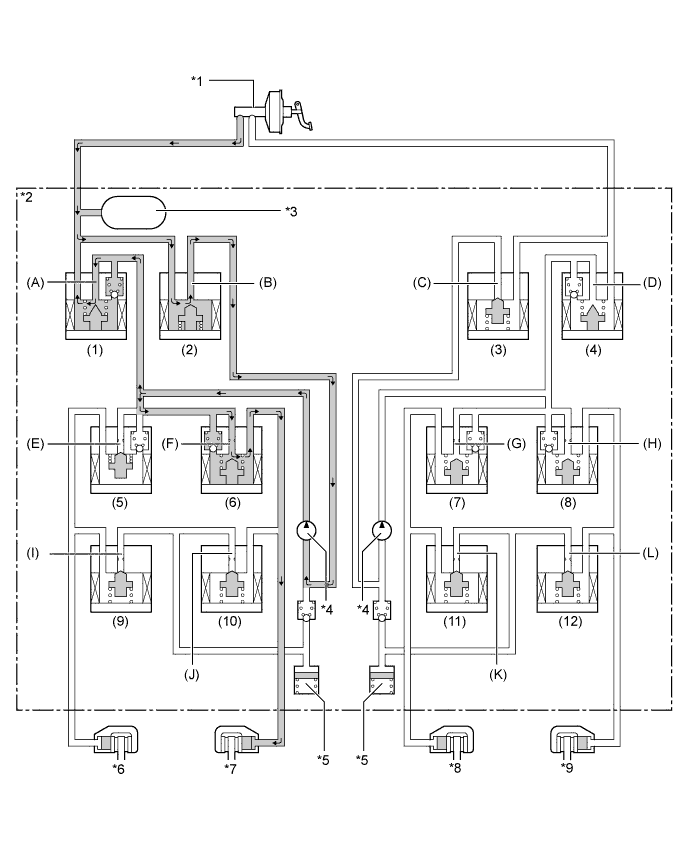
Text in Illustration (VSC Operation (Front Wheel Skid Restraining Control):) *1 Brake Master Cylinder Sub-assembly *2 Brake Actuator Assembly *3 Master Cylinder Pressure Sensor *4 Pump *5 Reservoir *6 Front Brake Caliper (Left Side) *7 Rear Brake Caliper (Right Side) *8 Rear Brake Caliper (Left Side) *9 Front Brake Caliper (Right Side) - - Item Port VSC Not Activated VSC Activated Increase Mode Holding Mode Reduction Mode Master Cylinder Cut Solenoid Valves (1) (A) OFF (Open) ON* ON* ON* (4) (D) OFF (Open) OFF (Open) OFF (Open) OFF (Open) Reservoir Cut Solenoid Valve (2) (B) OFF (Closed) ON (Open) ON (Open) ON (Open) (3) (C) OFF (Closed) OFF (Closed) OFF (Closed) OFF (Closed) Front Brakes Pressure Holding Solenoid Valves (5) (E) OFF (Open) ON (Closed) ON (Closed) ON (Closed) (8) (H) OFF (Open) OFF (Open) OFF (Open) OFF (Open) Pressure Reduction Solenoid Valves (9) (I) OFF (Closed) OFF (Closed) OFF (Closed) ON (Closed) (12) (L) OFF (Closed) OFF (Closed) OFF (Closed) ON (Closed) Brake Wheel Cylinder Pressure Right - - - - - - Left - - - - - - Rear Brakes Pressure Holding Solenoid Valves (6) (F) OFF (Open) ON* ON (Closed) ON (Closed) (7) (G) OFF (Open) OFF (Open) OFF (Open) ON (Closed) Pressure Reduction Solenoid Valves (10) (J) OFF (Closed) OFF (Closed) OFF (Closed) ON (Open) (11) (K) OFF (Closed) OFF (Closed) OFF (Closed) ON (Open) Brake Wheel Cylinder Pressure Right - - - Increased Held Reduced Left - - - - - - Pump OFF ON ON ON
-
*: Hydraulic pressure is controlled by continuously cycling the solenoid valves between open and closed, according to the operating conditions.
-
-
In the rear wheel skid restraining control, the brakes of the wheels of the outer circle of the turn is applied. Also, depending on whether the brakes are applied and the vehicle condition, there are circumstances in which the brake might not be applied to an individual wheel even if it was targeted for braking. The diagram below shows the hydraulic circuit in the pressure increase mode, as it controls the rear wheel skid condition while the vehicle is making a right turn. In other operating modes, the pressure holding valve and the pressure reduction valve are turned ON/OFF according to the ABS and EBD operation patterns.
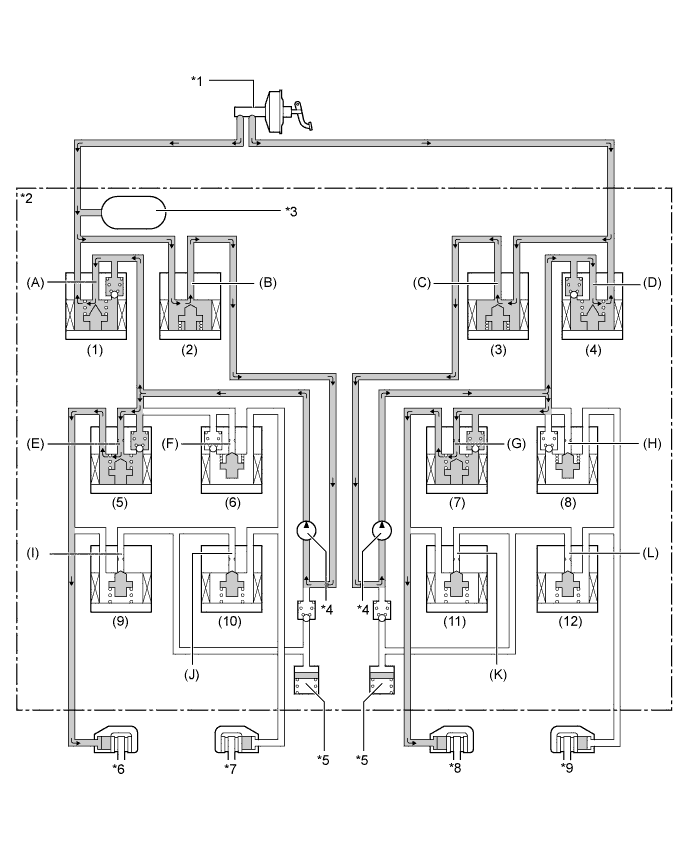
Text in Illustration (VSC Operation (Rear Wheel Skid Restraining Control):) *1 Brake Master Cylinder Sub-assembly *2 Brake Actuator Assembly *3 Master Cylinder Pressure Sensor *4 Pump *5 Reservoir *6 Front Brake Caliper (Left Side) *7 Rear Brake Caliper (Right Side) *8 Rear Brake Caliper (Left Side) *9 Front Brake Caliper (Right Side) - - Item Port VSC Not Activated VSC Activated Increase Mode Holding Mode Reduction Mode Master Cylinder Cut Solenoid Valves (1), (4) (A), (D) OFF (Open) ON* ON* ON* Reservoir Cut Solenoid Valve (2), (3) (B), (C) OFF (Closed) ON (Open) ON (Open) ON (Open) Front Brakes Pressure Holding Solenoid Valves (5) (E) OFF (Open) ON* ON (Closed) ON (Closed) (8) (H) OFF (Open) ON (Closed) ON (Closed) ON (Closed) Pressure Reduction Solenoid Valves (9) (I) OFF (Closed) OFF (Closed) OFF (Closed) ON (Open) (12) (L) OFF (Closed) OFF (Closed) OFF (Closed) ON (Open) Brake Wheel Cylinder Pressure Right - - - - - - Left - - - Increased Held Reduced Rear Brakes Pressure Holding Solenoid Valves (6) (F) OFF (Open) ON (Closed) ON (Closed) ON (Closed) (7) (G) OFF (Open) ON* ON (Closed) ON (Closed) Pressure Reduction Solenoid Valves (10) (J) OFF (Closed) OFF (Closed) OFF (Closed) ON (Open) (11) (K) OFF (Closed) OFF (Closed) OFF (Closed) ON (Open) Brake Wheel Cylinder Pressure Right - - - - - - Left - - - Increased Held Reduced Pump OFF ON ON ON
-
*: Hydraulic pressure is controlled by continuously cycling the solenoid valves between open and closed, according to the operating conditions.
-
-
-
Hill-start Assist Control Operation
-
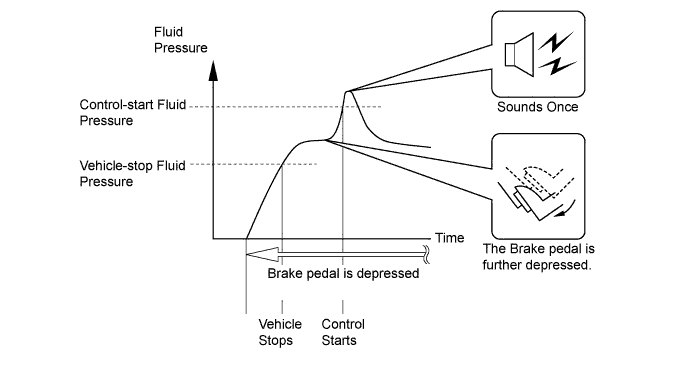
When Hill-start Assist Control is operating, the skid control ECU holds the brake fluid pressure.
-
Based on the information provided by various sensors, switches, and the ECM, the skid control ECU detects if Hill-start Assist Control can operate.
-
The skid control ECU starts Hill-start Assist Control operation when the operating conditions below are met and the driver further depresses the brake pedal, causing the fluid pressure to exceed the control-start fluid pressure.
-
When Hill-start Assist Control operation starts, the meter buzzer will sound once.
Hill-start Assist Control Operating Conditions
-
Shift lever is in a position other than P.
-
The accelerator pedal is not depressed.
-
The vehicle is at a standstill.
-
The parking brake is not applied.
-
-
During Hill-start Assist Control, the slip indicator light blinks and the stop lights are illuminated.
-
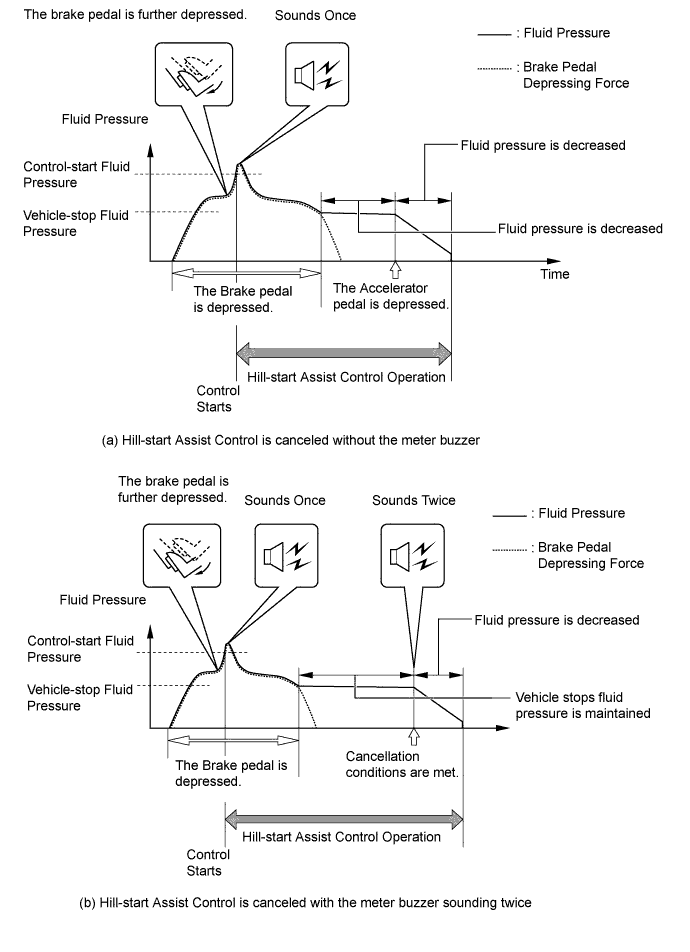
If any one of the below conditions is met during Hill-start Assist Control operation, Hill-start Assist Control will be canceled causing the slip indicator light to turn off.
-
The meter buzzer will operate as indicated below when Hill-start Assist Control is canceled.
Conditions which cause Hill-start Assist Control operation to be canceled a) Meter buzzer does not sound
-
The driver depresses the accelerator pedal.
b) Meter buzzer sounds twice
-
The driver moves the shift lever to P.
-
The driver depresses the parking brake pedal.
-
The driver depresses the brake pedal.
-
The driver releases the brake pedal for several seconds.
-
The driver keeps the brake pedal depressed continually for 10 minutes.
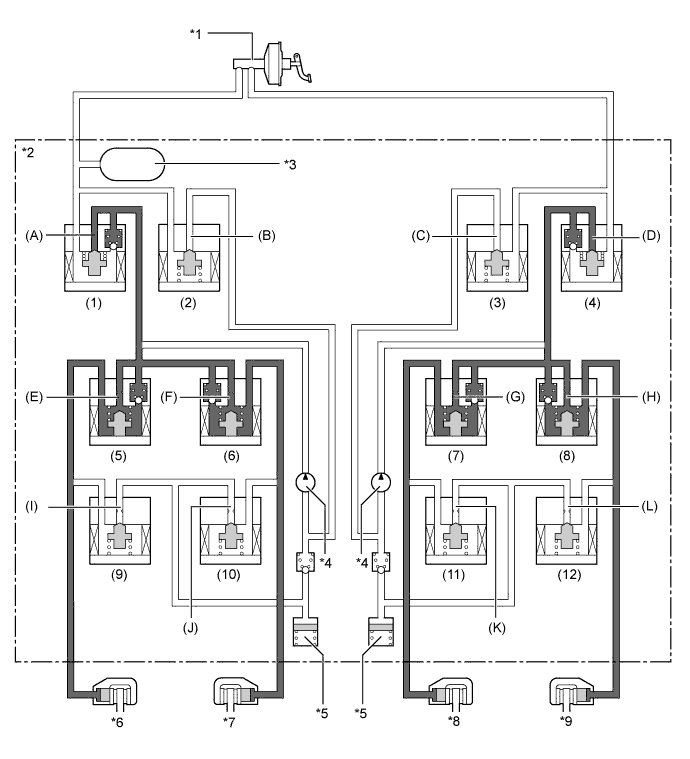
Text in Illustration (Hill-start Assist Control Operation:) *1 Brake Master Cylinder Sub-assembly *2 Brake Actuator Assembly *3 Master Cylinder Pressure Sensor *4 Pump *5 Reservoir *6 Front Brake Caliper (Left Side) *7 Rear Brake Caliper (Right Side) *8 Rear Brake Caliper (Left Side) *9 Front Brake Caliper (Right Side) - - Item Port Hill-start Assist Control Not Activated Hill-start Assist Control Activated Holding Mode Reduction Mode Master Cylinder Cut Solenoid Valve (1), (4) (A), (D) OFF (Open) ON* ON* Reservoir Cut Solenoid Valve (2), (3) (B), (C) OFF (Closed) OFF (Closed) OFF (Closed) Front Brake Pressure Holding Solenoid Valve (5), (8) (E), (H) OFF (Open) OFF (Open) OFF (Open) Pressure Reduction Solenoid Valve (9), (12) (I), (L) OFF (Closed) OFF (Closed) OFF (Closed) Brake Wheel Cylinder Pressure Right - - - Held Reduced Left - - - Held Reduced Rear Brake Pressure Holding Solenoid Valve (6), (7) (F), (G) OFF (Open) OFF (Open) OFF (Open) Pressure Reduction Solenoid Valve (10), (11) (J), (K) OFF (Closed) OFF (Closed) OFF (Closed) Brake Wheel Cylinder Pressure Right - - - Held Reduced Left - - - Held Reduced Pump OFF ON ON
-
*: Hydraulic pressure is controlled by continuously cycling the solenoid valves between open and closed, according to the operating conditions.
-
-
-
-
FAIL-SAFE
-
In the event of a malfunction in the ABS and/or Brake Assist controls, the skid control ECU prohibits brake controls (ABS, Brake Assist, TRC, VSC and Hill-start Assist Control).
-
In the event of a malfunction in the EBD control, the skid control ECU prohibits EBD operation. Even in this case, normal braking performance excluding the brake control system electronic controls (ABS with EBD, Brake Assist, TRC, VSC and Hill-start Assist Control) is maintained.
-
In the event of a malfunction in the TRC and/or VSC, the skid control ECU prohibits TRC and VSC operation.
-
If a communication malfunction occurs among the skid control ECU, the steering angle sensor, the yawrate sensor or ECM, the skid control ECU stops TRC, VSC and Hill-start Assist Control.
-
When the ECM detects an engine control DTC, it will disable ABS, Brake Assist, TRC, VSC and Hill-start Assist Control operation.
-
-
DIAGNOSIS
-
If the skid control ECU detects a malfunction in the brake control system, the ABS, brake system, slip indicator lights and multi-information display that corresponds to the function in which the malfunction has been detected illuminates or indicates to alert the driver of the malfunction.
-
At the same time, Diagnostic Trouble Codes (DTCs) are stored in memory.
-
This system has a sensor signal check (test mode) function.
-
For details of the DTCs that are stored in skid control ECU memory and the DTCs that are output through the sensor signal check functions, refer to the Repair Manual.
-