SEAT VIBRATION SYSTEM DETAILS
-
FUNCTION OF MAIN COMPONENTS
-
The main components in the rear seat relaxation system have the following functions:
Components Outline Rear Seat Back Mat
- Pneumatic Chamber
-
The pneumatic chambers are built into the seat back of the seat with an ottoman: 2 in the upper area (corresponding to the occupant's shoulders) and 6 in the lower area (corresponding to the occupant's lumbar area).
-
A pump assembly provides air pressure to inflate or deflate the pneumatic chambers.
Seat Vibrator Assembly The seat vibrator assembly, which is built into the seat back of the seat with an ottoman, vibrates upon receiving instruction signals from the rear seat relaxation ECU. Seat Vibrator Module Assembly
- Rear Seat Relaxation ECU
- Pump
- Three-way Solenoid Valve
-
Controls the primary functions of the rear seat relaxation system.
-
Based on the signals received from the seat vibrator switch, transmits instruction signals to the pump and the seat vibrator.
-
Driven by instruction signals from the rear seat relaxation ECU and supplies air pressure to the three-way solenoid valve.
-
There are 8 three-way solenoid valves to operate the 8 pneumatic chambers individually.
-
Integrated with the rear seat relaxation ECU.
-
Based on request signals received from the rear seat relaxation ECU, turns on or off to inflate the pneumatic chambers using air pressure provided by the pump or deflate the pneumatic chambers.
Seat Vibrator Switch
-
Transmits switch signals to the rear seat relaxation ECU to control the rear seat relaxation system. The user can check the settings of the rear seat relaxation system by looking at the indicators.
-
The seat vibrator switch and the rear seat relaxation ECU exchange signals via the Local Interconnect Network (LIN).
-
-
-
FUNCTION
-
The following functions are used for the rear seat relaxation system:
Function Outline PROGRAM Mode Acupressure Executes programmed movements of the 8 chambers to apply pinpoint pressures to the back. Stretch Executes programmed movements of the 8 chambers to stretch the back. MANUAL Mode Shoulder Operates the 2 chambers that are built into the upper rear seat back (corresponding to the occupant's upper back). Back Operates the 6 chambers that are built into the lower rear seat back (corresponding to the occupant's lumbar area). Intensity Adjusts the intensity of the air pressures in the chambers. Speed Adjusts the interval between the chamber inflation and deflation. -
The following functions are used for the seat vibration system:
Components Outline Seat Vibration Operates the vibrator that is built into the lower rear seat back (corresponding to the occupant's pelvic support area) as desired. Frequency Switching The operating frequency of the seat vibrator can be switched between 3 stages by pressing the seat vibrator switch (cycles through Low → Medium → High → Low).
-
-
CONSTRUCTION
-
Seat Vibrator Module Assembly
-
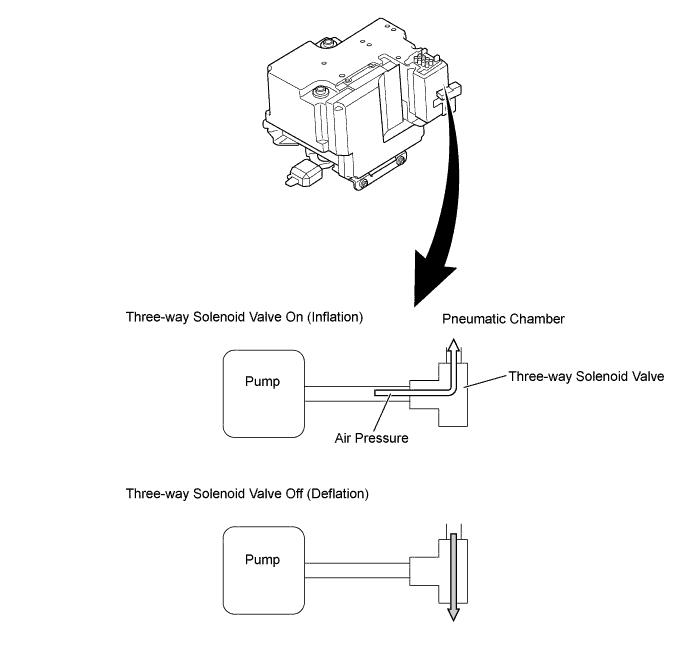
The pump assembly consists of a pump, a rear seat relaxation ECU and 8 three-way solenoid valves to individually control the 8 pneumatic chambers.
-
Upon receiving a pneumatic chamber inflation signal transmitted by the rear seat relaxation ECU, the pump starts operating to create air pressure and the three-way solenoid valve that is connected the applicable pneumatic chamber to inflate the pneumatic chamber is turned on (inflation). Upon receiving a pneumatic chamber deflation signal from the rear seat relaxation ECU, the three-way solenoid valve that is connected the applicable pneumatic chamber to deflate the pneumatic chamber is turned off (deflation).
-
The pump adjusts the air pressure that is applied to the pneumatic chambers in 3 stages. Also, the pump adjusts the speed of the inflation and deflation intervals.
-
-
-
SYSTEM CONTROL
-
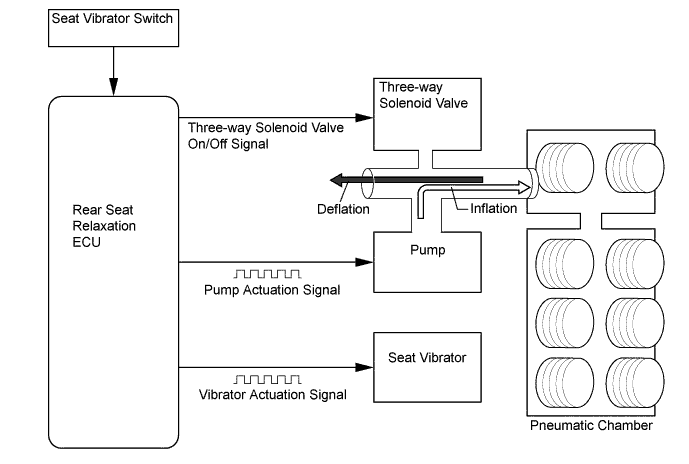
The rear seat relaxation ECU controls the primary functions of the rear seat relaxation system.
-
Upon receiving the switch signals from the seat vibrator switch, the rear seat relaxation ECU actuates the pump, controls the three-way solenoid valves between on and off, and controls the seat vibrator.
-
To control the pump, the rear seat relaxation ECU varies the duty cycle ratio to adjust the air pressure that is applied to the pneumatic chambers in 3 stages.
-
To control the three-way solenoid valves, the rear seat relaxation ECU varies the on duration of the three-way solenoid valves to adjust the speed of the pneumatic chamber inflation and deflation intervals in 3 stages.
-
To control the seat vibrator, the rear seat relaxation ECU adjusts the seat vibration speed of the seat vibrator in 7 levels by the duty signal.
-
The rear seat relaxation ECU contains a power timer function. This prevents the unintended operation of the rear seat relaxation system by the occupant, if the power of the rear seat relaxation system is inadvertently left on. If the rear seat relaxation system is not operated after approximately 3 minutes have elapsed with the power turned on, the rear seat relaxation ECU automatically stops the actuation of the pump and the vibrator, deflates the three-way solenoid valves, and turns off the power of the rear seat relaxation system. If an occupant presses the acupressure, stretch, shoulder, back or seat vibration switch of the remote controller within approximately 3 minutes after the power is turned on, the timer setting is extended approximately 15 minutes from that point in time. If any of those switches are not pressed again within approximately 15 minutes, the rear seat relaxation ECU automatically stops the actuation of the pump and the vibrator, deflates the pump and the pneumatic chambers by way of the three-way solenoid valves, and turns off the power of the rear seat relaxation system.
-
If the rear seat relaxation ECU detects a failure, it immediately stops the operation of the rear seat relaxation system and alerts the user of it by flashing the indicator light of the applicable switch on the seat vibrator switch.
-