BLIND SPOT MONITOR SYSTEM DETAILS
-
FUNCTION OF MAIN COMPONENTS
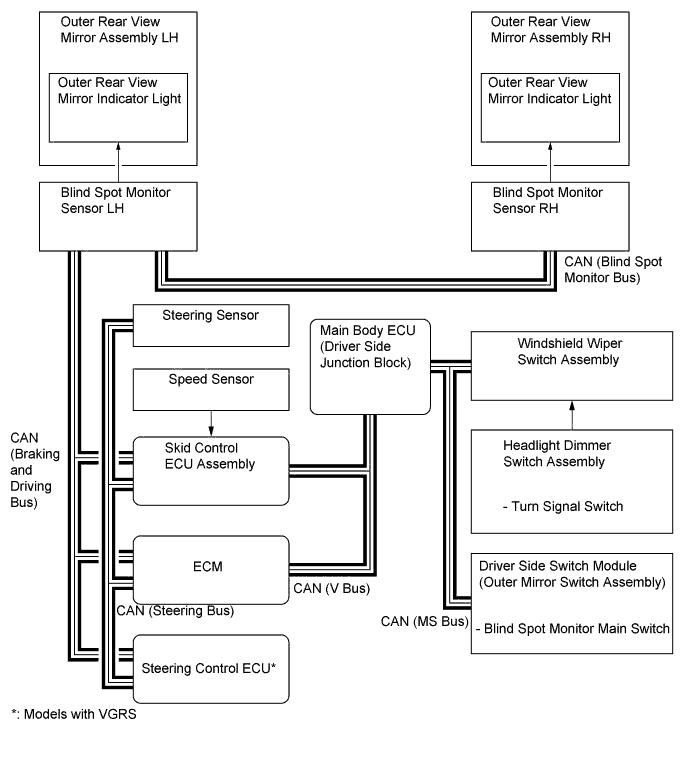
Component Function Blind Spot Monitor Sensor
-
Outputs millimeter waves from the blind spot monitor sensor to the blind spot sensor detection area, uses the reflected millimeter waves for detecting the presence of a vehicle, the vehicle-to-vehicle distance, and the relative speed, and then transmits this information to the built-in signal processing circuit.
-
The signal processing circuit determines if a vehicle is present, and illuminates or blinks the outer rear view mirror indicator accordingly.
-
Dims the outer rear view mirror indicator light on the outer rear view mirror assembly.
Driver Side Switch Module (Outer Mirror Switch Assembly)
- Blind Spot Monitor Main Switch
Pressing the blind spot monitor main switch (warning canceling switch assembly) turns the blind spot monitor system on or off. Outer Rear View Mirror Assembly
- Outer Rear View Mirror Indicator Light
-
Illuminates when a vehicle is detected in the detection area.
-
Blinks when the turn signal switch is operated while a vehicle is detected in the detection area.
Headlight Dimmer Switch Assembly
- Turn Signal Switch
Transmits the turn signal switch signal to the blind spot monitor sensors LH and RH. Combination Meter Assembly
- Multi-information Display
Displays "Check BSM System" when the blind spot monitor system malfunctions and "BSM not available" when the system cannot be used temporarily to inform the driver. Steering Sensor Transmits the steering angle signal to the blind spot monitor sensors LH and RH. Steering Control ECU* Transmits the steering angle signal to the blind spot monitor sensors LH and RH. Skid Control ECU Assembly Transmits the vehicle speed signal to the blind spot monitor sensors LH and RH. Main Body ECU (Driver Side Junction Block)
-
Transmits the destination signal to the blind spot monitor sensor LH and RH.
-
Transmits the illumination signal to the blind spot monitor sensor LH and RH.
-
Transmits the dimmer signal to the blind spot monitor sensor LH and RH.
ECM Transmits the reverse signal to the blind spot monitor sensors LH and RH.
-
*: Models with VGRS
-
-
OPERATING CONDITION
-
The blind spot monitor system operates when both of the following conditions are met:
-
The blind spot monitor main switch is on.
-
The vehicle speed is greater than approximately 16 km/h (10 mph).
-
-
The blind spot monitor system can detect vehicles in its detection areas.
-
The detection areas formed by the blind spot monitor sensors LH and RH are as shown below:
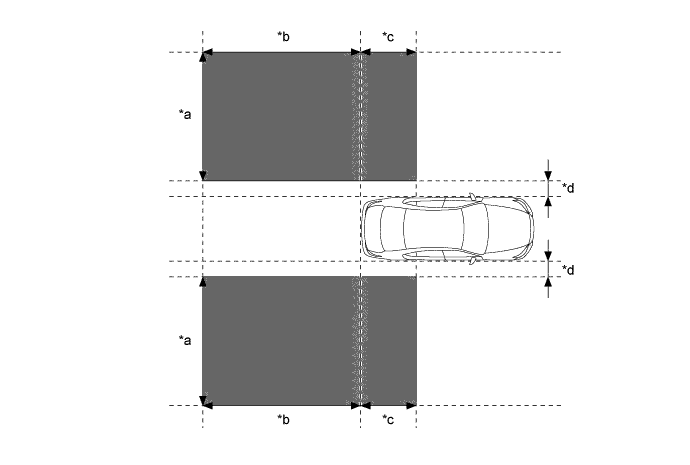
Text in Illustration (Detection Area) *a 3.5 m (11.5 ft.) *b 3.0 m (9.8 ft.) *c 1 m (3.3 ft.) *d 0.5 m (1.6 ft.) 
Detection Area - - -
When this vehicle is overtaken by another vehicle in the adjacent lane.
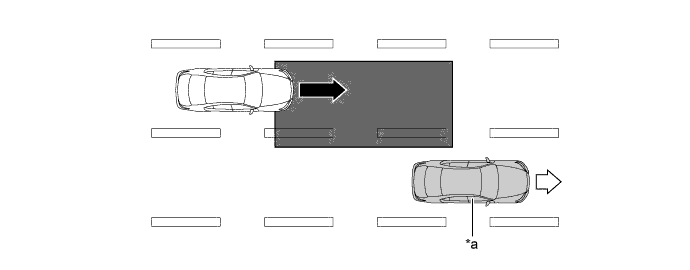
Text in Illustration *a Other Vehicle *b Driver's Vehicle 
Vehicle Speed (Fast) 
Vehicle Speed (Slow) Detection Area - - -
When another vehicle enters the detection area of this vehicle due to a lane change.
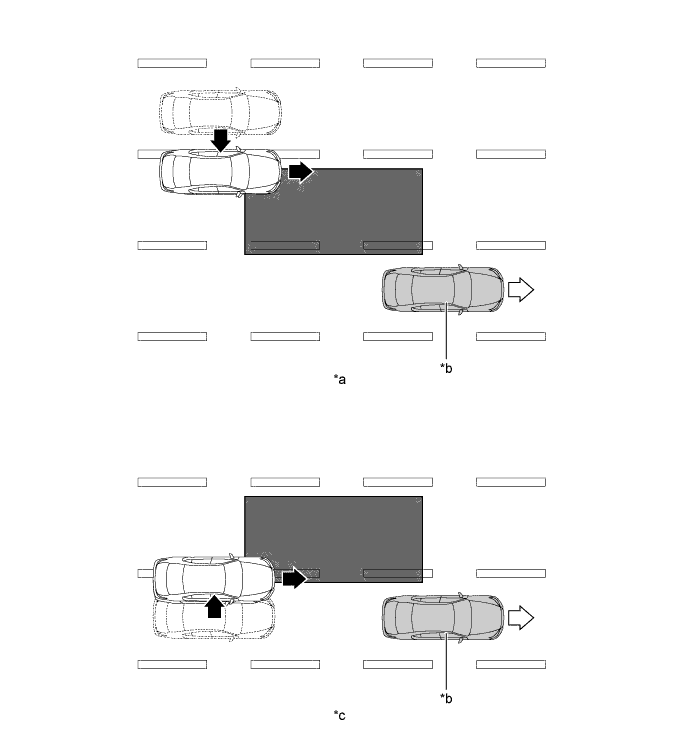
Text in Illustration *a Other Vehicle *b Driver's Vehicle *c Other vehicle enters the detection area during lane change (merge in) (Type 1). *d Other vehicle enters the detection area during lane change (merge in) (Type 2). Motion Direction of Other Vehicle Motion Direction of Driver's Vehicle Detection Area - -
-
-
-
CONSTRUCTION
-
Blind Spot Monitor Sensor
-
The blind spot monitor sensor consists of a millimeter wave radar circuit and a signal processing circuit.
-
The millimeter wave radar uses frequencies in the 24 GHz band.
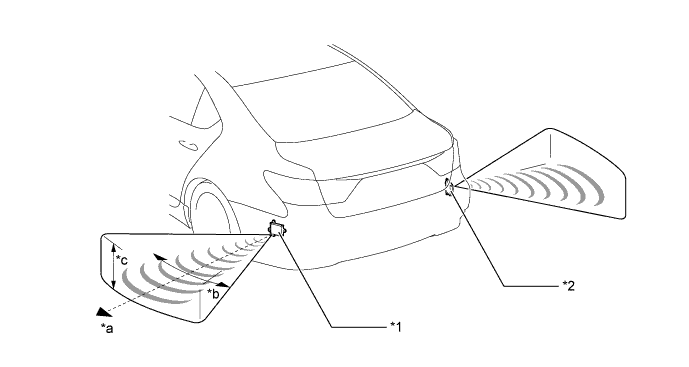
Text in Illustration *1 Blind Spot Monitor Sensor LH *2 Blind Spot Monitor Sensor RH *a Distance: Approximately 50 m (164 ft.) *b Horizontal Angle: Approximately 150° *c Vertical Angle: Approximately 20° - - -
The distance to the object, azimuth and relative speed are calculated from the information that is provided by the reflected millimeter wave radar as described below:
Item Calculation Method Distance Calculated from the length of time that has elapsed from the time the waves of the millimeter wave radar have been emitted, until the reflected waves are received by the millimeter wave radar circuit. The distance is approximately 50 m (164 ft.). Azimuth Calculated from the reception angle of the millimeter wave radar reflections received. The detection angle has a horizontal range of approximately 150° and a vertical range of approximately 20°. Relative Speed Calculated by utilizing the change (Doppler effect*) that occurs in the frequency of the reflected millimeter wave radar waves. Tech Tips
*: The Doppler effect causes the observer to perceive the radio waves emitted by a moving object to be a higher frequency as it approaches, and to be a lower frequency as it recedes. This phenomenon is created because when an object is located far away, the radio waves are perceived at higher frequencies than those of the radio source. An SST is used if radar axis confirmation is needed. For details, refer to the Repair Manual.
-
-
-
OPERATION
-
According to operation conditions, the blind spot monitor system promotes safety confirmation by using the outer rear view mirror indicator light to inform the driver that another vehicle has entered the blind spot monitor sensor detection area of this vehicle.
-
The outer rear view mirror indicator light informs the driver that a vehicle is present in the blind spot detection area by illuminating when the turn signal switch is not operated, and by flashing when a vehicle is present and the turn signal switch is operated.
-
-
DIAGNOSIS
-
The blind spot monitor system is equipped with a diagnosis function that can display warning messages in the multi-information display. For details, refer to the Repair Manual.
-