SRS AIRBAG SYSTEM
-
General
-
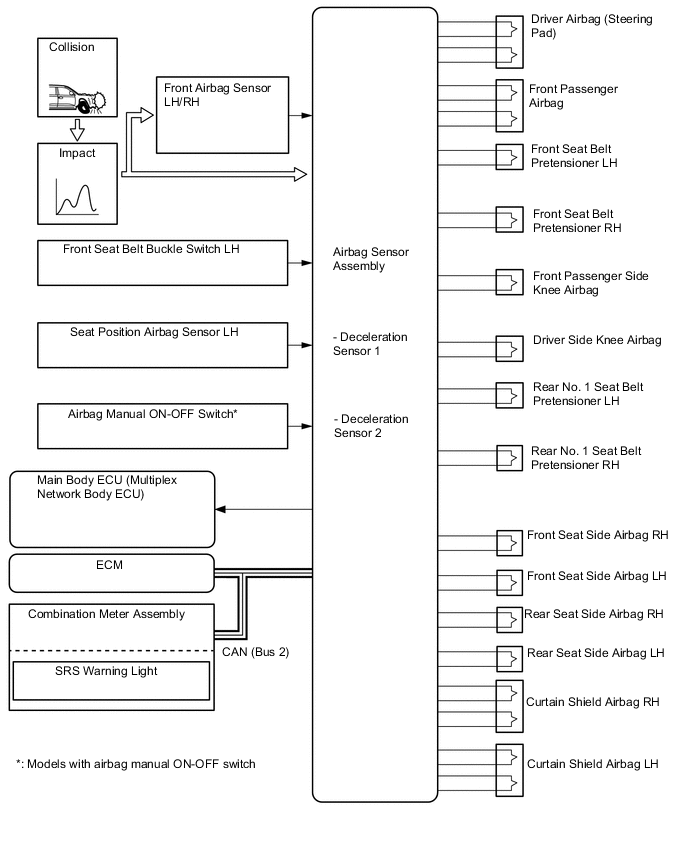
In conjunction with their impact absorbing structure for frontal collisions, the driver and front passenger dual-stage SRS airbags, the driver side and front passenger side knee airbags, front seat side airbags, rear seat side airbags and curtain shield airbags deploy simultaneously and are supplements to the seat belts. The driver and front passenger dual-stage SRS airbags have been designed to help reduce injuries to the head and chest in the event of a frontal collision. The driver and passenger knee airbags restrict the lower parts of the occupants' bodies, thus enhancing the excellent passenger protection provided by the seat belts and front airbags.
-
A deceleration sensor is provided in the front airbag sensor and the airbag sensor assembly. Due to the deceleration of the vehicle during a front collision, a distortion is created in the sensor and converted into an electrical signal. Accordingly, the extent of the initial collision can be detected in detail.
Figure 1. Front Airbag Operation
-
-
Dual-stage SRS Airbag System
-
General
-
In this system, when the front airbag sensors and airbag sensor assembly detect a front collision, the airbag sensor assembly judges the extent of impact, seat position, and whether or not the seat belts are fastened, thus optimizing the airbag inflating output by delaying the inflation timing of the 2nd initiator and the 1st initiator.
-
-
Seat Position Airbag Sensor
-
General
-
The seat position airbag sensor is mounted on the upper rail portion of the driver seat rail, and includes a Hall IC and a magnet. This sensor is used to detect the sliding position of the driver seat.
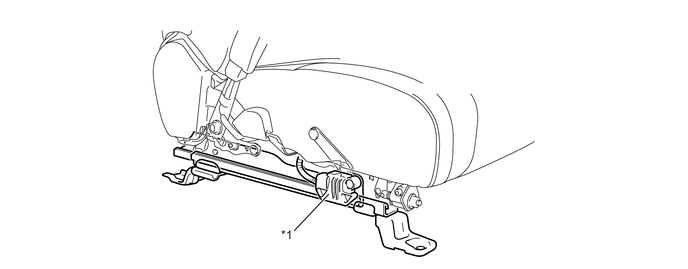
*1 Seat Position Airbag Sensor - - -
-
Operation
-
When the seat is in the rearward position, the lower rail portion of the seat rail is close to the seat position airbag sensor. When it is in the forward position, the distance between the lower rail portion and the sensor becomes larger. Thus, the magnetic flux of the magnet inside the seat position airbag sensor varies depending on the seat position. The Hall IC detects this variation and outputs signals to the airbag sensor assembly.
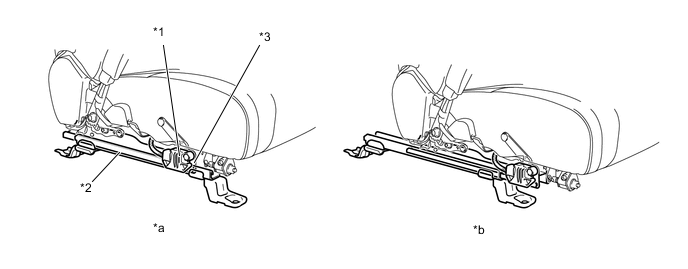
*1 Seat Position Airbag Sensor *2 Seat Rail (Lower Rail) *3 Seat Rail (Upper Rail) - - *a Seat position is rearward *b Seat position is forward -
-
-
Front Seat Buckle Switch
-
The front seat buckle switch detects whether or not the seat belt is fastened.
-
The non-contact type switch is composed of a Hall IC and magnet, installed into the front seat inner belt assembly.
-
The ejector inside the front seat inner belt assembly and the plate installed to the ejector move when the seat belt is removed or inserted. The movement of the plate changes the magnetic flux density of the magnet.
-
The Hall IC detects the changes in the magnetic flux density in accordance with the seat belt removal or insertion, and outputs a signal to the airbag sensor assembly (for driver seat) and occupant classification ECU (for front passenger seat).
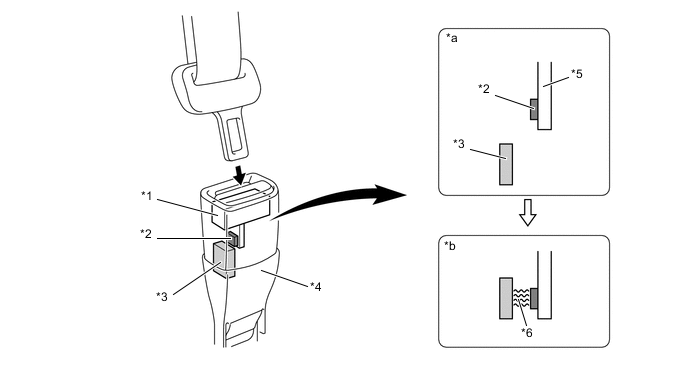
*1 Ejector *2 Magnet *3 Hall IC *4 Front Seat Inner Belt Assembly *5 Plate *6 Magnet Flux *a Seat belt not fastened *b Seat belt fastened
-
-
-
SRS Driver and Front Passenger Airbag
-
SRS driver and front passenger airbags contain 2 sets of initiators and propellants. The airbag sensor assembly helps optimize the airbag inflation speed by controlling the inflation timing of these initiators.
-
-
SRS Knee Airbag
-
The knee airbags deploy simultaneously with the front airbags in a frontal collision. With the deployment of the knee airbags, the driver and front passenger's lower bodies are restricted, thus enhancing the excellent the passenger protection provided by the seat belts and front airbags.
-
-
Front Airbag Sensor
-
The front airbag sensor uses an electrical type deceleration sensor. Based on the deceleration of the vehicle during a frontal collision, distortion is created in the sensor and converted into an electrical signal. Accordingly, the extent of the initial collision can be accurately detected.
-