AIR CONDITIONING
-
GENERAL
-
The air conditioning system has the following controls.
Control Outline Neural Network Control This control is capable of effecting complex control by artificially simulating the information processing method of the nervous system of living organisms in order to establish a complex input/output relationship that is similar to a human brain. Automatic Recirculation Control*1 Automatically changes the air inlet mode to fresh air or recirculation air mode in accordance with the level of harmful elements in the outside air, the room temperature, and outside temperature. Pollen Removal Mode Control Activated by the pollen removal mode switch operation. Switches the air vent to the FACE mode. Sends air which has passed through the clean air filter to the area around the upper part of the bodies of the driver and front passenger. This air is filtered by the clean air filter in order to remove pollen. Outlet Air Temperature Control Based on the temperature set at the temperature control switch, the neural network control calculates the outlet air temperature based on the input signals from various sensors. The temperature settings for the driver, front passenger, rear passengers are controlled independently in order to provide separate room temperatures for the right and left sides of the cabin. Thus, air conditioning that accommodates the occupants' preferences has been realized. Blower Control Controls the blower motor in accordance with the airflow volume that has been calculated by the neural network control based on the input signals from various sensors. Air Outlet Control Automatically switches the air outlets in accordance with the outlet mode that has been calculated by the neural network control based on the input signals from various sensors. In accordance with the engine coolant temperature, outside air temperature, amount of sunlight, required blower, outlet temperature, and vehicle speed conditions, this control automatically switches the blower outlet to FOOT / DEF mode to prevent the windows from becoming fogged when the outside air temperature is low. Air Inlet Control Automatically controls the air inlet control damper to achieve the required outlet air temperature which is calculated. Drives the servomotor (for air inlet) according to the operation of the air inlet control switch and moves the dampers to the FRESH or RECIRC position. Compressor Control The air conditioning amplifier compares the A/C pulley speed signals, which are transmitted by the lock sensor located on the A/C compressor, with the engine speed signals, which are transmitted by the ECM (crankshaft position sensor). When the air conditioning amplifier determines that the A/C pulley is locked, it turns OFF the magnetic clutch and blinks the indicator light in the A/C switch simultaneously, thus alerting the driver. PTC Heater Control*2 When the engine switch is ON (IG) and the blower motor is turned ON, the air conditioning amplifier turns ON the PTC heater if the conditions listed below are met.
-
Engine coolant temperature is below specified temperature.
-
Outside temperature is below specified temperature.
-
Tentative air mix damper opening angle is above the specified value (MAX HOT).
Rear Window Defogger Control
-
Switches the rear window defogger and outside rear view mirror heaters ON for 15 minutes when the rear window defogger button is pressed. Switches them OFF if the button is pressed again while they are operating.
-
If both of the following conditions are met approximately 15 minutes after the defogger and outer rear view mirror heater was activated, the defogger and outer rear view mirror heater continues to operate up to 255 minutes. If the following conditions are not met, the rear window defogger system stops operating immediately.
-
The outside temperature is -3°C(26.6°F) or below.
-
The vehicle speed is 30 mph (50 km/h) or more.
Outside Temperature Indication Control Calculates the outside temperature using signals transmitted by the ambient temperature sensor. Calculated values are corrected by the air conditioning amplifier and then indicated on the multi-information display and the air conditioning control panel. Self-Diagnosis A DTC (Diagnostic Trouble Code) is stored in the memory when the air conditioning amplifier detects a problem with the air conditioning system. *1: Except modelsfor G.C.C. countries
*2: Except models for Australia and G.C.C. countries
-
-
-
NEURAL NETWORK CONTROL
-
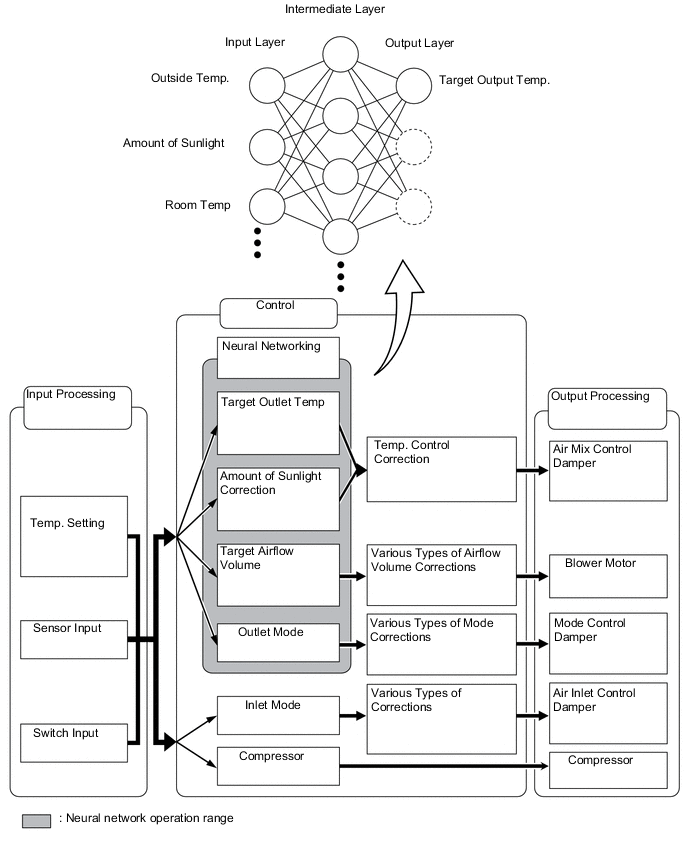
In previous automatic air conditioning systems, the air conditioning amplifier determined the required outlet air temperature and blower air volume in accordance with the calculation formula that has been obtained based on information received from the sensors. However, because the senses of a person are rather complex, a given temperature is sensed differently, depending on the environment in which the person is situated. For example, a given amount of solar radiation can feel comfortably warm in a cold climate, or extremely uncomfortable in a hot climate. Therefore, as a technique for effecting a higher level of control, a neural network is used in the automatic air conditioning system. With this technique, the data that has been collected under varying environmental conditions is stored in the air conditioning amplifier. The air conditioning amplifier can then effect control to provide enhanced air conditioning comfort.
-
The neural network control consists of neurons in the input layer, intermediate layer, and output layer. The input layer neurons process the input data of the outside temperature, the amount of sunlight, and the room temperature based on the outputs of the switches and sensors, and output them to the intermediate layer neurons. Based on this data, the intermediate layer neurons adjust the strength of the links among the neurons. The sum of these is then calculated by the output layer neurons in the form of the required outlet temperature, solar correction, target airflow volume, and outlet mode control volume. Accordingly, the air conditioning amplifier controls the servomotors and blower motor in accordance with the control volumes that have been calculated by the neural network control.
-
-
BLOWER CUSTOMIZED CONTROL
-
A blower customizing control has been adopted for Europe models, allowing the users to select the desired flow rate in the AUTO mode. A dedicated switch is provided for intuitive operations.
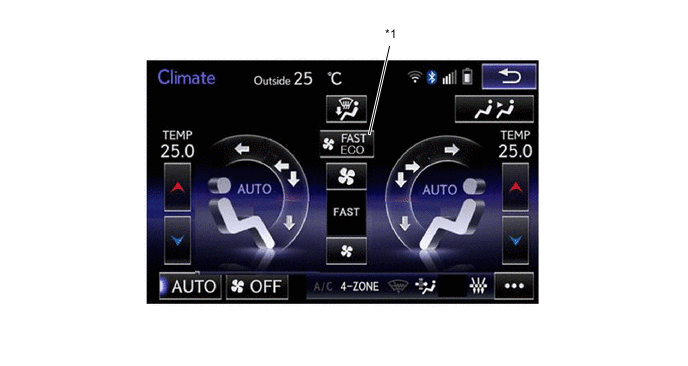
*1 Dedicated Switch - - -
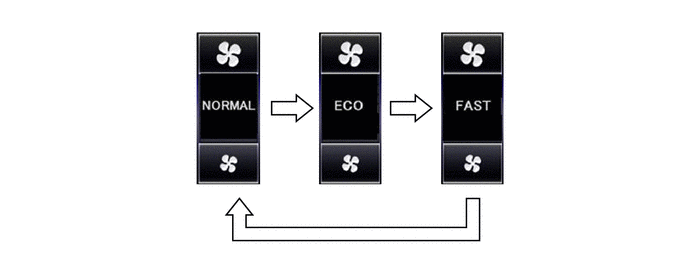
The blower customizing control allows the users to select the flow rate in the AUTO mode in 3 steps.
-
Pressing the dedicated switch on the screen allows the user to switch the flow rate in the order of NORMAL→ECO→FAST→NORMAL.
-
Use FAST to stabilize the temperature quickly or when there is a passenger on the rear seat.
-
Use ECO to reduce the flow rate.
-
-
LEXUS CLIMATE CONCIERGE
-
Lexus Climate Concierge
-
Lexus climate concierge has been adopted, which links the ventilated seat, the heated seat, and the steering heater for controlling the air conditioning system for more comfortability.
-
See each section for details on the controls excluding air conditioning.
-
A climate concierge switch has been adopted on front heater control panel (multi-media module receiver assembly), which links all of the heating devices to the automatic control through a single operation.
-
A front seat collective air blow control and an automatic rear seat heating device ON/OFF control have been adopted.
-
A seating sensor has been adopted for the second seat.
-
-
A Front Seat Collective Air Blow Control
-
A front seat collective air blow control has been adopted.
-
The control increases the air flow rate at the front seats by stopping the air conditioner for the rear seats when the following conditions are met.
Operating conditions
-
The climate concierge switch is lit (Full-auto state)
-
No passenger present on the rear seats (through the determination of seating on the rear seats)
-
Air blow mode: Face
-
-
-
An Automatic Rear Seat Heating Device ON/OFF Control
-
An automatic rear seat heating device ON/OFF control has been adopted.
-
The control turns the rear air conditioner and the rear seat air conditioner on or off automatically by detecting the presence of passengers on the rear seats with the second seats' seating sensors while the rear seat air conditioner is selected to Auto.
-
The control stops the heating devices when no passenger present, contributing to energy saving.
-
-
-
AUTOMATIC RECIRCULATION CONTROL
-
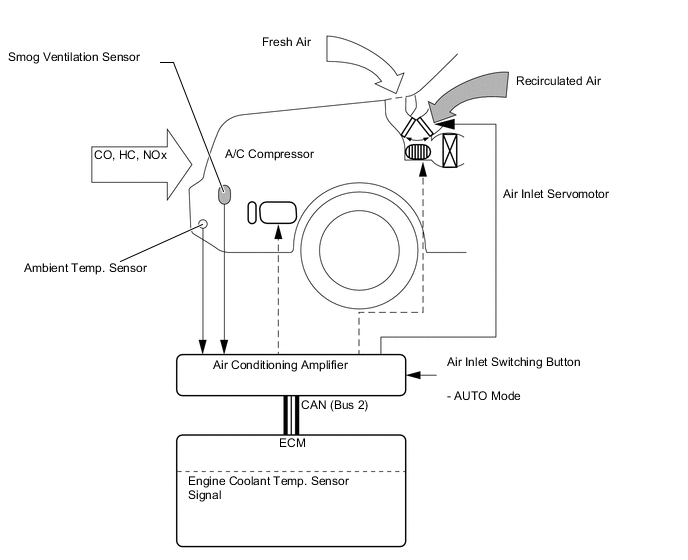
When the automatic recirculation control is operating, the air conditioning amplifier automatically changes the air inlet mode to the fresh air or recirculate air mode based on signals from the smog ventilation sensor, ambient temperature sensor, and ECM when the AUTO air inlet mode is selected.
-
The air conditioning amplifier detects harmful elements (CO, HC, and NOx) based on smog ventilation sensor signals and automatically switches the air inlet mode to the recirculate air mode to prevent such harmful elements from entering the cabin.
-
The air conditioning amplifier detects engine coolant temperature and automatically switches the air inlet mode to the recirculate air mode to prevent the room temperature from becoming too high.
-
The air conditioning amplifier detects the outside temperature based on an ambient temperature sensor signal and automatically switches the air inlet mode to the fresh air mode to prevent the windshield from fogging up.
Tech Tips
The smog ventilation sensor cannot detect elements such as the smoke from a bonfire or factory exhaust, foul or animal odors, and dirt or dust particles. Therefore, the air inlet modes are not switched in accordance with those elements.
-
-
-
POLLEN REMOVAL MODE CONTROL
-
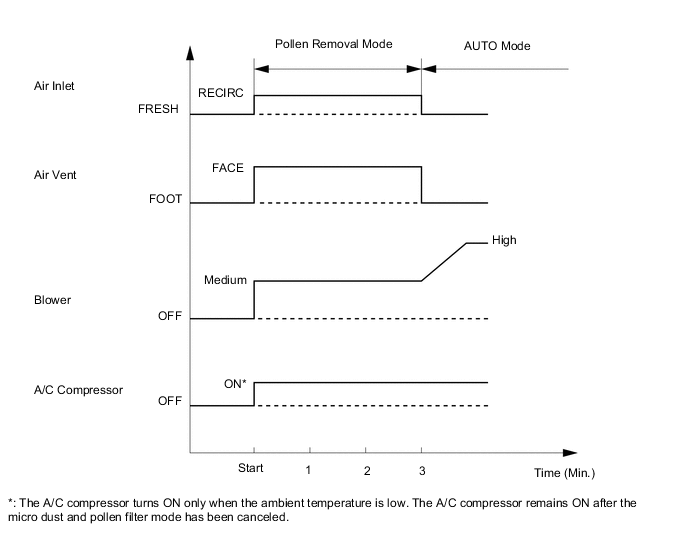
When the pollen removal switch is pressed, the pollen removal mode control is activated. Then, the air vent is switched to the FACE mode and recirculated pollen-free air flows in the area around the upper part of the bodies of the driver and front passenger.
-
When the pollen removal switch signal is input to the air conditioning amplifier, the air conditioning amplifier controls the A/C compressor, air inlet servomotor, air vent servomotor and blower motor as shown in the timing chart below.
-
The pollen removal mode control usually operates for approximately 3 minutes. However, when the outside temperature is low (5 °C maximum), it will operate for approximately 1 minute.
-
After the pollen removal mode control stop operating, the air conditioning amplifier controls the air conditioning system using the AUTO mode (when the AUTO mode was previously selected before the pollen removal mode).
-
-
-
DIAGNOSIS
-
The air conditioning amplifier has a self-diagnosis function. It stores any operation failures in the air conditioning system memory in the form of DTC (Diagnostic Trouble Code).
-
There are two methods for reading DTC. One is to use a Global TechStream (GTS), and the other is to read DTC indicated on the multi display.
-
For details, refer to the Repair Manual.
-