LIGHTING
-
General
-
An Adaptive High-beam System has been provided depending on the specifications. The system uses a forward recognition camera attached at the top center of the windshield glass on the interior side to detect the light sources of an oncoming vehicle in order to automatically and optimally arrange the headlight beams, maintaining visibility at night while reducing high and low beam switching operations.
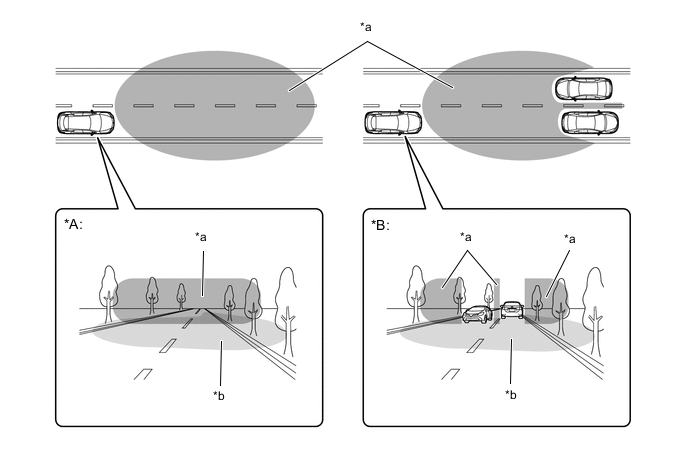
*A High-beam (Without Adaptive High-beam System Control) *B During Adaptive High-beam System Control (Light Shield Control Function) *a The lighting area of high-beam *b The lighting area of low-beam
-
-
Precaution of Adaptive High-beam System
-
Switching the beams between high and low manually
-
To change the beams from High or Variable shade mode to Low, use the dimmer switch to move it to Lo.
-
To change the beams from Low or Variable shade mode to High, turn off the auto high beam switch.
-
-
Ambient light conditions for activating Adaptive High-beam System
-
The Adaptive High-beam System uses the forward recognition camera provided in the vehicle interior to monitor in front of the vehicle. The system is activated when there are the headlights of an oncoming vehicle or the tail lights of a proceeding vehicle in a dark environment. The system might be activated unintentionally particularly in any of the following conditions.
-
The beams are kept in Low without switching to High or Shade mode in a bright environment even when the vehicle is running at a speed of approximately 15 km/h (9 mph) while the adaptive high-beam indicator light in the combination meter assembly is lit.
-
The beams might be kept in High or Shade mode without switching to Low when an oncoming vehicle approaches in a sharp curve or the like or when a vehicle crosses in front of you.
-
The beams might be switched from High to Shade mode when the fog light of an oncoming vehicle is detected.
-
The follow-up speed for the shaded areas or the timing for switching the beams to Low may differ depending on the luminous intensity of the headlights or the fog light of an oncoming vehicle or the tail lights or the rear fog light of a proceeding vehicle.
-
The follow-up speed for the shaded areas or the timing for switching the beams to Low may differ depending on the road conditions, including wet, frozen, and snowed up roads, compared to normal (fine weather) conditions.
-
The follow-up speed for the shaded areas or the timing for switching the beams to Low may differ depending on the number of passengers and loading conditions.
-
In some situations, light distribution may be switched in a different manner that does not match the sense of the driver.
-
The beams may be switched to Low or Shade mode, or the shaded areas may be changed, by recognizing other lights (signs, reflectors, signals, other light emitting objects) than those of an oncoming or proceeding vehicle.
-
-
-
Timing when the headlight beams come on in High through Adaptive High-beam System
-
The beams do not switch to High immediately even when there are neither the tail lights of a proceeding vehicle nor the headlights of an oncoming vehicle in a dark environment, because the system continuously detects ambient lights.
-
-
Replacing the windshield glass
-
A change in the transmittance of the windshield glass may affect the timing for operating the Adaptive High-beam System. When you need to replace the windshield glass, please ask a LEXUS dealer for a genuine windshield glass and optical axis adjustment for the forward recognition camera to match the optical axis of the headlights.
-
-
Handling the forward recognition camera
-
Please keep in mind the following to avoid damage.
-
Do not touch the camera lens directly with your hands.
-
Do not apply strong impacts to the forward recognition camera.
-
Do not get wet the forward recognition camera.
-
-
-
General precautions
-
The Adaptive High-beam System help keeps the visibility of the driver by automatically switching the headlight beams to High or Low, or Shade mode. Please do not fully rely on the automatic control through the Adaptive High-beam System because there are some limits.
-
Please pay attention to the surrounding conditions for safe driving, and switch the beams to Low or High manually as required.
-
-
Situations where Adaptive High-beam System does not operate fully
-
Please do not use the Adaptive High-beam System but switch the beams to Low or High manually in the following conditions where the system cannot correctly detect the surrounding vehicles and lights.
-
Weather and climate related factors
-
Bad weather (including rain, snow, fog, sandstorm).
-
When the tail lights of the proceeding vehicle cannot be seen due to snow splashed up from the vehicle.
-
When the temperature in the vehicle interior is high.
-
Windshield glass related factors
-
When the windshield glass is unclear (due to that it is frozen, snowed, frosted, or the like).
-
When the windshield glass is dirty (due to that it is adhered with sand, mud, water scale, bugs, or the like).
-
When the windshield glass is cracked.
-
When the windshield glass is clouded.
-
When a film or the like is applied on the windshield.
-
When the windshield glass reflects an object placed on the instrument panel.
-
Others, including that there is an abnormality in the windshield glass.
-
Forward recognition camera related factors
-
When the forward recognition camera is attached with a parking tag, a magnifier, or other accessories.
-
When the forward recognition camera is deformed.
-
When the forward recognition camera is dirty.
-
Others, including that there is an abnormality in the forward recognition camera.
-
Surrounding vehicle and ambient light related factors
-
When there are lights similar to headlights and tail lights around the vehicle.
-
When there is an oncoming vehicle or a proceeding vehicle with no lights, abnormally colored lights, or the misaligned lights.
-
When there is an oncoming vehicle with significantly dirty headlights or a proceeding vehicle with significantly dirty tail lights.
-
Road condition related factors
-
When the light intensity frequently changes between dark and bright.
-
When there are many slopes.
-
When there are many curves or when driving through a sharp curve.
-
When there is a strong reflective object (mirror, sign) ahead of you.
-
Vehicle itself related factors
-
When a headlight is damaged, deformed, or dirty.
-
When the vehicle is tilted forward, backward, leftward, or rightward while running (including that the vehicle has a flat tire, or is overloaded or towed).
-
Others, including that there is an abnormality in the vehicle, or if the vehicle is modified.
-
Abnormal Adaptive High-beam System related factors
-
When an abnormality is occurred in the Adaptive High-beam System, causing the adaptive high-beam indicator light in the combination meter assembly to go off.
-
Adaptive High-beam System related factors
-
When the driver feels something wrong in the timing for switching the beam to High or Low, or Shade mode, or in the change in the shaded areas, or when the switch over repeats frequently in the control of the Adaptive High-beam System.
-
Others, including that there is a possibility that a high beam state gives a dazzling light to other vehicles and pedestrians around the vehicle to cause them to get annoyed.
-
-
-
-
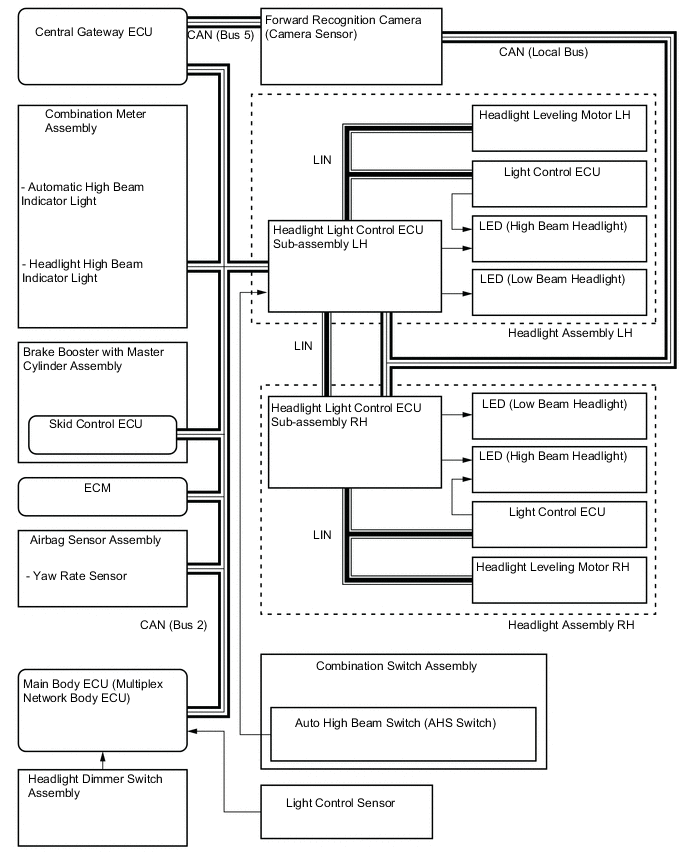
System Diagram
-
Layout of Main Components
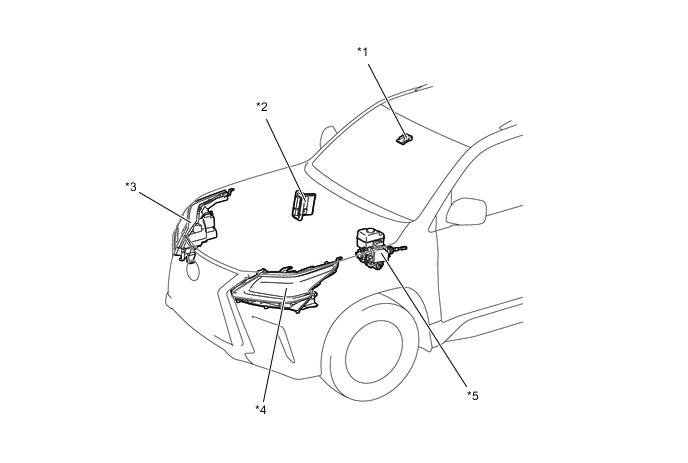
*1 Forward Recognition Camera(Camera Sensor) *2 ECM *3 Headlight Assembly RH
-
Headlight Light Control ECU Sub-assembly RH
-
Light Control ECU
-
Headlight Leveling Motor RH
*4 Headlight Assembly LH
-
Headlight Light Control ECU Sub-assembly RH
-
Light Control ECU
-
Headlight Leveling Motor LH
*5 Brake Booster with Master Cylinder Assembly
-
Skid Control ECU
- - 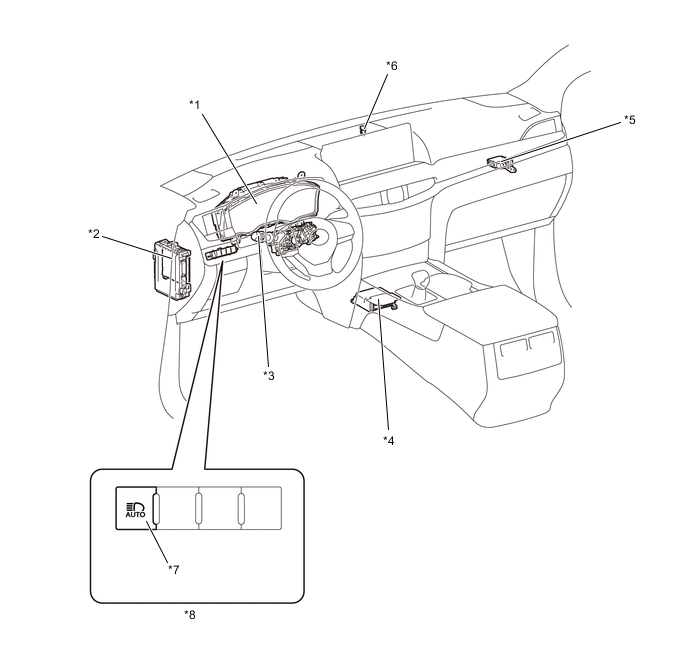
*1 Combination Meter Assembly *2 Main Body ECU (Multiplex Network Body ECU) *3 Headlight Dimmer Switch Assembly *4 Airbag Sensor Assembly
-
Yaw Rate Sensor
*5 Central Gateway ECU *6 Light Control Sensor *7 Auto High Beam Switch (AHS Switch) *8 Combination Switch Assembly -
-
Function of Main Components
Component Function Forward Recognition Camera (Camera Sensor) Determines when to turn the high beams on and off after identifying the lights of oncoming vehicles, preceding vehicles and other lights from the picture information of its camera sensor. Then, the sensor sends high beam request signals to the main body ECU. Headlight Light Control ECU Sub-assembly
-
Controls ON/OFF of the low-beam headlamp and outside one light of the high-beam headlamp.
-
Outputs ON/OFF and control signals for the center and inside two lights of the high-beam headlamp to the light control ECU.
-
Moves the headlights vertically and controls the beam axis direction according to control signals from the headlight light control ECU sub-assembly (LED driver module).
-
The headlight light control ECU sub-assembly LH receives the signals from the auto high beam switch (AHS switch).
Light control ECU Controls ON/OFF of the center and inside two lights of the high-beam headlamp according to the signals from the headlight light computer sub-assembly. Headlight Leveling Motor Moves the headlights vertically and controls the beam axis direction according to control signals from the headlight light control ECU sub-assembly (LED driver module). Airbag Sensor Assembly Yaw Rate Sensor Detects the yaw rate of the vehicle and transmits the signal to the forward recognition camera (camera sensor). Brake Booster with Master Cylinder Assembly Skid Control ECU The skid control ECU outputs information about the vehicle speed. This information is used by the forward recognition camera (camera sensor) to control switching between the high and low beams of the automatic high beam system. ECM The ECM outputs a signal to indicate that the shift lever is in R. Based on this signal, the forward recognition camera (camera sensor) determines the direction of vehicle movement. Combination Meter Assembly Automatic High Beam Indicator Light The automatic high beam indicator light illuminates to inform the driver when the adaptive high-beam system is activated. Headlight High Beam Indicator Light The headlight high beam indicator light illuminates to inform the driver when the high beam headlights are on. Main Body ECU (Multiplex Network Body ECU)
-
The main body ECU receives the signals from the headlight dimmer switch assembly and the light control sensor.
-
The main body ECU operates the high beams based on request signals that are received from the forward recognition camera (camera sensor).
-
The main body ECU transmits the signals to the combination meter assembly.
Headlight Dimmer Switch Assembly The headlight dimmer switch assembly transmits the auto position signal and the high beam position signal to the main body ECU. Combination Switch Assembly Auto High Beam Switch (AHS Switch) The auto high beam switch (AHS switch) turns on / off the power to the adaptive high-beam system. Light Control Sensor The light control sensor detects the ambient light level and transmits it to the main body ECU. -
-
Operation
-
Operating conditions of the adaptive high-beam system
-
Adaptive high-beam system operates when all of the following conditions are met. In addition, the adaptive high-beam system indicator illuminates in the combination meter blinks during the operation.
-
The engine switch is on (IG).
-
The light control switch is in the position of HEAD and AUTO, and the head light is illuminating.
-
The headlight dimmer switch is in the position of Hi.
-
Auto high beam switch (AHS switch) is on.*
-
The vehicle speed is approx.15 km/h (9 mph) or more.
Tech Tips
*: A message is displayed on the multi-information display in the combination meter assembly when the head light is off or the Auto high beam switch (adaptive high-beam switch) is ON except for when the headlight dimmer switch is in the position of Hi.
-
-
-
High-beam Light Distribution Control
-
High-beam light distribution control arranges the brightness and the range of lighting, utilizing the headlight control ECU sub-assembly and light control ECU.
-
With this system, the brightness and the range is changed in three stages depending on the vehicle speed:
Mode of lighting Functions Vehicle speed Except Models for Europe Models for Europe Low speed (for urban area) mode
-
Extends the range of lighting to left and right wider than normal mode.
-
Arranges the brightness to low-glare with pedestrian visibility.
-
Declines the light not to make the berm or pavement too bright.
15 - 30 km/h (9 - 19 mph) - Normal mode Ensures a wide range to left and light, and a long distance visibility for normal speed driving. 30 - 80 km/h (19 - 50 mph) 60 - 120 km/h (37 - 75 mph) High speed (for Highway) mode
-
Narrows the range of lighting than that of normal mode.
-
Arranges the brightness to ensure the long distance visibility.
-
Brightens illumination, adding the light of outside high-beam unit.
80 km/h (50 mph) or more 120 km/h (75 mph) or more Figure 1. Low speed (for urban area) mode (Except models for Europe)
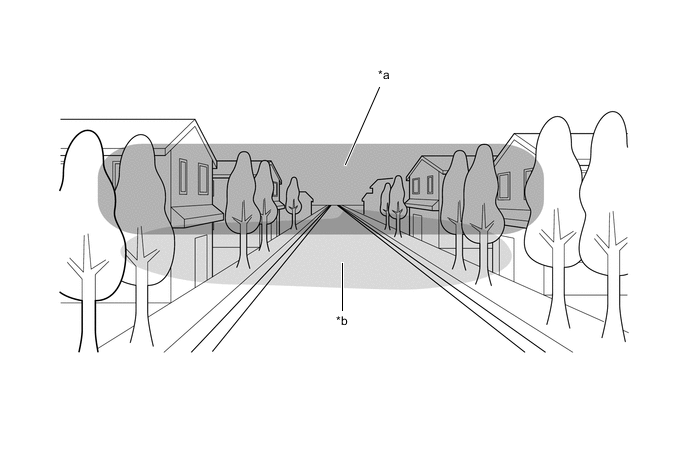
*a The lighting area of high-beam *b The lighting area of low-beam Figure 2. Normal mode
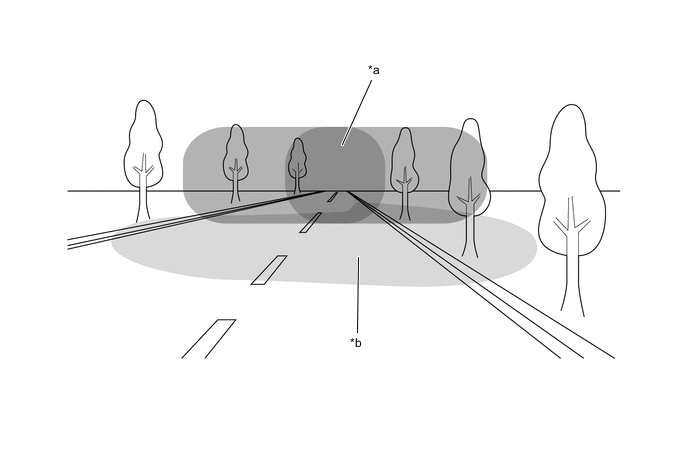
*a The lighting area of high-beam *b The lighting area of low-beam Figure 3. High speed (for Highway) mode
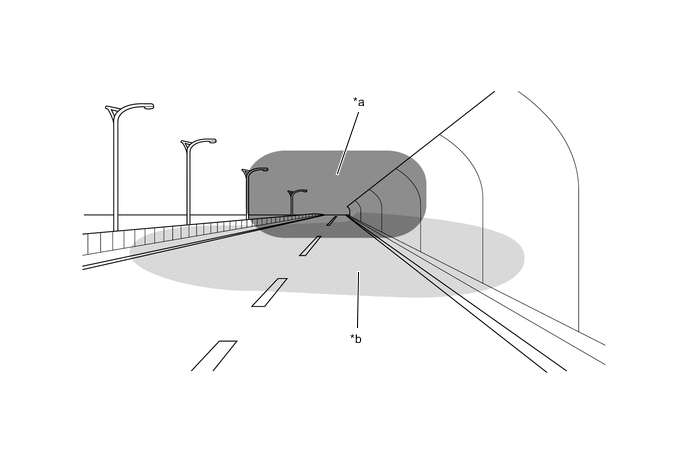
*a The lighting area of high-beam *b The lighting area of low-beam -
-
-
Light Shielding Control Function
-
Light shielding control partly shields high-beam when the forward recognition camera detects preceding vehicles or oncoming vehicles.
-
The headlight light control ECU sub-assembly, the light control ECU and the unit of LED enable shield the light at the required range partly and plurally.
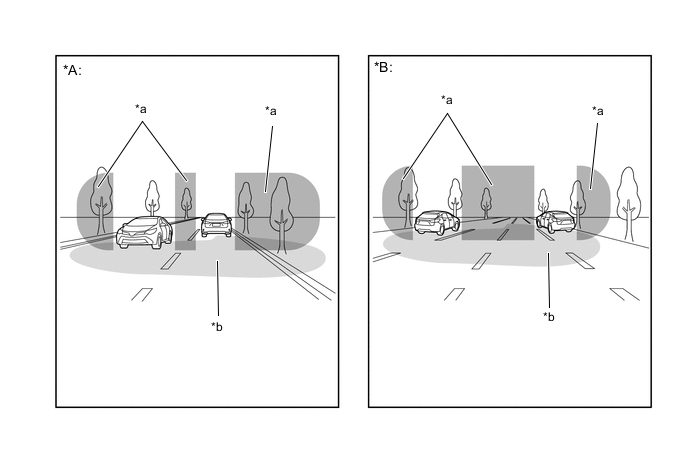
*A During driving on single-lane road *B During driving on multi-lane road *a The lighting area of high-beam *b The lighting area of low-beam
-
-
Electronic Swivel Control Function
-
Electronic swivel control ensures the curved road visibility by being variable to brighten the running direction during traveling curved road.
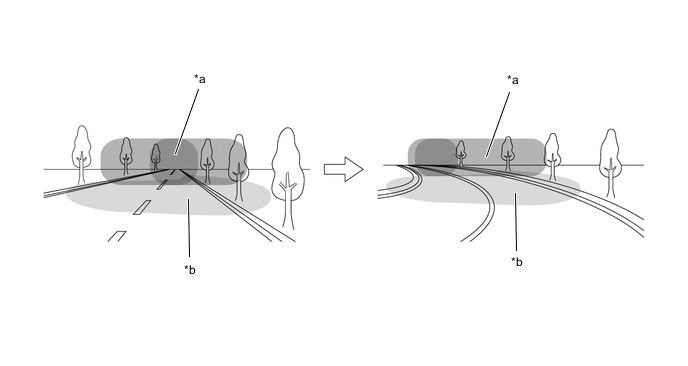
*a The lighting area of high-beam *b The lighting area of low-beam
-
-
Low-beam Cutline Automatic Up-down Control Function
-
By driving the headlight leveling motor in the headlight assembly, the lighting range of the low-beam is controlled properly, considering the position of the preceding vehicle which captured with the forward recognition camera.
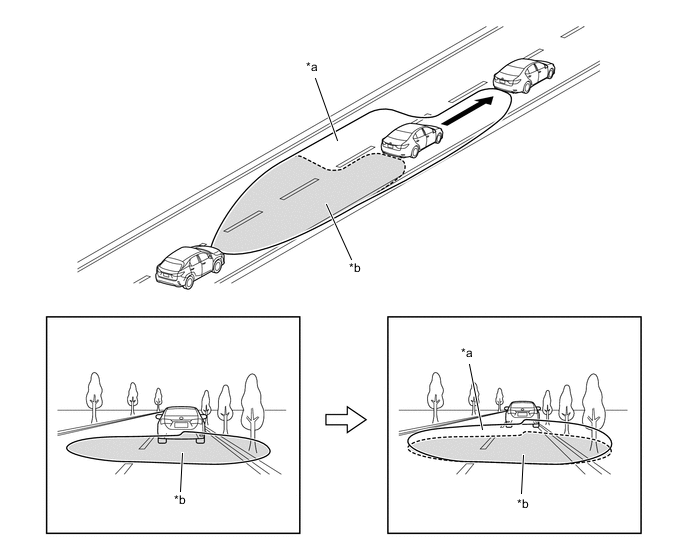
*a The lighting range after control *b The lighting range before control
-
-
-
Construction
-
Headlight Assembly
-
The light ON / OFF type LED unit is provided for 2 inside lights of the high beam head light.
-
8 LED chips for the inside unit and 3 for the center unit are provided in the light ON / OFF type LED unit.
-
The light distribution pattern of the adaptive high-beam system is made with 11 LED chips in the light ON / OFF type LED unit.
-
The light ON / OFF type LED unit is controlled by the light control ECU.
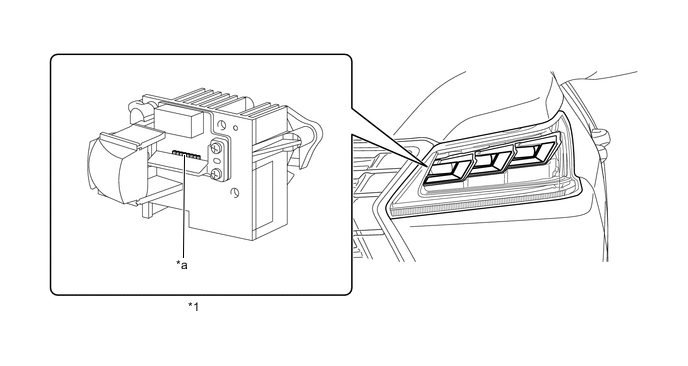
*1 Light ON/OFF type LED unit - - *a LED chips - - -
11 LED chips provided in the 2 inside lights of the high beam head light are controlled by the light control ECU.
-
By making variable each LED tips in the light ON/OFF type LED unit with the PWM dimmer and optimizing the lighting range and brightness, the high-beam light distribution can be done.
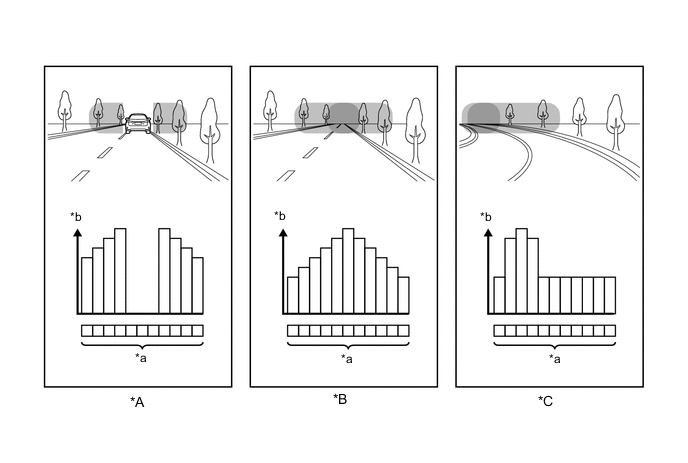
*A During partly shielding light *B Normal mode *C During the electronic swivel control - - *a LED chips *b The current value
-
-
Forward Recognition Camera (Camera Sensor)
-
The forward recognition camera consists of the Complementary Metal Oxide Semiconductor (CMOS) that receives images and the mirror portion that identifies light sources, and judges whether to turn high beam headlights on or off.

*1 Forward Recognition Camera - - *a Monocular Camera - -
-
-