LIGHTING
-
General
-
The automatic high beam system detects lights in front of the vehicle and automatically changes between high beams and low beams to support the driver during night driving.
-
-
Precaution of Automatic High Beam System
-
The automatic high beam system is a system that helps ensure visibility by automatically turning the high beams on and off.
-
However, due to control limitations of the automatic high beam system, it may be necessary to manually turn the high beams on and off. When driving, for safety reasons, make sure to change the high beams and low beams manually according to the driving conditions.
-
Under the following conditions, the automatic high beam system might not detect other vehicles or lights correctly, or the high beams might cause glare or flash pedestrians or the occupants of other vehicles. Manual operation should be used.
Factor Condition Weather/Climate When driving in bad weather (rain, snow, fog, sandstorms, etc.). Windshield Glass
-
When the windshield glass is not clear (ice, snow or frost on the glass).
-
When the windshield glass is dirty (sand, mud, water stains or bugs on the glass).
-
When the windshield glass is cracked.
-
When the windshield glass is fogged-up.
-
When the windshield glass has a film attached.
-
When an object on the instrument panel reflects off of the windshield glass.
-
When any other abnormal conditions exist with the windshield glass.
Inner Rear View Mirror Assembly (Automatic High Beam Sensor)
-
When a parking tag, magnifying lens or other accessory is mounted on the inner rear view mirror assembly.
-
When the inner rear view mirror assembly or its built-in automatic high beam sensor is deformed.
-
When the automatic high beam sensor in the inner rear view mirror assembly is dirty.
-
When any other abnormal conditions exist with the inner rear view mirror assembly or its built-in automatic high beam sensor.
Nearby Vehicles or Lights
-
When lights similar to headlights or taillights are in the vicinity of the vehicle.
-
When a nearby vehicle has no lights or its lights are off.
-
When a vehicle in front has misaligned lights, or its lights are changing color.
-
When a vehicle in front has extremely dirty headlights or taillights.
Road Conditions
-
When driving in an area where the conditions often change between bright and dark.
-
When driving on a road with many uphill and downhill slopes.
-
When driving on a winding road or around a sharp curve.
-
When driving on a bumpy road (cobblestone pavement, gravel road, rough unpaved road, etc.).
-
When highly reflective objects are in front of the vehicle (mirrors, road signs, etc.).
Vehicle Conditions
-
When the headlights are damaged, deformed or dirty.
-
When the vehicle posture is abnormal due to flat tire (or posture has changed due to the vehicle being fully loaded, a trailer being towed, road conditions etc.).
-
When the vehicle has other malfunctions or if the vehicle has been modified.
Automatic High Beam System Malfunction:
-
When the automatic high beam indicator light on the combination meter is blinking.
Others:
-
When the automatic high beam system does not seem to be changing between the high beams and low beams properly.
-
When the automatic high beam system is frequently changing between the high beams and low beams.
-
When the glare from the high beams would disturb pedestrians or the drivers of other vehicles.
-
-
-
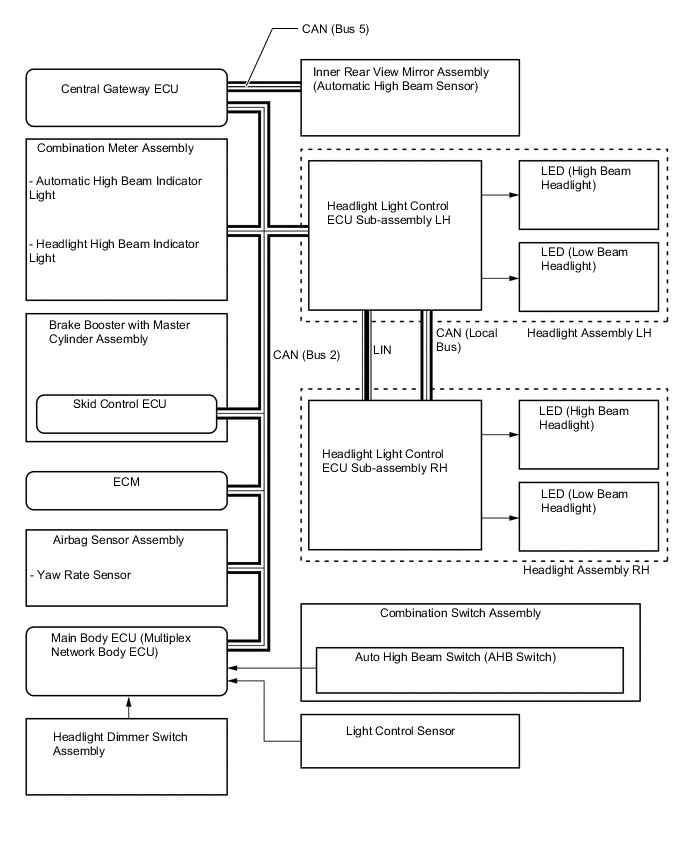
System Diagram
-
Layout of Main Components
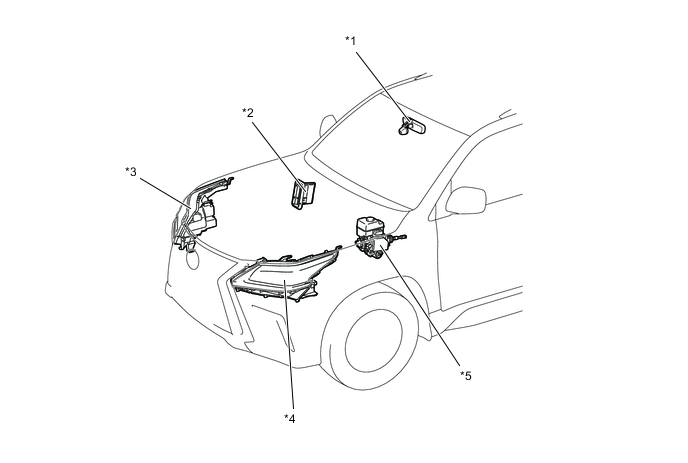
*1 Inner Rear View Mirror Assembly (Automatic High Beam Sensor) *2 ECM *3 Headlight Assembly RH
-
Headlight Light Control ECU Sub-assembly RH
*4 Headlight Assembly LH
-
Headlight Light Control ECU Sub-assembly LH
*5 Brake Booster with Master Cylinder Assembly
-
Slid Control ECU
- - 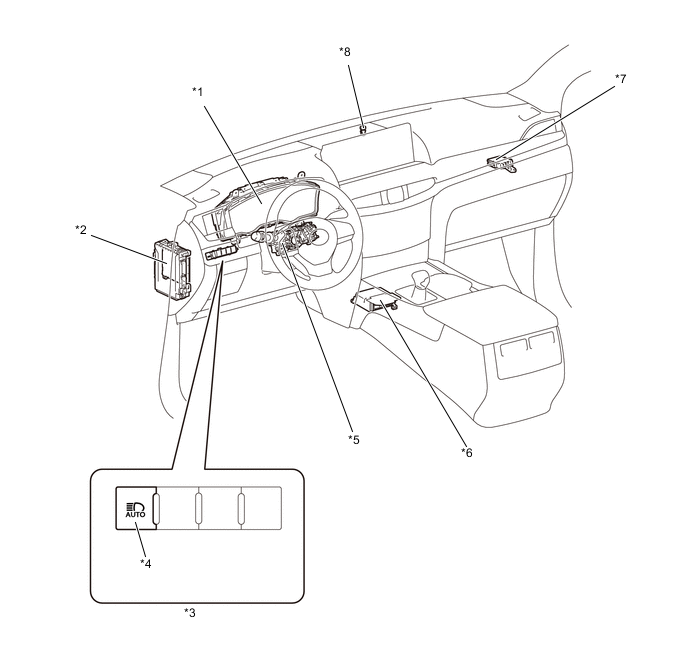
*1 Combination Meter Assembly *2 Main Body ECU (Multiplex Network Body ECU) *3 Combination Switch Assembly *4 Automatic High Beam Switch *5 Headlight Dimmer Switch Assembly *6 Airbag Sensor Assembly
-
Yaw Rate Sensor
*7 Central Gateway ECU *8 Light Control Sensor -
-
Function of Main Components
Component Function Inner Rear View Mirror Assembly (Automatic High Beam Sensor) The Automatic High Beam Sensor determines when to turn the high beams on and off after identifying the lights of oncoming vehicles, preceding vehicles and other lights from the picture information of its camera sensor. Then, it sends high beam request signals to the main body ECU. Headlight Light Control ECU Sub-assembly ON/OFF of the hi-beam headlight is controlled by the signal sent from the main body ECU. Airbag Sensor Assembly Yaw Rate Sensor Detects the yaw rate of the vehicle and transmits the signal to the inner rear view mirror assembly (automatic high beam sensor). Brake Booster with Master Cylinder Assembly Skid Control ECU The skid control ECU outputs information about the vehicle speed. This information is used by the inner rear view mirror assembly (automatic high beam sensor) to control switching between the high and low beams of the automatic high beam system. ECM The ECM outputs a signal to indicate that the shift lever is in R. Based on this signal, the inner rear view mirror assembly (automatic high beam sensor) determines the direction of vehicle movement. Combination Meter Assembly Automatic High Beam Indicator Light The automatic high beam indicator light illuminates to inform the driver when the automatic high beam system is activated. Headlight High Beam Indicator Light The headlight high beam indicator light illuminates to inform the driver when the high beam headlights are on. Main Body ECU (Multiplex Network Body ECU)
-
The main body ECU receives the signals from the auto high beam switch (AHB switch), headlight dimmer switch assembly and the light control sensor.
-
The main body ECU operates the high beams based on request signals that are received from the inner rear view mirror assembly (automatic high beam sensor).
-
The main body ECU transmits the signals to the combination meter.
Headlight Dimmer Switch Assembly The headlight dimmer switch assembly transmits the auto position signal and the high beam position signal to the main body ECU. Combination Switch Assembly Auto High Beam Switch (AHB Switch) The automatic high beam switch turns on/off the power to the automatic high beam system. Light Control Sensor The light control sensor detects the ambient light level and transmits it to the main body ECU. -
-
Construction
-
Automatic High Beam Sensor (Inner Rear View Mirror Assembly)
-
The automatic high beam sensor consists of the Complementary Metal Oxide Semiconductor (CMOS) that receives images and the mirror portion that identifies light sources, and judges whether to turn high beam headlights on or off.
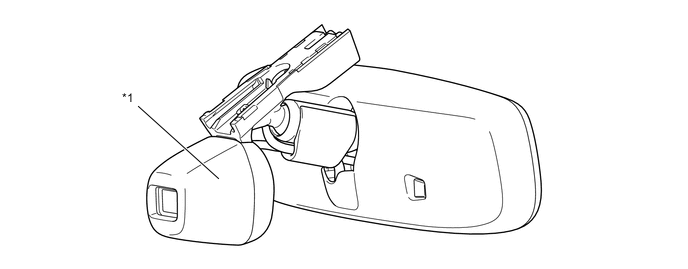
*1 Automatic High Beam Sensor (Inner Rear View Mirror Assembly) - -
-
-
Operating Condition
-
The automatic high beam system will operate as follows:
Item Operating Condition System Activation When all of the following conditions are met, the automatic high beam system is activated and the automatic high beam indicator light turns on:
-
The engine switch is on (IG).
-
The headlight dimmer switch assembly is in the auto position and high beam position.
-
The automatic light control sensor outputs the night mode signal (to turn the headlights on).
High Beam Headlight On When all of the following conditions are met, the automatic high beam system turns on the high beam headlights after a short delay:
-
Vehicle speed is more than approximately 34 km/h (21 mph).
-
The area in front of the vehicle is dark.
-
No oncoming vehicles are present with the headlights on.
-
No preceding vehicles are present with the taillights on.
-
Few streetlights are present along the street ahead.
High Beam Headlight Off When any of the following conditions are met, the automatic system turns off the high beam headlights after a short delay:
-
Vehicle speed is less than approximately 27 km/h (17 mph).
-
The area in front of the vehicle is not dark.
-
An oncoming vehicle with headlights on is detected.
-
A preceding vehicle with taillights on is detected.
-
Several streetlights are present along the street ahead.
-
-
-
Operation
-
When passing an oncoming vehicle
-
The automatic high beam system turns the high beam headlights off when there is an oncoming vehicle before its distance reaches approximately 800 m (2625 ft.).
-
When an oncoming vehicle passes the automatic high beam sensor range, the automatic high beam system turns the high beam headlights on after a short delay.
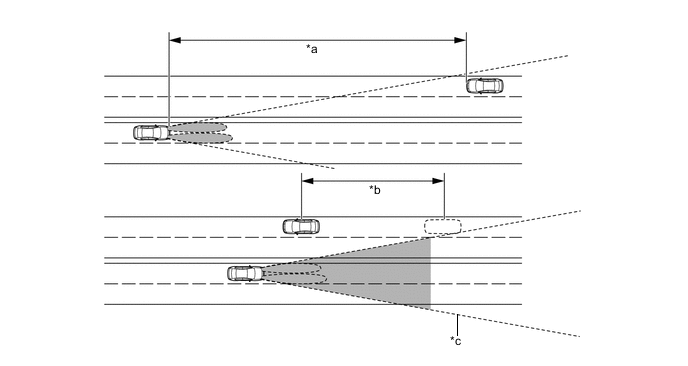
*a Approx. 800 m (2625 ft.) *b Delay *c Camera Angle - - Tech Tips
-
The detection distance varies depending on detected objects.
-
Depending on the intensity of oncoming (and preceding) vehicle lights, the timing of turning the high beam headlights on and off will vary.
-
-
When passing a preceding vehicle
-
The automatic high beam system turns the high beam headlights off when there is a preceding vehicle before its distance reaches approximately 600 m (1969 ft.).
-
When a preceding vehicle passes the automatic high beam sensor range, the automatic high beam system turns the high beam headlights on after a short delay.
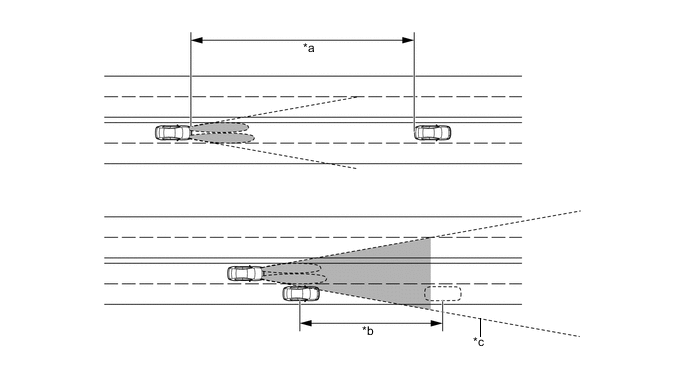
*a Approx. 600 m (1969 ft.) *b Delay *c Camera Angle - - Tech Tips
Depending on the intensity of preceding vehicle lights, the timing of turning the high beam headlights on and off will vary.
-
-
-
-
Diagnosis
-
When the headlight light control ECU sub-assembly or main body ECU detects a malfunction in the automatic high beam control system, a Diagnostic Trouble Code (DTC) is stored in memory.
-
The DTCs can be read using the Global TechStream (GTS). For details, refer to the Repair Manual.
-