REAR SUSPENSION SYSTEM GENERAL
-
OUTLINE
-
A torsion-beam type rigid axle suspension is used, in which an axle beam with a U-shaped cross section is located in the middle of the trailing arm.
-
The suspension layout has been optimized to make the vehicle floor low and flat, thus providing sufficient space in the rear compartment.
-
-
SPECIFICATION
Tire Size 205/60R16 215/55R17 Tread*1 1545 mm (60.8 in.) ← Camber*1 -1°23'
-1°22'*2
← Toe-in*1 2.2 mm (0.087 in.)
1.7 mm (0.067 in.)*3
2.0 mm (0.079 in.)*4
2.3 mm (0.091 in.)
1.7 mm (0.067 in.)*3
1.8 mm (0.071 in.)*4
Tech Tips
*1: Unladen vehicle condition
*2: 2-passenger models and models with raised vehicle height
*3: 2-passenger models
*4: Models with raised vehicle height
-
MAIN FEATURES
-
Anti-lift Geometry
-
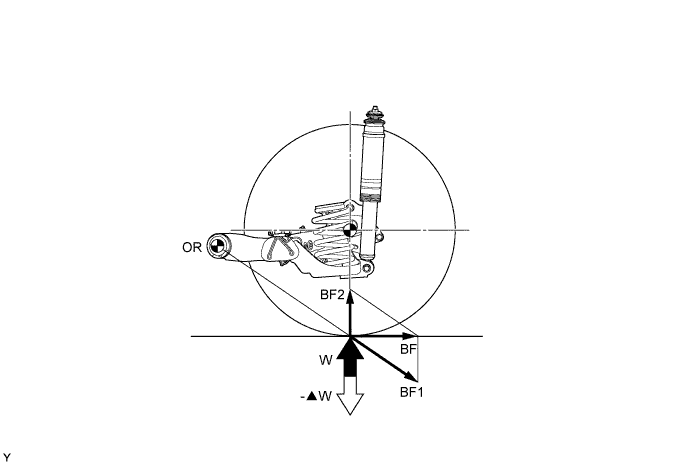
During braking the rear end of the vehicle lifts due to the shifting of the center of gravity caused by inertia. The intersecting point (OR) supports the braking force (BF), and generates a force (BF1) in the direction of the intersecting point (OR) and a component force (BF2) in the direction of the ground contact point. The force (BF1) can change the height of the intersecting point (OR). When intersecting point (OR) is set high, it acts in the opposite direction (-▲W) of the load fluctuation (W) in order to restrain the lift.
-
-
Toe and Camber Change
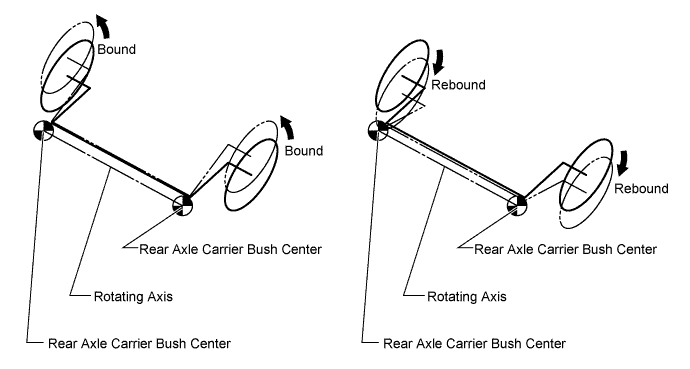
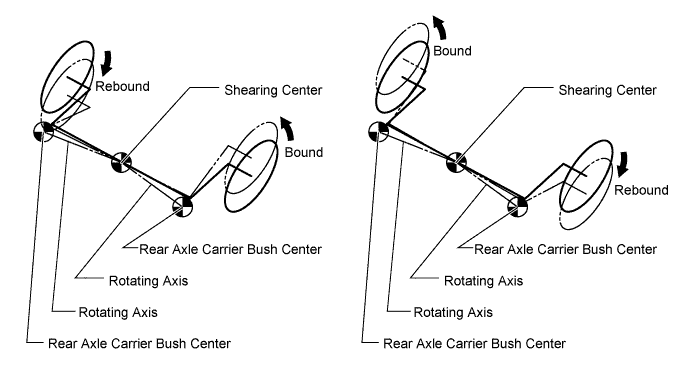
In a torsion-beam type suspension, the toe and camber angle change differs between the same direction stroke and the opposite direction stroke, thus ensuring straight line stability and cornering stability.
-
Same Direction Stroke
Similar to the full-trailing arm type suspension, the rotating axis that joins the right and left rear axle carrier bush centers becomes the center of movement for the rear axle beam assembly.
-
Opposite Direction Stroke
When a difference in suspension stroke is created between the right and left wheels, the movement is based on the rotating axis, which is a line between the shearing center and rear axle carrier bush centers. Toe and camber change is determined by the allocation of the rotating axis.
-
-
Arm Bush Slant Allocation
-
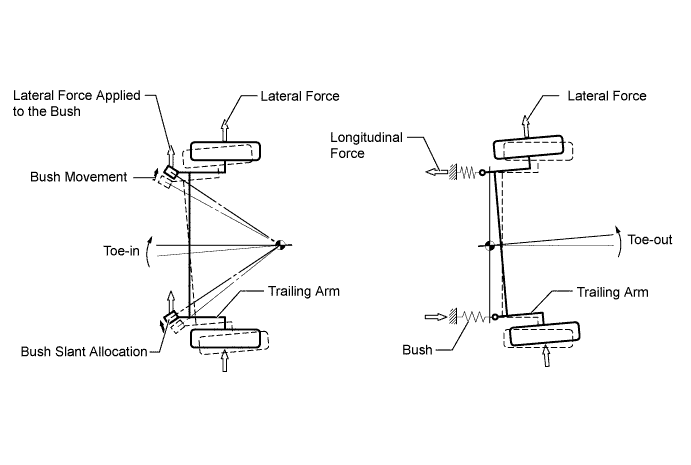
When the bushes are slanted, a correcting effect causes a lateral force on the suspension. This increases driving stability.
-
-
-
PRECAUTION
-
Be sure to use the jack-up points that are provided on the body when raising the vehicle on the jack. Never apply a jack under the component parts of the rear suspension.
-