BRAKE CONTROL SYSTEM GENERAL
-
OUTLINE
-
The electronically controlled brake system is used.
-
The regenerative brake cooperative control is used.
-
Vehicle Dynamics Integrated Management (VDIM) is a vehicle motion control system that integrates brake control (ABS with EBD, Brake Assist, TRC, VSC and Hill-start Assist Control) and steering assist control (EPS).
-
-
MAJOR DIFFERENCE
-
The new models have been modified from the previous models as shown below:
-
The brake pedal stroke sensor has been changed to a non-contact (semiconductor) type.
-
-
-
MAIN FEATURES
-
Electronically Controlled Brake System
-
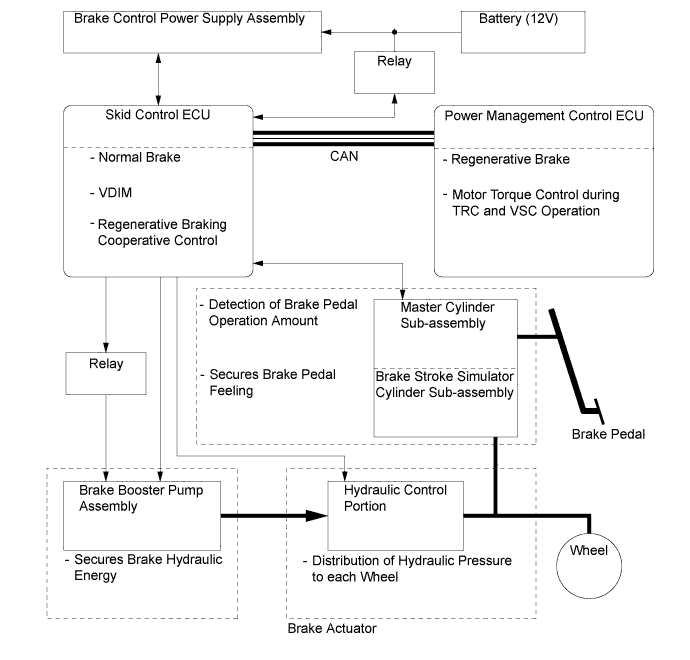
For the electronically controlled brake system, the conventional brake booster has been replaced by brake input, power supply, and hydraulic pressure control components.
-
During normal braking, the hydraulic pressure generated by the master cylinder does not directly actuate the wheel cylinders, but serves as a hydraulic pressure signal. Instead, the actual control pressure is obtained by regulating the hydraulic pressure of the brake actuator and the brake control power source assembly. This regulated hydraulic pressure actuates the wheel cylinders.
-
The electronically controlled brake system executes hydraulic control of the ABS with EBD, brake assist, TRC, and VSC functions in accordance with information provided by the sensors and ECUs.
-
The brake control power supply assembly is used as an auxiliary power source to supply power to the brake system in a stable manner.
-
-
Regenerative Braking Cooperative Control
-
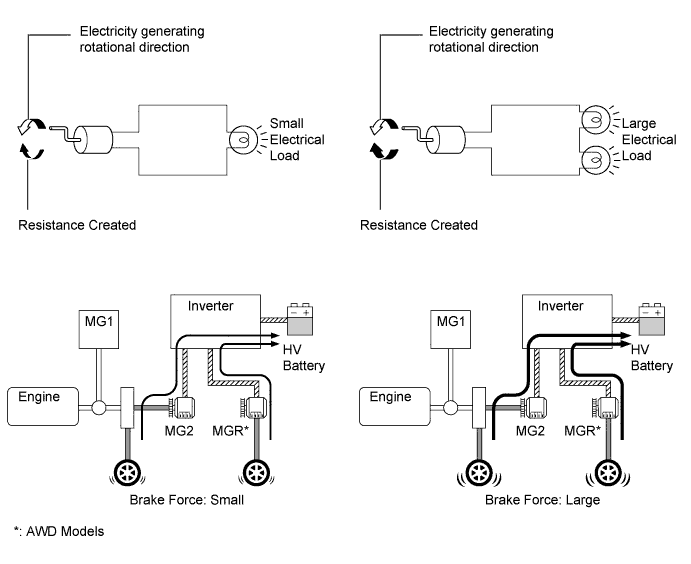
The regenerative braking cooperative control does not rely solely on the braking force of the hydraulic brake system to supply the brake force required by the driver. Instead, by performing cooperative control with the LEXUS Hybrid Drive, this control provides braking force using both regenerative braking and hydraulic braking. By recovering kinetic energy and converting it into electrical energy, this control minimizes the amount of kinetic energy usually wasted in hydraulic braking.
-
Regenerative braking consists of a resistance to rotation that is created by a motor generator acting as a generator (MG2 and MGR*). This resistance force created by generating electricity will oppose the rotational direction of the motor generator rotor, forcing it to slow down. The greater the generated amperage (battery charging amperage), the greater the resistance force will be.
-
The front and rear drive axles are joined electrically by MG2 and MGR*, which drive the respective axles.
-
The rotational movement of the drive wheels drives MG2 and MGR*, causing them to operate as generators. As a result, the brake force of MG2 and MGR* which results from generating electricity is transmitted to the drive wheels. LEXUS Hybrid Drive controls the amount of electricity generated in order to regulate the amount of brake force.
*: For AWD models
-
-
Vehicle Dynamics Integrated Management (VDIM)
-
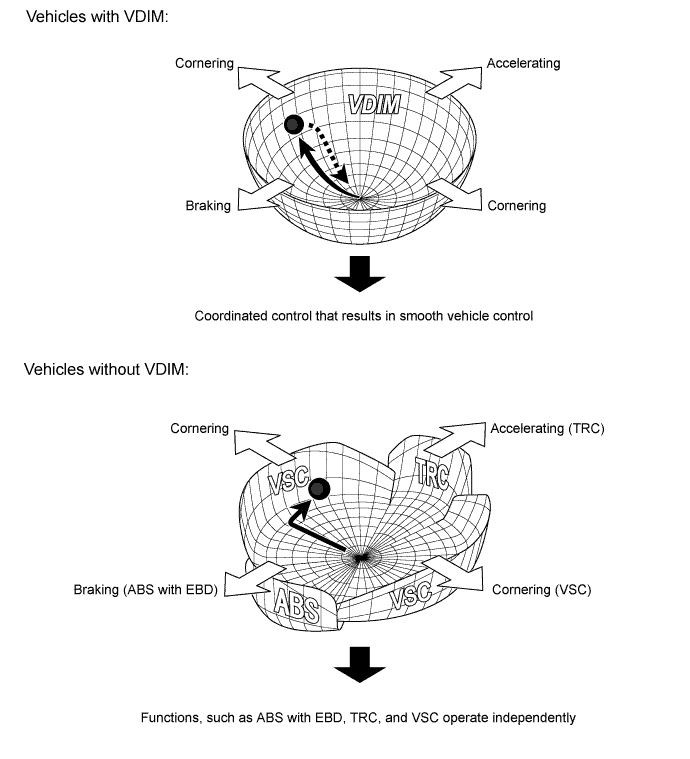
VDIM integrates brake control (ABS with EBD, Brake Assist, TRC, VSC and Hill-start Assist Control) and steering assist control (EPS) to enhance the dynamic performance when "accelerating, turning and stopping".
-
Using VDIM, brake control starts earlier in order to ensure that the vehicle does not exceed its behavioral limits. The brake control system and the Electric Power Steering (EPS) operate in a coordinated manner.
-
-