THEFT DETERRENT DETAILS
-
FUNCTION
-
The theft deterrent system has the following functions:
Function Outline Alarm When the theft deterrent system switches to the alarm state, the warning items are operated and the alarm sounds for approximately 30 seconds. Alarm Indicator When the state of the theft deterrent system enters the armed preparation or alarm state, the security indicator light is illuminated to inform the user. This indicator is also the engine immobiliser indicator, which blinks when the engine immobiliser is in the set state. Forced Door Lock The main body ECU (multiplex network body ECU) transmits a door lock signal to all the doors when all the following conditions are met:
-
The theft deterrent system is in the alarm state.
-
There is no key in the actuation are.
-
One of the doors has been unlocked.
The function stops when one of the following conditions is met:
-
All doors are locked.
-
The warning ends after approximately 30 seconds.
-
The key is in the actuation area.
Panic Control* When the PANIC button of the key is pressed, the main body ECU (multiplex network body ECU) operates the alarm function. *: Models except for Europe and China
-
-
-
CONSTRUCTION
-
Intrusion Sensor (Models with Intrusion Sensor)
-
An intrusion sensor is provided in the map light assembly.
-
The intrusion sensor detects any intrusion into the vehicle interior and transmits a warning signal to the main body ECU (multiplex network body ECU).
-
This sensor transmits radiowaves at 24.5 GHz in the vehicle interior. When an intruding object moves, in disrupts the reflection of the radiowaves, and the senor detects the resulting changes in the phase of the radiowaves.
-
The main body ECU (multiplex network body ECU) activates the intrusion sensor when the system changes from the armed preparation state to the armed state. If an intrusion detection signal is input from the intrusion sensor during the armed state, the ECU changes to the alarm state in order to output an alarm.
-
When the system is in the disarmed state, pressing the intrusion sensor cancel switch can disable the function of the intrusion sensor. If the system changes to the armed state, the intrusion senor will not activate. This function is canceled each time all doors are unlocked with a entry and start system, and is reinstated when the intrusion sensor is on.
-
-
Intrusion Sensor Cancel Switch (Models with Intrusion Sensor)
-
An intrusion sensor cancel switch is provided in the map light assembly.
-
When the system is in the disarmed state, pressing the intrusion sensor cancel switch can disable the function of the intrusion sensor and tilt sensor.
-
-
Tilt Sensor (Yawrate Sensor) (Models with tilt sensor)
-
The tilt sensor is incorporated in the yawrate sensor located inside the front floor console.
-
The tilt sensor detects pitch angle of vehicle inclination using the 2 deceleration sensors. When the tilt sensor detects a change in the pitch angle of vehicle inclination, such as a thief attempting to tow the vehicle, it transmits the warning signal to the main body ECU (multiplex network body ECU).
-
The main body ECU (multiplex network body ECU) activates the tilt sensor when the system changes from the armed preparation state to the armed state. If warning signal is input from the tilt sensor during the armed state, the ECU changes to the alarm state in order to output an alarm.
-
When the system is in the disarmed state, pressing the intrusion sensor cancel switch can disable the function of the tilt sensor. If the system changes to the armed state, the tilt sensor will not activate. This function is canceled each time all doors are unlocked with a entry and start system, and is reinstated when the tilt senor is on.
CAUTION:
Under the following conditions, if the vehicle tilts or the acceleration of gravity in the vertical and horizontal directions of the vehicle is detected by the tilt sensor, an alarm may occur accidentally. To avoid accidental alarm activation, turn the tilt sensor off using the intrusion sensor cancel switch.
-
The vehicle is transported by ferry, trailer or train.
-
The vehicle is parked in multi-story parking facilities.
-
The vehicle is washed by a conveyor type car washing machine.
-
A tire blew out.
-
The vehicle is jacked up for a tire or wheel change.
-
An earthquake occurs or road subsides.
-
Goods such as skis or snowboards are loaded or unloaded.
-
-
-
Self-power Siren (Models for Europe, China, Israel and Hong Kong)
-
During a normal operation, self-power siren sounds an alarm in accordance with the operation signal from the main body ECU (multiplex network body ECU). Because this siren has an internal battery, it can independently sound an alarm even if the vehicle battery terminals are disconnected or if the wiring harnesses that are related to the system are cut.
-
-
-
OPERATION
-
The states of the theft deterrent system are as follows:
State Description Theft Detection Disarmed State The theft deterrent system has not been set by the user. Not possible Armed Preparation State This is the preparation state before the theft deterrent system becomes active (enters the armed state) when the system has been set by the user. Not possible Armed State The theft deterrent system is active. (Theft can be detected.) Possible Alarm State A theft attempt has been detected and the warning operation activates. Possible 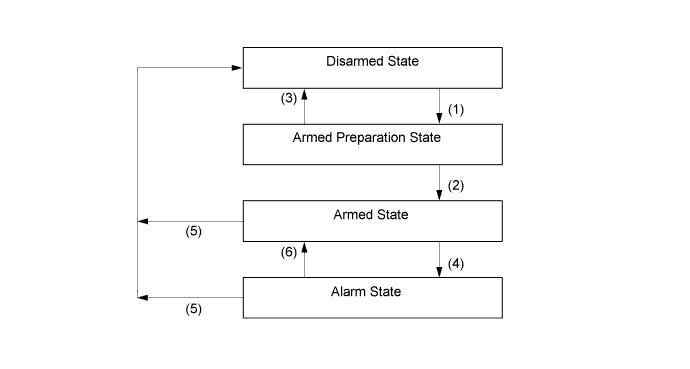
-
The theft deterrent system activates as shown in the diagram above when one of items in the chart occurs in order to cause the system to enter the respective state.
Condition Item (1) When all of the following conditions are met: The power source is off.
-
The power source is off.
-
The key is not in the actuation area.
-
All doors and engine hood are closed.
-
All doors are locked using the key or entry and start system.
(2) The system switches to the armed state when the doors, engine hood and back door all closed and locked, and 30 seconds*1 or 10 seconds*2 have elapsed. (3) The system switches to the disarmed state when one of the following conditions is met:
-
Doors are unlocked using the key.
-
The back door is opened.
-
Any door is unlocked.
-
Any door is opened.
-
The key is in the actuation area.
-
The engine switch is pushed.
-
The battery terminal is disconnected and reconnected.
(4) The system switches to the alarm state when one of the following conditions is met:
-
The engine hood is opened.
-
The back door is opened.
-
Any door is opened while all doors are closed.
-
Any door is unlocked while all doors are locked.
-
The battery terminal is disconnected and reconnected.
-
The engine switch is pushed while the key is in the actuation area (a remote control starter is not in use at this time).
-
The intrusion sensor detects movement in the vehicle interior.*3
-
The tilt sensor detects a change in vehicle inclination.*4
(5) The system switches to the disarmed state when one of the following conditions is met:
-
Any door is unlocked with the key.
-
The back door is opened with the key.
-
The engine switch is changed to on (IG).
(6) The system reverts to the armed state after the alarm time (30 seconds) elapses. *1: Models except for China
*2: Models for China
*3: Models with intrusion sensor
*4: Models with tilt sensor
-
-