СИСТЕМА АВТОМАТИЧЕСКОЙ ТРАНСМИССИИ ДЕТАЛЬНОЕ ОПИСАНИЕ
-
FUNCTION OF MAIN COMPONENTS
Component Function Torque Converter Assembly
-
Transmits the engine power to the transmission.
-
Increases engine torque.
Oil Pump Provides the oil pressure necessary for the transmission operation. No. 1 Clutch (C1)
Connects the input shaft and the intermediate shaft. No. 2 Clutch (C2)
Connects the input shaft and the center planetary carrier. No. 3 Clutch (C3)
Connects the input shaft and the front sun gear. No. 1 Brake (B1)
Prevents the front planetary carrier from turning either clockwise or counterclockwise. No. 2 Brake (B2)
Prevents the front and center planetary ring gears from turning either clockwise or counterclockwise. No. 3 Brake (B3)
Prevents the outer race of F2from turning either clockwise or counterclockwise.
No. 4 Brake (B4)
Prevents the center planetary carrier and the rear planetary ring gear from turning either clockwise or counterclockwise. No. 1 1-way Clutch (F1)
Prevents the front planetary carrier from turning counterclockwise. No. 2 1-way Clutch (F2)
Prevents the front planetary sun gear from turning counterclockwise when B3is operating.
No. 3 1-way Clutch (F3)
Prevents the center planetary carrier and the rear planetary ring gear from turning counterclockwise. Planetary Gears Change the route through which driving force is transmitted, in accordance with the operation of each clutch and brake, in order to increase or reduce the input and output speed. Shift Solenoid Valve DSL (S1) Switches the 2-3 shift valve. No. 3 Transmission Solenoid Assembly (S2) Switches the 1-2 shift valve or 3-4 shift valve. Shift Solenoid Valve S4 (SR) Switches the clutch apply control valve. Shift Solenoid Valve (SL1)
-
Controls clutch pressure.
-
Controls accumulator back pressure.
Shift Solenoid Valve (SL2) Controls brake pressure. Line Pressure Control Solenoid Assembly (SLT)
-
Controls line pressure.
-
Controls accumulator back pressure.
Lock-up Control Solenoid Assembly (SLU)
-
Controls lock-up clutch pressure.
-
Controls accumulator back pressure.
ATF Temperature Sensors Detect the ATF temperature. Transmission Revolution Sensor (NT) Detects the input speed of the transmission. Transmission Revolution Sensor (SP2) Detects the output speed of the transmission. Park/Neutral Position Switch Assembly Detects the shift lever position (P, R, N, D, 3, 2). Shift Lock Control ECU Sub-assembly Transmission Control Switch Detects that the shift lever is in 4 and L. Transfer Indicator Switch (L4 Position) Detects that the transfer gear position is low. Transfer Indicator Switch (Neutral Position) Detects that the transfer gear position is neutral. Transfer Indicator Switch (Center Differential Lock Position) Detects that the transfer gear position is center differential lock. ECM
-
Controls each shift solenoid valve and engine output in response to a signal from each sensor and switch.
-
Makes a diagnosis and memorizes the failed section when the ECM detects a malfunction.
Combination Meter Assembly Shift Position Indicator Light Indicates the shift lever position. MIL Illuminates or blinks to inform the driver when the ECM detects a malfunction. ATF Temperature Warning Light Warns the driver by lighting up when the ATF is at a high temperature. DLC3 The Diagnostic Trouble Codes (DTCs) can be read by connecting an intelligent tester II. -
-
SYSTEM CONTROL
Electronic Control of Automatic Transmission Control Function Shift Timing Control The ECM sends current to shift solenoid valves S1, S2 and/or SR based on signals from various sensors in order to shift the gears. Line Pressure Control Actuates the shift solenoid valve SLT to control the line pressure in accordance with information from the ECM and the operating conditions of the transmission. Clutch Pressure Optimal Control The shift solenoid valves SL1 and SLT minutely control the clutch pressure in accordance with the engine output and driving conditions of the transmission. Clutch to Clutch Pressure Control Controls the pressure that is applied directly to B1brake and C1clutch by actuating the shift solenoid valves SL1 and SL2 in accordance with the ECM signals.
Engine Torque Control Retards the engine ignition timing temporarily to improve shift feeling when upshifts or downshifts occur. N to D Squat Control When the shift lever is moved from N to D, the gear is temporarily engaged to the 2nd and then to the 1st to reduce vehicle squat. Lock-up Timing Control The ECM sends current to the shift solenoid valve SLU based on signals from various sensors and engages or disengages the lock-up clutch. Artificial Intelligence-shift Control (AI-shift Control) Based on the signals from various sensors, the ECM determines the road conditions and the intention of the driver. Then, an appropriate shift pattern is automatically determined, thus improving driveability.
-
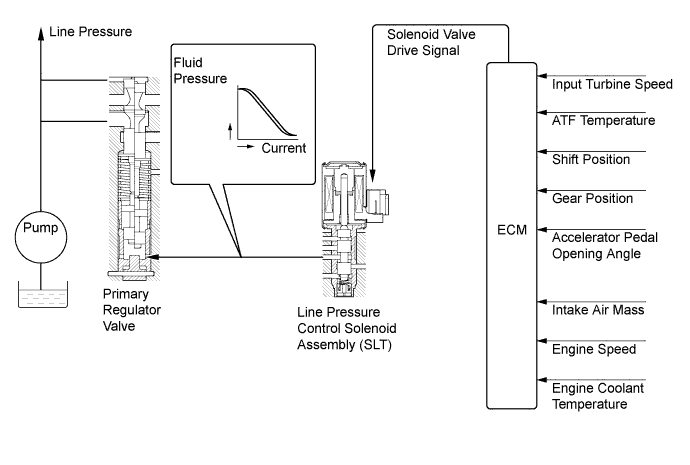
Line Pressure Control
-
In order to obtain a predetermined line pressure characteristic in accordance with each sensor signal, the ECM activates the shift solenoid valve SLT to regulate the throttle pressure.
-
This makes it possible for the primary regulator valve to precisely and minutely control the line pressure in accordance with the engine output, thus providing smoother shift characteristics.
-
-
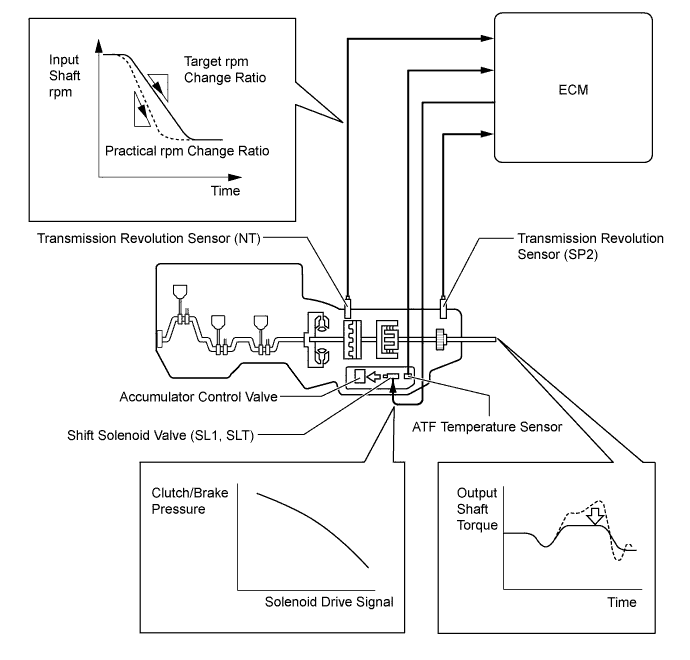
Clutch Pressure Optimal Control
-
The ECM monitors the signals from various types of sensors, such as the transmission revolution sensor (NT), allowing shift solenoid valves SL1 and SLT to minutely control the clutch pressure in accordance with engine output and driving conditions. As a result, smooth shift characteristics are achieved.
-
-
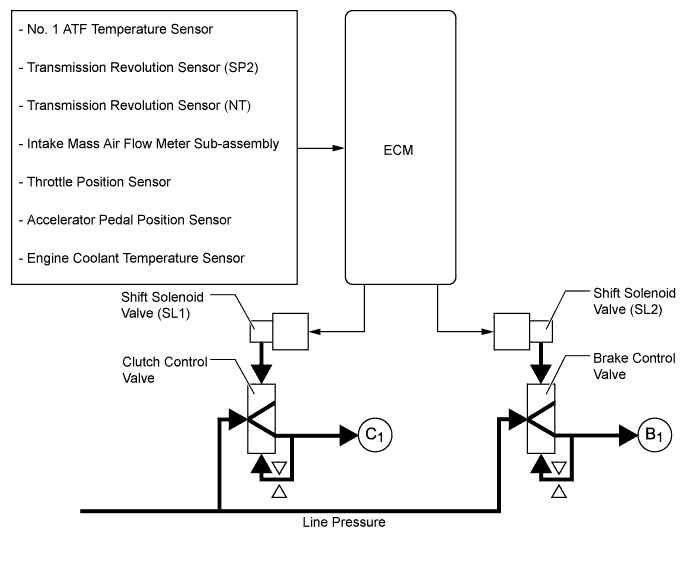
Clutch to Clutch Pressure Control
-
This control is used for shifting from 4th to 5th gear and from 5th to 4th gear.
-
The ECM actuates shift solenoid valves SL1 and SL2 in accordance with various signals. The output from these shift solenoid valves acts directly on control valves B1and C1in order to regulate the line pressure that acts on the B1brake and C1clutch.
-
As a result, high response and excellent shift characteristics have been achieved.
-
-
Lock-up Timing Control
-
The ECM operates the lock-up timing control in order to improve the fuel consumption performance in the top gear when the shift lever is in D or 4.
Lock-up Timing Control Operation Gear Shift Lever Position D 4 1st X X 2nd X X 3rd X X 4th X ○ 5th ○ - Tech Tips
○: Operates
X: Does not operate
-
-
Artificial Intelligence-shift Control (AI-shift Control)
-
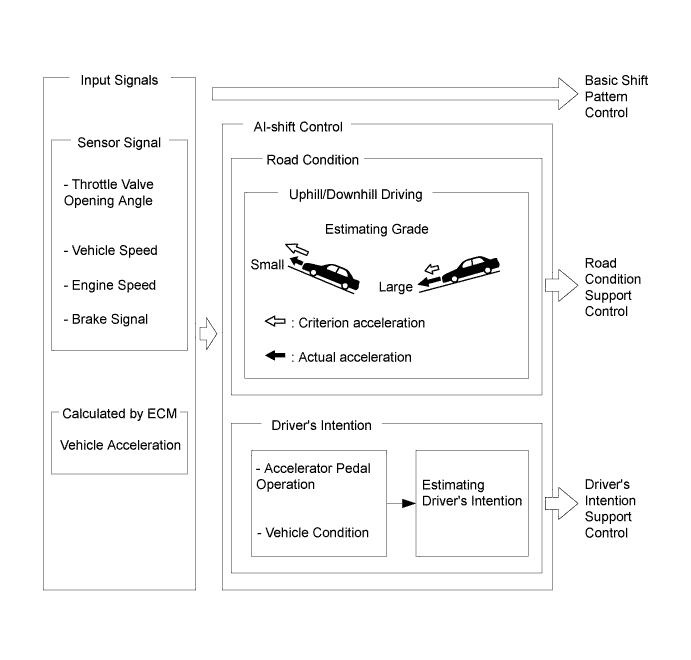
The AI-shift control determines optimal transmission control based on input signals and automatically changes the shift pattern. As a result, a high caliber of transmission operation is achieved.
-
The AI-shift control includes a road condition support control and a driver's intention support control.
-
The AI-shift control is effected only with the shift lever in D, based on the accelerator pedal and brake operation data. The AI-shift control will be canceled when the shift lever is moved to a position other than D.
-
Under road condition support control, the ECM identifies the throttle valve opening angle, the accelerator pedal opening angle and the vehicle speed to determine whether the vehicle is being driven uphill or downhill. To achieve an optimal drive force while driving uphill, this control prevents the transmission from upshifting to 4th or 5th gear. To achieve an optimal engine braking effect while driving downhill, this control automatically downshifts the transmission to 4th or 3rd gear.
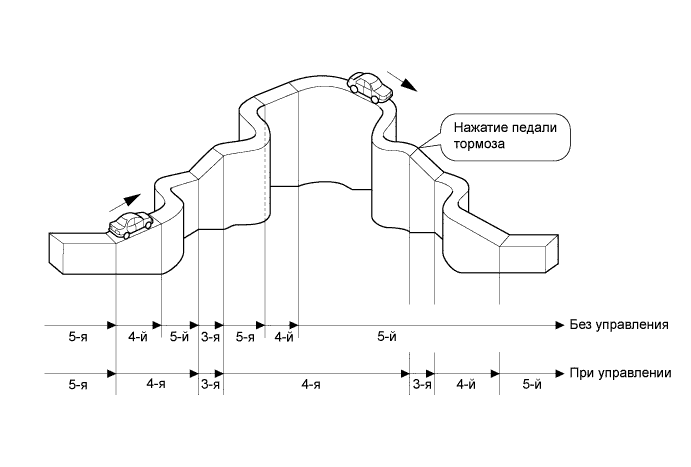
-
The driver's intention support control is estimated based on the accelerator pedal operation and vehicle condition.
-
-
-
FUNCTION
-
Shift Lock System
-
The shift lock system prevents the shift lever from being moved to any position other than P, unless the ignition switch is ON and the brake pedal is depressed. This prevents the vehicle from starting off suddenly.
-
The shift lock system is controlled by the shift lock control ECU sub-assembly, and it has a shift lock function and key interlock function.
-
The shift lock control ECU sub-assembly has a built-in P detection switch to detect the shift lever position, and receives input signals from the stop light switch assembly and ignition switch. Upon receiving these signals, the shift lock control ECU sub-assembly turns on the shift lock solenoid and the key interlock solenoid in order to release the shift lock and key interlock.
-
The key interlock function prevents the key from being pulled out after the ignition switch has been turned off, unless the shift lever has been moved to P. Thus, the driver is urged to park the vehicle with the shift lever in P.
-
A shift lock release button, which manually overrides the shift lock mechanism, is used.
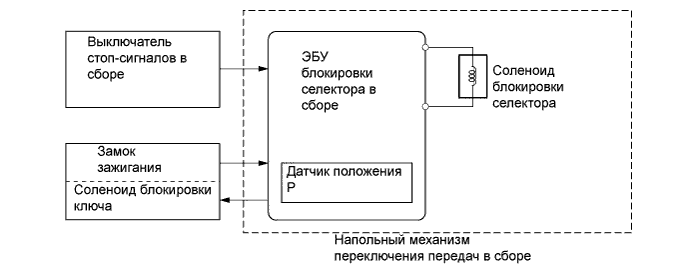
-
-
-
CONSTRUCTION
-
ATF Filling Procedures
-
An ATF filling procedure is used in order to improve the accuracy of the ATF level when the transmission is being repaired or replaced. As a result, the oil filler tube and the oil level gauge used in the conventional automatic transmission have been discontinued, eliminating the need to inspect the fluid level as a part of routine maintenance. For details about the ATF filling procedures, refer to the corresponding Repair Manual for this model.
-
This filling procedure uses a refill plug, overflow plug, No. 2 ATF temperature sensor, and shift position indicator D.
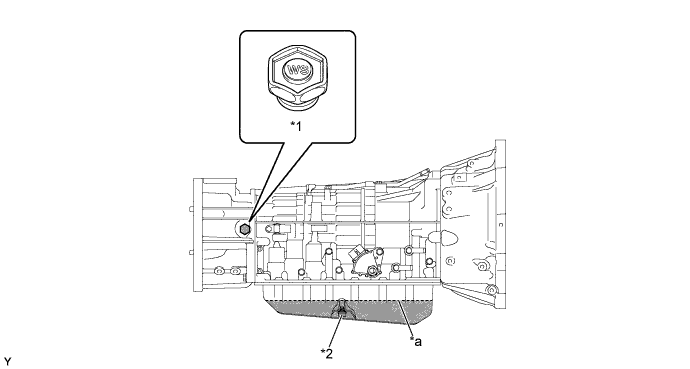
Text in Illustration *1 Refill Plug *2 Overflow Plug *a Proper Level - -
-
-
Torque Converter Assembly
-
A compact, lightweight and high-capacity torque converter assembly is used. The torque converter supports lock-up clutch control, thus improving fuel economy.
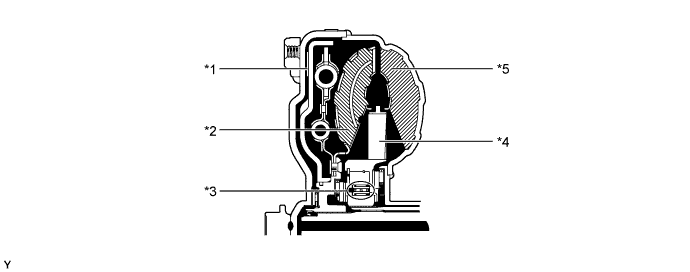
Text in Illustration *1 Lock-up Clutch *2 Turbine Runner *3 1-way Clutch *4 Stator *5 Pump Impeller - -
-
-
Oil Pump
-
The oil pump is operated by the torque converter assembly. It lubricates the planetary gear units and supplies operating fluid pressure for hydraulic control. The front oil pump drive gear is continually driven by the engine via the pump impeller. The pump has sufficient capacity to supply the necessary fluid pressure throughout all speed ranges, as well as in reverse.
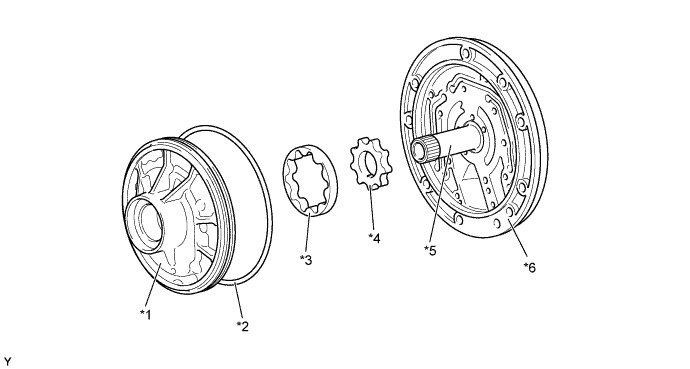
Text in Illustration *1 Front Oil Pump Body Sub-assembly *2 O-ring *3 Front Oil Pump Driven Gear *4 Front Oil Pump Drive Gear *5 Stator Shaft Assembly *6 Oil Pump Cover
-
-
Planetary Gear Unit
-
The gear train consists of three multi-plate clutches, four multi-plate brakes, three 1-way clutches, and three sets of planetary gears each consisting of a sun gear, a pinion gear and a ring gear.
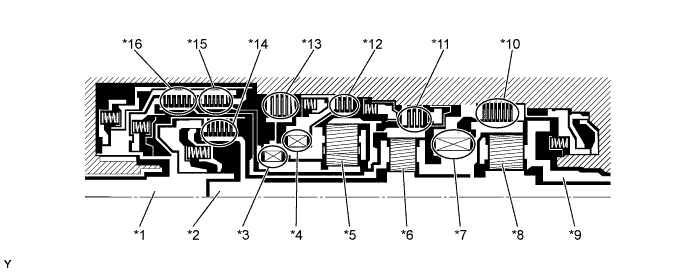
Text in Illustration *1 Input Shaft *2 Intermediate Shaft *3 No. 2 1-way Clutch (F2)
*4 No. 1 1-way Clutch (F1)
*5 Front Planetary Gear Assembly *6 Center Planetary Gear Assembly *7 No. 3 1-way Clutch (F3)
*8 Rear Planetary Gear Assembly *9 Output Shaft *10 No. 4 Brake (B4)
*11 No. 2 Brake (B2)
*12 No. 1 Brake (B1)
*13 No. 3 Brake (B3)
*14 No. 1 Clutch (C1)
*15 No. 3 Clutch (C3)
*16 No. 2 Clutch (C2)
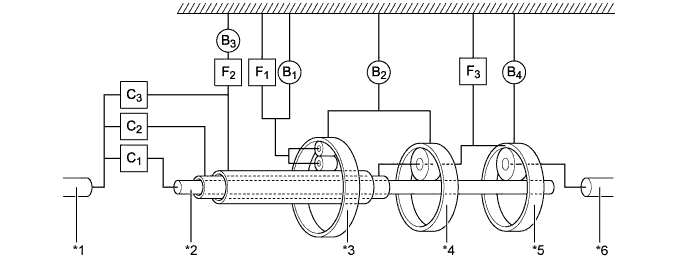
Text in Illustration *1 Input Shaft *2 Intermediate Shaft *3 Front Planetary Gear Assembly *4 Center Planetary Gear Assembly *5 Rear Planetary Gear Assembly *6 Output Shaft
-
-
Centrifugal Fluid Pressure Canceling Mechanism
-
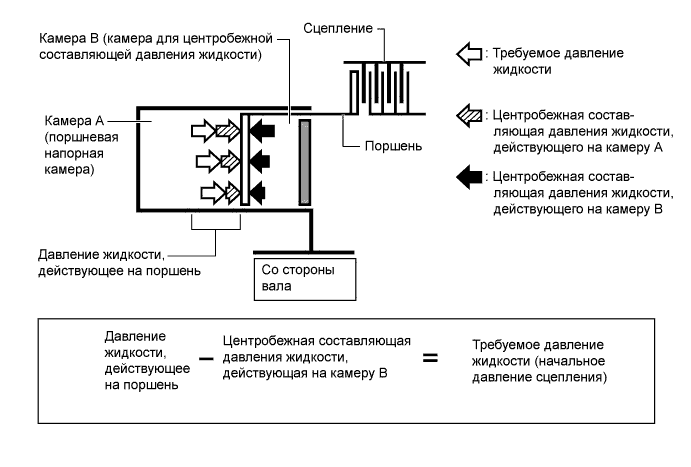
The centrifugal fluid pressure canceling mechanism is used on the C1, C2and C3clutches that are applied when shifting 2nd-3rd, 3rd-4th, and 4th-5th.
-
Clutch shifting operation is affected not only by the valve body controlling fluid pressure but also by centrifugal fluid pressure that is present due to fluid in the clutch piston oil pressure chamber. The centrifugal fluid pressure canceling mechanism uses chamber B to reduce the affect applied to chamber A. As a result, smooth shifting with excellent response has been achieved.
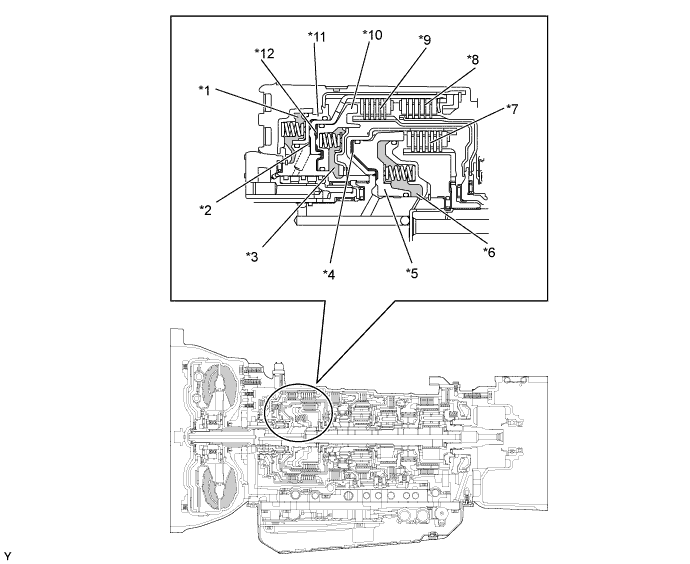
Text in Illustration *1 Chamber B (for C3)
*2 Chamber A (for C3)
*3 Chamber B (for C2)
*4 Chamber A (for C1)
*5 Piston (for C1)
*6 Chamber B (for C1)
*7 No. 1 Clutch (C1)
*8 No. 3 Clutch (C3)
*9 No. 2 Clutch (C2)
*10 Piston (for C2)
*11 Piston (for C3)
*12 Chamber A (for C2)
-
Chamber B is filled by fluid supplied to the shaft for lubrication. As a result of filling chamber B, the same amount of fluid pressure is present on both sides of the piston due to centrifugal force. This cancels the effects of fluid pressure on the piston caused by centrifugal force. Accordingly, it is not necessary to discharge the fluid through the use of a check ball, and highly responsive and smooth shifting characteristics are achieved.
-
-
Transmission Valve Body Assembly
-
The transmission valve body assembly consists of the upper (No. 1 and No. 2) and lower valve bodies and 7 shift solenoid valves.
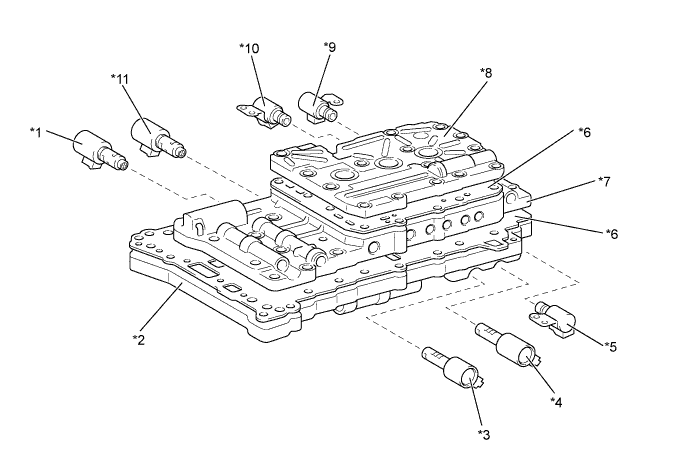
Text in Illustration *1 Line Pressure Control Solenoid Assembly (SLT) *2 Lower Valve Body *3 Shift Solenoid Valve (SL2) *4 Lock-up Control Solenoid Assembly (SLU) *5 Shift Solenoid Valve S4 (SR) *6 Plate *7 No. 1 Upper Valve Body *8 No. 2 Upper Valve Body *9 Transmission Solenoid Assembly No. 3 (S2) *10 Shift Solenoid Valve DSL (S1) *11 Shift Solenoid Valve (SL1) - - 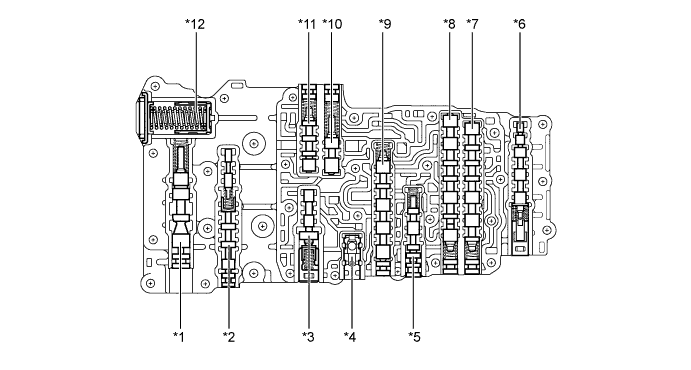
Text in Illustration (No. 1 Upper Valve Body) *1 Secondary Regulator Valve *2 Lock-up Relay Valve *3 Lock-up Control Valve *4 C3Check Valve
*5 Brake Control Valve *6 B1Apply Control Valve
*7 1-2 Shift Valve *8 2-3 Shift Valve *9 3-4 Shift Valve *10 Solenoid Modulator Valve *11 Clutch Lock Valve *12 B1Accumulator
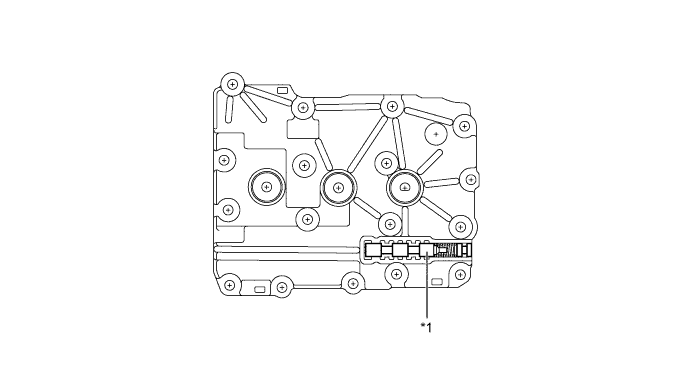
Text in Illustration (No. 2 Upper Valve Body) *1 Coast Brake Relay Valve - - 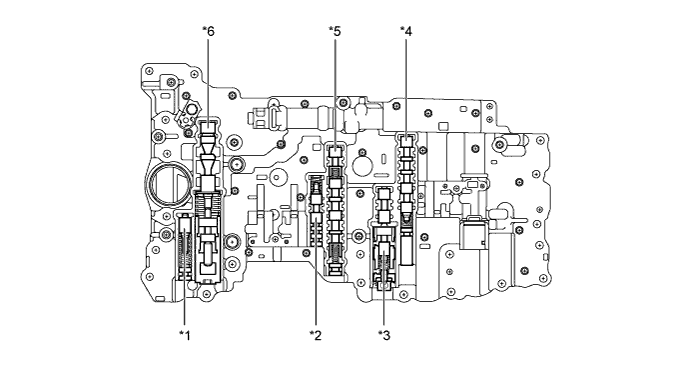
Text in Illustration (Lower Valve Body) *1 SLT Damper *2 Clutch Control Valve *3 Accumulator Control Valve *4 Sequence Valve *5 Clutch Apply Control Valve *6 Primary Regulator Valve
-
-
Shift Solenoid Valves S1, S2 and SR
-
The shift solenoid valve DSL (S1) and shift solenoid valve S4 (SR) are 3-way solenoid valves.
-
The No. 3 transmission solenoid assembly (S2) uses a 2-way solenoid valve.
-
A filter is provided at the tip of the solenoid valve to further improve operational reliability.
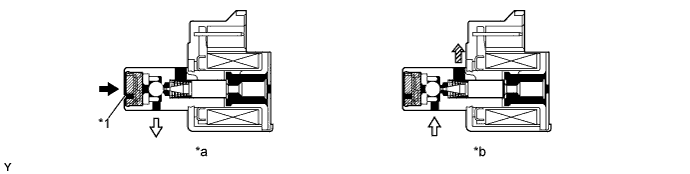
Text in Illustration (Shift Solenoid Valve S1) *1 Filter - - *a Off Condition *b On Condition 
Line Pressure 
Control Pressure 
Drain - - 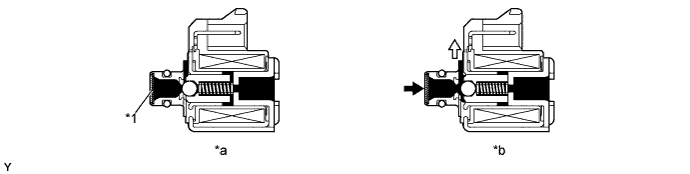
Text in Illustration (Shift Solenoid Valve S2) *1 Filter - - *a Off Condition *b On Condition Line Pressure Control Pressure 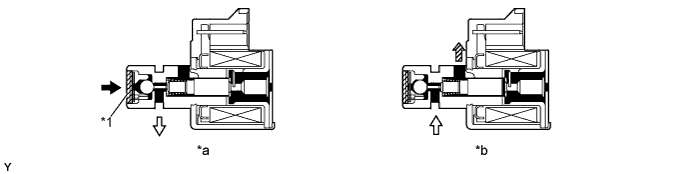
Text in Illustration (Shift Solenoid Valve SR) *1 Filter - - *a Off Condition *b On Condition Line Pressure Control Pressure Drain - - Function of Shift Solenoid Valves S1, S2 and SR Shift Solenoid Valve Function S1 Switches the 2-3 shift valve. S2 Switches the 1-2 shift valve and the 3-4 shift valve. SR Switches the clutch apply control valve.
-
-
Shift Solenoid Valves SL1, SL2, SLT and SLU
-
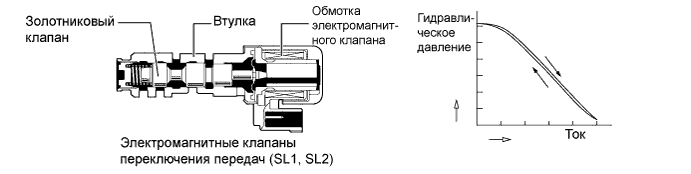
In order to provide a hydraulic pressure that is proportional to the current that flows to the solenoid coil, the shift solenoid valves SL1 and SL2 linearly control the clutch pressure based on the signals they receive from the ECM.
-
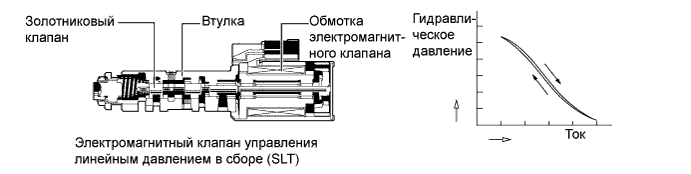
In order to provide a hydraulic pressure that is proportional to the current that flows to the solenoid coil, the line pressure control solenoid assembly (SLT) linearly controls the line pressure based on the signals it receives from the ECM.
-
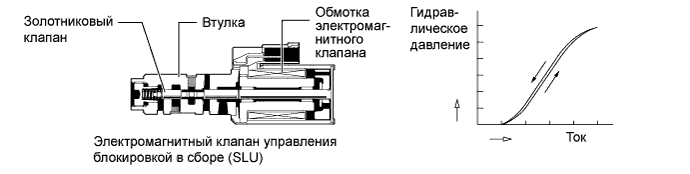
In order to provide a hydraulic pressure that is proportional to the current that flows to the solenoid coil, the lock-up control solenoid assembly (SLU) linearly controls the lock-up clutch engagement pressure based on the signals it receives from the ECM.
Function of Shift Solenoid Valves SL1, SL2, SLT and SLU Shift Solenoid Valve Function SL1
-
C1clutch pressure control
-
Accumulator back pressure control
SL2 B1, B2and B4brake pressure control
SLT
-
Line pressure control
-
Accumulator back pressure control
SLU
-
Lock-up clutch pressure control
-
Accumulator back pressure control
-
-
-
ATF Temperature Sensors
-
The No. 1 ATF temperature sensor (THO1) is used for hydraulic pressure control. This sensor is used for revision of the pressure that is used to apply clutches and brakes in the transmission. This helps to ensure smooth shift quality.
-
The No. 2 ATF temperature sensor (THO2) is used as a basis for modifying the ECT shift timing control when the ATF temperature is high. It is also used for the ATF temperature warning light.
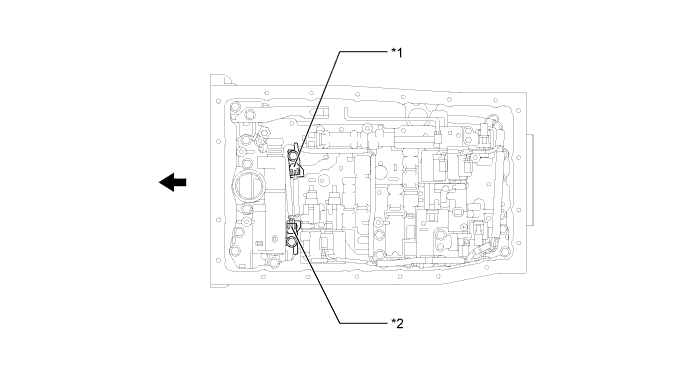
Text in Illustration *1 No. 1 ATF Temperature Sensor *2 No. 2 ATF Temperature Sensor Front - -
-
-
Transmission Revolution Sensors
-
This automatic transmission uses a transmission revolution sensor (for NT signal) and a transmission revolution sensor (for SP2 signal). Thus, the ECM can detect the timing of the shifting of the gears and appropriately control the engine torque and hydraulic pressure in response to various conditions.
-
These transmission revolution sensors are the pick-up coil type.
-
The transmission revolution sensor (for NT signal) detects the input speed of the transmission. The reverse clutch piston sub-assembly is used as the timing rotor for this sensor.
-
The transmission revolution sensor (for SP2 signal) detects the speed of the output shaft. The parking lock gear on the rear planetary gear is used as the timing rotor for this sensor.
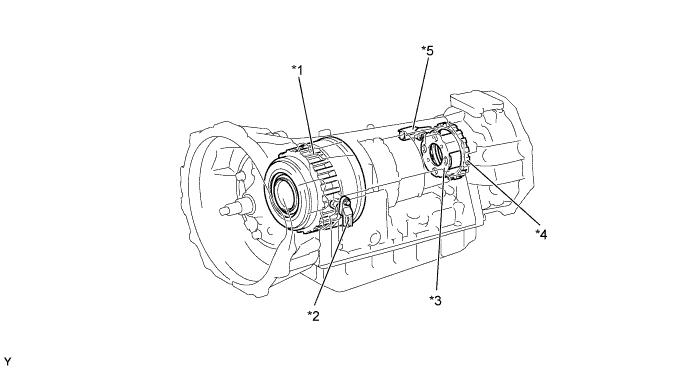
Text in Illustration *1 Reverse Clutch Piston Sub-assembly *2 Transmission Revolution Sensor (NT) *3 Rear Planetary Gear *4 Parking Lock Gear *5 Transmission Revolution Sensor (SP2) - -
-
-
Park/Neutral Position Switch Assembly and Transmission Control Switch
-
The ECM uses the park/neutral position switch assembly and the transmission control switch to detect the shift lever position.
-
The park/neutral position switch assembly sends the R, D, 3, 2 and NSW signals to the ECM. It also sends signals to the shift position indicator "P, R, N and 3" in the combination meter assembly.
-
The transmission control switch is located in the shift lock control ECU sub-assembly. This switch sends the 4 and L signals to the ECM. It also sends signals for the shift position indicator "D, 4, 2 and L" in the combination meter assembly.
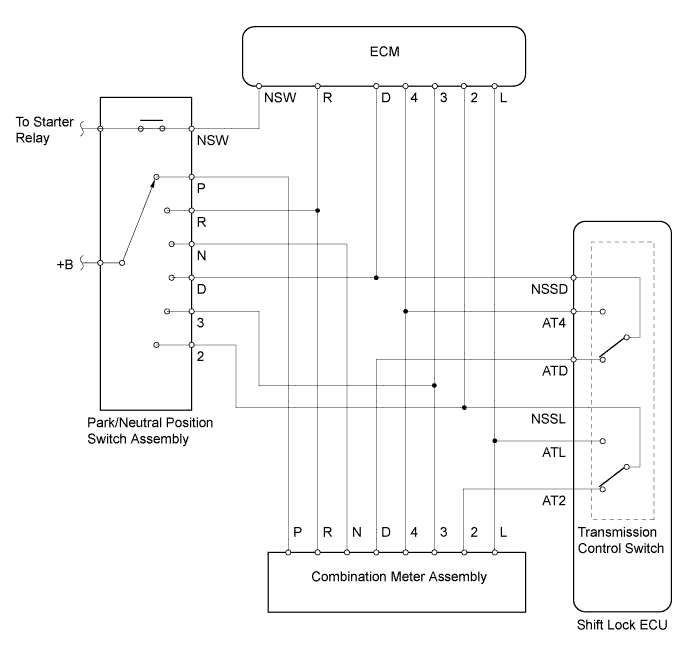
-
-
Shift Control Mechanism
-
A gate type shift lever that uses a transmission control cable is used.
-
The shift control mechanism consists of a transmission floor shift assembly and a transmission control cable assembly.
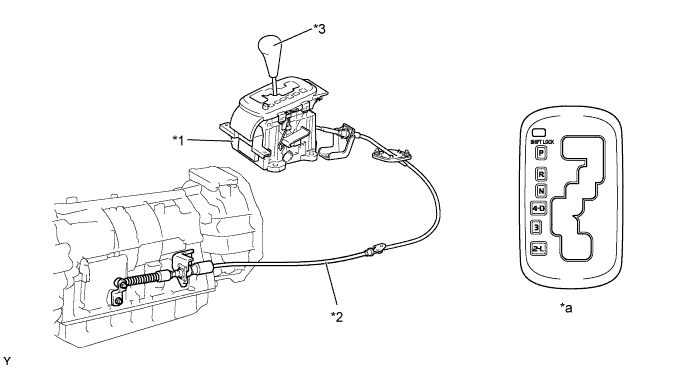
Text in Illustration *1 Transmission Floor Shift Assembly *2 Transmission Control Cable Assembly *3 Shift Lever Knob - - *a Shift Pattern - -
-
-
-
OPERATION
-
Transmission Power Flow
Operating Condition Shift Lever Position Gear Position Shift Solenoid Valve Clutch Brake 1-way Clutch S1 S2 SR SL1 SL2 SLU C1
C2
C3
B1
B2
B3
B4
F1
F2
F3
P Park On Off Off Off On Off - - - - - - - - - - R Reverse* On Off Off Off On Off - - ○ (○) - - ○ ○ - - N Neutral On Off Off Off On Off - - - - - - - - - - D 1st On Off Off Off On Off ○ - - - - - - - - ○ 2nd On On Off Off On Off ○ - - - - ○ - ○ ○ - 3rd Off On Off Off On Off ○ - ○ - - ● - ○ - - 4th Off Off Off Off On Off ○ ○ ● - - ● - - - - 5th Off Off On On Off On - ○ ○ ○ - ● - - - - 4 1st On Off Off Off On Off ○ - - - - - - - - ○ 2nd On On Off Off On Off ○ - - - - ○ - ○ ○ - 3rd Off On Off Off On Off ○ - ○ - - ● - ○ - - 4th Off Off Off Off On On ○ ○ ● - - ● - - - - 3 1st On Off Off Off On Off ○ - - - - - - - - ○ 2nd On On Off Off On Off ○ - - - - ○ - ○ ○ - 3rd* Off On Off Off Off Off ○ - ○ (○) - ● - ○ - - 2 1st On Off Off Off On Off ○ - - - - - - - - ○ 2nd* On On On Off Off Off ○ - - - (○) ○ - ○ ○ - L 1st* On Off Off Off Off Off ○ - - - - - (○) - - ○ Tech Tips
○: Operates
●: Operates but is not related to power transmission
(○): Operates during engine braking
-: Does not operate
*: Engine braking occurs
-
1st Gear (Shift Lever in D, 4, 3 or 2)
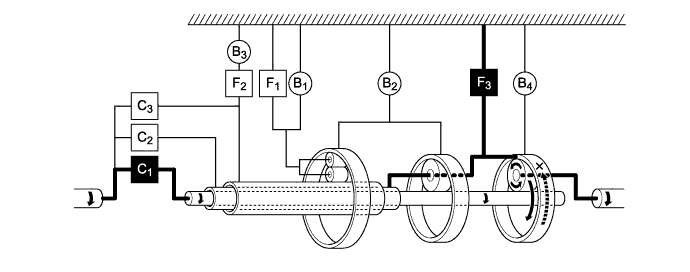
Text in Illustration 
Operates - - -
2nd Gear (Shift Lever in D, 4 or 3)
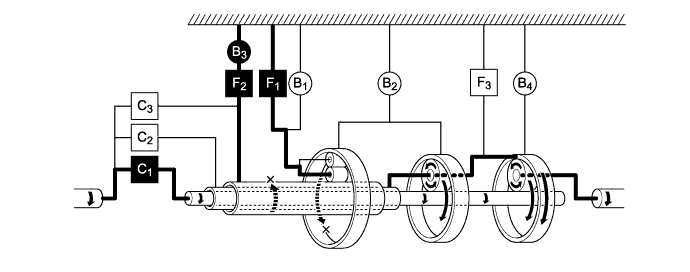
Text in Illustration Operates - - -
3rd Gear (Shift Lever in D or 4)
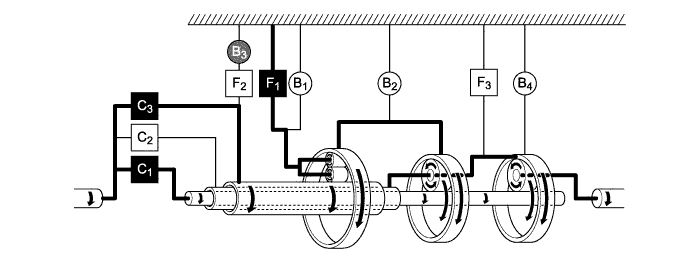
Text in Illustration Operates 
Operates but is not Related to Power Transmission -
4th Gear (Shift Lever in D or 4)
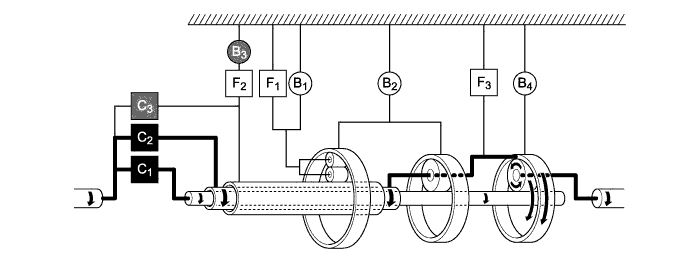
Text in Illustration Operates Operates but is not Related to Power Transmission -
5th Gear (Shift Lever in D)
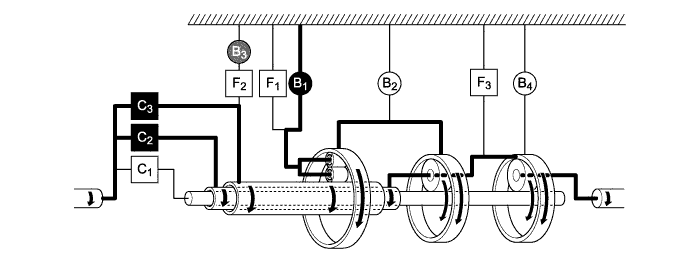
Text in Illustration Operates Operates but is not Related to Power Transmission -
1st Gear (Shift Lever in L)
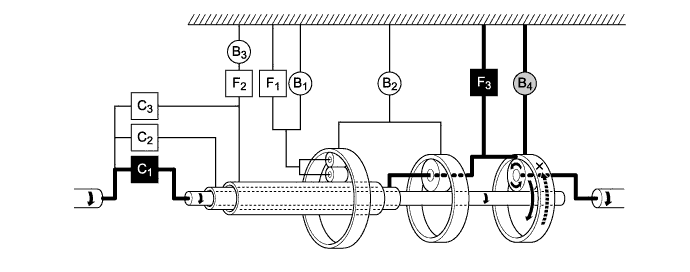
Text in Illustration Operates 
Operates during Engine Braking -
2nd Gear (Shift Lever in 2)
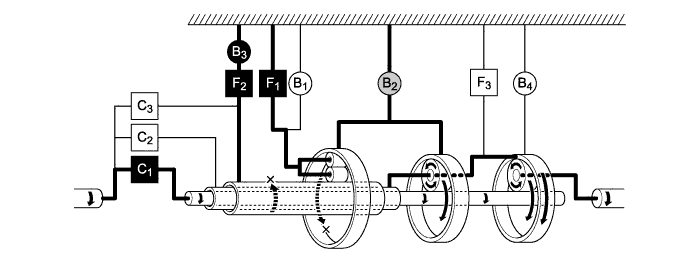
Text in Illustration Operates Operates during Engine Braking -
3rd Gear (Shift Lever in 3)
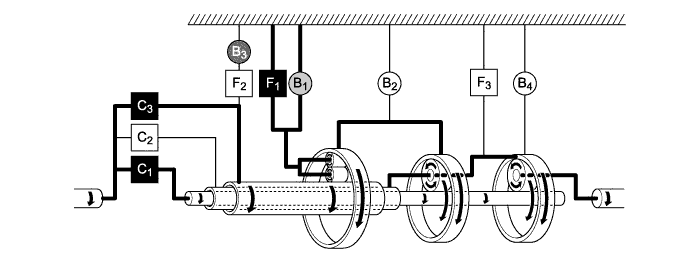
Text in Illustration Operates Operates but is not Related to Power Transmission Operates during Engine Braking - - -
Reverse Gear (Shift Lever in R)
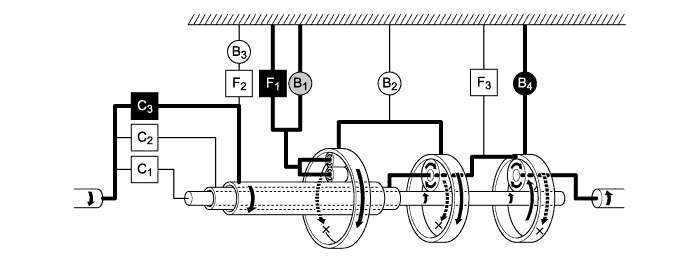
Text in Illustration Operates Operates during Engine Braking
-
-
-
FAIL-SAFE
-
The fail-safe function minimizes the loss of operability when an abnormality occurs in a sensor or a solenoid.
Fail-safe Control List Malfunction Part Function Transmission Revolution Sensor (NT)
-
During a transmission revolution sensor (NT) malfunction, shift control is effected based on the transmission revolution sensor (SP2) or speed sensor (SPD1) signal.
-
During a transmission revolution sensor (NT) malfunction, upshifting to 5th, AI-shift and lock-up control are prohibited.
Transmission Revolution Sensor (SP2)
-
During a transmission revolution sensor (SP2) malfunction, shift control is effected based on the transmission revolution sensor (NT) or speed sensor (SPD1) signal.
-
During a transmission revolution sensor (SP2) malfunction, upshifting to 5th, AI-shift and lock-up control are prohibited.
No. 1 ATF Temperature Sensor (THO1) During a No. 1 ATF temperature sensor malfunction, upshifting to 5th and lock-up control are prohibited. Shift Solenoid Valves S1, S2, and SR
-
When one of the shift solenoid valves listed left malfunctions, current to the failed shift solenoid valve is cut off.
-
Shift control is changed to a fail-safe mode to shift gears using the normal shift solenoid valves to allow continued driving.
Shift Solenoid Valves SL1 and SL2 During a shift solenoid valve SL1 or SL2 malfunction, upshifting to 5th and lock-up control are prohibited. Line Pressure Control Solenoid Assembly (SLT) During a line pressure control solenoid assembly (SLT) malfunction, the current to the shift solenoid valve is stopped. Because this stops line pressure optimal control, the shift shock will increase. However, shifting is effected based on normal clutch pressure control. Lock-up Control Solenoid Assembly (SLU) During a lock-up control solenoid assembly (SLU) malfunction, the current to the shift solenoid valve is stopped. Because this stops lock-up control, fuel economy decreases. -
-
-
DIAGNOSIS
-
When the ECM detects a malfunction, it makes a diagnosis and memorizes the failed section. Furthermore, the ECM illuminates or blinks the MIL in the combination meter assembly to inform the driver.
-
The ECM will also store the Diagnostic Trouble Codes (DTCs) of the malfunctions.
-
The DTCs can be read by connecting an intelligent tester II to the DLC3.
-
For details, refer to the corresponding Repair Manual for this model.
-