EXHAUST SYSTEM DETAILS
-
CONSTRUCTION
-
Exhaust Manifold
-
The exhaust manifold is made of stainless steel to reduce its weight and improve rust resistance.
-
Cooling holes have been provided on the heat insulator to reduce the exhaust manifold surface temperature, improving durability.
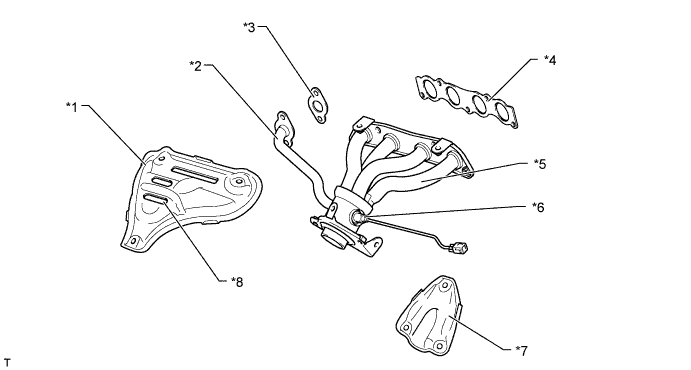
Text in Illustration *1 No. 1 Exhaust Manifold Heat Insulator *2 EGR Pipe *3 EGR Pipe Gasket *4 Exhaust Manifold To Head Gasket *5 Exhaust Manifold *6 Air Fuel Ratio Sensor *7 No. 2 Exhaust Manifold Heat Insulator *8 Cooling Hole
-
-
Exhaust Pipe
-
The exhaust pipe is made of stainless steel in order to reduce weight, improve rust resistance, and enhance the TWC warm-up capability.
-
Ball joints are used to join the exhaust manifold to the front exhaust pipe assembly, and the front exhaust pipe assembly to the tail exhaust pipe assembly. As a result, a simple construction and high reliability have been realized.
-
2 TWCs are provided at the front of the front exhaust pipe assembly.
-
An exhaust heat recirculation system has been provided on the sub muffler in order to enhance the warm-up capability. As a result, the necessary engine warm-up time can be minimized by using exhaust heat to warm the engine coolant.
-
A 2-way exhaust control system is provided to reduce noise and vibration from the main muffler.
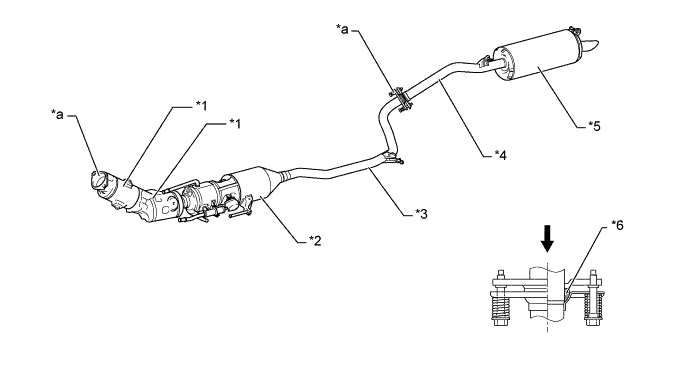
Text in Illustration *1 TWC *2 Sub Muffler *3 Front Exhaust Pipe Assembly *4 Exhaust Tail Pipe Assembly *5 Main Muffler *6 Gasket *a Ball Joint Portion - - 
Exhaust Gas - -
-
-
-
OPERATION
-
Exhaust Heat Recirculation System
-
The exhaust heat recirculation system applies the heat of the engine exhaust to the engine coolant in order to enhance heating performance at low temperatures, thus, warm-up capability is further improved.
-
The exhaust gas control valve, which is operated by the exhaust pipe gas control actuator, is located in the front exhaust pipe assembly. The exhaust gas control valve opens and closes in order to change the flow of the exhaust gas in the front exhaust pipe assembly.
-
An engine coolant temperature switch, which is used only for the exhaust heat recirculation system, detects the temperature of the coolant flowing from the front exhaust pipe assembly.
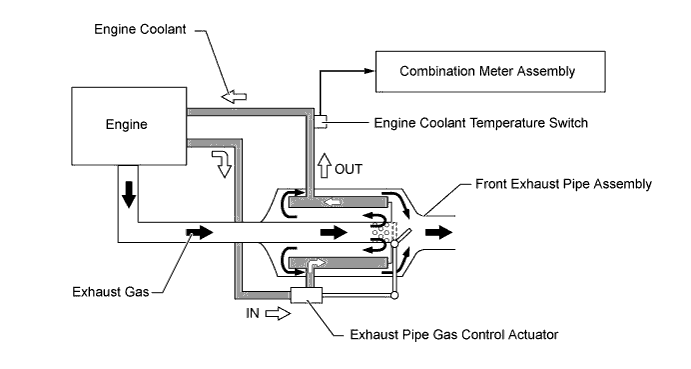
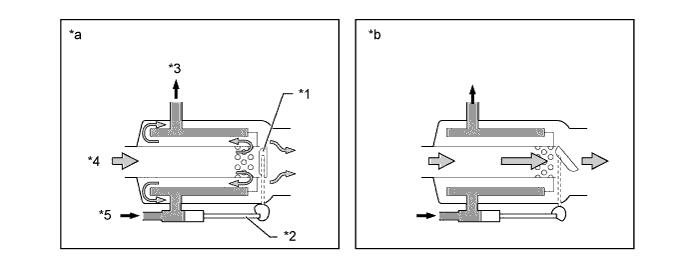
Text in Illustration *1 Exhaust Gas Control Valve *2 Rod *3 Water OUT *4 Exhaust Gas *5 Water IN - - *a Valve is Closed *b Valve is Open
-
-
2-way Exhaust Control System
-
A 2-way exhaust control system is used. This system reduces back pressure by opening and closing a variable valve that is enclosed in the main muffler, thus varying the exhaust gas pressure.
-
The valve opens steplessly in accordance with the operating condition of the engine, thus enabling quieter operation at lower engine speeds, and reducing back pressure at higher engine speeds.
-
The control valve is enclosed in the main muffler. When the exhaust gas pressure overcomes the spring pressure, the control valve opens steplessly in accordance with the exhaust gas pressure.
-
When the pressure in the main muffler is low, the control valve closes. Hence exhaust gas does not flow through the bypass passage, and exhaust noise is decreased in the main muffler.
-
When the engine speed and back pressure in the muffler increase, the control valve opens. This allows a large volume of exhaust gas to pass through the bypass passage, thereby substantially decreasing back pressure.
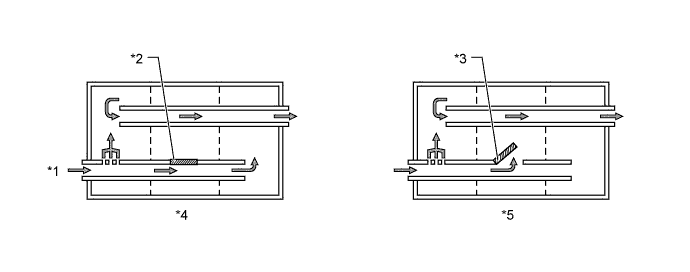
Text in Illustration *1 Exhaust Gas *2 Control Valve Closed *3 Control Valve Open *4 Low Engine Speed *5 Middle to High Engine Speed - -
-
-