AIR CONDITIONING SYSTEM DETAILS
-
FUNCTION OF MAIN COMPONENTS
-
The manual air conditioning system and automatic air conditioning system consist of the following parts:
Component Function Air Conditioning Control Assembly*1 Allows operation and adjustment of the air conditioning system via the switches. Integration Panel Sub-assembly*2 Air Conditioning Amplifier Assembly Transmits and receives data to and from the switches and sensors. Cooler Compressor Assembly A fixed displacement cooler compressor assembly is used. Cooler Condenser Assembly A Multi-Flow-IV (MF-IV) sub-cool condenser is used to improve heat exchange efficiency. Heater Radiator Unit Sub-assembly A Straight Flow Aluminum-II (SFA-II) heater radiator is used for compactness and high performance. Blower with Fan Motor Sub-assembly High magnetic force magnets and ball bearings are used to achieve a compact and lightweight assembly. No. 1 Cooler Evaporator Sub-assembly A Revolutionary super-slim Structure (RS) is used for compactness. No. 1 Cooler Thermistor Detects the temperature of the cool air past the No. 1 cooler evaporator sub-assembly and transmits the data to the air conditioning amplifier assembly. Cooler Expansion Valve Sprays the refrigerant in an atomized form. Cooler Thermistor (Ambient Temperature Sensor)*2 Detects ambient temperature and outputs it to the air conditioning amplifier assembly via the combination meter assembly. Cooler Thermistor (Solar Sensor)*2 Detects the changes in the amount of solar energy and outputs them to the air conditioning amplifier assembly. Cooler Thermistor (Room Temperature Sensor)*2 Detects room temperature and outputs it to the air conditioning amplifier assembly. Damper Servo Sub-assembly*2 Receives the input of the operation signals from the fresh-air/recirculation selector switch via the air conditioning amplifier assembly, operates the motor, and opens and closes the fresh-air/ recirculation damper. Mode Damper Servo Sub-assembly*2 Receives the input of the operation signals from the mode selector switch via the air conditioning amplifier assembly, operates the motor, and opens and closes the mode damper. Air Mix Control Servo Motor*2 Operates the motor to open and close the air mix damper upon receiving the input of the operation signals from the temperature setting dial via the air conditioning amplifier assembly, or when the system is operating under auto control. Clean Air Filter Removes other particles to provide a comfortable interior space. ECM Receives the signals from the engine coolant temperature sensor and transmits them to the air conditioning amplifier assembly. Air Conditioning Pressure Sensor Mounted on the high-pressure pipe, this sensor controls the compressor assembly.
-
*1: Models with manual air conditioning system
-
*2: Models with automatic air conditioning system
-
-
The rear cooler system consists of the following parts:
Component Function Cooler Control Switch Assembly Allows operation and adjustment of the air conditioning system via switches. Rear Cooler Switch Turns the rear cooler on/off. Rear Blower with Fan Motor Sub-assembly High magnetic force magnets and ball bearings are used to achieve a compact and lightweight assembly. Rear Evaporator Sub-assembly A Revolutionary super-slim Structure (RS) is used for compactness.
-
-
SYSTEM CONTROL
-
The air conditioning system uses the following controls:
Control Outline Outlet Air Temp. Control MAX Fix Control This control sets the outlet air temperature to -200°C when the temperature is set to MAX COOL, and to 200°C when the temperature is set to MAX HOT. Air Mix Damper Control This function provisionally calculates the required outlet air temperature through an arithmetic circuit in the air mix damper using the output signals from various sensors, and adjusts the value in accordance with signals from the evaporator temperature sensor and water temperature sensor. It then determines the appropriate air mix damper opening angle in accordance with the temperature control switch setting. Blower Control Manual Control Sets the blower speed in accordance with the operation of the blower switch. Automatic Control Warm-up Control:
When the air outlet is in the FOOT, BI-LEVEL or FOOT/DEF mode, the blower will not operate until the water temperature increases to above the prescribed value. When the temperature increases to above the prescribed value, the blower motor operates at the LO speed. Thereafter, control is effected by comparing the airflow calculated from the water temperature and the airflow calculated from the outlet air temperature.
Time-Lagged Air Flow Control:
2 types of time-lagged air flow control (in accordance with the temperature detected by the evaporator temperature sensor) help prevent hot air from being emitted from the FACE or BI-LEVEL vent.
Sunlight Air Flow Control:
Controls the blower speed in accordance with the intensity of the sunlight when the air outlet is in FACE or BI-LEVEL. The blower speed can be adjusted in response to the signal received from the solar sensor.
Air Outlet Control Manual Control Changes the air outlet in accordance with the selected position of the mode select switch. Automatic Control Mode Damper Switching Servomotor Control:
When the AUTO switch of the heater control panel has been turned on, automatic control causes the mode servomotor to rotate to a desired position in accordance with the target damper opening, which is based on the calculation of the outlet air temperature. (On the models with the automatic cooler, this function switches the damper to FACE or BI-LEVEL.)
Low-temperature FOOT/DEF Control:
In accordance with the water temperature, ambient temperature, amount of sunlight, required outlet air temperature and vehicle speed conditions, this control automatically switches the blower outlet between the FOOT/DEF modes to prevent the window from becoming fogged when the ambient temperature is low.
Compressor Control When the DEF mode switch is turned on, the magnetic clutch relay is activated automatically to engage the compressor. Also, when the blower is turned off and the front defroster switch is turned on, the blower will turn on in the automatic control condition. Self-diagnosis Checks the indicator, sensor and actuator in accordance with operation of the heater control panel switches, and then a Diagnostic Trouble Code (DTC) is displayed on the LCD portion to indicate if there is a malfunction or not.
-
-
CONSTRUCTION
-
Air Conditioning Control Assembly
-
Air Conditioning Control Assembly
-
A rotary switch type air conditioning control assembly is used.
-
5 air outlet modes are provided on the control panel on the models with manual air conditioning. To enable finer mode settings, a positive feel is provided between the positions of these modes, thus achieving a high comfort level.
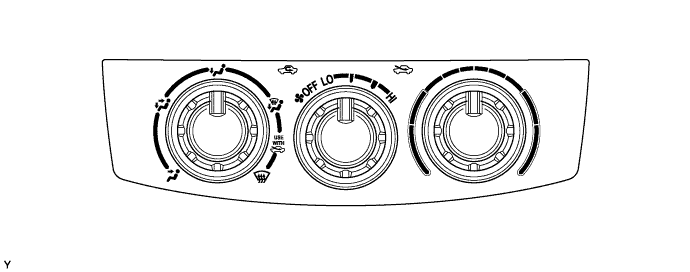
-
A control cable is used. This cable is circular, and is placed around the cable pulleys that are provided at the air conditioning control assembly and the damper.
-
The operation effort of the air conditioning control assembly is transmitted to the damper via the control cable, which always moves in the pulling direction. Due to the consistent action point of the pulleys, the fluctuation of the operating effort has been minimized through the use of the pulleys. These measures have ensured ease of use and have reduced the operating effort.
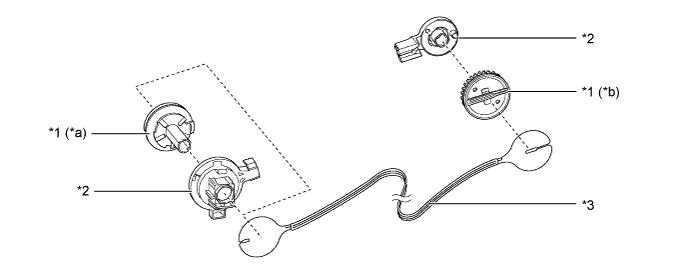
Text in Illustration *1 Pulley *2 Base of Pulley *3 Control Cable - - *a Air Conditioning Control Assembly Side *b Damper Side -
-
Integration Panel Sub-assembly
-
An integration panel sub-assembly with Liquid Crystal Display (LCD) is used to ensure excellent visibility.
-
A push button type integration panel sub-assembly is used.
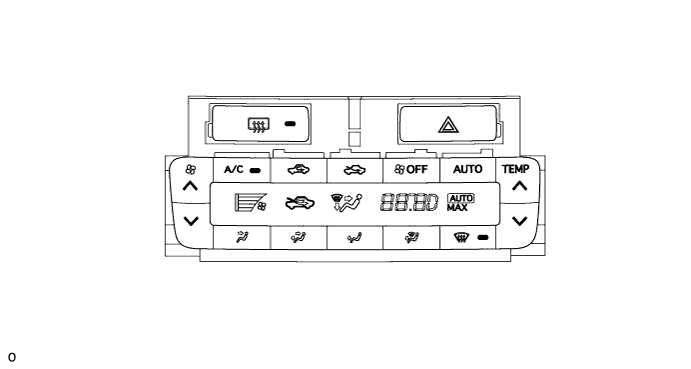
-
-
Cooler Control Switch Assembly
-
The blower motor of the rear cooler can be operated with the rear blower switch only when the cooler switch is on.
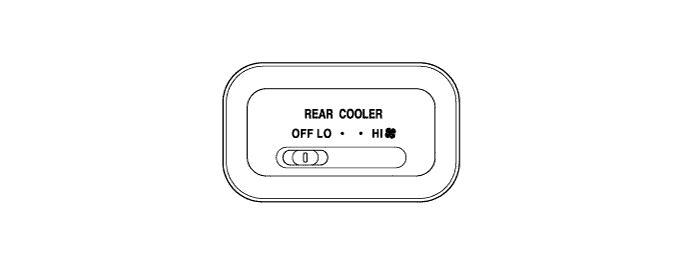
-
-
-
Air Conditioning Unit
-
A semi-center location air conditioning unit is used, in which the evaporator and heater radiator are placed in the vehicle's longitudinal direction. As a result, the air conditioning unit has been made compact and lightweight.
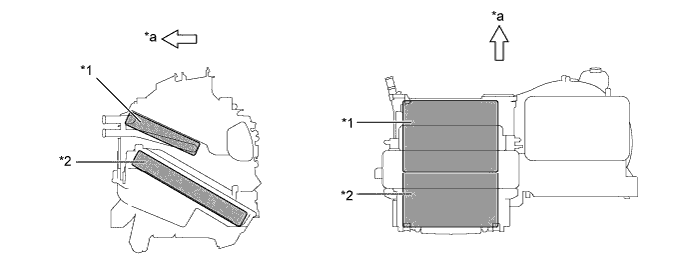
Text in Illustration *1 Heater Radiator Unit Sub-assembly *2 No. 1 Cooler Evaporator Sub-assembly *a Front - - -
A partial recirculation system is used. This system has an air inlet control door (sub) in the air inlet duct. Thus, it is able to cycle a small volume of recirculated air even in the FRESH mode, thus enhancing heating performance. When the blower switch is on, the suction force of the blower fan opens this air inlet control door (sub).
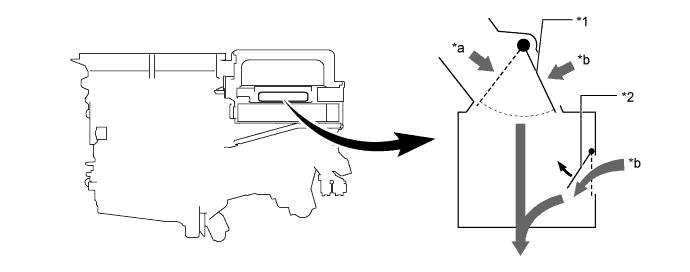
Text in Illustration *1 Air Inlet Control Door *2 Air Inlet Control Door (Sub) *a Fresh Air *b Recirculated Air
-
-
No. 1 Cooler Evaporator Sub-assembly
-
A Revolutionary super-slim Structure (RS) evaporator is used. By placing the tanks at the top and the bottom of the No. 1 cooler evaporator sub-assembly and by using a micropore tube construction, the following effects have been achieved:
-
Heat exchanging efficiency is ensured.
-
Temperature distribution is made uniform.
-
The No. 1 cooler evaporator sub-assembly is made thinner.
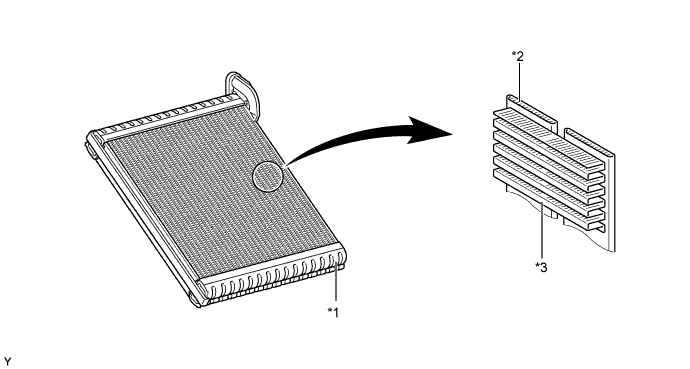
Text in Illustration *1 Tank *2 Micropore Tube *3 Cooling Fin - - -
-
-
No. 1 Cooler Thermistor
-
The No. 1 cooler thermistor detects the temperature of the cool air immediately past the No. 1 cooler evaporator sub-assembly in the form of resistance changes, and outputs it to the air conditioning amplifier assembly.
-
-
Heater Radiator Unit Sub-assembly
-
This heater radiator unit sub-assembly has been made more compact and performance has been improved by making the core section finer and improving the shapes of the tank section and flow section. Also, the environment has been considered.
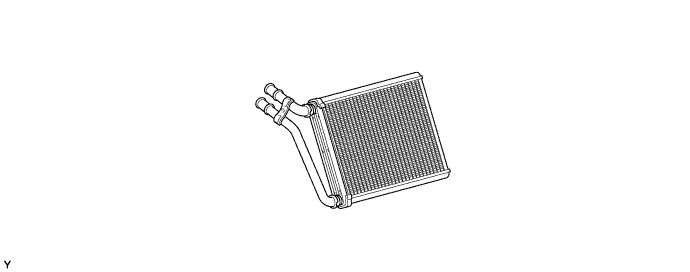
-
-
Blower with Fan Motor Sub-assembly
-
The blower with fan motor sub-assembly has a built-in blower controller, and is controlled using duty control performed by the air conditioning amplifier assembly.
-
-
Servomotor
-
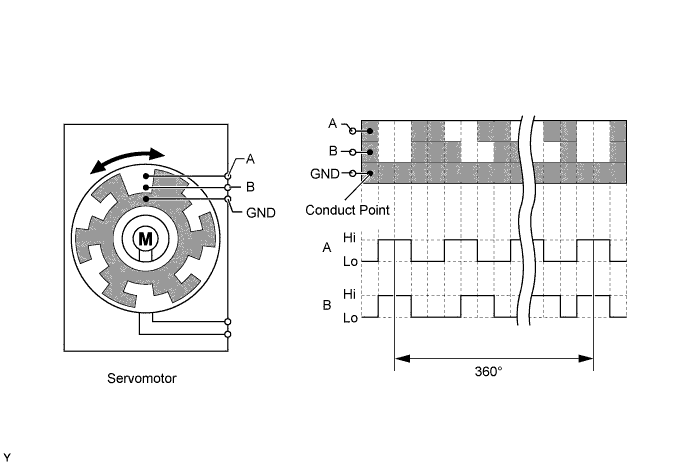
The pulse pattern type servomotor consists of a printed-circuit board and servomotor. The printed-circuit board has three contact points, and transmits the two on and off signals with different pulse phases to the bus connector. The bus connector detects the damper position and movement direction with these signals, and transmits the results to the air conditioning amplifier.
-
After the negative battery terminal cable has been reconnected, the air conditioning amplifier initializes both the mode and air inlet servomotors twice, once when the ignition switch is turned to ON and then turned off. The DEF light inside the heater control panel flashes while initializing.
-
-
Clean Air Filter
-
A high efficiency type clean air filter is used. The clean air filter is installed in the upper section of the blower fan for easy replacement of the clean air filter without the need for removing the one-touch clip in the glove box.
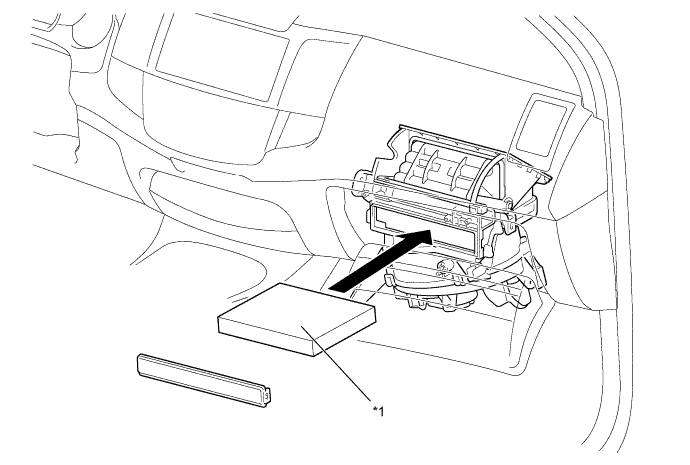
Text in Illustration *1 Clean Air Filter - - Tech Tips
The clean air filter should be replaced every 20000 km. However, observation of these guidelines should depend on the usage conditions (or environment). Replace the clean air filter after the engine switch has been turned off.
-
-
Cooler Condenser Assembly
-
In the sub-cool cycle, after the refrigerant passes through the condensing portion of the condenser assembly, both the liquid refrigerant and the gaseous refrigerant that could not be liquefied are cooled again in the super-cooling portion. Thus, the refrigerant is sent to the No. 1 cooler evaporator sub-assembly in an almost completely liquefied state.
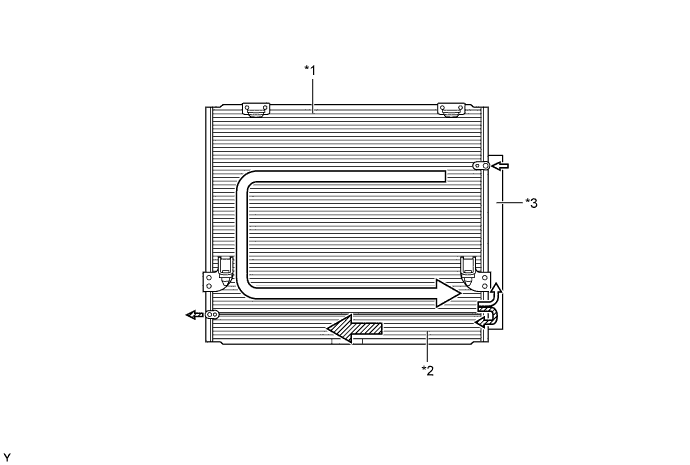
Text in Illustration *1 Condensing Portion *2 Super-cooling Portion *3 Modulator - - 
Gaseous Refrigerant 
Liquid Refrigerant Tech Tips
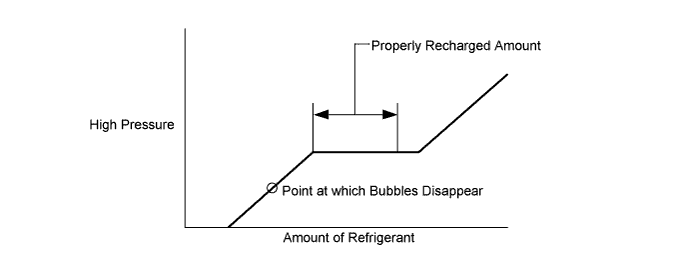
The point at which the air bubbles disappear in the refrigerant of the sub-cool cycle is lower than the proper amount of refrigerant with which the system must be filled. Therefore, if the system is refilled with refrigerant based on the point at which the air bubbles disappear, the amount of refrigerant would be insufficient. As a result, the cooling performance of the system will be affected. If the system is overfilled with refrigerant, this will also lead to reduced performance. For the proper method of verifying the amount of the refrigerant and to refill the system with refrigerant, refer to the corresponding Repair Manual for this model.
-
-
Cooler Compressor Assembly
-
The cooler compressor assembly is a continuously variable capacity type with a capacity that varies in accordance with the cooling load of the air conditioning.
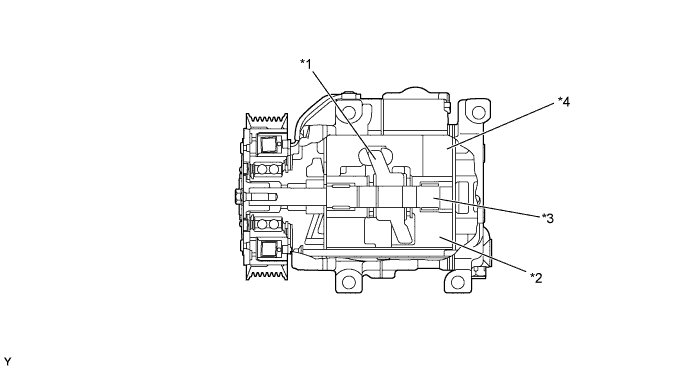
Text in Illustration *1 Swash Plate *2 Piston *3 Shaft *4 Swash Plate Chamber
-
-
Cooler Thermistor (Room Temperature Sensor)
-
The cooler thermistor (room temperature sensor) detects the room temperature based on changes in the resistance of its built-in thermistor, and outputs a signal. This signal is used by the air conditioning amplifier assembly.
-
-
Cooler Thermistor (Ambient Temperature Sensor)
-
The cooler thermistor (ambient temperature sensor) detects the ambient temperature based on changes in the resistance of its built-in thermistor, and outputs a signal. This signal is used by the air conditioning amplifier assembly.
-
-
Cooler Thermistor (Solar Sensor)
-
The cooler thermistor (solar sensor) consists of a photo diode, 2 amplifier circuits for the cooler thermistor (solar sensor), and a frequency converter circuit for the light control sensor.
-
The cooler thermistor (solar sensor) detects (in the form of changes in the current that flows through the built-in photo diode) the changes in the amount of sunlight from its LH and RH sides (2 directions) and outputs these sunlight strength signals to the air conditioning amplifier assembly.
-
-
-
OPERATION
-
Mode Position and Damper Operation
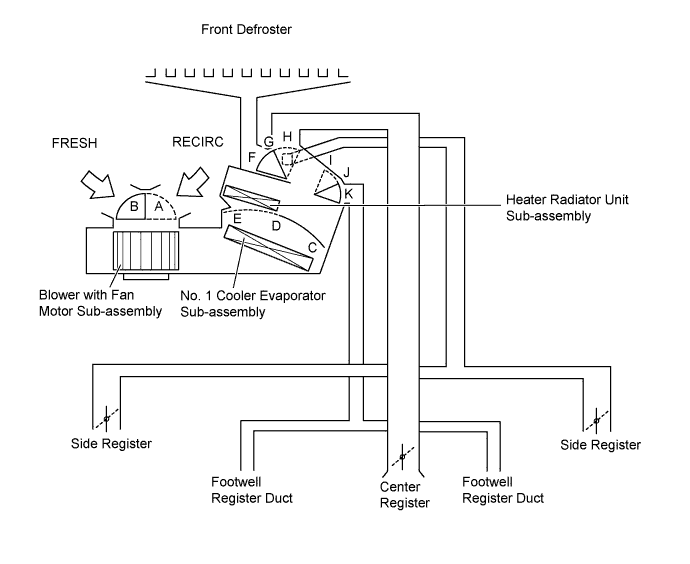
Control Damper Operation Position Damper Position Operation Air Inlet Control Damper FRESH A Brings in fresh air. RECIRC B Recirculates internal air. Air Mix Control Damper MAX COLD to MAX HOT C-D-E Varies the mixture ratio of the cool air and the warm air in order to regulate the temperature continuously from HOT to COLD. Mode Control Damper FACE 
F, K Air blows out of the center registers and side register. BI-LEVEL 
F, J Air blows out of the center registers, side registers and footwell register ducts. FOOT 
G, I Air blows out of the footwell register ducts and side register. In addition, air blows out slightly from the front defroster. FOOT/DEF 
H, I Defrosts the windshield through the front defroster and side register, while air is also blown out from the footwell register ducts. DEF 
H, K Defrosts the windshield through the front defroster and side register. -
Air Outlets and Airflow Volume
-
Manual Air Conditioning System and Automatic Air Conditioning System Model
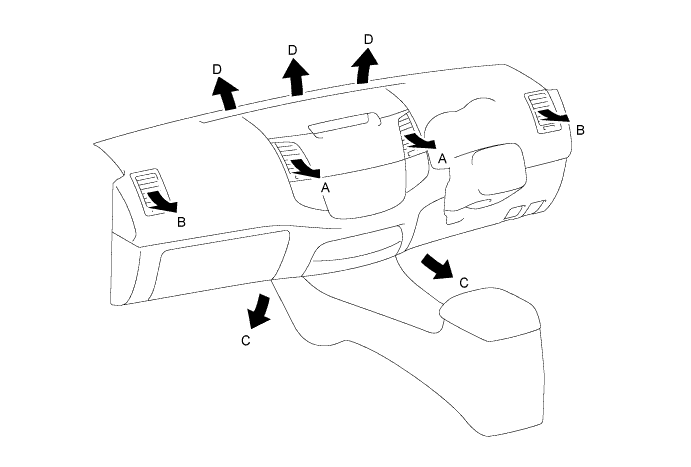
Indication Mode A B C D Center Side Footwell Defroster FACE 
- - BI-LEVEL 

- FOOT - 
FOOT/DEF - DEF - - Tech Tips
The size of the circle ○ indicates the proportion of airflow volume.
-
Rear Air Outlets
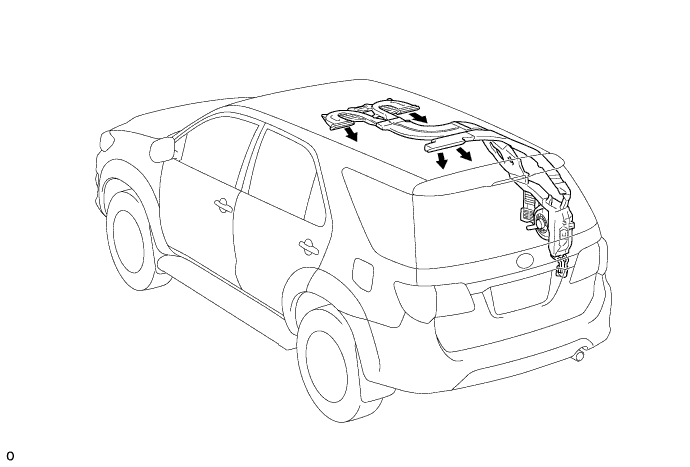
-
-
-
DIAGNOSIS
-
Diagnostic Trouble Code (DTC)
-
The air conditioning amplifier assembly has a self-diagnosis function. It stores any operation failures in the air conditioning system memory in the form of DTCs. For details, refer to the corresponding Repair Manual for this model.
-
-